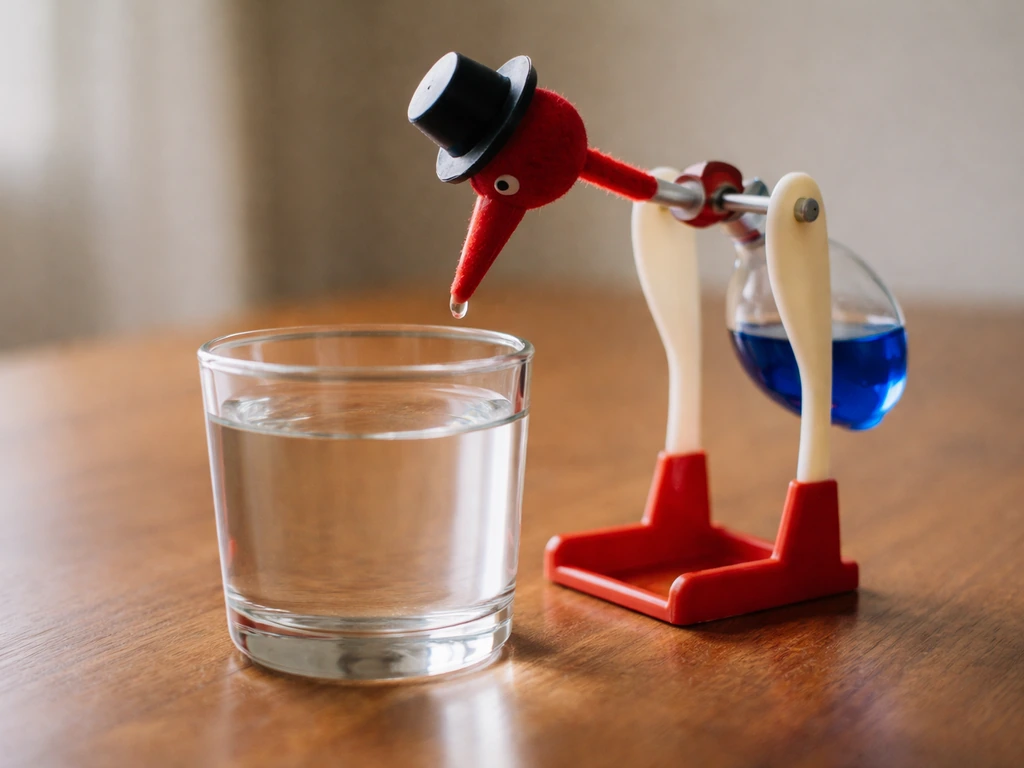
The drinking bird toy works by using evaporative cooling to create a pressure difference between its head and its belly, which shifts its center of mass and tips it forward into a glass of water. Once the beak gets wet, that cooling kicks off a repeating cycle that keeps the bird bobbing up and down for as long as there is water to dip into and enough evaporation happening at the head. It is a genuine heat engine in a felt hat, and getting it to run reliably comes down to three things: starting it correctly, placing the water glass at exactly the right height, and keeping the beak moist.
Drinking Bird Explained: How It Works, Troubleshooting, Symbolism

Marcus Whitmore
7 May 2026
What the drinking bird actually is
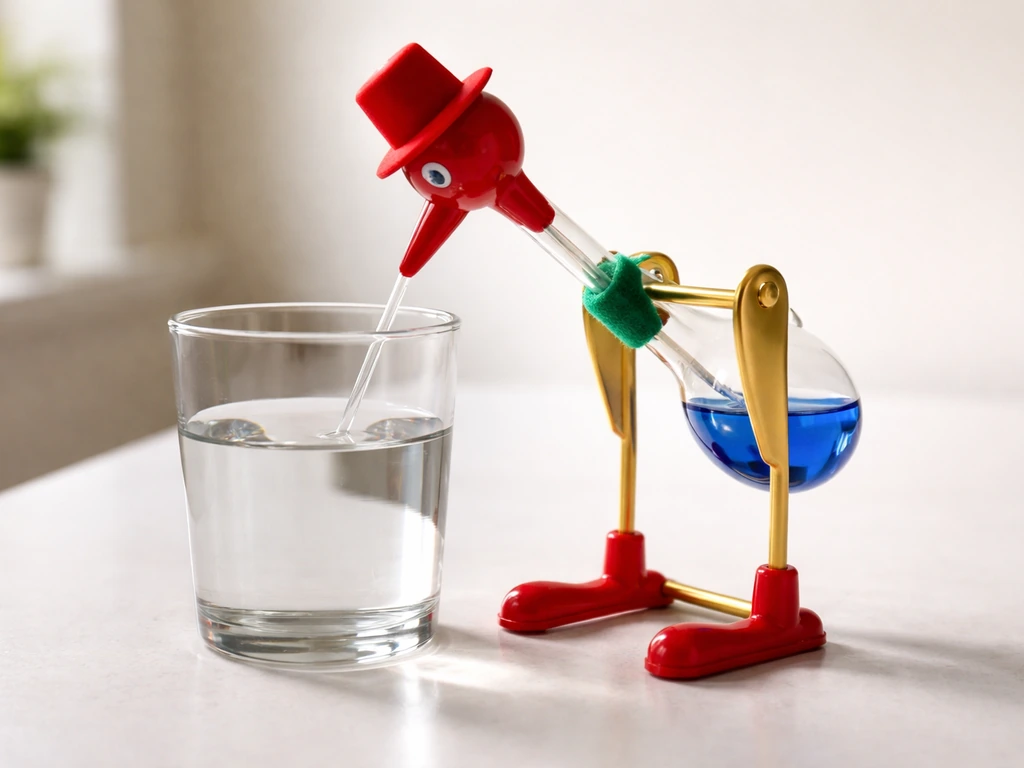
The drinking bird (sometimes called a dippy bird or dunking bird) is a glass toy shaped like a cartoon bird on a pivot stand. Inside it are two glass bulbs connected by a thin glass tube, and the whole sealed system is partially filled with a colored liquid, usually dichloromethane (a volatile solvent). NIOSH/CDC hazard guidance for dichloromethane, including methylene chloride, is available in CDC’s Pocket Guide chemical hazard pages. The head bulb is wrapped in a fuzzy felt material, and the bird wears a little hat. It looks like a novelty you would find on someone's desk, and it absolutely is that, but it is also a working thermodynamic device. Classrooms and physics labs use it to demonstrate heat engines and the conversion of thermal energy into mechanical motion, which is why you will see Flinn Scientific selling it as an experiment kit alongside the usual lab supplies.
One thing worth clearing up: the drinking bird is not the same as a siphon or a pump. It does not move water from the glass into itself in any meaningful way. The "drinking" is purely mechanical theater, a repeated dipping motion that mimics a bird bending down to take a sip. The bird never actually consumes the water. It just keeps leaning in, touching the surface, pulling back, and doing it again.
How the cycle works, in plain English
Here is the full cycle from start to finish. When the felt-covered head gets wet, water evaporates from it. Evaporation is a cooling process, so the head cools down relative to the lower bulb (the belly), which sits at room temperature. The dichloromethane inside the system is extremely sensitive to temperature. As the head cools, the vapor inside the head condenses slightly, lowering the vapor pressure there. The belly is now at higher pressure than the head, so the colored liquid gets pushed upward through the glass neck tube toward the head. As liquid rises into the head, the bird's center of mass shifts upward and forward. The bird tips forward. The beak dips into the water glass, re-wetting the felt head. At that tilted angle, the bottom of the neck tube is exposed inside the lower bulb, so a bubble of vapor travels up and the liquid falls back down into the belly. The bird rights itself. The head is wet again, evaporation restarts, and the cycle repeats.
The whole thing runs on the temperature difference between the wet, evaporating head and the warmer belly. If that difference disappears, the cycle stops. This is why humidity matters: in very humid air, evaporation from the felt head slows dramatically, the cooling effect weakens, and the bird either slows down or stops entirely. A light airflow near the head actually speeds the cycle up by whisking away the humid air layer around the felt and letting faster evaporation occur.
How to set it up so it actually works
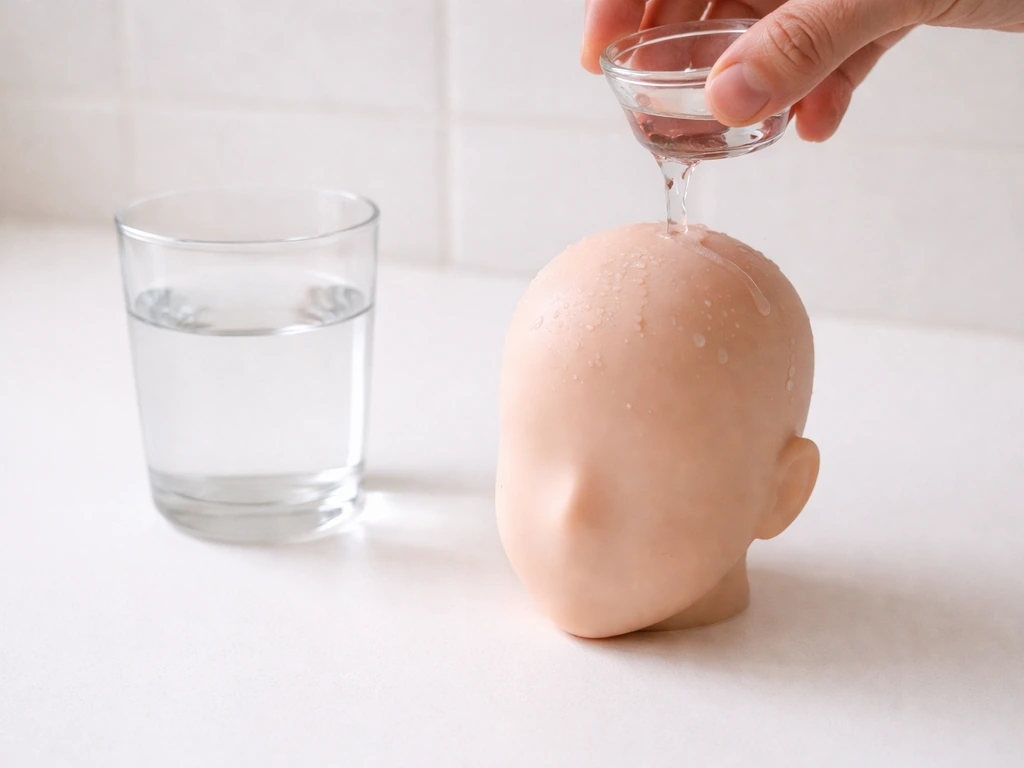
Setup is where most people go wrong, and it is almost always one of two mistakes: the head is not wet enough to start, or the water glass is at the wrong height. For example, Flinn Scientific’s handout describes starting the demo by submerging the entire head into a full cup of tap water Drinking Bird. Follow these steps and you will have a reliably oscillating bird within a few minutes.
- Fill a glass or small cup with room-temperature tap water. Do not use ice water (too much cooling can overwhelm the system) and avoid hot water.
- Submerge the entire head of the bird in the water for a few seconds, or thoroughly wet the felt hat and beak by dipping just the head. Flinn Scientific's instructions specifically say to soak the whole head to start the cycle reliably.
- Place the bird on its stand next to the glass, facing it directly, so the beak will dip into the water as the bird leans forward.
- Adjust the glass height so that when the bird tips forward at its natural angle, the beak just touches the surface of the water. If the glass is too short, the beak never reaches. If the glass is too full or too tall, the bird's beak hits the rim or plunges too deep, disrupting the reset.
- Give the bird a gentle forward nudge to start the first oscillation. It may take two or three dips before the cycle becomes self-sustaining.
- Place the setup in a spot with normal room airflow, away from direct sunlight or heating vents. Mild air movement helps; a draft that is strong enough to physically move the bird will throw off the timing.
Once the cycle is running, the bird can keep going for days as long as there is enough water in the glass to keep the head re-wetted on each dip. Idaho State University's demo notes confirm this: a full glass of water at the right position will sustain the bird's motion continuously without any intervention.
Why it stops or drinks weakly: troubleshooting
The most common complaint is that the bird bobs a few times and then slows to a stop, or tips forward but never quite makes it all the way down to the water. Here are the most likely causes and fixes.
| Symptom | Most Likely Cause | Fix |
|---|---|---|
| Bird tips but never reaches the water | Glass is too low or too far away | Raise the water glass or move it closer so the beak just touches the surface at full forward tilt |
| Bird bobs weakly and slows to a stop | Head not wet enough; insufficient evaporative cooling | Re-wet the entire felt head and restart; check that ambient humidity is not very high |
| Cycle starts then gradually gets slower | High room humidity slowing evaporation | Move to a drier spot or a room with mild airflow to speed evaporation |
| Bird tips forward and stays there | Glass too tall or too full; beak is submerged too deeply | Lower the water level so the beak just grazes the surface |
| Bird will not tip at all after wetting | Pivot point is sticking or stand is off-balance | Check that the bird swings freely on its pivot; adjust stand on a flat, level surface |
| Liquid is stuck high in the neck and won't fall | Air bubble or blockage in the neck tube | Gently tilt the bird fully horizontal to let liquid redistribute, then stand it up again |
| Bird oscillates but never dips into water | Stand positioned too far from the glass | Move the glass until the beak touches the water surface at the forward tip of the swing |
Temperature plays a bigger role than most people expect. A warm room accelerates evaporation from the head, which drives faster cycling. A cold room or very humid conditions slow everything down. If you are troubleshooting in winter with the heat running and the air is dry, the bird will likely cycle faster than usual. In a humid summer kitchen, it may barely move. That is not a broken bird; it is the thermodynamics working exactly as described. If you are wondering “bird in room meaning” in the context of the drinking bird, it usually points to how the setup and conditions reflect the role of the surrounding environment.
Maintenance, cleaning, and keeping it going long-term
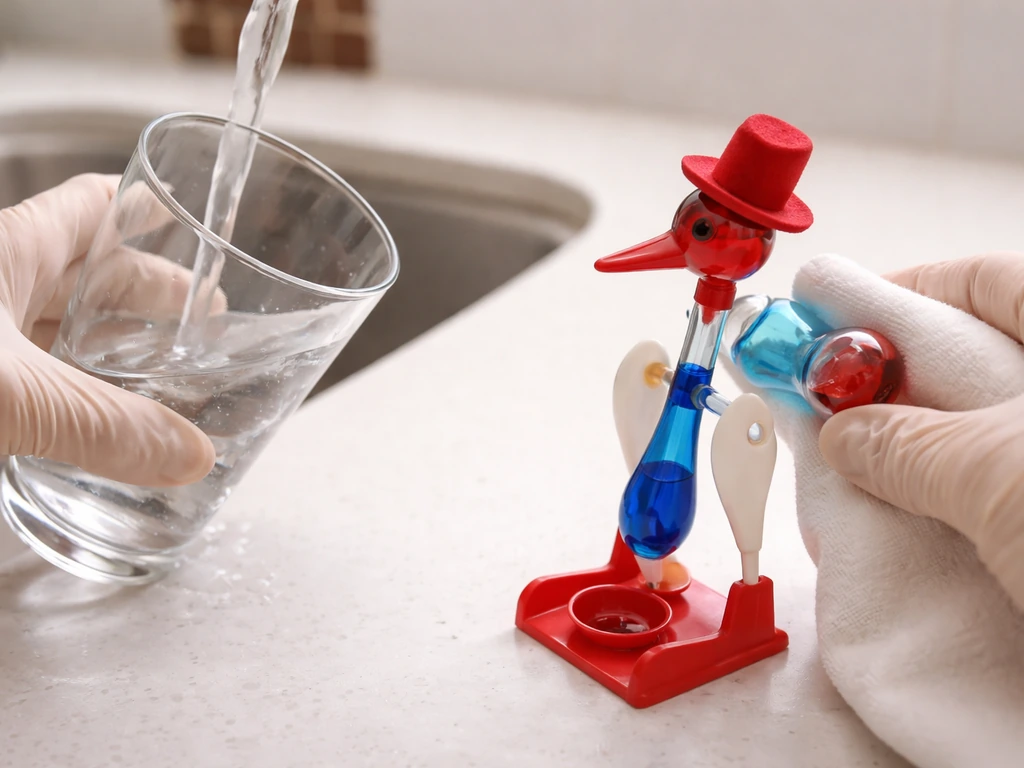
The drinking bird is mostly maintenance-free, but a few habits will keep it running well and extend its life significantly.
- Change the water in the glass every few days. Tap water left sitting picks up dust and can develop algae or deposits that clog the felt on the beak.
- Keep the felt head clean. If the felt gets grimy or compressed from repeated dunking, it will not wick moisture as effectively. A gentle rinse under cool water and air-drying is usually enough.
- Store the bird upright and away from direct sunlight when not in use. UV exposure can degrade the felt and the colored dye in the dichloromethane solution over time.
- Never try to open or refill the sealed glass bulbs yourself. The dichloromethane inside is a harmful solvent and the glass is fragile. If you see a crack or a leak, dispose of the toy safely rather than trying to repair it.
- Keep it away from children under about 8 years old. The glass can break, and the internal liquid is not safe if ingested or if it contacts skin repeatedly.
- If the felt gets stiff or the beak stops wicking water properly, a very brief soak in clean water (just the head) can revive it before the next session.
With reasonable care, a well-made drinking bird can last for years. The mechanism itself has no moving parts that wear out; it is the glass and felt that eventually degrade. Keeping the glass intact and the felt clean is essentially the whole maintenance job.
Why a bird? The symbolism behind the shape
This is the part that makes the drinking bird genuinely interesting beyond the physics. The toy could have been designed as any shape, but a bird is exactly right, and not just visually. Birds drinking from water sources carry a rich set of cultural associations: patience, persistence, the rhythm of returning again and again to the same place. The drinking bird's repeating dip is a near-perfect physical metaphor for those qualities. It never gives up, never rushes, never skips a beat. It just keeps coming back.
In folklore and common idiom, birds are almost always associated with alertness and attentiveness. The early bird watches, listens, and returns persistently. The drinking bird enacts that exact quality in mechanical form: it is always there, always leaning in, always paying attention to the water. That is why it became a desk object and a classroom fixture rather than just a physics curiosity. It models a kind of quiet, reliable diligence that people find oddly satisfying to watch.
There is also something appealing about the "thirst" metaphor. In many cultures, thirst and drinking symbolize desire, pursuit, and the drive to seek something out. A bird that perpetually seeks water and perpetually returns to it is a small, cheerful symbol of that kind of driven curiosity. It is not an accident that the toy gets used in classrooms specifically to provoke the question: does it drink forever? Is it a perpetual motion machine? (It is not; it runs on the heat of the room.) Those questions point toward something genuinely philosophical about energy, limits, and the nature of work.
It is worth noting that birds-as-art and birds-as-metaphor occupy a wide space in human culture. Constantin Brâncuși's Bird in Space sculptures, for instance, are not birds at all in any literal sense; they are the idea of flight made physical. Constantin Brâncuși's Bird in Space meaning is often discussed as a statement about flight, spiritual ascent, and the abstraction of motion. Brâncuși’s Bird in Space sculptures are often read as a meditation on flight and freedom, which is why the phrase “bird in space sculpture meaning” comes up so often. The drinking bird works from the opposite direction: it is the most literal bird shape possible, a cartoonish profile, but it enacts a concept (persistence, thermodynamic work, the heat engine) that is entirely abstract. Both approaches use the bird as a vessel for an idea rather than a description of an animal. That is how thoroughly the bird has embedded itself in human symbolic thinking.
So when you set up your drinking bird on a desk and watch it bob, you are getting the science and the story at the same time. The science is a genuine thermodynamic cycle running on evaporation and pressure. The story is one humans have been telling about birds for as long as there have been words for patience and persistence. Both of those things are worth understanding, and fortunately, both fit on a desk.
FAQ
Does a drinking bird actually drink the water or transfer it into itself?
No. The bird creates motion by evaporation at the felt head and pressure shifts inside a sealed two-bulb system. The liquid in the base tube does not act like a siphon that transfers the water into the bird, so the water level in the glass should drop only very slowly, if at all.
My drinking bird tips forward but does not reach the water reliably. What is the most likely fix?
A quick check is to look for a shallow steady dip, not a deep plunge. If the beak touches but the felt never gets fully rewetted, the bird may not generate enough cooling. Re-wet the felt directly with a small splash (or briefly dip the head) and confirm the water height matches the recommended position for your specific model.
How do I set the glass height correctly, and why does height matter so much?
Aim for a stable water glass height, where the beak can consistently wet the felt on each cycle. If the glass is too low, the bird may lose the ability to re-wet. If it is too high, it can over-wet and change the evaporation dynamics, sometimes causing early stalling. Use a ruler or mark the setup, then avoid moving the glass during troubleshooting.
Why does humidity make my drinking bird stop or run slowly?
Yes, and it is the most common reason the bird slows in certain rooms. In very humid air, evaporation from the felt head is weak, so the head does not cool enough to drive the pressure change. In very dry air with airflow near the head, evaporation can be strong and the cycle speeds up, making the bird seem “too fast.”
Should I use a fan or open window to make a drinking bird run better?
A light breeze can help, because it removes the humid air layer around the felt and lets evaporation proceed faster. However, strong or constant drafts can cool the head unevenly and lead to irregular bobbing. Try gentle, indirect airflow, not a fan blasting directly into the felt area.
What maintenance actually matters for keeping the drinking bird working for years?
The sealed working fluid and the felt are the key components. Keep the felt clean and free of dust or residue so it can evaporate efficiently. If the felt is clogged or the glass surface is scratched and prevents consistent contact, the cycle can degrade. If you notice discoloration or a persistent performance drop, inspect both the felt and the head-contact area before doing further adjustments.
What should I do if the drinking bird bobs a few times and then immediately stops?
If the bird does not start, the head usually is not wet enough or the water position is off. Another edge case is when the bird has been sitting dry for a while, so the felt needs time to fully saturate and begin evaporation. Re-wet the felt thoroughly and re-check the height, then restart once the bird has a reliable first contact.
Why is the drinking bird not a perpetual motion machine, and what limits its runtime?
The oscillation uses ambient heat through evaporation, so there is no true “perpetual motion.” If the temperature difference between the wet head and the belly becomes too small, the pressure-driven cycle stalls. This is more likely in steady, warm, humid conditions where evaporation is weak, even if the room feels warm overall.
Next Article
War Bird Meaning: Literal, Slang, and Historical Uses
Understand war bird meaning: literal, slang metaphor for fighters, and historical bird symbolism, plus close phrase comp