"Tip of the bird" is not a standard idiom or fixed phrase in English. When people search for its meaning, they are almost always asking about one of two things: a literal anatomical reference (the tip of a beak, wing, feather, or tail, as you would find in a field guide or birding forum) or a misremembered version of a well-known bird idiom like "give someone the bird" or "flip the bird." Occasionally the phrase turns up in poetry or literary prose as a precise sensory image. There is no single figurative meaning to unpack here, so the first job is figuring out which sense the writer or speaker intended.
Tip of the Bird Meaning: Literal, Idiom & Poetic Uses

Marcus Whitmore
17 Jul 2026
Is "tip of the bird" literal, idiomatic, or something else?
The honest answer is: ambiguous, and almost always literal. Major general-purpose dictionaries define "tip" simply as the pointed or distal end of an object. None of the major English idiom references (Collins, Merriam-Webster, Wiktionary, Oxford Dictionaries of Idioms) list "tip of the bird" as a conventional standalone expression with an agreed figurative meaning. When the exact string "tip of the bird" appears in historical books and newspapers, it is overwhelmingly used in measurement contexts, such as "from the tip of the beak to the tip of the tail," borrowed directly from natural history writing. The phrase has no settled idiomatic meaning the way "early bird" or "bird in the hand" does.
That said, it is worth walking through every plausible reading, because the context that sends someone to a search engine varies quite a bit. You might have read it in a field guide, heard it in a joke, spotted it in a poem, or been told a proverb that used a bird metaphor. Each of those routes leads to a different explanation.
The literal anatomical senses: beak tip, wingtip, feather tip, tail tip
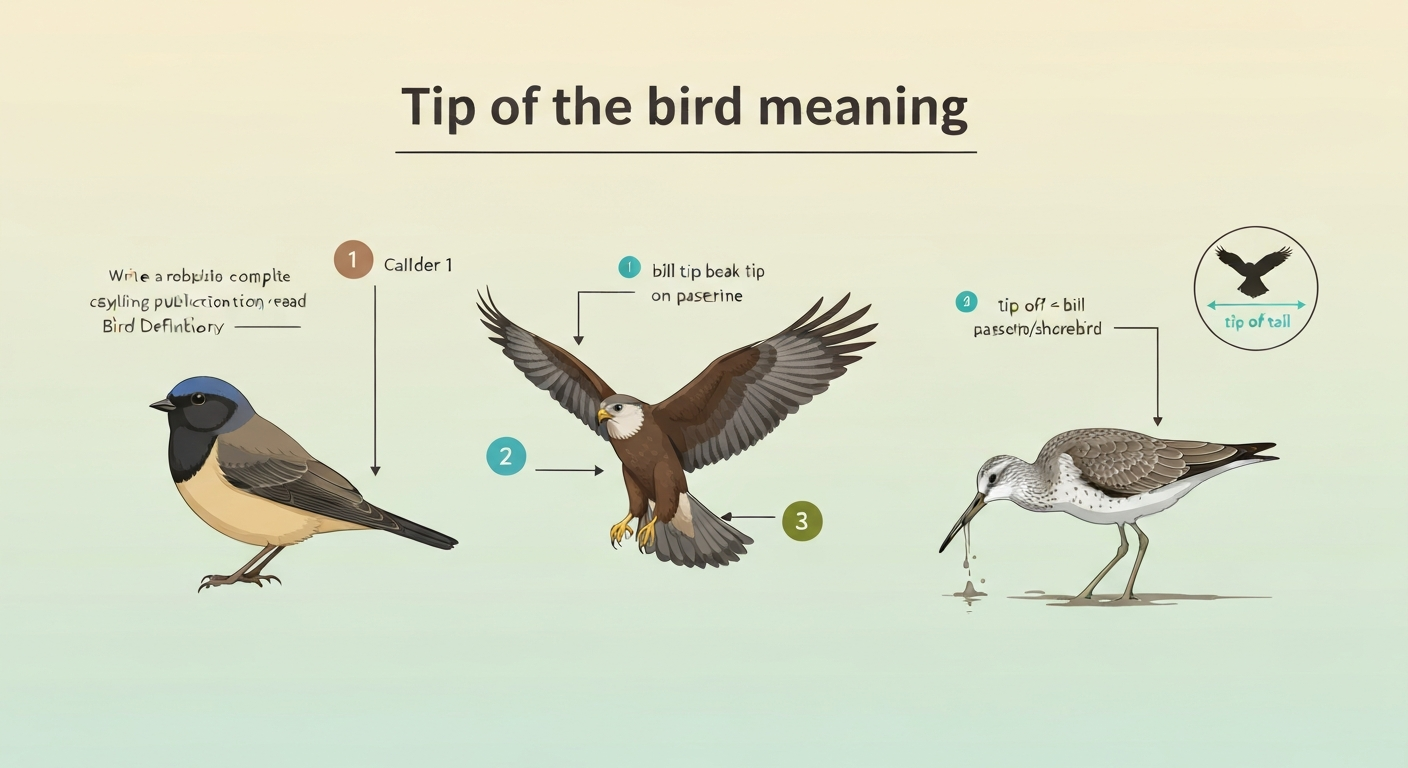
Ornithology uses "tip" constantly, and with precision. When a birder or field guide writer says "tip of the bird," they are usually shorthand for one of four distinct anatomical locations, each with its own terminology and functional importance.
Bill tip (beak tip)
The bill tip is the distal end of the beak, and it is more interesting biologically than most people realize. In many species, especially kiwis, probing shorebirds, some ibises, and certain ducks, the bill tip contains a dense cluster of sensory pits called the bill-tip organ. These mechanoreceptors allow the bird to detect prey through touch while probing mud or soil, a form of "remote touch" that lets a kiwi find a worm without seeing it or smelling it. The technical measurement most often anchored on the bill tip is the culmen, which is the upper ridge of the bill measured from base to tip. When field guides give total body length, it is almost always measured "from the tip of the bill to the tip of the tail."
Wingtip
Wingtip refers to the outermost point of the extended wing, typically the tip of the longest primary feather. In aerodynamics and bird-flight literature, wingtips are where lift generation creates wingtip vortices, small rotating columns of air that increase induced drag. Birds that soar efficiently (hawks, vultures, albatrosses) have evolved wing shapes that minimize this effect, either through slotted primary feathers that reduce vortex size or through long narrow wings that keep wingtip energy loss low. In field identification, wingtip projection (how far the primary tips extend beyond the tertials when the wing is folded) is a key diagnostic feature for separating otherwise similar species.
Feather tip
The feather tip is the distal end of an individual feather, specifically the distal portion of the vane. Feather tips are often described as field marks: "white tips on the rectrices," "buff-tipped wing coverts," "worn feather tips." Tip coloration or shape (rounded, pointed, notched) can identify both species and individual age, since feather tips wear down over time and fresh, unworn tips often look strikingly different from late-season plumage.
Tail tip
The tail tip refers to the distal end of the tail feathers as a group (the rectrices), and it serves three main functions: steering during flight, braking on landing, and visual display. The shape of the tail tip (rounded, square, forked, graduated) is a primary identification feature across many bird families. Some species use the tail tip specifically in courtship displays, fanning or spreading the rectrices to show off coloration or iridescence.
| Anatomical tip | Technical term(s) | Primary function | Common context |
|---|---|---|---|
| Bill tip | Bill tip; bill-tip organ; culmen endpoint | Tactile prey detection; food handling | Field guides, ornithology research, pet-care forums |
| Wingtip | Wingtip; outer primary tip | Aerodynamic lift and vortex generation; identification | Flight biology, identification guides, aerodynamics |
| Feather tip | Distal vane; feather tip | Field mark (color, shape, wear) | Plumage description, ageing birds, field guides |
| Tail tip | Rectrices tip; tail tip | Steering, braking, display | Identification guides, behavioral studies |
Idiomatic and slang possibilities: what the phrase might actually be pointing at
If you encountered "tip of the bird" in a non-scientific context, it is worth checking whether the phrase is being used loosely in place of, or in reference to, one of these established bird idioms. None of them mean the same thing as a literal anatomical tip, but search patterns suggest people sometimes conflate them.
"Give someone the bird" / "flip the bird"
This is the most well-documented bird-related gesture idiom in English. "Give the bird" originally referred to a British theatrical tradition of making a loud hissing sound (like a goose) to boo a performer off the stage. In American English it evolved into the middle-finger gesture, and "flip the bird" is now the standard US phrasing. Wiktionary and Collins both document the idiom's regional and historical senses clearly. It has nothing etymologically to do with a physical tip or point on a bird's body, but someone looking for the meaning of a rude gesture they called "the tip of the bird" may have landed on this by accident. The gesture involves a raised finger, not a beak tip or wingtip, so the connection is purely linguistic confusion. You can find a full breakdown of this idiom in the "give someone the bird" entry on this site.
"Proverbial bird" usages
Phrases like "the early bird," "a bird in the hand," and "the proverbial bird" use birds as conventional symbolic stand-ins for opportunity, caution, or freedom. None of these involve the word "tip," but someone paraphrasing a proverb loosely might say something like "the tip of the bird" when they are trying to articulate the point or moral of a bird proverb. This is a misquotation or approximation rather than an established phrase. The proverbial bird entries on this site treat those idioms on their own terms.
"Eneke the bird" (Igbo proverb)
One genuinely interesting fixed phrase that involves a named bird is the Igbo proverb made famous in English by Chinua Achebe's Things Fall Apart: "Eneke the bird says that since men have learned to shoot without missing, he has learned to fly without perching." This proverb is about adaptation and survival in a changed world. It is not related to "tip of the bird" in any direct sense, but scholarly articles and literary commentary about this proverb will sometimes appear in search results for bird-phrase meanings. If you found "tip of the bird" in a discussion of Achebe or African literature, it is worth going back to the source text, because the Eneke proverb is distinct and specific. There is a dedicated entry for the Eneke the bird proverb elsewhere on this site. See the eneke the bird proverb meaning entry for a full explanation of Achebe’s proverb and its Igbo context.
"A home bird" and similar compound idioms
British English has a productive tradition of compound bird idioms: "home bird" (a person who prefers staying close to home), "odd bird" or "rare bird" (an unusual person), "jail bird," and so on. None of these use the word tip, but a reader unfamiliar with the home bird idiom might search for bird-phrase meanings broadly and arrive at "tip of the bird" as a guess. The home bird idiom meaning entry on this site explains that tradition in detail.
Likely mishearings and mis-phrasings
- "Tip of the beak" or "tip of the bill" (the most common literal re-phrasing in birding and pet-care contexts)
- "Tip of the wing" (aerodynamics or field identification contexts)
- "The bird's-eye view" (a different idiom entirely, meaning a view from above)
- "Flip the bird" (the gesture idiom, where 'flip' or 'give' was misheard or misremembered as 'tip')
- A specific proverb where 'bird' appears and 'tip' is being used to mean the crux or point of the saying
Cultural and literary uses: how poets and storytellers deploy "tip" imagery
Even without a fixed idiomatic meaning, "tip of the bird" (and its variants) appears in literary writing as a precise sensory or visual image. Poets and nature writers reach for it when they want to anchor attention at a single point of contact between bird and world: the moment a heron's beak breaks the water surface, the silhouette of a hawk at the wingtip of a thermal, or the way a wren's tail tip bobs with each call. These are not idioms with transferable figurative meanings. They are deliberate images, and their meaning is local to the text.
Nineteenth-century natural history writing is full of the phrase in its most literal form. Google Books returns examples from the 1800s and early 1900s where authors describe specimen measurements as "from the tip of the beak to the tip of the tail," a formula so common it was practically its own genre convention. This usage never developed into an idiom because it was always being used literally, as a measurement protocol.
If you are reading a contemporary poem or piece of literary fiction and the phrase "tip of the bird" appears, the best approach is to treat it as imagistic description rather than a coded idiom. Ask what sensory detail the writer is drawing attention to, and what emotional or thematic weight the image carries in that specific passage. There is no authoritative figurative reading to look up, which actually gives the image more flexibility in skilled hands.
For verification, a search of Google Books with the exact phrase in quotation marks, filtered to a specific century or genre, will show you how the phrase has actually been used in print. The Library of Congress Chronicling America newspaper archive is useful for historical press usage and consistently returns literal measurement and natural history contexts rather than any figurative idiom. Chronicling America (Library of Congress), example 1920s literal usage documents the phrase in a measurement context, e.g. "from the tip of the beak to the tip of the tail." Chronicling America (Library of Congress) — example 1920s literal usage.
How to figure out which meaning is intended
Context is everything with an ambiguous phrase like this. Here are the questions I would ask before committing to an interpretation.
- What is the source genre? A field guide, birding journal, or pet-care forum almost certainly means a literal anatomical tip. A comedy sketch, slang glossary, or social media joke about a rude gesture most likely means 'flip the bird.' A poem or literary essay may be using it as a precise visual image.
- Is there a measurement or description nearby? If the text mentions length, size, color pattern, or species identification, the tip is anatomical.
- Is the tone formal or irreverent? Idioms like 'give the bird' are casual and often humorous; anatomical uses are neutral and descriptive.
- Is there a named bird in the phrase? 'Eneke the bird' and similar fixed proverbs name the bird directly. A phrase like 'tip of the bird' without a named species is more likely measurement or image than proverb.
- What part of the bird is being discussed? If the surrounding text mentions beak, bill, or feeding, the bill tip is the target. If the text discusses flight, wingspan, or migration, wingtip is more likely.
- Is this a possible typo or autocorrect error? Social media posts asking about a bird's 'broken tip' are almost always asking about the bill tip, and the phrase 'tip of the bird' is often a contracted version of 'tip of the bird's beak.'
Quick corpus and search tips
- Search Google Books with the exact phrase in quotes: "tip of the bird" — the results will almost exclusively be literal, 19th-century natural history usage.
- Add a genre or context term to the search: "tip of the bird" poetry will return literary uses; "tip of the bird" ornithology will return anatomical ones.
- If you are looking for idiom verification, check Wiktionary, Collins Dictionary, or the Oxford Dictionary of Idioms specifically for the full phrase. If it is not listed there, it is not a standard English idiom.
- For slang verification, check Green's Dictionary of Slang or Wiktionary's idiom sections. 'Flip the bird' appears; 'tip of the bird' does not.
- For literary attestation, Google Scholar searches for the exact phrase in literary journals will tell you whether it has been used and analyzed as a poetic image.
Etymology and usage notes for the key senses
The word "tip" in the sense of a pointed end comes from Middle English, related to Low German and Middle Dutch words for the end or point of something. It has been used in English since at least the 13th century in this basic spatial sense, and it was applied to bird anatomy as soon as English-language natural history writing emerged in the 16th and 17th centuries. There is nothing unusual or figurative about the combination "tip of the bird" in that tradition.
The idiom "give the bird" (booing) is documented in British English from the early 19th century, rooted in the theatrical practice of hissing like a goose. The American sense (the middle-finger gesture) developed separately in the 20th century. Both senses are well-attested and appear in major dictionaries. The word "tip" does not appear in the etymology of either sense.
"Wingtip" as a compound noun appears in English ornithological and aeronautical writing by the late 19th and early 20th centuries, and it entered general aviation vocabulary during the early years of aircraft design, where engineers borrowed heavily from bird-flight observations. The term is now standard in both fields.
"Bill-tip organ" as a technical biological term is a 20th-century coinage from comparative anatomy research. Peer-reviewed literature from the 1990s onward describes it systematically, and recent 2024 reviews document it across seabirds and shorebirds. It is a well-supported scientific concept, not folk terminology.
Example sentences for each sense
These short examples show how each literal and idiomatic reading of 'tip of the bird' (or its closest recognized forms) actually appears in use.
| Sense | Example sentence | Register / context |
|---|---|---|
| Bill tip (anatomical) | "The kiwi detects earthworms through pressure-sensitive pits clustered at the tip of the bird's bill." | Scientific / field guide |
| Wingtip (anatomical / aerodynamic) | "Vortices trailing from the tip of the bird's wing create the characteristic spiraling wake visible in slow-motion footage." | Biology / aerodynamics |
| Feather tip (identification field mark) | "Look for the pale buff fringe at the tip of each wing-covert feather — this marks a first-winter bird." | Birding / identification guide |
| Tail tip (anatomical / display) | "The male fans the rectrices until the white spots at the tip of the bird's tail are fully visible to the female." | Behavioral study / nature writing |
| Total body length (measurement convention) | "The specimen measured 38 cm from the tip of the beak to the tip of the tail." | Natural history / museum catalogue |
| Literary / imagistic | "She watched until the tip of the bird dissolved into the fog above the estuary." | Literary prose / poetry |
| Misphrase for 'flip the bird' (gesture idiom) | "He gave me the tip of the bird — I think he meant 'flip the bird' but either way the message was clear." | Casual / humorous / slang adjacent |
| Proverb paraphrase (not fixed idiom) | "The moral, the tip of the bird proverb if you like, is that survival demands constant adaptation." | Informal literary commentary |
Where to look next
Because "tip of the bird" is not a standard idiom, no single dictionary entry will definitively settle every question about it. The most useful moves depend on what you are actually trying to resolve.
For the anatomical senses, the Cornell Lab of Ornithology's All About Birds glossary and the Bird Academy A-to-Z Glossary of Bird Terms are the most reliable free references. They define wingtip, bill tip, culmen, and rectrices with diagrams. Merriam-Webster covers "culmen" as a technical term. For the bill-tip organ specifically, PubMed and Google Scholar searches for "bill-tip organ" return peer-reviewed literature going back to the 1990s and up to recent 2024 comparative reviews.
For the gesture idiom, Collins Dictionary's entry for "flip the bird" and Wiktionary's entry for "give the bird" both give etymology, regional notes, and usage examples. These are the places to go if the phrase you encountered was clearly about a rude gesture and you want the full history.
For proverbs and literary bird expressions, this site has dedicated entries worth consulting. The give someone a bird idiom meaning entry covers the gesture idiom in full. The proverbial bird meaning entry addresses how birds function as conventional symbols in proverbs across English. The eneke the bird proverb meaning entry goes deep on the Achebe proverb and its Igbo literary context. And if you are thinking about bird expressions that relate to home, belonging, or personality, the a home bird idiom meaning entry is the place to start.
One important verification note: because "tip of the bird" is rare and not standardized, be cautious about any source that presents it as a fixed idiom with a single meaning. If a website or AI tool tells you it has a settled figurative definition, ask for a dated citation from a recognized dictionary or corpus. The honest answer, supported by the evidence, is that the phrase is almost always literal, occasionally literary, and never a conventional idiom in its own right.
FAQ
Short answer: What do people mean when they search “tip of the bird meaning” — is it a standard phrase?
Short answer: There is no widely recognized fixed idiom “tip of the bird.” Most uses are ambiguous and resolve to literal anatomical/topographic senses (e.g., bill/beak tip, wingtip, feather tip, tail tip) or to a writer’s poetic image. Established bird idioms exist (e.g., “give the bird,” “early bird”), but “tip of the bird” is not a standard figurative expression in major idiom dictionaries. Marked or rare figurative uses exist but should be flagged as uncertain unless context proves otherwise.
What literal anatomical senses can “tip of the bird” mean? (And what do those tips do?)
Literal senses (common in field guides, ornithology, and pet care): - Beak/Bill tip: the distal point of the beak (often the locus for the culmen measurement). Functions: prey capture/handling, probing, cutting; many species have tactile receptors or bill‑tip organs concentrated at or near the bill tip. - Wingtip: the distal end of the wing (outer primaries). Functions: creates wingtip vortices, influences induced drag, maneuvering and flight efficiency; important in flight descriptions and measurements. - Feather tip: the distal end of an individual feather (e.g., worn feather tips, colored tips used as field marks). Functions: affects insulation, display, and identification; wear and molt show at feather tips. - Tail tip / rectrices tip: the distal end of tail feathers or the tail as a whole. Functions: steering, braking, display. These senses are routine in ornithological glossaries and field‑mark descriptions; when writers mean one of these, they usually use compound forms (tip of the beak, wingtip, feather tip, tip of the tail).
How can I tell which literal tip is meant in context? (Practical quick checks)
Ask short context questions: - Is the sentence about feeding, probing, or injuries? If so, likely the beak/bill tip. - Is it about flight, wingspan, or aerodynamics? Then wingtip is most likely. - Is the text describing plumage, molt, or patterning? Then feather tip or tail tip (rectrices) is probable. - Does the phrase appear in measurement language (“from the tip of the X to the tip of the Y”)? Expect literal anatomical measurement. Search tips: put quotes around nearby words (e.g., “tip of the bird” + beak; “tip of the bird” + wingtip) or search corpora/Google Books for exact phrasing. In birding forums and Q&A, “tip of bird” is often shorthand or a mis‑phrasing for “tip of the beak.”
What idiomatic or slang possibilities should I consider, and how likely are they?
Idiomatic/slang possibilities (evaluation): - “Give someone the bird” / “flip the bird”: well‑attested idiom meaning to boo or make an obscene gesture; unrelated to any ‘‘tip’’ meaning. Likely confusion when people search for bird idioms, but not the intended sense of “tip of the bird.” - Proverbial named birds (e.g., “Eneke the bird”): an established proverb about adaptation popularized by Achebe; it is unrelated to “tip of the bird” and should not be conflated. - Local proverbs or regional sayings invoking a bird’s “tip”: possible but rare. No major idiom dictionaries list “tip of the bird” as a conventional proverb. Mark uncertain/rare: if you find it in folklore, treat as local usage and seek citation. - Compound idioms using “bird” with other words (e.g., “home bird,” “early bird”): documented and common, but again do not use “tip” specifically. Bottom line: idiomatic senses are unlikely unless context explicitly frames a figurative meaning; if you see “tip of the bird” used figuratively, flag it as context‑specific or rare and seek the source for clarification.
How do poets and storytellers use “tip” imagery with birds? Any examples or search advice if no standard idiom exists?
Cultural/literary uses: poets and storytellers frequently use bird imagery and may pair ‘tip’ with a bird for physical detail or metaphor (e.g., “light on the wingtip,” “the tip of her bill brushed the dawn”). These are creative images, not standardized idioms. Example pointers: - Look for passages where a poet describes a precise motion, edge, or small change (e.g., a feather’s tip catching light) — that clarifies a literal sensory image. - If you cannot find a fixed idiom, search literary corpora and Google Books with larger spans: try queries like “wingtip of the bird,” “tip of the beak,” or “tip of the feather” plus the poet’s name or time period. - For notable proverb context, remember “Eneke the bird” (Chinua Achebe’s Things Fall Apart cites it) is a proverb about adaptation — not a ‘tip’ phrase. When a phrase appears only in a creative work, treat it as authorial imagery rather than a general idiom.
What practical steps help verify the intended meaning in an unknown occurrence? (Checklist and corpus tips)
Verification checklist: 1) Read surrounding sentences for physical cues (feeding, flying, plumage). 2) Look for lexical collocates: beak, bill, wing, feather, tail, flight, molting. 3) Check register: scientific texts → literal anatomical meaning; poetry/fiction → probably image/metaphor. 4) Search exact phrase in quotes plus a nearby keyword (e.g., "tip of the bird" "beak"). Use Google Books, newspaper archives, and corpora (COCA, BNC) to see attestation. 5) If from social media/forums, consider common mis‑phrasing; check whether participants correct it to “beak” or “wingtip.” 6) If the usage seems idiomatic, demand sources—proverbs and idioms should be attested in dictionaries or proverb collections; otherwise flag as rare/uncertain.
Next Article
Proverbial Bird Meaning: How to Interpret the Phrase
Learn proverbial bird meaning in English, including when it is idiom, how to spot context, and common variants.