What 'as free as a bird' actually means

The idiom 'as free as a bird' means completely free, with no obligations, restrictions, or worries holding you down. Wiktionary also lists “free as a bird” as an idiom and glosses it as “completely free.” blank" rel="noopener noreferrer">The idiom 'as free as a bird' means completely free, with no obligations, restrictions, or worries holding you down.. Cambridge and Merriam-Webster both define it the same way: total freedom. When someone says they feel as free as a bird, they're describing that specific lightness you get when a responsibility has lifted, a commitment has ended, or a constraint has disappeared. It's not just about physical movement. It captures the emotional feeling of being unburdened, at liberty, able to do exactly what you want. Dictionary.com frames it as being 'without obligations,' which is a useful, precise way to think about it.
The phrase is a simile, not a metaphor. You're comparing yourself to a bird (using 'as'), not declaring that you are one. That distinction matters for how you use it, which we'll get into shortly.
Why birds carry the idea of freedom
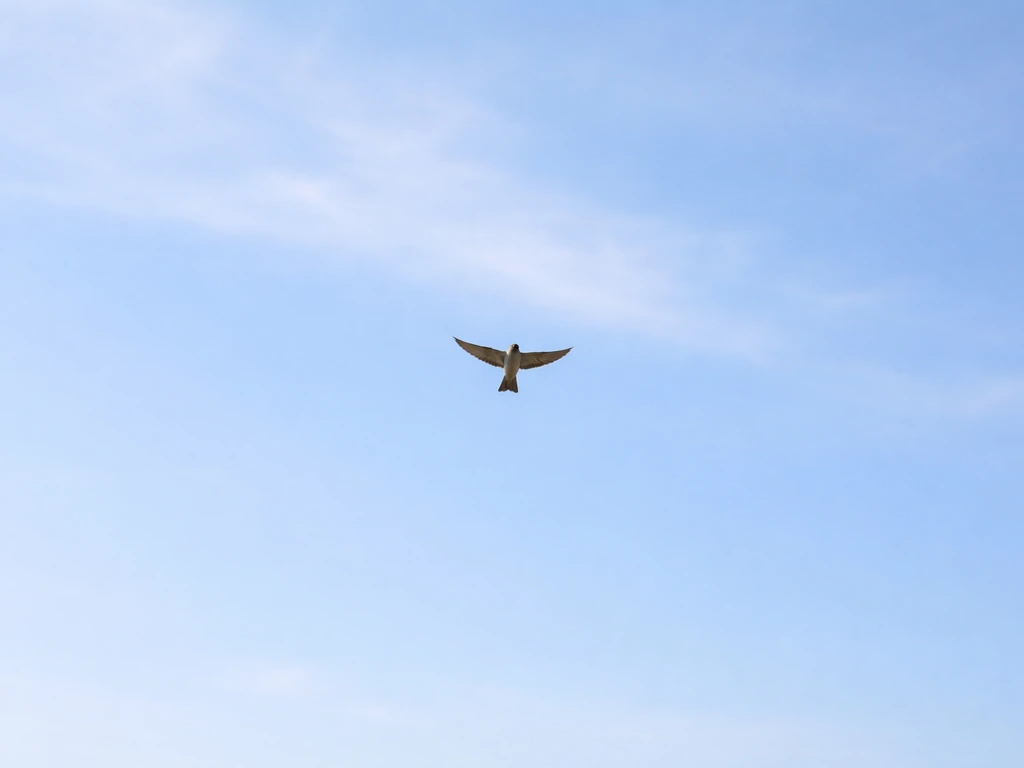
Birds fly. That's the obvious reason, and it's also the real one. Flight has been a symbol of freedom in almost every culture humans have built because it represents escape from the ground, escape from gravity, and by extension, escape from constraint. A bird in the open sky isn't fenced in, isn't tied down, isn't told where to go. It moves entirely on its own terms, and that image maps cleanly onto the human desire to feel unrestricted.
The connection goes back a long way. One early attestation traces to John Heywood's writing around 1533, with a line containing 'As free As be the byrdes that in the ayre flee.' That's nearly 500 years of people reaching for the same image when they want to describe unburdened freedom. The German concept 'vogelfrei' even uses the same bird-freedom link directly, translating literally as 'free as a bird' and historically referring to someone who is not bound by obligations or bonds.
The symbolism is also why you'll find bird imagery showing up across so many other freedom-adjacent idioms and expressions. If you're curious about how birds sit in more precarious emotional territory, the phrase about being perched on a frail branch explores a very different side of that bird-as-symbol tradition, one where the bird represents vulnerability rather than freedom.
'Free as a bird' vs 'free like a bird' and other wording variants
This is where people get tripped up, so let's sort it out clearly. The established idiom is 'as free as a bird' or 'free as a bird.' The word 'as' at the beginning is optional. Cambridge lists the headword as '(as) free as a bird,' with the parentheses showing you can drop the opening 'as' without changing the meaning. So both of these are correct:
- 'She felt as free as a bird.'
- 'She felt free as a bird.'
What about 'free like a bird'? Textranch addresses this directly: 'free as a bird' is the conventional idiomatic form, while 'free like a bird' is a less standard variant. It's not wrong in an everyday sense, and plenty of people say it naturally. But if you want to use the established idiom, stick with 'as.' The simile structure 'as [adjective] as [noun]' is the traditional English pattern for this kind of comparison, and that's what locks 'as free as a bird' into the idiom category.
One more variant worth flagging: you might occasionally see 'as free as bird' with the article 'a' dropped before 'bird.' That's simply an error. The correct form always includes 'a bird,' not just 'bird.' One English grammar source even demonstrates this slip in a sample sentence, so it's worth keeping an eye out for.
Example sentences, including 'I am free as a bird'
Here are examples across different tenses, subjects, and contexts. These show both the casual drop of the opening 'as' and the full form, so you can see how flexible the phrase actually is in real use.
- 'After he left school, he felt as free as a bird.' (past tense, relief after obligation ends)
- 'I felt as free as a bird.' (simple past, personal reflection)
- 'I am free as a bird.' (present tense, declaring current freedom)
- 'Yes, I'm free as a bird.' (casual, conversational affirmation)
- 'Now that her exam is over, she's as free as a bird.' (present, tied to a specific relief moment)
- 'Once the semester is over, I'll be as free as a bird.' (future tense, anticipating freedom)
- 'He's free as a bird. He can travel wherever he chooses.' (present, describing someone else's unrestrained life)
- 'That means she will be as free as a bird before she's 40.' (future with context)
- 'Other than that, he was as free as a bird.' (past, qualifying a situation)
Notice how the phrase works across all tenses without any adjustment to the core phrase itself. You don't change 'as free as a bird' to fit past or future. You just shift the verb around it. 'I felt as free as a bird,' 'I am as free as a bird,' 'I'll be as free as a bird.' The idiom stays fixed while the surrounding grammar moves.
How to use it naturally in conversation
The most natural use of this phrase is to mark the end of something that was holding you back. A job contract ends, a difficult semester wraps up, a relationship that felt controlling is over, a long trip is finally done. That's the sweet spot for this idiom. It signals relief and liberation together, which is why you hear it used most often in the past tense ('I felt...') or as an anticipatory future ('I'll be...').
It works in both spoken and written English without sounding overly formal or literary. You can drop it into casual conversation without anyone finding it odd. Just be aware that it fits contexts where freedom is actually meaningful. Saying 'I'm free as a bird, I finished my coffee' would sound strange. Saying 'I'm free as a bird, I just handed in my last assignment' lands perfectly.
The phrase also pairs well with contrast. You can use it to flip from a previously restricted state to a new free one: 'She spent three years tied to that contract, and now she's as free as a bird.' That before-and-after structure is one of the most effective ways to deploy the idiom.
Register and tone
This is a casual to neutral phrase. It fits informal conversation, personal writing, and light journalism perfectly well. It would feel a bit out of place in formal academic writing or legal documents, but that's true of most idioms. In everyday speech, it reads as warm and relatable rather than fancy, which makes it easy to drop into most contexts without overthinking it.
Comparing the main forms at a glance
| Form | Status | Example |
|---|
| as free as a bird | Standard idiomatic form | She felt as free as a bird after graduation. |
| free as a bird | Equally correct, shortened | He's free as a bird now. |
| free like a bird | Non-standard variant, less idiomatic | She felt free like a bird. |
| as free as bird | Error, missing article 'a' | Avoid this form. |
For everyday use, either 'as free as a bird' or 'free as a bird' is correct and natural. 'Free like a bird' gets the meaning across but isn't the recognized idiom. 'As free as bird' is a typo-level mistake worth avoiding.
Other bird phrases that live in the same neighborhood
If 'as free as a bird' is in your vocabulary, a few related expressions are worth knowing because they handle nearby emotional territory. The Farlex idiom inventory, for instance, groups 'free as air' alongside 'free as a bird' as a close relative. 'Free as air' carries almost exactly the same meaning, emphasizing total, unencumbered freedom. It's slightly more poetic and less commonly heard in everyday speech today, but it's still understood.
On the other side of the tonal spectrum, there's an interesting phrase worth exploring if you want to understand how bird idioms handle calm and composure: the expression 'sober as a bird' takes the bird comparison in a more restrained, controlled direction, which makes for an interesting contrast with the breezy freedom of 'as free as a bird.'
There's also the well-known bald eagle connection, since that bird is practically a cultural symbol of freedom on its own. If you're curious about birds and baldness in language more broadly, it's worth looking at what a bald bird symbolizes across different contexts, since the imagery overlaps in some interesting ways with freedom symbolism. And if you've ever wondered about the specific species behind the phrase the bird you can be proverbially as bald as, that's a fun thread to follow into the world of bird-based comparisons.
The short version: 'as free as a bird' sits in a cluster of similes that use animals, air, and nature to express the feeling of having no constraints. It's the most common and most recognized of the group, which is why it's been around for nearly five centuries and shows no sign of going anywhere.