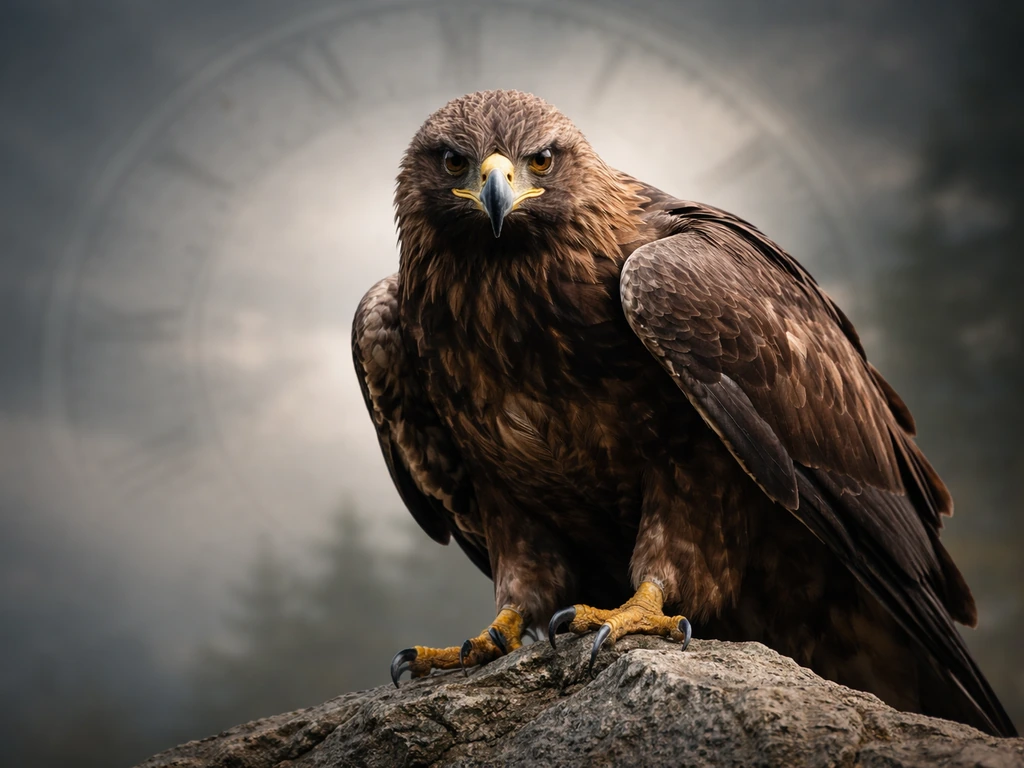
A predatory bird, more formally called a bird of prey or raptor, is any bird that hunts and kills other animals for food using its feet. That last part matters: the defining physical feature is not the hooked bill or the sharp eyesight, impressive as those are, but the raptorial talons and powerful feet used to seize and subdue prey. Merriam-Webster traces the headword 'bird of prey' to the 14th century, and the core meaning has barely shifted since: carnivorous birds that actively hunt, including hawks, eagles, falcons, owls, and vultures.
Predatory Bird Meaning: Definition, Uses, Symbolism & Tips

Marcus Whitmore
14 Jul 2026
What the term actually means, literally
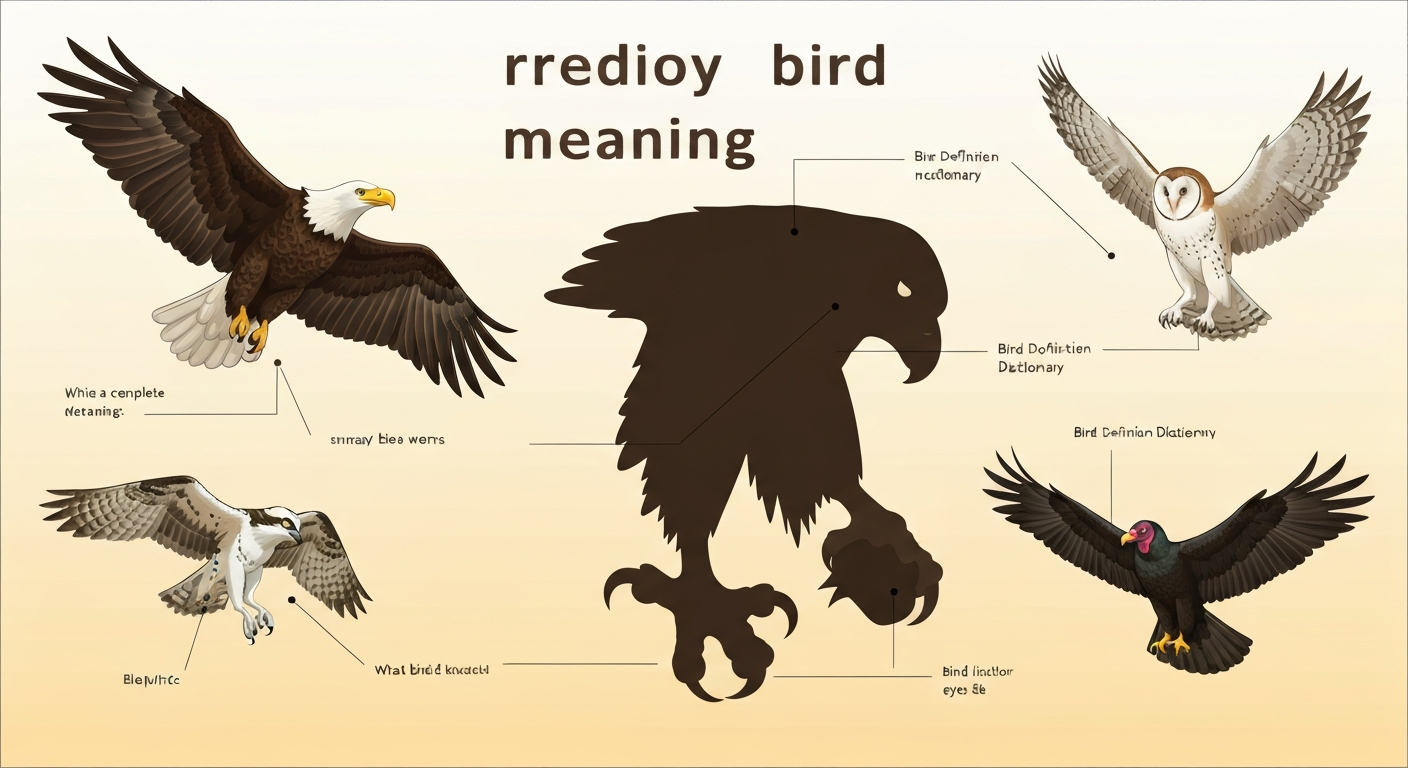
The phrase 'predatory bird' is the plain-English description of a concept that ornithologists usually call 'bird of prey' or, in specialist writing, 'raptor. Google Books Ngram Viewer, (tool for historical frequency trends) shows that usage of 'raptor' rises in scientific and popular contexts from the 19th century onward, while 'bird of prey' remains dominant in general‑audience texts Google Books Ngram Viewer — (tool for historical frequency trends). ' The word raptor comes from the Latin rapere, meaning to seize or snatch, which is also the root of words like rapacious and rapine. The New Latin taxonomic grouping Raptores was coined in the 19th century to pull these seizing birds together as a functional category. Cambridge and Oxford learner dictionaries both define 'bird of prey' straightforwardly as a bird that kills and eats other animals, and bilingual editions typically give Spanish ave de presa or French rapace as the translation equivalent, so if you are a translator working across those languages, those are the standard register-neutral terms.
It is worth flagging a real tension in the literature: 'bird of prey' as a common-language term does not map perfectly onto any single taxonomic order. The Journal of Raptor Research has published commentary noting that authors should declare their working scope, because 'raptor' in a strict ornithological sense means something slightly different from 'any predatory bird' in everyday speech. For this entry we are using the practical, widely accepted definition: birds from the orders Accipitriformes (hawks, eagles, kites, Old World vultures, osprey), Falconiformes (falcons), and Strigiformes (owls) are conventionally birds of prey. Herons, skuas, and shrikes hunt animals but are not typically included in the category, even though they are predatory in behaviour.
The biological traits that make a bird 'predatory'
Several morphological features show up consistently across birds of prey, and they are worth knowing because writers, translators, and lyricists frequently invoke them as shorthand. Peer-reviewed morphology research (including Fowler et al., 2009, in PLoS ONE) identifies grasping feet with curved talons as the single most functionally diagnostic trait: the shape and curvature of the talons predict whether a raptor kills by constriction or by piercing, and it is what distinguishes raptors from other large-bodied hunters like herons. Alongside that, work published in the Journal of Morphology documents three other classic features: a strongly hooked beak for tearing flesh, large forward-facing eyes with exceptionally high visual acuity, and robust hindlimb musculature for the force required to restrain struggling prey.
- Raptorial feet with curved talons used to seize and kill prey
- Hooked, sharply curved beak for tearing meat
- Large, forward-facing eyes providing binocular vision and high-resolution acuity
- Strong leg and foot musculature for gripping
- Typically compact, aerodynamic body suited to fast pursuit or sustained soaring
- Keen hearing (especially pronounced in owls, which can locate prey by sound alone)
- Sexual size dimorphism (females larger than males) found across most raptor families
Owls share all of these functional traits but are nocturnal and belong to a separate taxonomic order, Strigiformes. The 2025 State of the World's Raptors synthesis published by the Peregrine Fund specifically addresses this and recommends treating owls as birds of prey on functional grounds even though they sit in their own order, which is the approach taken by BirdLife International and Cornell Lab of Ornithology as well.
Common species: a quick tour around the world
The IOC World Bird List, maintained by the International Ornithologists' Union, currently recognises over 550 species that fall under the broad 'birds of prey' umbrella across the three main orders. That is an enormous group, so it helps to know a few of the most familiar examples and what makes each one a useful reference point.
- Bald Eagle (Haliaeetus leucocephalus) — North America's national bird and one of the most culturally loaded raptors in the world; a large fish-hunting eagle with a wingspan reaching about 2.4 metres.
- Golden Eagle (Aquila chrysaetos) — widespread across the Northern Hemisphere and a common heraldic symbol across European and Central Asian cultures; hunts mammals up to the size of young deer.
- Red-tailed Hawk (Buteo jamaicensis) — the most commonly seen hawk in North America; its distinctive screech is routinely used as a stock sound effect in film and television whenever any eagle or hawk appears on screen.
- Peregrine Falcon (Falco peregrinus) — the fastest animal on Earth in a hunting stoop, reaching speeds above 320 km/h; found on every continent except Antarctica.
- Osprey (Pandion haliaetus) — almost exclusively eats fish, which it snatches by diving feet-first into water; placed in its own family, Pandionidae.
- Barn Owl (Tyto alba) — one of the most widely distributed land birds on the planet; hunts entirely by hearing in near-total darkness.
- Great Horned Owl (Bubo virginianus) — North America's heaviest owl and a powerful predator capable of taking prey larger than itself.
- Eurasian Sparrowhawk (Accipiter nisus) — a small, agile forest hawk and one of the most familiar birds of prey in European gardens.
- Secretary Bird (Sagittarius serpentarius) — a terrestrial African raptor that kills snakes by stomping; currently placed in Accipitriformes by the IOC.
- Turkey Vulture (Cathartes aura) — a New World scavenger that locates carrion primarily by smell, unusually for a bird; BirdLife and Cornell include New World vultures within birds of prey.
How to tell them apart at a glance
If you ever need to describe or identify a bird of prey, whether in writing, field birding, or interpreting a lyric or artwork, these are the characteristics ornithologists and field-guide authors (RSPB, Cornell, Forsman's Flight Identification of Raptors) use as primary distinguishing markers.
| Feature | Typical in Hawks/Eagles | Typical in Falcons | Typical in Owls | Typical in Vultures |
|---|---|---|---|---|
| Wing shape | Broad, rounded or slotted | Long, pointed, swept back | Rounded, silent-flight adapted | Very broad, finger-tipped soaring wings |
| Tail shape | Rounded or banded | Narrow, long, wedge or fan | Short, often hidden | Short, fanned when soaring |
| Flight style | Soaring or short powered flight | Fast powered flight, stooping | Silent flapping, low glides | Thermal soaring, rarely flapping |
| Activity time | Mostly diurnal | Diurnal | Mostly nocturnal | Diurnal |
| Bill notch | No tooth notch | Tomial tooth on upper bill | Strongly hooked | Strongly hooked, bare head |
| Talons | Large, curved, gripping | Long, slender, gripping | Asymmetric in some species | Weak, less curved (scavenger) |
| Example species | Red-tailed Hawk, Golden Eagle | Peregrine Falcon, Kestrel | Great Horned Owl, Barn Owl | Turkey Vulture, Griffon Vulture |
Idiomatic and figurative uses: when 'predatory bird' leaves the field guide
The figurative life of 'predatory bird' and its relatives is rich and old. Because Latin rapere meant both 'to seize prey' and 'to plunder or violate,' figurative senses of raptor and rapacious were circulating in English from the early modern period, well before the word became the standard ornithological term. When English speakers call someone a hawk, a vulture, or, more broadly, a bird of prey, they are reaching back into that same etymological well.
The political sense of 'hawk' is probably the most familiar. Merriam-Webster's 'war hawk' entry documents the term as a label for those favouring aggressive or military foreign policy, a usage that crystallised during the lead-up to the War of 1812 in the United States but has remained standard ever since. Central bank rhetoric extended it further: a 'monetary hawk' is an official who favours higher interest rates and tight monetary policy, the opposite of a 'dove.' The pairing hawk/dove has become so established in political language that most readers no longer consciously think of a bird at all. 'Vulture' took a different figurative path: in economic journalism, a vulture fund is an investment entity that buys distressed or defaulting debt cheaply, with the connotation of circling and feeding on something already dying. The expression 'circling like vultures' follows the same logic.
Beyond politics and finance, the broader phrase 'bird of prey' functions idiomatically whenever a speaker wants to evoke predatory watchfulness, patience before striking, or a power imbalance between hunter and hunted. If you look up 'a bird of prey idiom meaning,' the core sense is always some variation of a person or entity that preys on others, whether financially, romantically, or socially. The image works because it is precise: not all predators stalk patiently from above. It is specifically the raptor's combination of height, vision, and sudden lethal descent that the idiom invokes.
Cross-cultural symbolism worth knowing
Across cultures and centuries, birds of prey have accumulated symbolic weight that writers and translators need to be aware of, because the same bird can carry very different connotations depending on context. The eagle is sovereign power and divine vision in ancient Rome, in Indigenous North American traditions, and across European heraldry, yet in some folk traditions it is an omen of conflict. The falcon in ancient Egypt (specifically the Peregrine Falcon) was identified with the sky god Horus, so its image carried sacred and royal resonances that are entirely absent in contemporary Western bird slang. The owl presents perhaps the sharpest cultural contrast: in Western classical tradition it represents wisdom (Athena's owl), while in many parts of Africa, South Asia, and Latin America it is an omen of death or witchcraft. A vulture is almost universally associated with death and scavenging in English metaphor, but in ancient Egypt the vulture hieroglyph represented the letter A and the vulture goddess Nekhbet was a protective deity. None of these symbolic readings is more correct than another; they simply come from different cultural contexts, and a writer choosing a bird of prey as a metaphor or image needs to know which tradition their reader will be drawing on.
What 'bird of prey' means in songs and lyrics
Songs that use 'bird of prey' as a title or central image are almost always doing one of two things: invoking power and danger over another person, or using the raptor's hunting behaviour as a metaphor for a specific emotional or relational dynamic. When you encounter the phrase in song lyrics, the most useful interpretive question is: who is the bird, and who is the prey? In many rock and folk songs the bird of prey is a lover who is dominant, consuming, or emotionally overwhelming. In protest or political songs it is authority, capitalism, or an oppressive system descending on individuals. In more introspective writing the singer can be both: the predator circling something they want to destroy and the creature caught in a pattern they cannot escape.
Tone is the other key dimension when reading bird-of-prey lyrics. A song that leans into the soaring, majestic side of raptors (flight imagery, height, wide vision) tends to frame the predation as something awe-inspiring or even aspirational, even if it is also frightening. A song that emphasises the talons, the stooping descent, or the moment of capture tends to frame it as violation or control. Neither reading is wrong; skilled songwriters often use the ambiguity deliberately. If you are trying to interpret a specific song's meaning, close attention to which sensory details the lyricist chose to foreground will tell you more than any general definition can. A dedicated entry on bird of prey song meaning covers specific song examples and how lyricists have used the image across genres.
Birds of prey in Eurovision: how the meaning shifts on a contest stage
Eurovision Song Contest entries that use 'bird of prey' imagery work under a specific set of constraints and expectations that change how the phrase functions. Eurovision songs are constructed to travel: they need to communicate emotional content to audiences across dozens of languages and cultural contexts simultaneously, often in under three minutes, with staging and costume doing as much interpretive work as the lyrics themselves. When a Eurovision act uses a bird of prey as a visual or lyrical motif, the practical effect is almost always to invoke the most universal layer of the symbol: power, freedom, dominance, and transformation.
The contest's voting structure and its tradition of theatrical staging mean that 'bird of prey' imagery on the Eurovision stage tends to be read as empowerment rather than threat, because staging choices (wings, elevated platforms, dramatic lighting) align the performer with the raptor rather than with the prey. A lyric that might read as menacing or predatory in a stripped-back studio recording often reads as triumphant liberation in a Eurovision performance context. If you are trying to interpret what 'bird of prey' means in a specific Eurovision entry, look at the staging and costume alongside the lyrics: whether the performer is ascending or descending, whether the imagery emphasises freedom or capture, and what emotional arc the song traces in its three minutes. A more detailed breakdown of specific Eurovision entries that use this imagery is available in the entry on bird of prey Eurovision meaning.
Venue names, café art, and place-specific uses
You will sometimes encounter 'bird of prey' or raptor imagery as the name or theme of a venue, café, bar, or creative space, and the interpretive challenge there is different from songs or idioms. When a place is called 'The Falcon,' 'The Kestrel,' 'The Eagle,' or uses a raptor in its branding, the name is usually doing one of a small number of jobs: signalling a specific local or regional identity (the eagle on a coat of arms, a falcon associated with a local falconry tradition), evoking a feeling of sharpness or quality (the bird's precision as a metaphor for the venue's food or service), or simply functioning as a striking visual mark with broadly positive masculine and powerful connotations.
Some contemporary independent café and coworking spaces use raptor imagery in a more self-conscious way, layering in ideas of watchfulness, independence, or vision that fit a certain creative or entrepreneurial brand identity. If you have come across 'bird of prey' in the context of a Ziferblat-style pay-per-minute café or a similarly concept-driven space, the name is likely doing double duty: using the raptor's associations with presence, alertness, and free movement to describe the spirit of the place. Ziferblat spaces (originally a Russian concept meaning 'clockface,' emphasising time as the currency rather than coffee) have a history of using poetic and slightly oblique names for their venues and events, and a bird-of-prey reference in that context is typically an invitation to think about how you occupy time and space, not a literal description. A fuller exploration of the Ziferblat-specific use appears in the entry on bird of prey Ziferblat meaning.
Practical notes for writers and translators
If you are writing about or translating the phrase 'predatory bird' or 'bird of prey,' register is the first decision. In scientific and ornithological writing, raptor is the preferred term; 'bird of prey' works in popular science and general-audience contexts; 'predatory bird' is the most literal plain-English paraphrase and is perfectly clear, though less idiomatic than the established phrase. Avoid using raptor in figurative prose unless you want the Latin-derived word's slightly more elevated or clinical connotation: calling a corporate raider a 'raptor' reads differently from calling them a 'hawk' or 'vulture,' both of which have long-established idiomatic pedigrees.
For translators, Cambridge Dictionary's bilingual editions confirm that French rapace and Spanish ave de presa are the standard equivalents, both register-neutral and appropriate across formal and informal contexts. German Greifvogel (literally 'gripping bird') is the direct functional parallel and is the standard ornithological and general-use term. When translating figurative uses, check whether the specific species metaphor (hawk, vulture, eagle) has the same idiomatic force in the target language: 'hawk' as a political label does not translate as neatly into every European language as it does between English and French, where faucon de guerre is understood but less entrenched than the English expression.
One final practical note on scope: if you are writing for a general audience and need to explain what counts as a bird of prey, the cleanest approach is to say 'birds that hunt and kill using their feet' and list the main groups. That keeps you out of the taxonomic debates documented in the Journal of Raptor Research commentary and gives readers an immediately usable mental model, which is almost always what they are actually looking for.
FAQ
What is a clear, concise literal definition of “predatory bird” / “bird of prey” for a general reference entry?
A predatory bird (bird of prey, raptor) is a bird that captures and eats other animals as its primary food source, characterized by adaptations for hunting and killing prey. In common and reference usage this typically includes hawks, eagles, falcons, kites, osprey, vultures, and owls. Authoritative dictionaries (e.g., Merriam‑Webster, Cambridge) and ornithology portals (e.g., Cornell Lab 'All About Birds') use this working definition; taxonomic scope should be stated in the entry (see 'ambiguous cases').
What key biological traits should be listed as diagnostic for birds of prey?
List concise, citable traits: 1) raptorial feet with strong, curved talons for grasping prey; 2) a hooked, stout beak for tearing flesh; 3) strong legs and muscle suited to seizing or carrying prey; 4) keen vision (large eyes, high acuity) for detecting prey at distance; 5) predatory hunting behaviours (soaring, stooping, perch‑hunting, nocturnal or diurnal techniques). Support these claims with morphology and functional‑ecology studies (e.g., Fowler et al. 2009; Journal of Morphology literature) and field resources.
Which common species should be given as examples across regions?
Provide short, geographically representative examples: - North America: Red‑tailed Hawk (Buteo jamaicensis), Peregrine Falcon (Falco peregrinus), Great Horned Owl (Bubo virginianus), Turkey Vulture (Cathartes aura) - Europe: Common Buzzard (Buteo buteo), Eurasian Sparrowhawk (Accipiter nisus), White‑tailed Eagle (Haliaeetus albicilla), Barn Owl (Tyto alba) - Africa/Asia/Oceania: African Fish Eagle (Haliaeetus vocifer), Martial Eagle (Polemaetus bellicosus), Wedge‑tailed Eagle (Aquila audax), Oriental Hobby (Falco severus) Use regional field guides and IOC World Bird List for current names and ranges.
What short, user‑friendly table of distinguishing features should the entry include?
Provide a compact comparison (text form suitable for quick reference): - Feet: talons present (raptors) vs typical perching feet (non‑raptors) - Bill: strongly hooked for tearing vs straight/pointed or long probing bills - Eyes/vision: large forward‑facing (high acuity) vs varied positions - Hunting style: active predation (seizing/killing) vs scavenging/foraging - Activity: diurnal (hawks, eagles, falcons) or nocturnal (owls) - Typical families/orders: Accipitridae/Falconidae/Strigidae/Tytonidae/Vulturidae. Cite Raptor ID guides (RSPB/Cornell/Forsman) and morphology literature for each feature. (If a visual table is needed, convert these rows into a two‑column table in the final layout.)
How should I explain ambiguous or borderline cases (e.g., vultures, herons, shrikes, corvids)?
Explicitly define your working scope and note common conventions: most ornithologists treat Accipitriformes, Falconidae, Strigiformes and similar families as raptors. Vultures are usually included despite scavenging habits; some piscivores or aggressive passerines (e.g., herons, skuas, shrikes, corvids) are sometimes described as predatory but are not standard 'birds of prey' in specialist lists. Cite IOC World Bird List, BirdLife International, and commentary like the Journal of Raptor Research 'Defining Raptors' to justify inclusions/exclusions and recommend the article state which definition it follows.
What are the idiomatic, slang, and figurative uses of 'predatory bird'/'bird of prey' and their origins?
Summarize register and examples: - Figurative meaning: used for predatory, rapacious, or aggressive people/forces ('vulture' for opportunists, 'hawk' for aggressive politicians). - Origins: metaphors link birds' hunting traits to human behaviour; 'raptor' and related figurative senses derive from Latin rapere ‘to seize’ (etymologies in OED/Etymonline). - Common labels: 'war‑hawk', 'vulture capitalist' etc.; dictionaries and political lexicons document these uses. Advise noting pejorative force and cultural sensitivity when using figuratively; cite Merriam‑Webster and historical etymology sources for earliest attestations.
Next Article
Bird of Prey Ziferblat Meaning Explained and How to Confirm
Clarifies bird of prey ziferblat meaning, likely references, symbolism of raptors, and steps to confirm the exact contex