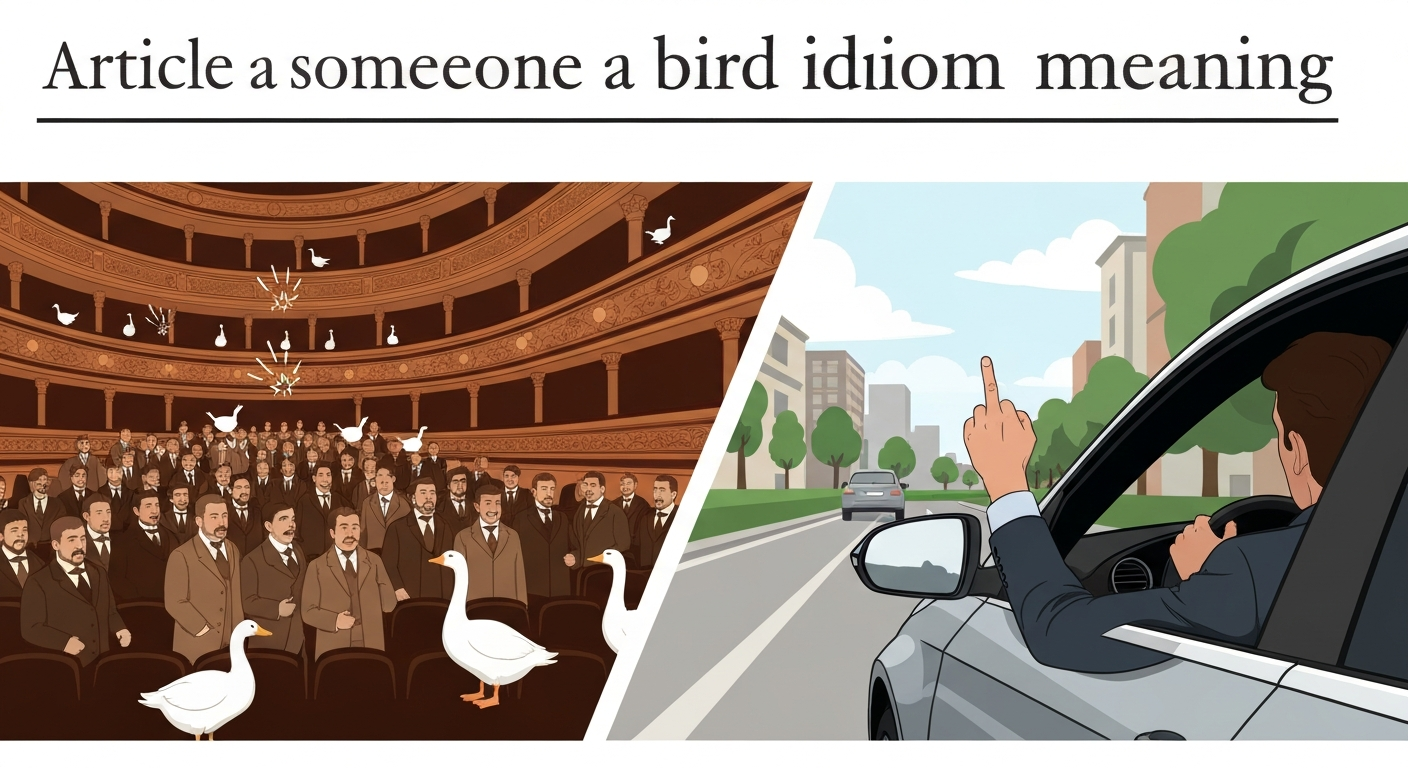
To 'give someone the bird' means one of two things depending on where you are. In American English, it almost always refers to making an obscene hand gesture, specifically raising the middle finger at someone as an expression of contempt or defiance. In British English, the phrase traditionally means to boo, hiss, or jeer someone, rooting back to a time when a bad night at the theatre ended with the audience sounding very much like an angry goose.
Give Someone the Bird, Idiom Meaning, Origin & Usage

Marcus Whitmore
26 Jul 2026
Quick definition: what 'give (someone) the bird' actually means
At its core, the idiom carries a single emotional load regardless of geography: it is a way of expressing strong disapproval, contempt, or dismissal toward someone. The delivery method is what changes across dialects. Merriam-Webster defines the American sense directly as making an obscene gesture (the raised middle finger). Collins and Oxford Learner's both document the British sense as rudely booing or telling someone to get lost, closely related to scoffing or jeering. Both senses belong to the informal register, both are deliberately rude, and both aim to humiliate or rebuff.
Two distinct senses, one phrase
It is worth unpacking each sense properly because readers sometimes conflate them, and the confusion matters if you are reading older British fiction or watching American media.
Sense 1: to boo or express public disapproval (chiefly British)
In British usage, 'giving someone the bird' means subjecting them to jeers, hisses, or hostile reception, the kind a performer dreads. This sense is theatrical in origin (more on that in the etymology section below) and still appears in British newspapers when a public figure is roundly booed. Collins glosses this as 'to tell someone rudely to depart; scoff at; hiss.' The imagery here is collective and public. You can give an entire audience the bird, or an audience can give it to you. The phrase functions naturally in the passive: 'she got the bird' meaning she was booed off stage.
Sense 2: the obscene hand gesture (chiefly North American)
In American English, the phrase refers specifically to raising the middle finger at someone, the gesture linguists classify under the Latin term 'digitus impudicus' (the shameless or indecent finger). Merriam-Webster labels this sense informal and gives the example 'He flipped them the bird.' This is a personal, one-on-one act, aimed at a specific individual rather than performed by a crowd. The gesture itself is ancient, attested in Aristophanes and Roman sources, but the English lexical label 'the bird' for it is a 20th-century American coinage. A closely related and very common variant is 'flip the bird,' which refers to the same gesture.
Grammar and the main variants you will encounter
The idiom appears in several grammatical forms, and knowing which is standard helps whether you are writing dialogue, editing copy, or just trying to decode what someone said. The most common patterns are listed below.
- give someone the bird — the most standard form in both UK and US; the definite article 'the' is typical
- give someone a bird — less standard and often heard as a mishearing or informal variant; 'a bird' does appear in speech but most dictionaries prefer 'the bird'
- get the bird — the passive/recipient form; 'he got the bird at the Edinburgh Fringe' or 'she got the bird from a passing driver'
- flip the bird — almost exclusively American; refers specifically to the middle-finger gesture
- give the bird (without specifying a person) — used when context makes the target obvious: 'she just gave the bird and walked out'
- the big bird — the historical precursor form, chiefly 19th-century British theatrical slang (see etymology below)
Note that 'give someone a bird' with the indefinite article is not wrong in casual speech, but it reads as slightly non-standard in writing. Most major dictionaries use 'the bird' and that is the safer choice if you want your prose to look intentional.
Where the phrase comes from: etymology and earliest attestations
The origin story for this idiom is genuinely odd and worth knowing because it makes the phrase much easier to remember. The 'bird' in question was originally a goose.
In 19th-century British theatrical slang, the 'big bird' or simply 'the bird' meant the goose, and the goose was shorthand for the audience hissing a performer off stage. A goose hisses when threatened, and so did an unhappy theatre crowd. W. E. Henley's 'Slang and Its Analogues' (compiled in the 1890s) explicitly records 'big bird' as theatrical vocabulary meaning to be hissed on stage, and identifies the goose as the source animal. Eric Partridge's 'Dictionary of Slang' later treated the phrase as originally theatrical and noted its gradual generalization beyond the stage door.
One of the earliest printed mentions places the phrase in the context of theatrical memoirs. Pierce Egan's writing from around 1825 and early 19th-century theatrical sources use the 'get/give the big bird' construction to describe audience derision. By the time P. G. Wodehouse wrote 'Jeeves and the Song of Songs' in 1929, the phrase had slipped comfortably into literary fiction: Tuppy 'got the bird' at a village concert, meaning he was booed and hissed by the audience. That is a clear and natural literary snapshot of the booing sense in early 20th-century British English.
The second sense, the American obscene-gesture meaning, developed separately and came to prominence in the mid-20th century. The gesture itself is ancient: classical scholars have found references in Aristophanes and Roman legal and literary sources, described as 'digitus impudicus.' But the specific English label 'the bird' for the raised middle finger is a 20th-century American coinage. The variant 'flip the bird' is attested in print by at least 1967, with a citation in the American publication 'Broadside' that year. The blank" rel="noopener noreferrer">English StackExchange discussion (compiles scholarly/lexicographic evidence; cites 1960s Broadside instance) documents a 1967 Broadside print attestation of the phrase 'flip the bird'. Secondary sources including phrase historians and Atlas Obscura's research into the idiom have noted this 1967 printed instance as a useful early anchor. Atlas Obscura, “How Humans Went From Hissing Like Geese To Flipping The Bird” (notes Broadside 1967 and 1960s usage) documents a 1967 Broadside citation and discusses the idiom's 1960s American usage blank" rel="noopener noreferrer">Atlas Obscura — “How Humans Went From Hissing Like Geese To Flipping The Bird” (notes Broadside 1967 and 1960s usage). The connection between the booing sense and the gesture sense is likely a metaphorical merger: both involve a contemptuous dismissal, both felt like the same insult in spirit even if the mechanics differ.
How the meaning shifted across regions and over time
This is one of those idioms where the same phrase genuinely means different things on different sides of the Atlantic, and the split has deepened rather than narrowed over time.
| Region | Primary sense | Typical form | Era of dominance |
|---|---|---|---|
| British English | To boo, hiss, or jeer; give a hostile reception | give/get the bird | 19th century to present |
| American English | To make the obscene middle-finger gesture | give/flip the bird | Mid-20th century to present |
| Historical (UK theatrical) | To be hissed off stage by an audience | get the big bird | Early–mid 19th century |
| General informal English | To show contempt or dismissal (either mechanism) | give someone the bird | 20th century to present |
In British English today, 'he got the bird' is still understood as being booed or rejected. In American English, the same sentence would most naturally be read as someone receiving the middle-finger gesture. Corpora like COHA (Corpus of Historical American English, covering 1810 to 2019) and Google Books N-grams show the theatrical booing sense dominating written English in the 19th century, with the gesture-related phrasing ('flip the bird,' 'gave him the bird') rising sharply in American texts from the mid-20th century onward. Other varieties of English tend to follow the British sense more closely, though American media has exported the gesture meaning widely.
Australian and New Zealand English generally understand both senses, with the British booing meaning the older and more literary usage, and the American gesture sense well understood through film and television. In South Asian and West African English contexts, the gesture meaning is recognized mainly through American cultural exports, while the theatrical booing sense is less embedded in local idiom. That said, birds carry enormous idiomatic and proverbial weight across cultures, just not always through this particular phrase.
Register and when you should think twice about using it
Both senses of this phrase are firmly informal and deliberately rude. Neither belongs in formal writing, professional communication, or any context where maintaining dignity and respect matters. The obscene-gesture sense (American) is the more explicitly offensive of the two, since it refers to a gesture that most English-speaking cultures recognize as a direct insult. The booing sense (British) is less physically explicit but still carries a sharp edge of public humiliation.
In fiction and journalism, the phrase works well when you need to convey contempt without spelling it out. Wodehouse used it with comic effect because Victorian and Edwardian readers immediately understood the theatrical humiliation it implied. In contemporary dialogue, the American gesture sense is often used for comic or dramatic emphasis. The idiom loses its punch if it feels gratuitous, so most skilled writers deploy it deliberately and sparingly.
Avoid using either sense in: formal essays or academic writing, professional emails or workplace communication, discussions with or about people who may not share the cultural reference point, and any context where you would not want the explicit meaning spelled out plainly. In spoken English, 'give someone the bird' can land as funny or hostile depending almost entirely on tone, body language, and relationship. In writing, where tone is harder to control, be deliberate.
Neutral and formal alternatives
If you want to describe the same emotional territory without the informal edge, here are some alternatives organized by which sense you are replacing.
Alternatives for the booing/disapproval sense
- to boo someone — direct, clear, and neutral
- to hiss at someone — slightly more literary, equally clear
- to jeer at someone — captures the collective scorn element well
- to receive a hostile reception — formal and appropriate for reviews or critical writing
- to be roundly rejected — useful in professional or academic contexts
- to be met with derision — formal and precise
Alternatives for the obscene-gesture sense
- to make an obscene gesture at someone — descriptive and neutral
- to raise one's middle finger at someone — literal and unambiguous
- to gesture contemptuously at someone — slightly softer and suitable for formal prose
- to show contempt for someone — abstracts the physical act into its emotional meaning
- to insult someone with a gesture — broad but clear
The phrase in action: example sentences across both senses
Seeing how a phrase actually moves through real writing is often more useful than a definition alone. Here are short examples spanning both senses and different time periods.
- When Tuppy performed at the village concert in 1929, the crowd gave him the bird before he had finished the second verse. (booing sense, after Wodehouse's 'Jeeves and the Song of Songs')
- The comedian walked off stage after the audience gave him the bird for twenty uninterrupted minutes. (booing sense, contemporary British)
- She was so furious that she rolled down the window and gave the other driver the bird without a second thought. (gesture sense, contemporary American)
- He flipped them the bird and drove off, which in hindsight probably did not help the situation. (gesture sense, colloquial American)
- The Victorian theatre crowd had a tradition: if you were bad enough, you got the big bird and never came back. (historical theatrical sense, British)
- The politician got the bird from practically every corner of the auditorium after his speech. (booing/jeering sense, British English)
- By the 1960s, 'giving someone the bird' in American slang referred unmistakably to the middle-finger gesture rather than any theatrical booing. (explanatory/historical usage)
Related bird expressions worth knowing
Bird language is remarkably rich, and 'give someone the bird' sits in a much larger ecosystem of expressions. If you have arrived here curious about bird idioms generally, a few neighboring phrases are worth a look.
The idea of someone being a 'home bird' (or 'homebird') is an interesting contrast: rather than expressing aggression or contempt outward, a home bird is someone who prefers the comfort of domestic life and feels no pull toward adventure. For more on a home bird idiom meaning, see the entry on 'home bird'. It is a gentle, affectionate idiom that treats the bird's nestlike quality as a positive trait rather than a limitation. The two expressions show how flexible bird language is: the same creature family lends vocabulary to both insults and terms of endearment.
Proverbs featuring birds tend to use the bird as a symbol of wisdom, caution, opportunity, or fate. The West African proverb associated with the character Eneke the bird ('Eneke the bird says that since men have learned to shoot without missing, he has learned to fly without perching') is a striking example of how bird imagery carries moral weight across entirely different literary traditions. The bird in that proverb is clever and adaptive rather than contemptuous, showing how different cultural contexts draw different qualities from the same animal symbol.
More broadly, 'proverbial birds' as a category cover everything from the early bird that catches the worm to the rare bird as a symbol of the exceptional individual. Birds appear so frequently in proverbial language across cultures partly because they are visible, observable creatures whose behaviors, such as migration, flight, nesting, and song, translate easily into moral or philosophical lessons.
One phrase that sometimes appears in searches alongside this idiom is 'tip of the bird,' which is not a standard idiom. It is most likely a mishearing or misremembering of 'give the bird' or possibly 'flip the bird. For more on this phrase and its usage, see tip of the bird meaning. ' If you have encountered this phrase in a specific context and are unsure of its meaning, the closest standard idioms are the ones covered in this article.
The deeper cultural logic behind using a bird as an insult
It is worth pausing to ask: why a bird at all? The theatrical goose connection makes the booing sense logical once you know it, the hiss of an audience and the hiss of a goose share a sound and a feeling. But the broader pattern of using birds in expressions of contempt, dismissal, or transgression shows up in many languages and cultures. Birds that are considered pests, that make irritating sounds, or that are associated with bad omens tend to attract negative idiomatic use, while birds associated with beauty, rarity, or freedom attract positive ones.
Gesture researchers have documented that insult gestures vary substantially by culture. What reads as deeply offensive in one culture may be meaningless or even friendly in another. The English 'bird' label for the middle-finger gesture is a specifically American English lexicalization of an ancient gesture, one attested in Greek comedy and Roman law, but the naming of it as a 'bird' is a 20th-century American coinage. That is a reminder that words and labels for gestures have their own separate histories from the gestures themselves.
Language about birds keeps proving itself to be one of the richest veins in English idiom, running from gentle affection to sharp contempt and everything between. The fact that a single phrase can mean a theatrical goose hiss in London and a raised middle finger in New York is, honestly, one of the more entertaining things about English as a living language.
FAQ
What does “give (someone) the bird” mean today?
Contemporary senses: (1) In British and other Commonwealth usage, chiefly to boo, hiss, jeer or give a hostile reception to someone (e.g., an actor or speaker). (2) In North American informal usage it often refers to making an obscene hand gesture (raising the middle finger), expressed as “flip the bird” or “give them the bird.” Dictionaries (Merriam‑Webster, Oxford) list both senses, noting the regional preference.
How did the expression develop—what is its etymology and earliest attestations?
Etymology: The booing sense comes from 19th‑century theatrical slang. Sources such as Henley’s Slang & Its Analogues and early theatrical memoirs record “the big bird”/“to get the big bird” to mean being hissed or jeered on stage; commentators link this to the goose (a ‘big bird’) and to imitative hissing. Earliest printed theatrical uses date to the early‑to‑mid 1800s (Pierce Egan and similar sources). The obscene‑gesture sense is a later lexicalization: “flip the bird” and related formulations appear in U.S. print from the mid‑20th century (examples attested by the 1960s). Scholarly and lexicographic sources (OED summaries, Oxford Learner’s, Merriam‑Webster, Partridge) summarize this timeline.
What dated citations or historical examples illustrate these senses?
Representative attestations: 19th‑century theatrical slang compendia (Henley) record “get/give the big bird” for audience hissing. Early 20th‑century literary examples show the booing sense (e.g., P. G. Wodehouse uses “got the bird” in 1929 to indicate being jeered). The obscene‑gesture phrasing (“flip the bird,” “flipped them the bird”) is attested in U.S. print by the 1960s; modern dictionaries (Merriam‑Webster) cite examples for the gesture sense.
How does meaning and tone vary regionally and historically?
Regionally: In the UK and many Commonwealth varieties, the primary sense remains ‘to boo/jeer’ and carries a hostile but non‑sexual connotation. In the U.S., informal usage often equates “give the bird” with the rude middle‑finger gesture; this usage is coarser and more directly offensive. Historically: the booing sense is older (19th century theatrical origin); the gesture sense arose and spread later (mid‑20th century onward). Always check audience and variety of English before using the idiom.
What register and tone warnings should writers and speakers heed?
Register: The booing sense is informal to neutral depending on context (e.g., theatrical review). The obscene‑gesture sense is informal and vulgar; avoid in formal writing and sensitive contexts. Tone: because of possible regional misunderstanding (UK readers may interpret booing; US readers may infer an obscene gesture), prefer a clearer verb (boo, hiss, jeer, make an obscene gesture, raise the middle finger) when precision or politeness matters.
Can you give natural example sentences for both meanings?
Booing sense (UK/commonwealth): “When the unlucky actor fluffed his lines, the crowd gave him the bird.” Gesture sense (US/informal): “After the other driver cut him off, he flipped the bird in anger.” Neutral paraphrase for clarity: “The audience booed him” / “He made an obscene gesture.” (Use the paraphrase in formal or ambiguous contexts.)
Next Article
Tip of the Bird Meaning: Literal, Idiom & Poetic Uses
Is 'tip of the bird' literal, idiomatic, poetic, or misheard? Clear meanings, examples, and context tips.