
"The early bird gets the worm" means exactly what it sounds like on the surface: if you show up early, you get the reward. More precisely, it's a proverb about the advantage of acting before everyone else. Cambridge puts it plainly: the person who acts early is more likely to get what they want. Collins frames it as an arrival problem: the person who arrives first in a place is most likely to walk away with whatever's on offer. That's the core message, and it applies to everything from job applications to sale prices to grabbing the last seat on a train.
Early Bird Gets the Worm Meaning: Proverb, Origin, Examples

Marcus Whitmore
2 Apr 2026

The plain-English meaning
Strip away the bird imagery and the proverb is saying this: early action gives you a competitive edge. If multiple people want the same thing, the one who moves first wins. That's it. The "worm" stands in for any desirable outcome: a job, a deal, a spot, an opportunity. The "bird" is you, the person who shows up before the competition.
Dictionary.com's definition reinforces this: the person who arrives first has the best chance for success. University handouts and classroom idiom guides phrase it almost identically: people who wake up early or get to places early have a better chance of achieving what they want. The word "worm" isn't glamorous, but that's partly the point. Even unglamorous rewards go to whoever shows up first.
You'll also hear "early bird" used as a standalone noun, meaning someone who wakes up or arrives early as a habit. Merriam-Webster notes this directly: "early bird" as an "early riser" is a usage that grew directly out of the proverb. When a restaurant advertises an "early bird special" for diners who come in before 6 p.m., it's borrowing the same logic: reward for arriving ahead of the crowd.
Does the bird really get the worm? Literal vs. metaphor

Here's where it gets a little fun. The proverb is almost entirely figurative, but there's a kernel of literal truth inside it. Actual birds, especially robins and thrushes, do forage for earthworms in the early morning when the soil is moist and worms are closer to the surface. So in a strict nature-documentary sense, the saying isn't wrong. An early-rising bird does have better odds of catching a worm than one that sleeps in.
But nobody quoting this proverb at a Monday morning team meeting is talking about robins. Cambridge presents the phrase as a figurative advantage statement, full stop. Cambridge also has a dedicated entry for “the early bird gets the worm” variant, reinforcing the same figurative meaning that acting early gives an advantage [Cambridge presents the phrase as a figurative advantage statement](https://dictionary. cambridge.
org/dictionary/english/early-bird-gets-the-worm1). Collins echoes that by defining it entirely through the human scenario of arriving first. The literal bird-and-worm image is a vehicle for the metaphor, not the point. If you want to go deeper on what bird imagery means in everyday English, the day bird meaning covers how "daytime" bird references tend to carry positive, active, and industrious connotations in language generally, which fits perfectly with what the early bird represents here.
So: literally true-ish, metaphorically intended. When someone says it to you, they mean the metaphor.
All the variants worth knowing
"Gets" vs. "catches" vs. "catches the prey"
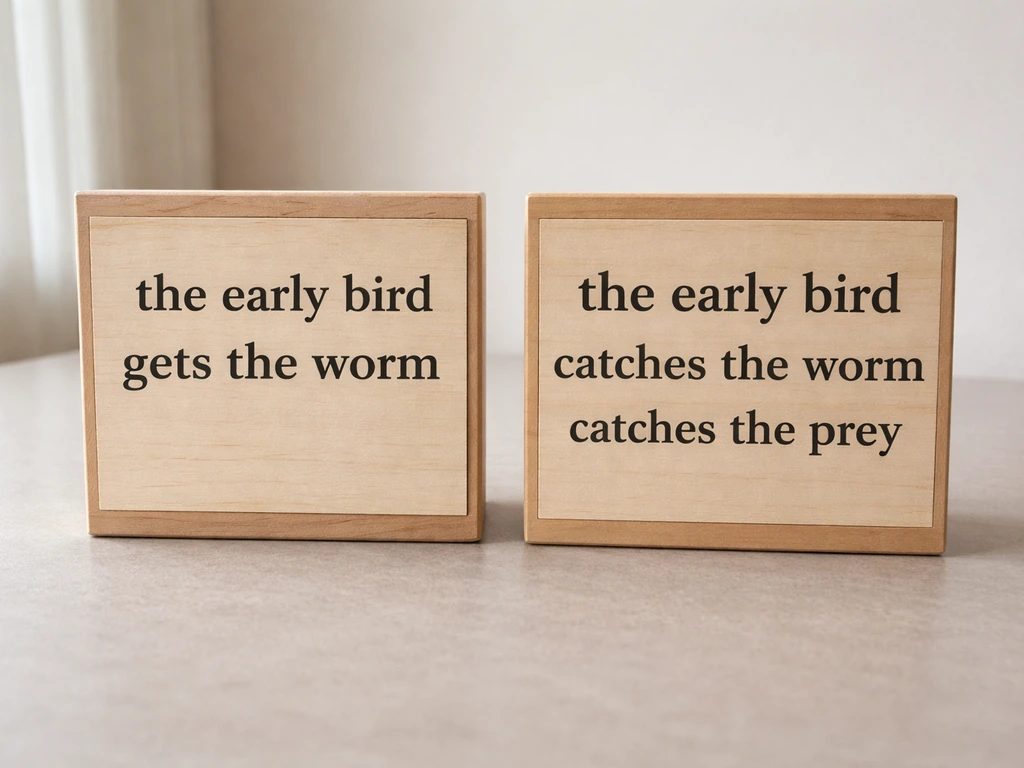
The two most common forms are "the early bird gets the worm" and "the early bird catches the worm." Both are standard and interchangeable. Dictionary.com lists both as part of the same proverb family. Collins uses "catches" as its headword. You can use either version and no one will blink. A less common variant replaces "worm" with "prey," making the predator imagery slightly more dramatic, but the meaning is identical: early action secures the reward.
"The early bird gets the worm, but the night owl..."
This is probably the most popular modern riff on the original. The full rhetorical structure usually runs something like: "The early bird gets the worm, but the night owl catches the mouse." The point is symmetry: both early risers and late-night workers can be productive, just in different windows. It shows up in workplace humor, memes, and magazine articles as a gentle pushback against the idea that morning people have a monopoly on success. If you identify as a night owl rather than an early bird, understanding that contrast is useful. The morning bird meaning digs into exactly why the morning framing carries such strong cultural weight and why that night-owl contrast resonates so widely.
The reversal: "The early worm gets the bird"
This is a deliberate wordplay flip of the original. Instead of celebrating the early bird, it warns that being the first one out in the open can make you a target. Wikipedia notes the phrase as a recognized variant, and it's been used in film titles and dark humor contexts. The joke works because it inverts the proverb's optimism: sometimes being early just means you're the easiest one to catch. Context matters a lot here. When someone says it sincerely, they're usually counseling caution about moving too fast or too visibly.
"He is an early bird" and figurative shorthand
The proverb also collapses into a simple character description. Calling someone "an early bird" means they habitually wake or arrive early. This is a common figure of speech in everyday English, and it's worth understanding as its own usage. The article on he is an early bird figurative language breaks down how this shorthand works grammatically and why it qualifies as figurative speech even when it feels like a plain statement.
How to use it in a sentence: real examples

Seeing the proverb in context is the fastest way to lock in the meaning. Here are some concrete scenarios and sample sentences across different settings:
- Job hunting: "I submitted my application the morning the posting went up. The early bird gets the worm, and that interview request came in before noon."
- Shopping: "She was at the store when it opened on Black Friday. Early bird gets the worm, and she got the last one at the sale price."
- Real estate: "They put in an offer the day the house hit the market. In this neighborhood, the early bird catches the worm."
- Fitness class booking: "Spots fill up in minutes, so I set a reminder for when registration opens. Early bird gets the worm."
- Networking event: "He arrived first, got to talk to the keynote speaker alone for ten minutes. Classic early bird situation."
- Warning someone: "If you wait until the last day to book, don't complain when it's sold out. The early bird catches the worm for a reason."
Notice that in every case, the proverb is either used as a justification after the fact ("I got there first and won") or as advice before an action ("go early if you want the reward"). You can also use it as a mild lecture when someone misses an opportunity by waiting too long.
Where the proverb comes from
The proverb's first recorded appearance in English dates to 1605. Dictionary.com puts that date on record, and BookBrowse traces it specifically to a proverbs collection compiled by William Camden, a British antiquarian and historian. Camden's 1605 collection gathered common sayings of the era, and "the early bird catches the worm" appeared among them. The American Heritage Idioms Dictionary also cites Camden's collection as the first recorded source.
That said, a recorded date isn't the same as an origin date. Proverbs almost always circulate orally long before anyone writes them down. The 1605 entry tells us the saying was already established enough to be worth collecting, not that Camden invented it. The exact origin, who coined it and when, is genuinely unclear.
This is true of most proverbs: they emerge from folk wisdom rather than individual authorship. Tilley's historical proverb scholarship shows how the saying spread well beyond literal bird-watching and became embedded in commercial language (think "early bird specials") and cultural shorthand for productivity. If you're curious about a related Australian English spin on the same idea, the early bird gets the wood on meaning covers a regional variant that follows the same structural logic.
The sexual or slang interpretation

Yes, this comes up, and it's worth addressing directly. A subset of people search for "early bird gets the worm meaning sexually," which tells you that the phrase has picked up an informal double meaning in some contexts. The sexual reading typically plays on the same metaphor of "getting" something desirable early, applied to romantic or sexual pursuit. In this reading, "worm" and "bird" carry crude slang associations, and the proverb becomes a suggestive joke about being the first to make a move on someone.
Here's how to tell which meaning is in play. The standard proverb appears in professional contexts, motivational content, classroom materials, and casual conversation about productivity and opportunity. It's the default interpretation in every major dictionary: Merriam-Webster, Dictionary.com, Cambridge, Collins. None of them flag a sexual meaning. The sexual reading lives in humor, social media banter, and intentionally double-edged comments. It relies on a knowing wink or a context that's already flirtatious or crude. If someone says it at a morning meeting about Q1 deadlines, they mean productivity. If someone says it while grinning at 2 a.m. in a bar, read the room.
The phrase "she is an early bird" follows the same interpretive fork: in most contexts it's a simple figure of speech about someone's morning habits, but tone and setting shift the meaning. The article on she is an early bird figure of speech explains how this kind of figurative shorthand works and why context is everything when a phrase has both an innocent and a loaded reading.
Standard vs. slang: a quick reference
| Feature | Standard Proverb Meaning | Sexual/Slang Interpretation |
|---|---|---|
| Core idea | Acting early gives you an advantage over others | Being the first to pursue someone romantically or sexually |
| Typical context | Work, school, shopping, networking, general advice | Humor, banter, flirtatious conversation |
| Tone | Neutral to encouraging | Knowing, suggestive, or joking |
| Dictionary-recognized? | Yes (Cambridge, Collins, Dictionary.com, Merriam-Webster) | No major dictionary flags this as a primary meaning |
| Delivery cues | Straightforward, often used as advice or explanation | Often accompanied by a smirk, ellipsis, or loaded pause |
| Safe to use at work? | Yes | No |
How to use this proverb correctly going forward
The proverb is genuinely useful in everyday English once you have the meaning locked in. Use it to justify early action you've already taken, to encourage someone who's hesitating, or to gently explain why someone missed out by waiting. The "catches" and "gets" versions are equally correct, so use whichever sounds natural to you. If you want the night-owl contrast for humor or balance, "the early bird gets the worm, but the night owl catches the mouse" is the most common structure and lands cleanly.
Avoid it in contexts where the sexual reading could be accidentally triggered: keep it out of flirtatious exchanges unless you're deliberately going for the double meaning. In professional writing, the proverb reads as motivational and slightly folksy, which works fine in blog posts, advice columns, and casual speeches but can feel cliched in formal documents.
The deeper cultural pattern behind the proverb is that English associates birds with human personality types across a surprisingly wide range of idioms. The early bird is just one entry in a much larger system where bird behavior maps onto human behavior. Once you start noticing that pattern, you'll find bird idioms everywhere in English and understand them faster.
FAQ
Does “early bird gets the worm” mean you will always win if you show up first?
Yes, but it is meant as a nudge, not a guarantee. The proverb assumes the opportunity favors speed, so if delays come from skill gaps, rules, or slow decision-makers, arriving early may not change the outcome.
In what situations does the proverb actually apply, and when is it misleading?
Use it when timing gives you information, options, or choices (first picks, first applications, first seats). Avoid it when the process is merit-based or regulated so that “first” has little or no advantage (for example, blind auditions or strictly ranked hiring steps).
What’s the best way to use the proverb in a sentence without sounding like you’re rubbing someone’s loss in?
If you are the one speaking, it typically works best as retrospective justification (“I submitted it early, so I got the slot”) or gentle advice (“Let’s start early so we have options”). If you are responding to someone else who missed out, phrase it as a lesson rather than blame.
Can “early bird gets the worm” backfire at work or in school?
It can, especially in workplace or school settings. If being early makes you look pushy, interrupts processes, or violates deadlines for others, you may create friction. Pair the “early” message with respect for procedure (for example, “Let’s get ready early, then wait for the right submission window”).
If I’m not an early riser, how can I still apply the meaning?
The proverb is about acting before others, not about waking up at dawn. You can “be an early bird” by starting your work earlier in the process, prepping ahead of deadlines, or being first to respond once the opportunity opens.
Is it okay to use this proverb in formal emails or reports?
Don’t. Use it only when the context supports a competitive “first-mover” advantage, otherwise it can sound dismissive or cliche. In more formal documents, prefer a direct, neutral phrase like “early submission increases availability” rather than the bird imagery.
How do I tell whether someone will interpret it in the sexual double-meaning way?
The sexual double meaning is context-dependent and usually triggered by flirtatious tone, intimate setting, or innuendo. In professional settings, default to the productivity meaning, but avoid repeating it in banter where ambiguity could offend or confuse.
Are the “gets/catches/prey” variations always safe to use?
Yes. Versions like “catches” vs “gets” are interchangeable, but be careful with rare substitutions such as “prey,” which can feel darker or more aggressive. Also, keep the “worm” metaphor consistent with the situation (sales, seats, roles) so it lands cleanly.
How can I apply the proverb even when success is not purely first-come-first-served?
There are two common productive readings: (1) start early to secure the best choice (first-come rewards), or (2) start early to reduce risk (more time to troubleshoot, iterate, and correct errors). The second is especially useful when “first” doesn’t literally decide the outcome.
What should I say if I’m being told the proverb after someone else already got the opportunity?
If someone already got there first, the proverb still fits, but consider flipping the lesson from “you won because you were early” to “being prepared early helps you act decisively.” That keeps it constructive instead of competitive.
Next Article
War Bird Meaning: Literal, Slang, and Historical Uses
Understand war bird meaning: literal, slang metaphor for fighters, and historical bird symbolism, plus close phrase comp