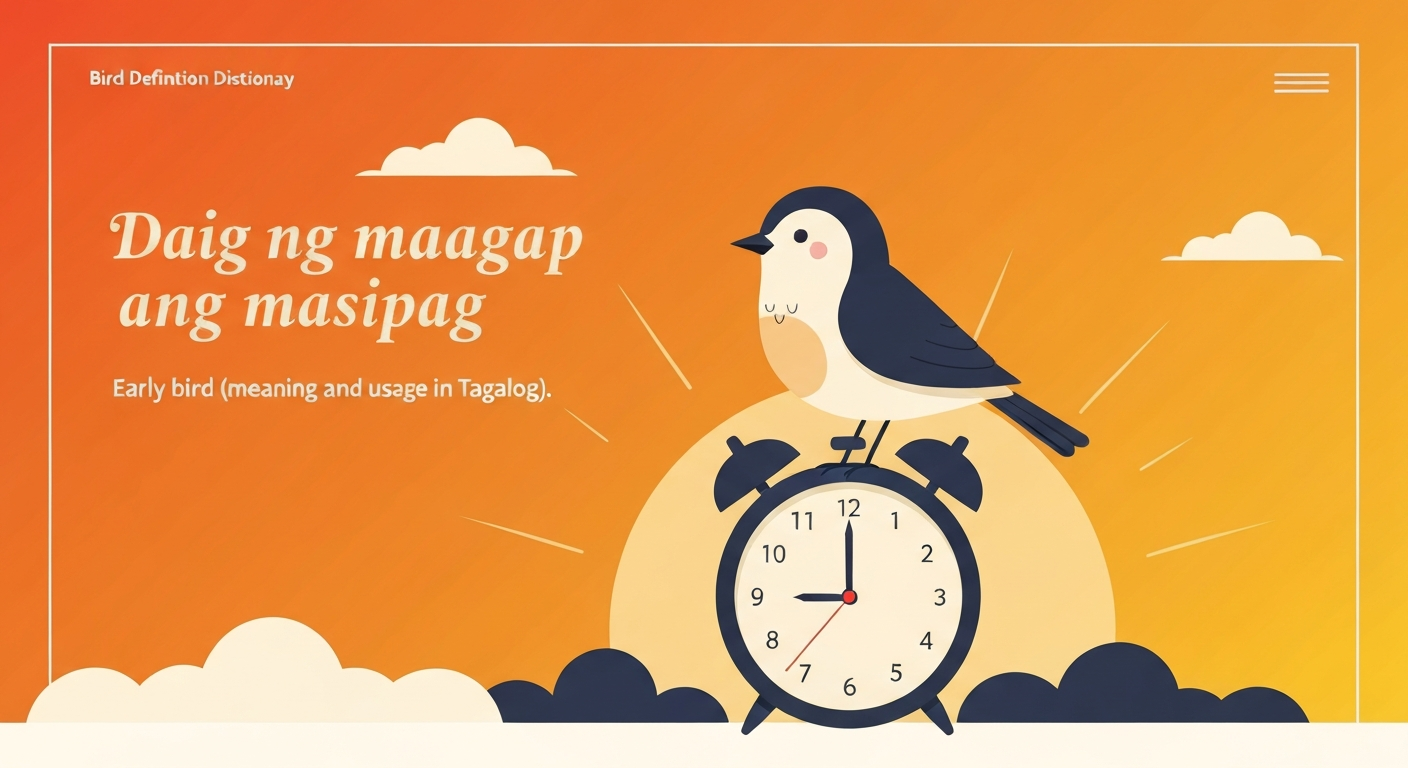
In Tagalog, 'early bird' translates literally as 'maagang ibon' (pronounced roughly mah-AH-gang EE-bon), but that phrase almost never appears in natural Filipino speech. The expression you will actually hear or read, the one that carries the same cultural weight, is the proverb 'Daig ng maagap ang masipag,' which means 'The one who acts early beats even the hardworking one.' When you see 'Early Bird' on a Philippine concert ticket or event page, the label is almost always kept in English, exactly as written, even when the rest of the copy is in Tagalog or Taglish.
Early Bird Meaning in Tagalog: Translation & Usage Guide

Marcus Whitmore
18 Jul 2026
What this article covers and who it's for
This entry is for Filipino language learners, translators, writers, and event marketers who need to understand exactly what 'early bird' means in a Tagalog context, not just the dictionary translation, but how speakers actually use it, how ticketing platforms handle it, and what compound labels like 'early bird couple' or 'early bird stag' mean when they show up on an event checkout page. I've also included pronunciation notes, a quick translation table, and sample sentences so you can put the phrase to work straight away.
Literal translation and pronunciation: 'maagang ibon'
Breaking the phrase down word by word gives you 'maagang ibon.' The root word 'maaga' means early in Tagalog (IPA: /maˈʔaɡa/, notice the glottal stop between the two a vowels, which is characteristic of Tagalog). The linked form used before a noun is 'maagang,' which works like an adjective modifying what follows. 'Ibon' means bird (IPA: /ˈʔibon/, with a glottal stop at the start). Put together, 'maagang ibon' is a perfectly grammatical Tagalog phrase, and in a translation exercise or a textbook sentence like 'Ang maagang ibon ang nakakakuha ng uod' (literally: 'The early bird is the one that catches the worm'), it reads clearly. It's just not an idiom Filipino speakers would reach for in everyday conversation.
A practical pronunciation tip: the stress in 'maaga' falls on the second syllable (ma-A-ga), and the glottal stop between the two a sounds gives it a slight catch in the throat, similar to the pause you hear in the English expression 'uh-oh.' For 'maagap' (the adjective meaning prompt or ahead of time, used in the proverb below), the stress pattern and glottal stop work the same way: ma-A-gap.
The idiomatic meaning and natural Tagalog equivalents
The English idiom 'the early bird gets the worm' is really about getting an advantage by acting before others do. Filipino has its own proverb that captures exactly this idea: 'Daig ng maagap ang masipag.' A natural English rendering of this would be 'The one who is prompt beats even the diligent one.' It's a beautiful Tagalog spin on the same thought, being early or proactive matters even more than simply working hard. This proverb appears in Philippine school curricula, opinion columns, and everyday social-media conversation, so it genuinely is the idiomatic home for the 'early bird' idea in Filipino.
If you need to translate 'early bird' as a concept rather than quoting the proverb directly, the most natural Tagalog paraphrases include 'ang taong maagang gumigising' (a person who wakes up early) for the morning-person sense, and 'ang maagang nagsimula ang nakakakuha ng pagkakataon' (the one who starts early is the one who gets the opportunity) for the advantage-seeking sense. These are longer than the English phrase, which is why most Filipino marketers and translators simply keep 'Early Bird' in English when they need a short, snappy label.
Translation variants at a glance
| Register / Use | Tagalog / Filipino Rendering | Notes |
|---|---|---|
| Literal (word-for-word) | maagang ibon | Correct grammar; used in textbooks and translation exercises |
| Literal sentence | Ang maagang ibon ang nakakakuha ng uod. | Direct Tagalog rendering of the English proverb |
| Idiomatic / cultural equivalent | Daig ng maagap ang masipag. | Standard Filipino proverb; taught in DepEd curriculum; most natural for writing or speech |
| Descriptive paraphrase | Ang taong maagang gumigising / ang maagang nagsimula | Used when describing a person or explaining the concept in context |
| Marketing / ticketing | Early Bird (English, untranslated) | Standard practice in Philippine event promotions; Taglish copy surrounds the English label |
Describing a morning person or early riser in Tagalog
When 'early bird' is used casually to describe someone who naturally wakes up or starts their day before most people, Filipino speakers reach for 'maagang gumigising' (one who wakes up early) or simply 'maaga siyang gumigising' (he or she wakes up early). In informal conversation you might hear 'maaga talagang bumabangon iyon' (that person really gets up early), which carries the same warm, slightly admiring tone the English 'early bird' has when you call a colleague one.
In Taglish, which is the everyday mixed register most urban Filipinos use, the phrase often stays in English: 'Early bird talaga siya, lagi siyang nandoon bago pa magsimula ang lahat.' (She's a real early bird, she's always there before everything even starts.) This kind of code-switching is completely natural and widely understood across the Philippines, particularly in Metro Manila and other urban centers.
- Maagang gumigising siya. — He/She wakes up early. (neutral, descriptive)
- Daig ng maagap ang masipag. — The prompt beats the hardworking. (proverb; philosophical/motivational tone)
- Early bird talaga siya. — He/She is a real early bird. (casual Taglish)
- Lagi siyang unang dumadating. — He/She always arrives first. (plain description of habit)
How 'early bird' is used in Philippine marketing and ticketing
If you have bought a concert or festival ticket in the Philippines, you have definitely seen 'Early Bird' as a ticket tier label, most likely in all caps, often with a price and a deadline. Philippine event platforms like Bandwagon and Eventbrite Philippines use 'Early Bird' (in English) as a standard ticket category name. This is true even when the rest of the event page is written in Tagalog or Taglish. The label functions more as a marketing term than as a phrase anyone feels the need to translate.
The mechanics are simple: early bird tickets are released before general admission tickets and priced lower, rewarding buyers who commit early. Event organizers in the Philippines frequently stack these tiers: 'Super Early Bird,' 'Early Bird,' 'Regular,' and 'Door Price' is a common progression. Philippine football events have used the same system, a SunStar report on a Philippine Football League match involving Cebu FC explicitly stated that 'early bird ticket rates are available until [date],' showing that the sports ticketing world uses the same language as concerts and festivals. For a football-specific example, see what does early bird mean in football.
For marketers writing Tagalog copy around an 'Early Bird' promotion, the practical approach is to keep the tier name in English and explain the benefit in Tagalog alongside it. Something like: 'Bumili na ngayon! Limitado lang ang Early Bird tickets, mas mura habang maaga!' (Buy now! Early Bird tickets are limited, cheaper while it's early!) is a natural way to do it.
What 'early bird couple,' 'early bird male,' and 'early bird stag' mean
These compound labels are standard event-ticketing categories that combine a pricing tier (Early Bird) with an entry type or group configuration. You will see them on checkout pages for concerts, parties, comedy shows, and festivals both in the Philippines and internationally.
Early Bird Couple
An 'Early Bird Couple' ticket is a discounted presale ticket sold as a bundle for two people. It's cheaper than buying two individual early bird tickets and cheaper still than two regular-price tickets. You might see it labeled 'SUPER EARLY BIRD COUPLE/DUO' on some event platforms when organizers offer an even earlier presale window. In Tagalog marketing copy, this is typically described as: 'Early Bird Couple ticket, para sa dalawang tao, mas mababang presyo kapag binili nang maaga.' (Early Bird Couple ticket, for two people, lower price when bought early.) See the early bird couple meaning entry for a focused explanation and examples.
Early Bird Male
'Early Bird Male' is a gendered ticket category used mainly for events that have separate male and female entry pricing, nightclubs, parties, and some sporting events sometimes do this. The 'male' tag simply specifies who the ticket is for. The 'early bird' part still means the discounted presale tier. In Tagalog you would explain it as: 'Early bird ticket para sa lalaki, diskwentadong presyo para sa mga lalaking bumili nang maaga.' (Early bird ticket for males, discounted price for males who buy early.) The sibling entry 'early bird male meaning' covers this category in more detail.
Early Bird Stag
'Stag' in event ticketing means solo or single entry, one person attending alone, without a partner or group package. An 'Early Bird Stag' ticket is therefore a single-person discounted presale ticket, as opposed to a couple or group bundle. The word 'stag' comes from British and Irish English event culture and is common on ticket pages for parties and nightlife events. In Tagalog copy you would write: 'Early Bird Stag ticket, para sa isang tao lamang, biniling maaga.' (Early Bird Stag ticket, for one person only, bought early.) The sibling entry 'early bird stag meaning' goes deeper into where that specific term comes from.
A quick comparison of the three ticket types
| Ticket Label | Entry Type | Who It's For | Tagalog Description |
|---|---|---|---|
| Early Bird Couple | Pair / bundle of 2 | Any two people attending together | Para sa dalawang tao; biniling maaga |
| Early Bird Male | Single / gendered | Male attendee buying at the presale price | Para sa lalaking bumili nang maaga |
| Early Bird Stag | Single / solo | One person attending alone (no partner/group rate) | Para sa isang taong pumunta nang mag-isa |
All three carry the same core 'early bird' logic: buy before the deadline, pay less. The second word just specifies the configuration of the ticket. If you are writing Tagalog promotional copy for any of these tiers, keeping the English label intact and adding a short Tagalog explanation of the benefit and deadline is the most practical and widely understood approach in the Philippine market.
FAQ
What is a search-friendly title and short description for an article about 'early bird' meaning in Tagalog?
Title: "Early Bird Meaning in Tagalog: Literal, Idiomatic & Marketing Uses" Description (≤160 chars): "Clear Tagalog translations and pronunciation for 'early bird'—literal, idiomatic, marketing/ticketing, sports uses, and sample sentences."
What is the literal Tagalog translation and pronunciation of 'early bird'?
Literal translation: "maagang ibon" Pronunciation notes: maaga /maˈʔaɡa/ (glottal stop between vowels), ibon /ˈʔibon/. Combined: "maagang ibon" (approx. /maˈʔaɡaŋ ˈʔibon/). Literal phrasing is fine for glosses or teaching but sounds marked in everyday Tagalog.
What is the idiomatic Tagalog equivalent for the proverb 'The early bird catches the worm'?
Common idiomatic/proverbial equivalent: "Daig ng maagap ang masipag." This is taught in schools and used in everyday Filipino to express the same idea (advantage to those who act promptly). It's natural and culturally established compared with a literal word-for-word rendering.
How should translators choose between literal and idiomatic renderings?
Translation strategies: (1) Literal/gloss ("maagang ibon") for explanatory/lexicographic contexts; (2) Established idiom/proverb ("Daig ng maagap ang masipag") for fluent, natural text; (3) Paraphrase ("ang unang dumating ang may kalamangan" / "ang maagang gumigising") when neither literal nor a proverb fits. Use literal when you must preserve imagery; use idiomatic for communicative fluency. (Guidance follows standard idiom-translation trade-offs.)
What are natural everyday Tagalog equivalents for describing an 'early bird' person (a morning person)?
Natural descriptions: "maagang gumigising" (one who wakes up early), "maagang nagsisimula" (one who starts early), "mahilig gumising nang maaga" or the loan/Taglish "early bird" used colloquially. For a short label: "mahilig sa umagang gising" or simply "maagang gumigising".
How is 'early bird' used in Philippine marketing and ticketing, and should it be translated?
Practice: event organizers in the Philippines commonly leave the label in English as "Early Bird" (Taglish) for presale discounts. Options for translators/marketers: (a) Keep English "Early Bird" (most common on ticket pages); (b) Tagalog explanatory subtitle: "Early Bird (diskwento para sa maagang bumili)"; (c) Full translation: "Maagang Diskwento" or "Presyo para sa Maagang Pagpapa-reserba". For clarity in local markets, hybrid Taglish labels are acceptable and widely understood.
Next Article
Early Bird Stag Meaning: Literal, Metaphor, and Slang Use
Learn early bird stag meaning: idiom and slang uses, plus how context reveals the intended metaphor or literal deer sens