
When someone uses the phrase 'early bird stag,' they almost certainly mean one of two things: an early-access or discounted ticket category specifically for solo male attendees at an event (the most common real-world usage), or a mashup of the classic 'early bird gets the worm' proverb with 'stag' used to signal a bachelor, a single man, or a men-only gathering. In most cases you'll encounter it on an event listing, a party booking page, or a social media post related to nightlife or celebrations, and it's ticket-category language, not a standalone proverb.
Early Bird Stag Meaning: Literal, Metaphor, and Slang Use

Marcus Whitmore
7 Jul 2026
What 'early bird' actually means

The proverb 'the early bird catches the worm' was first recorded in English around 1605, and it's been doing its job ever since: reminding people that starting early gives you an advantage. Cambridge defines it simply as meaning the person who arrives or acts first is most likely to succeed. By the 1800s, 'early bird' had taken on a life of its own as a standalone noun, meaning someone who gets up or shows up early. Merriam-Webster dates that standalone usage to at least 1830.
In modern usage, 'early bird' has picked up a third layer: pricing and access. 'Early-bird specials,' 'early-bird tickets,' and 'early-bird rates' are everywhere in hospitality, events, and retail. This commercial extension is so common now that when you see 'early bird' on a booking page, most readers automatically reach for the discount interpretation rather than the proverb. That shift matters a lot when you're trying to decode 'early bird stag.'
What 'stag' means in everyday language
The word 'stag' carries two main meanings that come up constantly in figurative and slang usage. First, it's an adult male deer, the image most people picture when they hear it outside a social context. Second, and far more relevant to modern conversation, 'stag' means a man attending a social event without a female partner, or it refers to the culture of men-only gatherings. Merriam-Webster captures both: the male deer and 'a man who attends a dance or party unaccompanied by a woman.'
The party-culture sense is especially strong in British and Commonwealth English. A 'stag party,' 'stag do,' or 'stag night' is what Americans call a bachelor party, a celebratory event typically held before a wedding for the groom and his male friends. Cambridge's entry for 'stag party' notes it directly as the British term for a bachelor party. But 'going stag' to any event, not just a pre-wedding party, simply means showing up alone, without a date, which is the meaning that bleeds into event ticket categories worldwide.
How the two words combine into 'early bird stag'
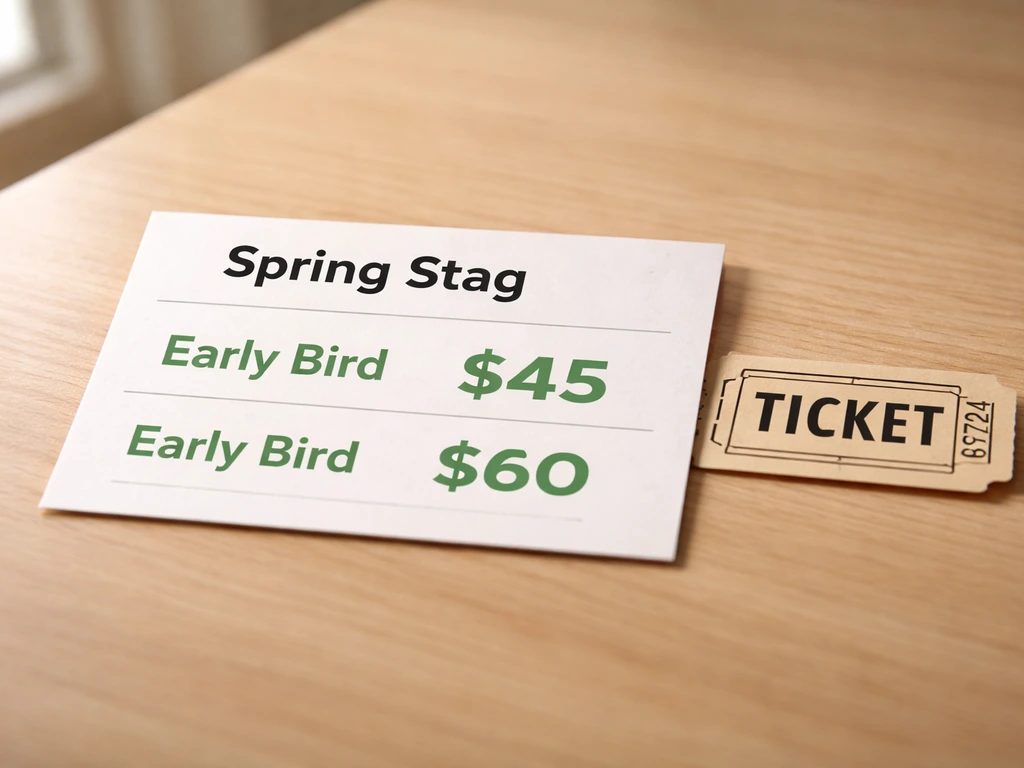
Put them together and you get a phrase that borrows the commercial meaning of 'early bird' (buy or register early, get a deal or priority access) and attaches it to 'stag' as a ticket or entry category (solo male, unaccompanied by a partner, or attending as part of a men-only group). The resulting phrase 'Early Bird Stag' functions as a labeled ticket tier on event listings and booking pages, essentially meaning: 'discounted or early-access entry for a solo male attendee.' Real event listings, including New Year's Eve parties and festival-style nights, use exactly this formatting, where ticket categories are labeled 'Early Bird Stag,' 'Stag Entry,' and 'Couple Entry - Early Bird' as separate line items.
It's also possible to read the phrase as a stylistic or playful mashup of the proverb. In that reading, someone calling themselves an 'early bird stag' is saying they are a proactive, solo (or bachelor-lifestyle) man: the guy who shows up first, acts decisively, and does it on his own terms. This reading pops up in captions, hashtags, and social media posts where the proverb angle is more prominent than a ticketing context.
There's also a niche regional usage worth knowing about. In some Filipino sports and agricultural contexts, 'early bird stag' appears in the cockfighting and poultry derby world, where 'stag' refers to a young male fighting bird and 'early bird' signals a seasonal or early-entry breeding category. If you are also looking for the Tagalog meaning of “early bird,” here is how the phrase is commonly understood in Filipino early bird stag. That usage is specific to those communities and is unlikely to be what someone means in a general social media or party context.
Most likely meanings depending on where you found it
Context is everything with a phrase like this. Here's how the meaning shifts depending on where you spotted it:
| Where you saw it | Most likely meaning | Key clue |
|---|---|---|
| Event booking page or ticket site | Early-access/discounted solo male ticket tier | Other categories like 'Couple Entry' or 'Ladies Entry' appear nearby |
| Nightlife or club promotional post | Early-bird pricing for stag (men-only/bachelor group) entry | Mentions of price, time limit, or 'book now' |
| Social media caption or hashtag | Proactive solo/bachelor-lifestyle identity ('I hustle early, I go alone') | No price info; personal tone, motivational language |
| Meme or humor post | Parody or mashup of 'early bird gets the worm' with bachelor/single-man energy | Comedic framing, relatable single-life content |
| Filipino sports/poultry context | Young male bird (stag) entered in an early-season derby | References to breeding, derbies, or cockfighting |
| Text message or group chat | Bachelor-party planning shorthand ('early bird deal for the stag do') | Adjacent messages about a wedding or 'stag do' planning |
How to confirm the meaning quickly
The fastest way to nail down which meaning is in play is to look for the surrounding words. Dictionary guidance on both 'early bird' and 'stag' points to reliable context clues. If the post or message includes words like 'entry,' 'ticket,' 'book,' 'price,' 'couple,' or 'table,' you're almost certainly looking at an event ticket category. If it includes 'bachelor,' 'stag do,' 'blank" rel="noopener noreferrer">stag party,' 'groom,' or 'lads,' it's the bachelor-party register. If it reads like motivational content, uses hashtags like #earlybird or #hustlelife, and doesn't mention an event, the proverb-plus-identity mashup reading fits better.
- Check for pricing or booking language nearby. If there's a number, a currency symbol, or a call to action like 'limited slots,' it's a ticket tier.
- Look for companion categories. 'Early Bird Stag' almost always appears alongside 'Couple,' 'Ladies,' or 'Group' ticket types on event pages.
- Read the tone. Motivational or personal captions lean toward the proverb or identity reading. Transactional language means event access.
- Search the event name plus 'early bird stag' if you're unsure. Event pages that use this label usually make all their categories visible.
- Ask directly in conversation. 'Are you talking about a ticket deal or the proverb thing?' is a completely reasonable question and will instantly clear it up.
The symbolism underneath: bird as opportunity, stag as strength
Even when 'early bird stag' is being used practically (as a ticket label), the symbolic weight of both words is part of why the combination feels intuitive and catchy rather than arbitrary. Birds in language, especially in the 'early bird gets the worm' tradition, almost always represent alertness, readiness, and the reward that comes from acting before others. The bird is up at dawn when most creatures are still asleep. That image carries genuine cultural resonance, not just as a lesson for children but as a framing device for hustle culture, entrepreneurship, and competitive preparation.
The stag carries its own symbolic weight. In folklore and heraldry, stags represent strength, masculinity, independence, and leadership. A stag is a solitary, powerful animal that stands apart from the herd. That symbolism aligns naturally with the bachelor-culture meaning of 'stag': the man who is unattached, self-sufficient, and in his own space. When the two symbols combine, the phrase does real work even beyond its practical function. An 'early bird stag' in the identity sense is someone who combines proactive discipline (the bird) with bold, independent masculinity (the stag).
It's worth noting that 'early bird' appears in a cluster of related expressions worth knowing if you dig into this further. There are distinct uses of 'early bird' when applied to couples, to specific sports contexts like football, and even interesting cross-language differences in how the proverb translates. The stag angle specifically connects 'early bird stag' to bachelor and single-man culture rather than those other uses, so if you came here from one of those neighboring meanings, the stag element is the key differentiator.
What to say or do with this information
If you're trying to interpret someone else's use of 'early bird stag,' run the context check above first. For most people reading it on an event page or nightlife post, the answer is straightforward: it's a discounted solo-male ticket tier, and you either qualify (you're attending alone or as part of a stag group) or you don't. If you’re actually wondering about the “early bird couple” meaning, it typically refers to an early-registration discount for two people attending together early bird couple meaning. If it's in a social media bio, caption, or meme, the person is probably riffing on the proverb to project an identity, early-riser energy combined with bachelor or independent-male identity, and responding to it as a personality statement rather than a literal claim makes more sense. If you're in a Filipino agricultural or cockfighting community context, the entirely different 'young male bird in an early derby' reading applies, and the other two interpretations won't fit at all.
The phrase doesn't have one locked-in meaning precisely because it's built from two idioms that each have multiple lives. Once you know the components and can read the room, 'early bird stag' stops being confusing and starts being a genuinely useful piece of language to know.
FAQ
If I buy an “Early Bird Stag” ticket, do I have to be male and attending completely solo?
Usually, yes. This tier is typically set up for solo male attendees (unaccompanied by a woman), so if the event applies a strict “stag” rule, bringing a female partner or switching to a couple ticket can change eligibility or require a different ticket type.
What if the event listing is unclear, does “stag” mean bachelor-only or any single-man entry?
Most modern “Early Bird Stag” labels are treated as a single-man or unaccompanied entry category, not necessarily a pre-wedding bachelor party. Still, some organizers use “stag” loosely, so the safest move is to check the ticket terms for “bachelor,” “groom,” or “unaccompanied” language.
Is “Early Bird Stag” ever just a joke or identity caption, not an actual ticket option?
Yes. If you see the phrase in a bio, caption, or hashtag without any words like ticket, entry, price, or booking, it is more likely a playful mashup of “early bird gets the worm” plus “stag” identity (a proactive solo man).
Can “Early Bird Stag” be used for non-nightlife events like festivals or sports?
Often, yes. Even when it is used for nightlife, organizers follow similar ticket-tier logic for other events. If the listing shows it as a line item with a category name, it is functioning as a pricing or access tier regardless of the event type.
What should I look for in the surrounding text to avoid misreading the meaning?
Scan for category markers. Words like entry, ticket, book, price, quota, or couple are strong signals of a ticket tier. Words like stag do, stag party, groom, or lads point more toward a bachelor-party registration meaning.
What if I am attending with a male group and no date, am I still eligible as “stag”?
Typically, yes for “unaccompanied” rules, because “stag” usually refers to not having a female partner. However, some events restrict the tier to “individual solo entry only,” so check whether the organizer distinguishes between “solo,” “stag group,” and “group booking.”
Is “Early Bird Stag” different from “Stag Entry” or “Stag Ticket” in practice?
Usually, the difference is timing and pricing, not the category definition. “Stag Entry” is generally the standard unaccompanied male entry, while “Early Bird Stag” is an earlier-purchase or discounted version of the same eligibility group.
Could “Early Bird Stag” be used in the Filipino cockfighting or poultry context I’m seeing online?
It is possible but uncommon in general event-ticket usage. If the post mentions cockfighting, derby, breeding categories, poultry, or young male birds, that niche reading is more likely. In typical party or festival posts, it almost always refers to solo-male ticket tiering.
How do I confirm eligibility if I’m unsure whether I qualify?
Look for fine print on the event page (refund rules, who can use the tier, whether couple rules apply). If it’s not explicit, contact the organizer with one clear question: whether “stag” requires no female companion and whether the early-bird discount depends only on purchase time or also on attendee status.
Does “early bird” always mean a discount, or can it mean priority access even without a price change?
It can mean either. Some events keep the price the same but offer earlier entry times, shorter queues, or better seating. If you need a priority benefit, check whether the listing mentions early entry time, queue access, or designated arrival windows.
Next Article
War Bird Meaning: Literal, Slang, and Historical Uses
Understand war bird meaning: literal, slang metaphor for fighters, and historical bird symbolism, plus close phrase comp