"Year of the bird" has at least three distinct meanings depending on where you encounter it: a documented conservation campaign (the 2018 Year of the Bird, coordinated by National Geographic, the National Audubon Society, the Cornell Lab of Ornithology, and BirdLife International to mark the centennial of the Migratory Bird Treaty Act), a metaphorical label people attach to any personally or culturally significant year involving birds, or a title borrowed by films, exhibitions, and local festivals. Understanding which meaning is in play usually takes no more than a line of context.
Year of the Bird Meaning: Definition, Symbolism & Uses

Marcus Whitmore
22 Jul 2026
Three quick definitions at a glance
- Literal calendar/theme year: A designated period in which birds are the central subject of organized conservation, education, or cultural programming — most prominently the 2018 Year of the Bird campaign.
- Metaphorical year of change: An informal label used by writers, birders, and social-media communities to describe a personal year shaped by bird-watching, bird symbolism, or a meaningful avian encounter.
- Event, book, or media title: An independent creative or institutional title applied to films (e.g., the 2016 short film "Year of the Bird" / 새의 해, screened at the Busan International Film Festival), gallery exhibitions, and local festival programs.
The 2018 Year of the Bird: where the phrase really took off
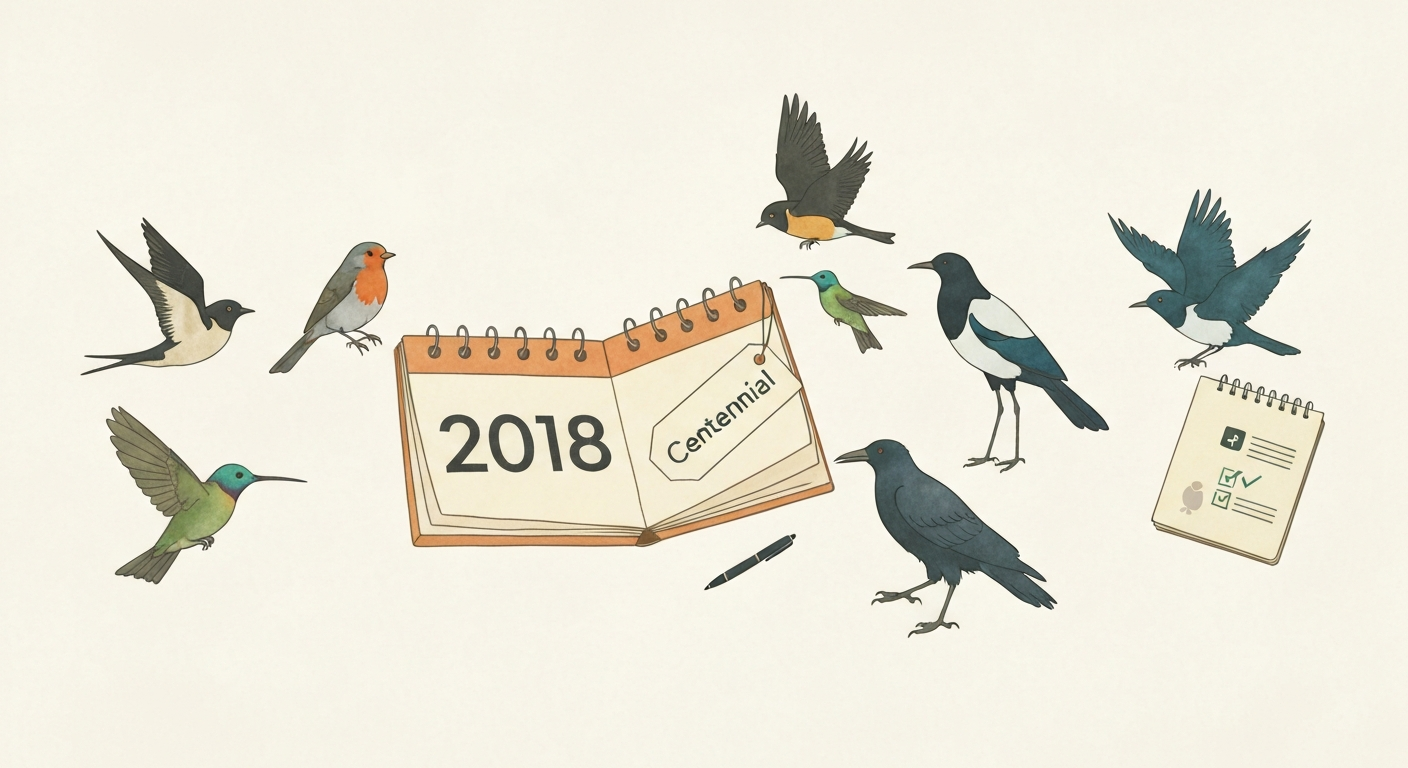
The phrase gained its clearest institutional meaning in 2018, when National Geographic announced a coordinated Year of the Bird campaign alongside the National Audubon Society, the Cornell Lab of Ornithology, and BirdLife International. The hook was historically specific: 2018 marked the 100th anniversary of the Migratory Bird Treaty Act (MBTA) of 1918, the landmark U.S. federal law that banned the unregulated killing and trade of most wild birds in North America. The campaign used that centennial as a launching point for a full calendar year of storytelling, research, and public conservation actions.
Cornell Lab documented that more than 180 organizations ultimately joined the partnership. The campaign was structured around monthly themes, each spotlighting a different conservation issue or bird group, and it actively channeled participants into citizen-science actions. One of the biggest focal events was Global Big Day through eBird, where Year of the Bird partners asked the public to go outside, record what they saw, and submit eBird lists. The result was one of the largest coordinated bird-counting efforts in the project's history at that point.
Museums, galleries, and nature centers quickly borrowed the phrase for their own programming. Wonders of Wildlife ran a Year of the Bird exhibition, Kent State University Museum organized Year of the Bird events, and regional galleries staged shows under the same title. To locate printed uses of the exact phrase “Year of the Bird” in exhibition catalogues and book titles, consult WorldCat (OCLC), library catalog for locating books, exhibition catalogues, and exact‑phrase title usage WorldCat (OCLC) — library catalog for locating books, exhibition catalogues, and exact‑phrase title usage. That secondary wave of uses shows how quickly an institutional campaign phrase can scatter into independent cultural contexts.
First bird of the year: meaning, traditions, and how it differs
"First bird of the year" is a related but quite different phrase. Where "year of the bird" describes a theme or campaign, "first bird of the year" (often abbreviated FOY in birding communities) refers to the specific species a birder sees or hears first on January 1st. It is a personal, informal tradition rather than an organized event, and it has been part of birding culture long enough to generate its own folklore. BirdNote has aired dedicated segments on the practice, including one drawn from naturalist Lyanda Haupt's writing, and Audubon has collected member stories about their FOY sightings as holiday birding traditions.
The practice is deliberately low-stakes and self-defined. Some birders count the first bird they see through a window at midnight. Others wait until they go outside. A few insist on a wild bird rather than a domestic one. Online communities, including Reddit's r/birding and r/birdwatching, see an annual surge of FOY posts every January where members share their sightings, debate the rules, and celebrate unusual or meaningful first species. The emotional weight people attach to their FOY sighting says a lot about why bird symbolism in general carries so much cultural traction: a single bird, seen at the right moment, can feel like a message.
It is worth noting that New Zealand runs a separate but thematically adjacent tradition: the Bird of the Year public election (Te Manu Rongonui o te Tau), organized annually since 2005 by the Royal Forest and Bird Protection Society (Forest & Bird). Voters choose a favorite native species, and the campaign generates significant national media coverage and conservation awareness. That is a species-popularity contest rather than a personal first-sighting ritual, but both practices share the underlying instinct to mark time and meaning through birds.
If you want to go deeper on what the first-bird tradition means and how birders observe it, the related entry on first bird of the year meaning covers the customary rules, regional variations, and what different species are thought to signal when spotted first.
Historical and cultural origins of bird-year thinking
The idea of marking a year, or a season, through a bird sighting is genuinely old. Classical and medieval sources collected in modern folklore compilations treat the first swallow of spring as a calendrical event rather than a casual observation. Seeing the swallow meant the cold was over; hearing the cuckoo set the date for planting in parts of rural England. Jeremy Mynott's Birds in the Ancient World (Oxford University Press) traces this kind of avian time-marking through Greek and Roman literary and omen traditions, showing that birds functioned as living calendars long before organized ornithology existed.
Ernest Ingersoll's Birds in Legend, Fable and Folklore (available in full on Project Gutenberg as a public-domain text) is a useful secondary source for cross-cultural bird lore. Ingersoll compiled traditions from Indigenous North American, European, and Asian sources showing consistent patterns: birds appear at thresholds (seasonal, annual, life-stage), and the species that appears first carries predictive or symbolic weight. The 1918 Migratory Bird Treaty Act itself was passed partly in response to the commercial slaughter of birds that had already driven the passenger pigeon to extinction in 1914, so the conservation campaign 100 years later was consciously invoking historical memory as well as ecological urgency.
Regional folklore and variations
Bird-year traditions look noticeably different depending on where you are in the world, though the underlying logic, birds as threshold markers, is surprisingly consistent.
| Region | Tradition or belief | Key species involved |
|---|---|---|
| British Isles / Western Europe | First cuckoo heard in spring marks the seasonal year; hearing it while facing east was considered lucky. First swallow seen was reported in local newspapers into the 19th century. | Common Cuckoo, Barn Swallow |
| Eastern Europe | The stork's spring return was treated as a marker of the new agricultural year in Poland, Germany, and neighboring countries; early return meant a good harvest. | White Stork |
| North America (Indigenous traditions) | Various nations used migratory bird arrivals as seasonal calendars; Haudenosaunee (Iroquois) traditions linked the return of specific species to planting cycles. | Various migratory species |
| New Zealand (Maori / Aotearoa) | Early 20th-century ethnographic records in the Transactions of the Royal Society of New Zealand document birds as forest omens and seasonal markers in Maori lore. | Kōkako, Tūī, Kiwi |
| East Asia (China / Japan) | The crane symbolizes longevity and auspicious beginnings in Chinese and Japanese tradition; cranes appear in New Year imagery and are associated with good fortune for the year ahead. | Red-crowned Crane |
| South Korea | The magpie (Pica serica) is a traditional symbol of good news and a fortunate omen when seen early in the morning, particularly around the Lunar New Year. | Oriental Magpie |
What individual species symbolize: a quick reference
Species-specific symbolism runs through nearly every culture's bird lore, and these meanings often bleed into how people interpret a first sighting. Here is a compact reference drawing on classical, folklore, and cross-cultural sources.
| Species | Primary symbolic associations | Cultural context |
|---|---|---|
| Robin (Erithacus rubecula / Turdus migratorius) | New beginnings, renewal, good luck | British and North American folklore; associated with spring and Christmas in the UK |
| Raven (Corvus corax) | Prophecy, intelligence, death, mystery | Norse mythology (Odin's ravens Huginn and Muninn); Indigenous Northwest Coast traditions; Edgar Allan Poe |
| Dove (Columba livia / various) | Peace, hope, purity, the Holy Spirit | Biblical tradition; widespread across Mediterranean and Western cultures |
| Swallow (Hirundo rustica) | Seasonal return, safe homecoming, spring | Classical Greek and Roman omens; sailors' tattoo tradition (safe return) |
| Owl (various) | Wisdom, death omen, transition | Ancient Greek (Athena's owl = wisdom); many Indigenous traditions link owl calls to death |
| Crane (Grus japonensis and others) | Longevity, fidelity, auspicious new year | Chinese and Japanese tradition; paper crane (origami) symbolizes healing and wishes |
| Eagle (various) | Sovereignty, power, spiritual vision | U.S. national symbol; sacred messenger in many Indigenous North American traditions |
| Hummingbird (Trochilidae family) | Joy, resilience, love, good luck | Mesoamerican traditions (Aztec god Huitzilopochtli); widespread New Age symbolism |
| Magpie (Pica pica / Pica serica) | Good fortune or misfortune (context-dependent), news | British "one for sorrow" rhyme; auspicious in Chinese and Korean tradition |
| Stork (Ciconia ciconia) | Birth, spring's return, domestic luck | European folklore; linked to baby delivery in modern popular culture |
| Wren (Troglodytes troglodytes) | Resourcefulness, humility, king of birds in some traditions | European folklore; Wren Day (St. Stephen's Day) in Ireland and Wales |
| Cuckoo (Cuculus canorus) | Seasonal marker, infidelity (in English idiom), transformation | English spring tradition of counting cuckoo calls; "cuckold" etymology |
Bird idioms and slang: literal vs. figurative
Bird language saturates everyday English to a degree most speakers don't notice until they start looking. The Oxford English Dictionary is the authoritative record for earliest attestations; Merriam-Webster and Cambridge provide accessible current definitions for the phrases below. Here is a working selection with notes on how each one actually functions in conversation.
| Expression | Literal meaning | Figurative / idiomatic meaning | Example in use |
|---|---|---|---|
| Early bird | A bird that forages or sings early in the morning | A person who wakes early or arrives before others | "She's an early bird — already at her desk by 6 a.m." |
| Early bird gets the worm | Early-rising birds find food first | Those who act promptly gain an advantage | "Sign up before Friday — early bird gets the worm." |
| Bird's-eye view | The literal perspective of a bird in flight | A broad overview from above; a high-level perspective | "The report gives a bird's-eye view of the market." |
| Free as a bird | A bird's unrestrained flight | Complete personal freedom | "After finishing exams, I felt free as a bird." |
| Bird-brained | A reference to the (incorrectly assumed) small bird brain | Foolish or scatterbrained (Merriam-Webster dates use to the 20th century) | "That was a bird-brained idea — no planning at all." |
| A little bird told me | An unnamed small bird as messenger | An unnamed or secret source provided information | "A little bird told me you're moving to Portland." |
| The bird has flown | A bird that has escaped its cage or departed | A person or opportunity has gone, often irreversibly | "We arrived at the address — but the bird had flown." |
| Kill two birds with one stone | Literally killing two birds with one throw | Accomplish two tasks with one action | "This trip will kill two birds with one stone." |
A few of these have interesting etymological wrinkles. "Bird-brained" is actually a bad-faith insult: modern neuroscience has shown that corvids and parrots in particular have cognitive abilities that rival those of mammals with much larger brains. The idiom survives because language fossilizes old assumptions. Similarly, "cuckoo" as a slang term for crazy draws on the cuckoo's distinctly odd life strategy (brood parasitism) rather than on any observed irrationality, which is its own kind of poetic logic.
How writers and marketers use "year of the bird"
The phrase is genuinely versatile as a title or campaign hook, and people working in communications, publishing, and events use it in at least four recognizable ways.
- Conservation campaigns: The 2018 model — a named year tied to a historical anniversary or policy milestone — is a replicable format. Any organization with a round-number anniversary or a threatened-species focus can structure a year-long storytelling calendar around it. The key move, as the 2018 partners demonstrated, is anchoring the year to something historically specific (the MBTA centennial) rather than floating it as a vague theme.
- Exhibition and event titling: Regional galleries, natural history museums, and nature centers borrowed "Year of the Bird" as an exhibition title throughout 2018 and beyond. The phrase works as a title because it signals scope (a full year's worth of content) and subject (birds broadly) without locking in a single species or argument.
- Personal essays and memoir: Writers use "my year of the bird" or "year of the bird" as a structuring metaphor for personal transformation narratives — the bird as witness to, or symbol of, a year-long change. This sits in the same tradition as "year of" memoir titles generally, where the named subject becomes a lens for self-examination.
- Social media and community campaigns: Birding communities on Reddit, Instagram, and dedicated platforms use the phrase to frame annual personal challenges (e.g., "my year of the bird" as a 365-day birding journal), FOY announcement posts, and species-of-the-year voting threads. New Zealand's Forest & Bird Bird of the Year election generates substantial social media activity each autumn and is a clean example of how species-centered engagement can drive conservation publicity.
One practical note for writers: the phrase is broad enough to absorb almost any angle, which means it needs a clear qualifier to do real communicative work. "2018 Year of the Bird" is historically specific. "Our gallery's Year of the Bird exhibition" is institutionally specific. "My year of the bird" is personally specific. Without that anchor, the phrase can drift into decoration.
Birding traditions around the first bird of the year
The first-bird-of-the-year tradition is informal enough that there is no single authoritative rulebook, which is partly why it has stayed alive and enjoyable. Different birding clubs and communities have their own customs, and the unwritten rules vary considerably.
- Window vs. outdoor rule: Many birders insist the FOY must be a bird seen or heard outside, not through a window from inside the house. Others count any sighting after midnight on January 1st, window or not. The debate itself is a regular feature of FOY community threads.
- Heard vs. seen: In many birding communities, hearing a species counts as much as seeing it — a robin singing before dawn is a valid FOY. This matters in regions where January light is limited.
- Domestics excluded: Most traditions implicitly or explicitly exclude domestic poultry and cage birds; the FOY is meant to be a wild species.
- Recording the sighting: Serious birders log their FOY on eBird, in paper field journals, or in dedicated notebooks. Some local Audubon chapters collect and compile members' FOY reports as part of New Year programming.
- Social sharing: Since at least the early 2010s, posting an FOY sighting on social media has become part of the tradition. The posts are often accompanied by a quick photograph, the time, and the location.
- Omens and personal meanings: BirdNote's segment drawing on Lyanda Haupt's writing touches on the emotional and quasi-superstitious weight people attach to their FOY — a crow might feel ominous, a goldfinch cheerful, a robin meaningful in a year of grief. This is entirely personal, but it connects the modern practice to the historical omen traditions described earlier.
For practical tips on recording and interpreting FOY sightings, including how to set up an eBird list specifically for a January 1st outing and what species are statistically most common as FOY birds in different regions, the first bird of the year meaning entry goes into much more detail on the birding mechanics.
Why the phrase keeps working across so many contexts
"Year of the bird" lands well as a phrase because it sits at the intersection of time (a year, a cycle, a threshold) and nature (birds as the most visible and audible wild animals most people encounter daily). That combination is genuinely ancient. From the first swallow reported in Georgian-era English newspapers to the 2018 Global Big Day eBird data, people have consistently used birds to mark, measure, and make meaning out of time. Whether you encounter the phrase in a National Geographic press release, a gallery program, or a Reddit thread about what species you saw at 12:01 a.m. on New Year's Day, the underlying instinct is the same: this bird, at this moment in the year, means something worth noting.
FAQ
What is a natural, search-oriented title for an article about “year of the bird” and a short meta description (≤160 characters)?
Title: "Year of the Bird — Meanings, Origins, and the ‘First Bird of the Year’ Tradition"; Meta description: "Clear definitions, cultural origins, birding traditions, and authoritative sources for the phrase ‘year of the bird’ and ‘first bird of the year’."
One-line definitions: What does “year of the bird” mean?
"Year of the bird" can mean (1) an organized calendar or campaign year centered on birds (literal/theme year), (2) a metaphorical year marked by bird‑related change or focus, or (3) an arts/media title that uses the phrase as a name.
One-line definition: What does “first bird of the year” mean for birders?
The "first bird of the year" (FOY) is the first bird species a birder sees or hears after the new year begins—a common informal tradition among birdwatchers.
What documented, authoritative example establishes a literal “Year of the Bird” campaign?
National Geographic, Cornell Lab of Ornithology, the National Audubon Society and BirdLife International jointly promoted 2018 as the coordinated "Year of the Bird" to mark the Migratory Bird Treaty centennial; see National Geographic press materials and Cornell/Audubon hubs for program details.
Are there independent or preexisting uses of the exact phrase “Year of the Bird”?
Yes. The exact phrase appears as exhibition and media titles (e.g., local museum exhibitions, a 2016 short film listed at Busan IFF). Library and catalog searches (WorldCat, Google Books) can verify pre‑2018 uses and titles.
What cultural or historical origins explain treating a bird (or first bird) as a seasonal omen or marker?
Ethnographic and folklore sources show many cultures use birds as seasonal markers or omens (examples: Maori forest lore and classical/medieval European references). Use scholarly works (Oxford University Press, folklore journals, digitized archives like Papers Past and Project Gutenberg) to document specific attestations.
Next Article
First Bird of the Year Meaning: What It Really Means
Learn first bird of the year meaning, how to interpret the first sighting, log it, and understand common symbolism