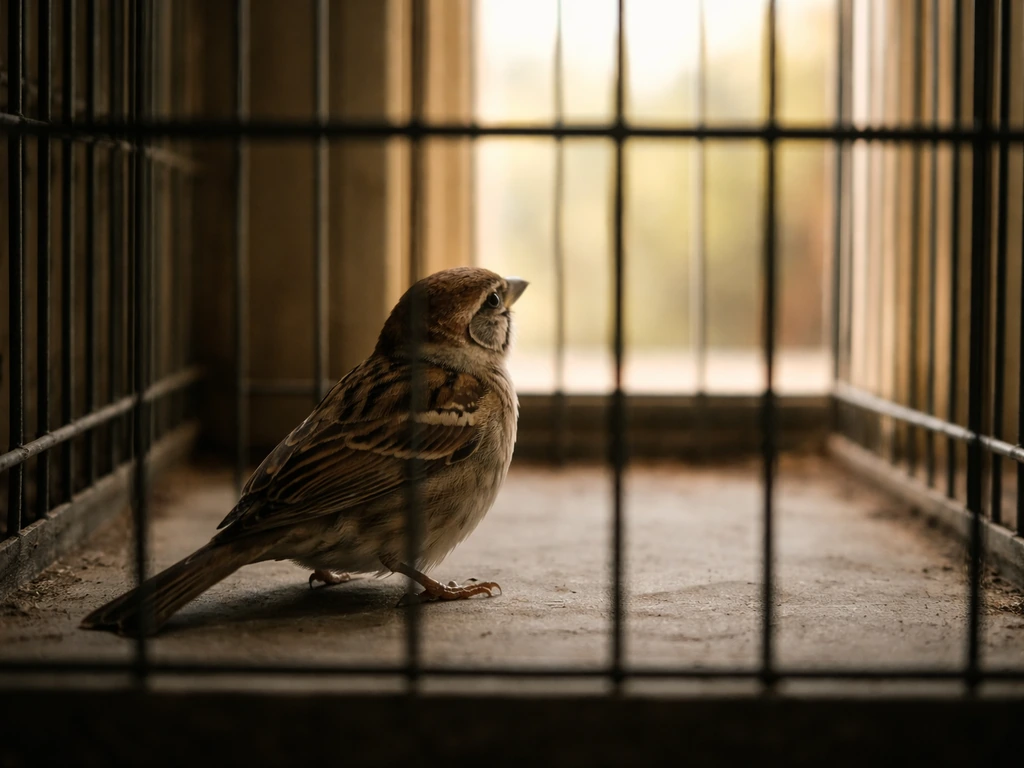
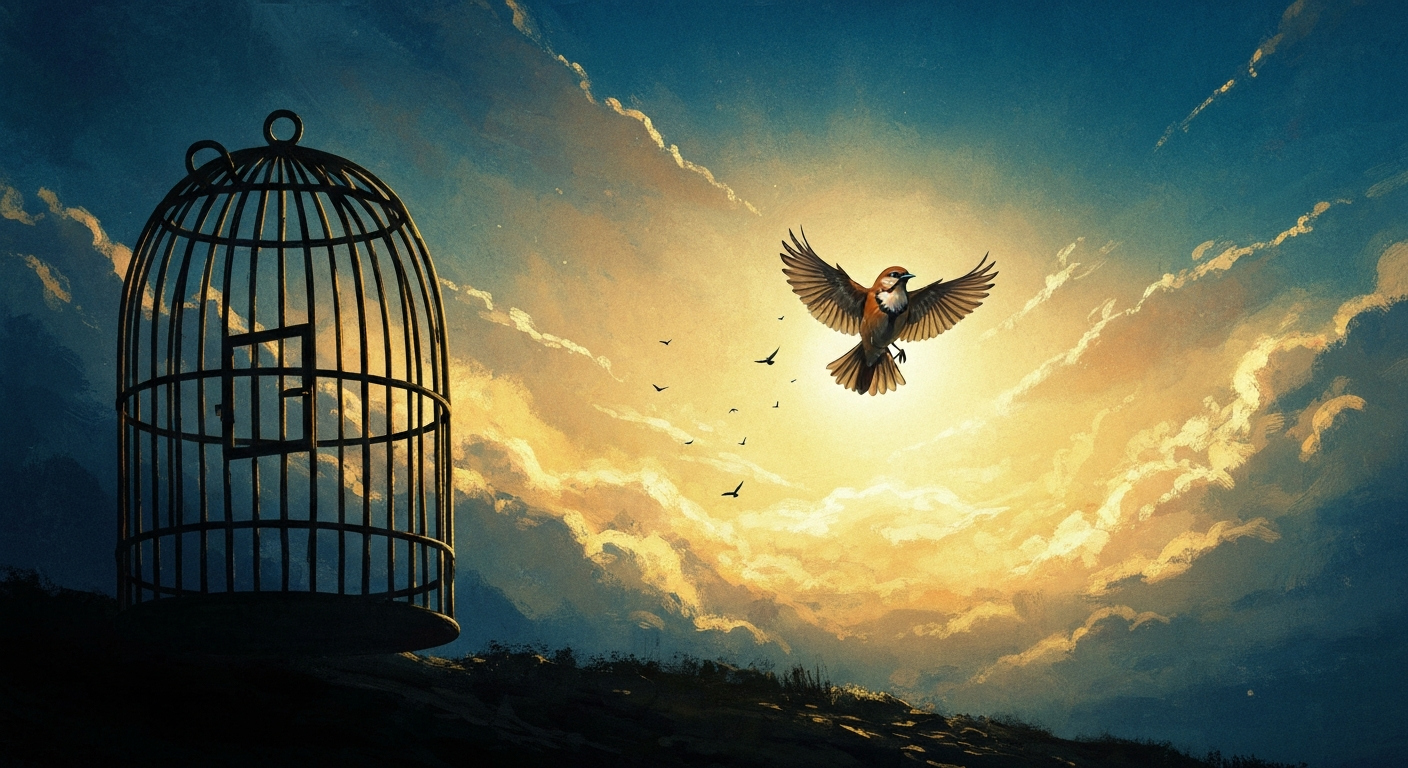
When people search for meaning through the image of a bird, they are almost always circling the same tension: freedom versus captivity. The Myths of the New World, Daniel G. Brinton (Project Gutenberg / historical comparative folklore) notes that Cross‑cultural folklore and ethnography identify recurring bird meanings: birds as sky‑world messengers/psychopomps and as omens or soul‑carriers in many traditions (e.g., Indigenous American myth collections, comparative folklore treatises describing birds as upper‑world messengers). These comparative sources show the flight/freedom association is widespread but variable in valence. (See 19th‑century compendia and folklore surveys compiled in Project Gutenberg and library archives.) The Myths of the New World — Daniel G. Brinton (Project Gutenberg / historical comparative folklore). A bird in flight is one of the most intuitive symbols humans have ever produced for the unbound self, the soul, the possibility of escape. A bird behind bars flips that meaning into something painful and precise: a life capable of flight that is being prevented from flying. That contrast, simple enough for a child to feel and rich enough for poets to spend careers unpacking, is the engine behind nearly every bird metaphor that shows up in literature, music, protest, and everyday speech.
Man's Search for Meaning: Bird as Freedom vs Captivity

What the bird motif actually means in a search for meaning
In symbolic dictionaries and Jungian readings, birds consistently appear as carriers of the soul, figures of spiritual ascent, and beneficent spirit-like presences. The core mapping is straightforward: birds occupy the sky, the domain above ordinary human life, and that spatial fact becomes a conceptual fact. Flight equals freedom, transcendence, release from earthly constraint. Captivity inverts all of that. A caged bird retains the physical form of a free creature but has been stripped of the one capacity that defines it. That is why the image hits so hard when it appears in literature or protest poetry: it is not just sad, it is categorically wrong in a way that is immediately legible.
Linguists George Lakoff and Mark Johnson argued that conceptual metaphors are not decorative flourishes but actual cognitive structures we use to think with. The domain of BIRDS and FLIGHT supplies what they would call a source domain: a concrete, embodied experience that gets mapped onto abstract targets like freedom, aspiration, oppression, and the constrained self. When Maya Angelou writes about a caged bird, she is not being poetic for its own sake. She is activating a metaphor so deeply embedded in how English speakers think that it lands with immediate force, even before the reader consciously processes the politics behind it.
Where the language comes from: roots of bird metaphors
Bird metaphors in English draw on several converging streams. The oldest and most pervasive is biblical. Matthew 6:26 invokes birds as objects of divine care ('Consider the birds of the air'), and Ecclesiastes 10:20 (KJV) gives us the line 'a bird of the air shall carry the voice,' which is the scriptural ancestor of the idiom 'a little bird told me.' That phrase is attested in English writing from at least the 18th century, and it trades on a very old idea: that birds, because they move invisibly through the air between places and people, are natural conduits for secrets and rumors. The phrase survives in casual conversation today precisely because the underlying image is so intuitive.
The 'canary in a coal mine' expression has a more industrial origin. British mines literally used canaries as biological gas detectors from the 19th century into the late 20th century, when electronic equipment finally replaced them. The canary would stop singing or die before toxic gases reached dangerous concentrations for human miners, giving workers an early warning. That very specific, documented practice is the reason the idiom means 'early warning sign' today. It is a case where a literal bird behavior, in a specific occupational context, crystallized into a durable figurative phrase.
Coleridge's 1798 poem 'The Rime of the Ancient Mariner' gave English another major bird-derived idiom. The albatross, killed by the mariner and hung around his neck as punishment and symbol of guilt, became the basis for 'an albatross around one's neck,' meaning a heavy, inescapable moral burden. This is a slightly different symbolic register from freedom and captivity: here the bird becomes a burden rather than a goal, and the weight is moral rather than physical. Harper Lee's 'To Kill a Mockingbird' (1960) works in a related but distinct vein, using the mockingbird as a symbol of innocence whose destruction is a moral failing, a duty of protection framed in avian terms.
What real birds actually do that makes the metaphor work
It is worth pausing on the literal biology, because the metaphors do not work by accident. A review (Exploring the Relationship between Brain Plasticity, Migratory Lifestyle, and Social Structure in Birds, Frontiers in Neuroscience) links migratory lifestyle and specialized orientation systems to brain plasticity and species‑specific vocal learning, helping to explain cultural associations of birds with long‑distance freedom and voice Exploring the Relationship between Brain Plasticity, Migratory Lifestyle, and Social Structure in Birds — Frontiers in Neuroscience (review). They work because bird behaviors are genuinely extraordinary and visually obvious in ways that map cleanly onto human experiences of freedom, constraint, longing, and communication.
- Flight: Birds generate lift through wing structure and aerodynamics in ways no terrestrial animal can match. The sheer physical departure from the ground, from the same surface humans are anchored to, makes flight an immediate, visceral image of escape and transcendence.
- Song: Songbirds produce complex vocalizations using a specialized vocal organ called the syrinx, and many species learn their songs through a developmental window, a fact documented extensively in neuroecology research. Song is not just noise: it is identity, territory, courtship, alarm, and in captive parrots, it is also one of the first behaviors to deteriorate under stress.
- Migration: Many birds navigate thousands of miles using magnetic field orientation and stellar cues, following migratory programs that are partly hardwired. This annual, unstoppable movement toward a different place is one reason migration functions as a metaphor for longing, seasonal change, and the pull toward somewhere else.
- Nesting: Birds invest enormous energy in building and defending nests, creating a contained safe space that then launches offspring into independence. Nesting supplies a whole separate set of idioms around home, security, and eventually departure ('empty nest').
- Flocking: The collective movement of birds in murmurations or V-formations communicates social behavior, coordinated survival, and shared purpose. Flocking feeds metaphors of community, conformity, or collective voice.
- Alarm calls: Birds produce distinct alarm vocalizations when predators are near, alerting both their own species and others. This is the behavioral root of 'sentinel' metaphors and of the canary-in-a-coal-mine idea more broadly.
Captivity disrupts nearly all of these. Konrad Lorenz's foundational work on imprinting in greylag geese showed that birds form powerful early social bonds that shape their behavior permanently. Later research on captive parrots documented feather-damaging behavior, stereotypies, and aberrant vocalizations as measurable effects of confinement. Those literal, physiological consequences of captivity are what serious literary uses of the caged bird are gesturing toward: not just sadness, but measurable damage, self-harm, and corrupted expression.
A working dictionary of bird symbolism
Because this site is, at its core, a reference resource, it helps to be precise about what each symbolic register actually means when you encounter bird imagery in text or conversation.
| Symbolic Register | What It Means in Practice | Common Vehicle |
|---|---|---|
| Freedom | The capacity to move, choose, and exist without external constraint; the soul's natural state | Bird in flight, open sky, released bird |
| Captivity | Externally imposed restriction on a being capable of freedom; the condition of oppression | Cage, clipped wings, closed window |
| Voice | The right and capacity to express oneself; song as identity and resistance | Birdsong, singing caged bird, silenced bird |
| Longing | Desire for a freedom or home that is absent; the ache of constraint felt against a remembered or imagined alternative | Migratory pull, bird looking through cage bars |
| Hope | Persistence of life force and expression despite constraint; song as insistence that things can change | Caged bird that still sings |
| Resignation | Acceptance of constraint, sometimes as survival strategy; song as endurance rather than protest | Bird that has forgotten flight, 'tamed' bird |
| Burden | A moral or emotional weight that cannot be put down; the opposite of flight | Albatross, dead bird hung around neck |
| Innocence | Harmlessness and vulnerability that creates a duty of protection in others | Mockingbird, small songbird |
The caged bird in literature: from Dunbar to Angelou
Paul Laurence Dunbar's 1899 poem 'Sympathy' is the primary literary origin for the caged bird as a symbol of racial oppression in American literature. The poem's famous closing line, 'I know why the caged bird sings,' reads the bird's song not as contentment but as pain expressed under constraint, as prayer, as the only available form of communication for a creature that cannot achieve physical freedom. Dunbar was writing immediately after Reconstruction, in a period of codifying segregation, and the poem was understood by Black readers as a direct statement about the experience of being legally, socially, and economically caged within American life.
Maya Angelou picked up Dunbar's line explicitly. Her 1969 autobiography 'I Know Why the Caged Bird Sings' borrowed his phrase as a title, signaling a conscious inheritance and continuation of the motif. Her 1983 poem 'Caged Bird' (from 'Shaker, Why Don't You Sing?') is probably the more widely read poetic treatment. The poem alternates between two birds: a free bird that 'dares to claim the sky' and a caged bird whose feet are tied and wings clipped, who 'stands on the grave of dreams' and whose song is a 'fearful trill of things unknown.' The contrast is stark and deliberately unresolved. The free bird gets the open sky; the caged bird gets a song that is both suffering and survival.
Both Dunbar and Angelou are working within a longer tradition that includes slave spirituals, protest song, and civil-rights iconography. The caged bird motif in this lineage is doing something specific: it insists on the reality of constraint (unlike narratives that minimize or deny oppression) while simultaneously asserting that the constrained self retains dignity, voice, and the capacity for expression. The song is not evidence that captivity is acceptable. It is evidence that the singing self has not been entirely destroyed. This is a fine and important distinction that readers sometimes miss.
The captive bird theme connects naturally to broader questions about names and naming in this context. Names that invoke birds, particularly caged or bound birds, carry these literary and political resonances whether their bearers consciously intend them or not.
Bird imagery in music: freedom, cages, and everything between
Music has returned to bird-as-freedom and bird-as-captivity imagery so consistently that it is almost its own subgenre. 'Blackbird' by the Beatles (1968) uses the image of a blackbird 'with broken wings learning to fly' as a direct response to the American civil rights movement, according to Paul McCartney's own statements. The broken wings and learning-to-fly framing echoes the caged bird tradition: freedom is the destination, injury and constraint are the current condition, but movement toward freedom is still happening.
Charlie Parker, the jazz saxophonist who effectively invented bebop, went by the nickname 'Bird' and was sometimes called 'Yardbird.' The nickname became so associated with freedom, virtuosity, and improvisational flight that it entered jazz vocabulary as a kind of shorthand for musical liberation. His compositions 'Ornithology' and 'Yardbird Suite' lean directly into the avian identity. In jazz culture, playing like Bird meant playing with a kind of unbounded creative freedom that the caged-bird tradition would recognize as its precise opposite.
Alicia Keys and Beyonce have both used bird-and-flight imagery in ways that draw on the feminist and racial dimensions of the caged bird tradition. Nicki Minaj's album 'Pink Friday' features bird imagery that oscillates between predator (the Roman Zolanski persona) and the caged or hunted self. Leonard Cohen's 'Bird on the Wire' (1969) takes the tension in a more existential direction: the bird on a wire is free in the sense that it is alive and choosing, but also poised between departure and staying, between commitment and escape. That ambivalence is part of why the song has lasted.
Bird and cage in pop culture: Bioshock Infinite and The Hunger Games
Bioshock Infinite (2013) makes the bird-and-cage binary one of its central organizing symbols, stamped literally onto factions, architecture, and characters throughout the game. The Founders wear a bird (the songbird, a mechanical creature that functions as warden and weapon) as their symbol; the Vox Populi wear a cage. The game's central question is which is worse: the false freedom promised by nationalist ideology (represented by the bird/Founders) or the revolutionary uprising that risks becoming as oppressive as what it replaces (represented by the cage/Vox Populi)? It is a more cynical reading of the bird-and-cage dynamic than Dunbar or Angelou offer, and it deliberately refuses to let either symbol remain purely positive or negative.
Elizabeth, the game's central character, wears a bird-and-cage brooch (the two are sometimes combined into a single pendant), making her a literal embodiment of the tension. She is both imprisoned (by Comstock, by the tower, by her power) and capable of opening tears between realities: a form of transcendence that maps onto the bird side of the equation. The game's ending, which involves multiple alternate histories, deepens this into a philosophical statement about whether any individual can truly escape the cages of history and identity.
Suzanne Collins's Hunger Games trilogy deploys the mockingjay as its central bird symbol. The mockingjay is itself a hybrid: part mockingbird, part jabberjay (a Capitol surveillance creature), making it literally a symbol of resistance repurposing the tools of oppression. Katniss becomes 'the Mockingjay,' a revolutionary symbol whose song (her whistled melody) is a rallying call for the districts. The Hunger Games mockingjay sits comfortably within the Dunbar-Angelou tradition: song as resistance, the caged self insisting on expression, voice as political act. Collins also imports the mockingbird's specific association with innocence (via Harper Lee) into a war narrative where innocence is precisely what is being destroyed.
How to read bird imagery: political, psychological, spiritual, and social angles
The bird motif is genuinely versatile, and reading it well means knowing which lens you are using. Here are the four most productive interpretive angles, each of which opens up different meanings in the same text or image.
The political reading
In the political register, the caged bird represents any group whose freedom of movement, speech, or self-determination is constrained by law, custom, or force. Dunbar and Angelou give the most historically grounded version of this: the caged bird is the enslaved person, the segregated citizen, the colonized subject. But the image travels. It appears in feminist writing as the woman confined to domestic space, in disability rights discourse as the person institutionalized against their will, and in immigration debates as the detained person or the refugee behind a fence. The power of the metaphor is that it does not need to be explained: the wrongness of caging a creature that can fly is immediately intuitive.
The psychological and existential reading
Viktor Frankl's 'Man's Search for Meaning' (1946) does not use bird imagery explicitly, but the existential framework he develops in that book maps directly onto what bird symbolism expresses. Frankl argued that human beings can endure almost any external condition if they retain a sense of inner freedom and meaning. The caged bird that still sings is, in this reading, enacting Frankl's central insight: external captivity cannot fully extinguish the inner life. The bird's song is what Frankl would call the last human freedom, the ability to choose one's attitude toward unavoidable suffering. This is also why the caged bird that stops singing, that falls silent or begins self-harming (as captive parrots literally do), reads as the complete defeat of the self: not just the body caged, but the will to exist meaningfully extinguished.
From a Jungian perspective, birds represent the psyche's capacity for ascent, for moving beyond the ego's constraints into a larger self. A caged bird in a dream or literary text would signal that this capacity is being suppressed, whether by external circumstances or by internal psychological structures, by fear, by conditioning, by what Lorenz's imprinting research would frame as bonds formed too early and too completely to easily break.
The spiritual reading
Across many traditions, birds function as messengers between the human world and a higher or other world. In Indigenous American mythologies documented in comparative folklore studies, birds are often sky-world emissaries, psychopomps, or omens whose appearance marks transitions between states. In the Judeo-Christian tradition, birds appear under divine care (Matthew 6:26) and as carriers of providential messages. In these spiritual registers, a caged bird becomes a more troubling image than it might at first appear: not just an animal confined, but a soul's messenger prevented from moving between worlds, a communication channel closed.
The social power reading
There is a reading that focuses specifically on who builds the cage and who benefits from the captivity. This is where the bird motif connects most directly to social power analysis. The canary in the coal mine is a useful example here: the canary's captivity and death serve the interests of the mine owners and the safety of the human miners, while the canary itself has no say in its role as sentinel. Its suffering is instrumentalized. The caged bird in protest poetry operates similarly: the point is not just that the bird suffers, but that someone built the cage, that the captivity serves specific interests, and that the bird's song, heard correctly, is an indictment of the cage-builder as much as an expression of the bird's inner life.
Species matter here too. Different birds carry different social valences. Canaries and songbirds accumulate captivity associations partly because they were historically kept as pets and used as industrial tools. Eagles and other raptors accumulate sovereignty and dominance associations, which is why national symbols so often favor them. Albatrosses carry burden and curse. Mockingbirds carry innocence and the duty of protection. Reading bird imagery well means being aware of which species is being invoked and what cultural freight that species carries into the text.
Species, idioms, and the bigger picture
If you are using this as a reference entry, it is worth noting how the bird-and-freedom tension connects outward to other entries on this site. The bird-and-cage pairing as a binary symbol (especially as deployed in Bioshock Infinite) has its own entry worth consulting for the iconographic history of that specific image. The captive bird as a category covers not just the literary and protest tradition but the naming traditions that encode captivity in specific words and phrases. The idea of a caged bird also shows up in naming contexts where bird names carry inherited meanings, whether or not the people bearing them are aware of that freight.
The through-line across all of these is the same: birds are the creature through which English speakers, and many other language communities, have chosen to think about freedom and its loss. That choice was not arbitrary. It was grounded in real bird behavior, in real cultural history, in real political struggle, and in real psychological need. When you encounter a bird image in a text, a song, a game, or a phrase, you are almost always encountering that tension, sometimes consciously deployed and sometimes operating below the surface of the writer's or speaker's awareness. Knowing how to read it makes the image considerably richer and more useful.
FAQ
What is the basic symbolic definition of a "bird" in human searches for meaning, especially regarding freedom vs. captivity?
Concise definition: In symbolic registers a bird typically maps two core domains—flight/freedom/transcendence (movement, soul, vision) and vulnerability/captivity (entrapment, constrained voice). Primary mapping: visible avian behaviors (flight, migration, song) supply the embodied image of freedom; observed captivity effects (caged birds, stereotypies, feather‑plucking) supply the image of imprisonment and silenced expression. Together the motif often signals an existential tension between the desire to transcend and the reality of constraint.
Why do birds repeatedly serve as metaphors for abstract ideas like freedom and the soul?
Theoretical grounding: Cognitive metaphor theory (Lakoff & Johnson) explains that people use concrete source domains like BIRDS/FLIGHT to structure abstract target domains (FREEDOM, SPIRIT, UNDERSTANDING). Ethology and neuroecology add that striking, embodied bird traits—flight mechanics, long migration, vocal learning, and visible social behaviors—make birds intuitively available as metaphors for movement, voice, navigation, and identity.
What literal bird behaviours are most often invoked by the metaphor, and how do they shape interpretation?
Key behaviours: flight (lift, aerial mobility) → transcendence, escape; migration/orientation → long‑distance freedom, direction and homecoming; song/vocal learning → voice, communication, protest; flocking → community or conformity; nesting/parental care → home, protection. Conversely, capture effects documented in ethology (feather‑plucking, stereotypies) provide literal analogues for trauma, constrained expression, and psychological harm.
How has the 'caged bird' motif been used in literature and music, and what primary texts should readers consult?
Canonical uses: Paul Laurence Dunbar's poem 'Sympathy' (origin of 'I know why the caged bird sings') reads the caged bird as symbolic of slavery and suppressed longing; Maya Angelou's 'Caged Bird' and her autobiography I Know Why the Caged Bird Sings explicitly rework Dunbar into a modern protest and resilience image. Other traditions: spirituals and protest songs use caged‑bird voice as witness. Primary texts to consult: Dunbar's 'Sympathy' and Angelou's 'Caged Bird' and I Know Why the Caged Bird Sings; pedagogical/critical essays that situate these in African American literary history.
What pop culture or gaming references explicitly use bird/cage symbolism?
Examples: Bioshock Infinite uses bird‑and‑cage motifs to explore freedom, determinism, and political control, with literal and metaphoric cages appearing across environments and narrative images. Film, TV, and music often reuse the caged bird as shorthand for constrained voice (e.g., protest music, album artwork). Use of the motif varies between literal captivity scenes and symbolic visual language that frames characters' emotional or moral confinement.
Which idioms and slang involving birds link to the freedom vs. captivity tension, and what are their origins?
Useful idioms: 'A little bird told me' (rumor‑bearing; attested from 18th–19th c., with older biblical echoes); 'canary in a coal mine' (sentinel/early warning—originates in mining practice of using canaries as gas detectors); 'an albatross around one's neck' (a burden—from Coleridge's 'Rime of the Ancient Mariner'); 'it's a sin to kill a mockingbird' (moral duty to protect innocence—Harper Lee). These idioms draw on literal uses or literary sources to encode warnings, burden, innocence, or message‑bearing.
Bird and Cage Meaning: Literal and Metaphorical Uses
Meaning of bird in a cage and its metaphor: freedom vs control, restriction vs safety, and how to interpret it by contex