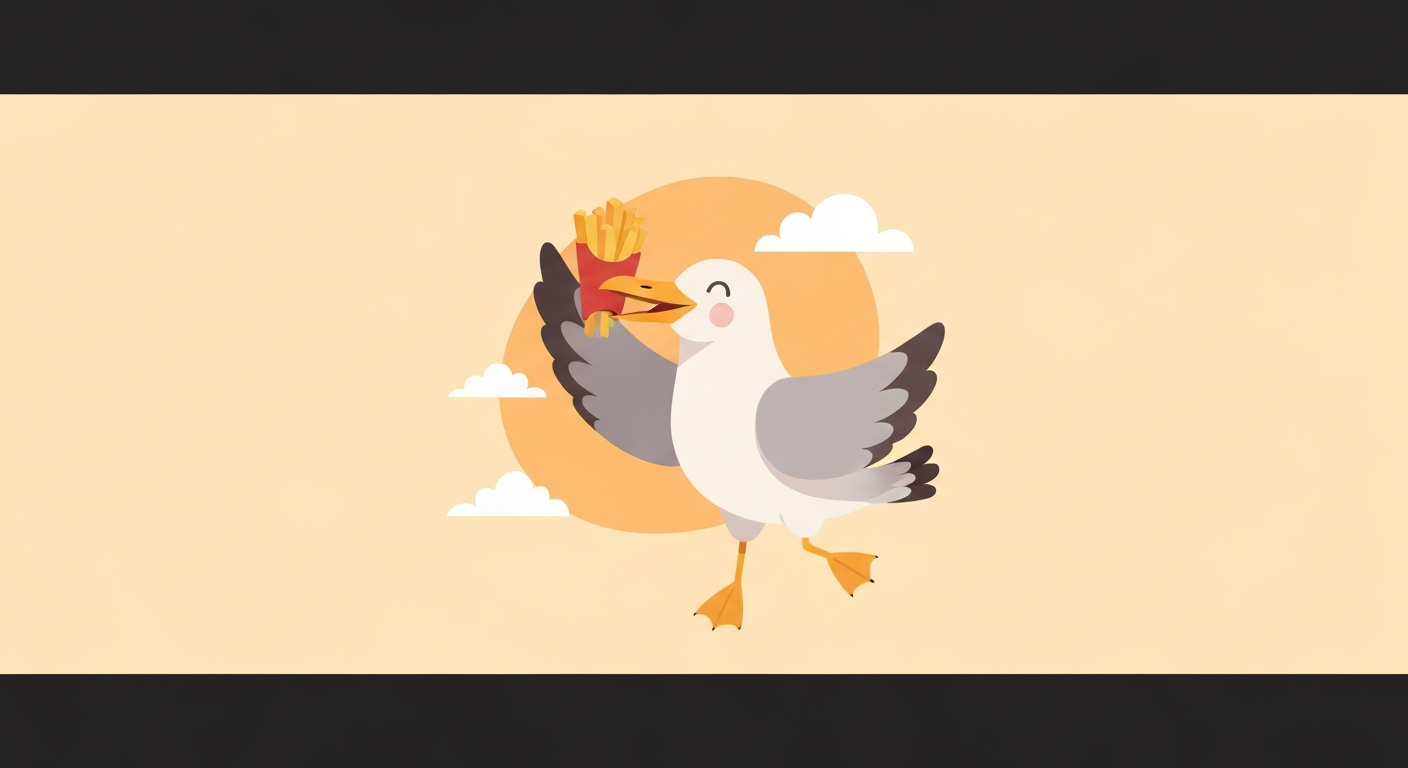
"Happier than a bird with a French fry" means extremely happy, specifically the kind of simple, uncomplicated delight that comes from getting exactly what you wanted. It is a casual English simile, used mostly in American English, to describe a state of pure contentment over something small but genuinely satisfying.
Happier Than a Bird with a French Fry Meaning Explained

Marcus Whitmore
8 Aug 2026
Dictionary-Style Definition
happier than a bird with a French fry (informal simile, chiefly U.S.): Extremely pleased or delighted, especially by a simple pleasure or small reward.
What the Phrase Would Mean If You Took It Literally
Read at face value, the phrase describes a bird, most vividly a seagull or gull, that has successfully snagged a French fry. Anyone who has spent time near a boardwalk, beach, or outdoor food court knows this is a real and vivid scene. Urban gulls of the species Larus argentatus (the herring gull) are well-documented scavengers of human fast food. Research published in the early 2020s on urban herring gull behavior confirmed they actively track human behavioral cues to locate and steal food, and chips or fries are a documented target. So the literal reading is grounded in observable reality: a bird that has just obtained a fry is, by all appearances, extremely motivated and satisfied. That concrete image is exactly what gives the simile its punch.
The Figurative Meaning and How People Actually Use It
Figuratively, the phrase is a playful, warm way of saying someone is over the moon about something, especially something uncomplicated. It carries a deliberately light tone. You would not use it to describe complex or bittersweet happiness. It is joy without nuance: enthusiastic, uncomplicated, a little goofy. That tonal quality is a big part of why the phrase shows up on home decor signs, social media captions, and coffee shop chalkboards rather than in op-eds or speeches.
In practice, people use it in a few common ways. Sometimes it describes their own mood: "I just found twenty dollars in my coat pocket. I am happier than a bird with a French fry." Sometimes it is aspirational, as in the blog post title "Today I Will Be Happier Than a Bird With a French Fry" from 2011, which framed the phrase as an intention or mantra for the day. And sometimes it appears in questions, like the early Quotev entry from January 2010: "Are you as happy as a bird with a French fry?" That question framing turns the phrase into a gentle, playful mood check.
Where the Phrase Came From (and What We Actually Know)
No single author, book, or television show has been identified as the origin of this phrase, and anyone claiming otherwise is guessing. What the trail of web evidence does show is a pattern of emergence through informal digital channels rather than through any single broadcast source.
The earliest dated instance found in open-web research is a Quotev quiz entry from January 16, 2010, which used the phrase in a casual, quiz-context question. Earliest dated instance found in open‑web research: a Quotev quiz entry from January 16, 2010 Quotev (Jan 16, 2010). By July 2011, a personal blog called OrdinaryLegacy ran it as an entire post title. By January 2012, another blogger was already referencing a Pinterest image captioned with the phrase, suggesting it had jumped from text to shareable image format very quickly. From there it spread to merchandise: retro metal wall signs sold at mass retailers like Walmart, plus Etsy and Zazzle print-on-demand listings. By the mid-2010s it was appearing in community newsletters and university publications.
The linguistic structure behind it is not new at all. English has a long tradition of "happy as" and "happier than" similes using animals and nature: "happy as a lark," "happy as a clam," "happy as a sandboy." The Cambridge Dictionary lists "happy as a lark" as a standard idiom meaning very happy. The French-fry simile plugs into that same grammatical mold but replaces the abstract or archaic image with something anyone can picture from their own weekend at the beach. That combination of familiar structure plus vivid, contemporary imagery is probably exactly why it spread so naturally on Pinterest and in casual writing.
There is also a conceptual-metaphor angle worth noting. Research in cognitive linguistics, particularly the work associated with Lakoff and Johnson's conceptual metaphor theory, points out that food and reward are deeply grounded source domains for expressing joy in many languages. When you want to convey simple pleasure, pointing to a creature successfully getting food is one of the most immediate images available. The bird-plus-fry simile is a modern, very specific instance of that universal mapping.
Close Variants and Meme-Derived Forms
The phrase has a small family of variants, each with slightly different flavor and usage. Understanding these is useful if you are writing, editing, or just trying to identify a version you spotted somewhere.
"As happy as a bird with a French fry"
This is the most grammatically standard form, following the classic "as [adjective] as" simile template. It reads cleanly in prose and is slightly softer in tone than the "happier than" version.
"Happier than a seagull with a French fry"
Swapping generic "bird" for "seagull" sharpens the visual considerably. Seagulls are the culturally iconic chip thieves, so this version feels slightly more specific and perhaps a touch funnier to anyone who has had fries stolen at the seaside. It turns up on merchandise and in social posts with about the same frequency as the generic "bird" version.
"Bird with a French fry" (standalone noun phrase)
Used on its own, without the "happy as" framing, the phrase becomes an image rather than a comparison. It appears as a photo caption, a meme label, or a description of the literal image motif. Public-domain photographs of gulls holding fries are widely shared online with this caption, and the image itself has taken on a standalone meaning of cheerful, uncomplicated pleasure, even without the full simile attached. For more on how the image functions as a symbol, see the article bird with a french fry meaning.
"Cheeseburger bird"
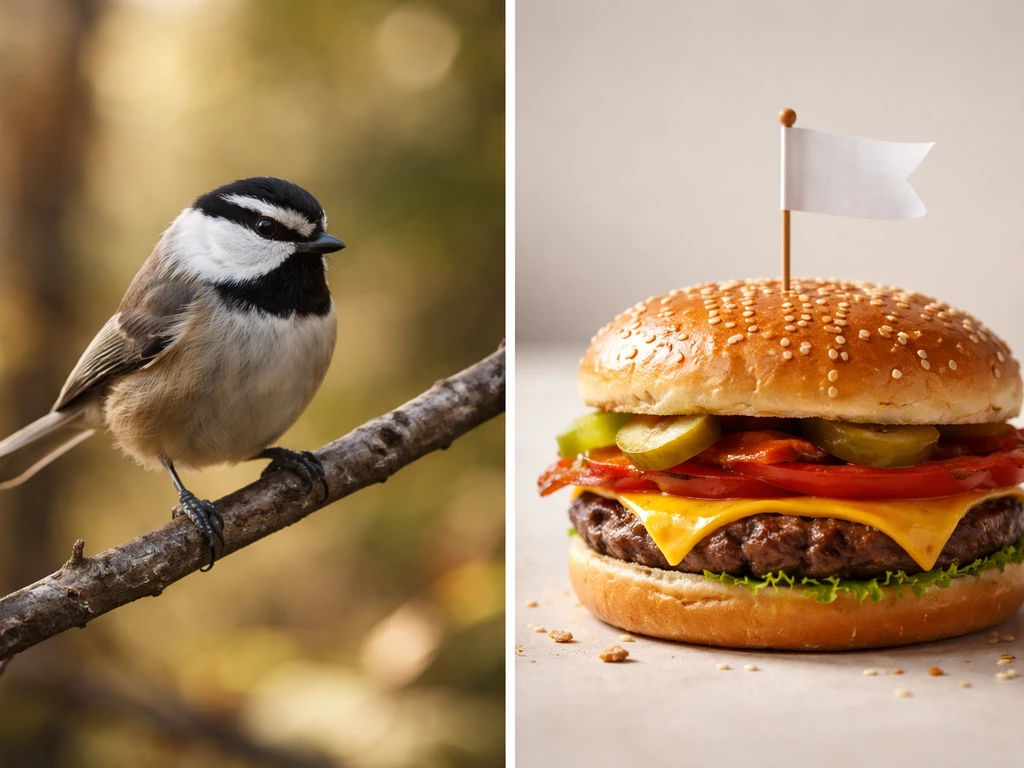
This is a related but distinct meme form. For more on the meme's origins and usage, see the article on cheeseburger bird meaning. The "cheeseburger bird" references are typically built around a specific viral photo or video of a bird (often a gull or crow) interacting with a cheeseburger. The tone is more absurdist than the French-fry phrase, and it is more specifically meme-format rather than a conversational simile. Where the French-fry phrase is something you might write in a caption or say out loud, "cheeseburger bird" lives almost entirely inside meme culture.
"Happy bird day"
A playful phonetic pun on "happy birthday," this phrase stands apart from the others because it does not describe a bird's happiness at all. See happy bird day meaning for a short explanation of that pun and how it's used. It is a wordplay greeting, the kind you write on a birthday card for a bird-lover or post as a caption for a bird photo on someone's birthday. The connection to the French-fry simile is thematic (birds, happiness, lighthearted tone) rather than linguistic.
Variants at a Glance
| Variant | Typical Tone | Common Context | Note on Meme Usage |
|---|---|---|---|
| happier than a bird with a French fry | Warm, playful, upbeat | Personal blogs, social captions, signage, casual speech | Core meme phrase; appears on merchandise and Pinterest images widely from ~2011 |
| as happy as a bird with a French fry | Slightly softer, classic simile feel | Writing, teaching examples, list posts about similes | Same image, gentler grammatical form; used in educational simile lists |
| happier than a seagull with a French fry | Slightly funnier, more specific | Beach/coastal contexts, social posts, merchandise | Seagull specificity sharpens the image; interchangeable with "bird" version in practice |
| bird with a French fry (standalone) | Visual, caption-style | Photo captions, image memes, stock photo titles | Functions as a standalone image label; the photo motif carries the meaning without the full simile |
| cheeseburger bird | Absurdist, internet-humor | Meme culture, image macros, online forums | More meme-specific than conversational; rarely used as a spoken simile |
| happy bird day | Punny, celebratory | Birthday greetings, bird-lover cards, social posts | Phonetic pun on "happy birthday"; not a happiness simile, but shares the birds-plus-joy theme |
How This Phrase Fits With Similar Expressions
The phrase sits within a cluster of bird-and-happiness idioms that are worth understanding as a group, because they overlap in meaning but diverge in tone, register, and cultural weight.
"Happy as a bird" is the broadest and most generic of the group. It simply uses birds as a symbol of natural, free-spirited contentment, the way birds in flight have represented freedom and lightness across dozens of cultures. It is older, more literary, and carries a quiet, wistful quality that the French-fry version deliberately does not. Where "happy as a bird" might suit a poem or a gentle personal essay, "happier than a bird with a French fry" is firmly in casual-funny territory.
"Bird of happiness" operates on a completely different register again. That phrase points to a rich symbolic tradition, including the bluebird of happiness from Maeterlinck's 1908 play, the Firebird of Slavic folklore, and the Chinese happiness bird. It is metaphorical and often mythological rather than colloquial. The French-fry phrase has no real overlap with this symbolic tradition; the only common thread is that both involve birds and positive emotion.
The classic English idiom "happy as a lark" is probably the closest structural ancestor. Like the French-fry phrase, it is a nature-based simile for uncomplicated joy. But "happy as a lark" is well over a century old and reads as slightly elevated or old-fashioned today, which is part of why the French-fry version has found such easy traction on social media. It does the same emotional work but with an image anyone who has been near a boardwalk concession stand can picture instantly.
One way to think about the whole family is as a spectrum from the mythological (bird of happiness) to the literary (happy as a lark, happy as a bird) to the contemporary and internet-native (happier than a bird with a French fry, cheeseburger bird). The French-fry phrase lands at the very informal end of that spectrum, and that position is exactly its strength. It communicates joy without any pretension, using an image that is funny precisely because it is so ordinary and specific.
Tone, Register, and When to Use It
The web evidence is pretty consistent on register. Every documented context for this phrase, from personal blogs to Pinterest images, university newsletter signs, Reddit posts, and Walmart wall art, is informal. This is not a phrase for a cover letter, a news article, or any context where you want to sound measured and professional. It is a phrase for social media captions, casual personal essays, birthday messages to bird-loving friends, home decor, and light-hearted conversation.
If you are writing and want the playful simile without the slang feel, "as happy as a lark" or simply "delighted" will land better in formal contexts. But if you want warmth, humor, and a visual that makes people smile, the bird-with-a-fry image earns its place in any casual piece.
- Social media captions for good-news posts
- Casual blog writing and personal essays
- Greetings cards and home decor copy
- Coffee shop signage and chalkboard quotes
- Light feature writing with a conversational voice
- Teaching examples of modern English similes
Why the Image Works So Well
It is worth pausing on why a bird stealing a fry became an idiom for joy rather than, say, a dog with a bone or a cat with a mouse. Part of it is the visual absurdity: a gull clutching a single French fry is a comically oversized reaction image. The bird looks completely triumphant over something objectively small and a bit greasy. That gap between the bird's evident delight and the modesty of the reward is what makes the image funny and relatable. Most human happiness is like that, big emotional responses to small, specific pleasures.
The ethology also helps. Seagulls stealing fries is not just a casual observation; it is a well-documented behavior. Research on urban herring gulls has shown they actively use human behavioral cues to locate food, and fries are a prime target. National Geographic has covered the topic directly. So when you picture the bird in this simile, you are picturing an animal at the apex of its scavenging success, which layers the image with a kind of triumphant competence on top of the simple joy.
FAQ
Title and meta description for SEO
Title: "Happier Than a Bird With a French Fry — Meaning, Origin, Variants, and Usage" Meta description (≤160 chars): "Informal simile meaning extremely pleased; origins in 2010s web culture, variants, examples, and style guidance for speech, writing, and captions."
Concise dictionary-style definition
Happier than a bird with a French fry (informal simile): Extremely happy or delighted, especially by a small, simple pleasure. Usage label: informal, jocular; chiefly used in Anglophone social media, signage, and everyday speech.
Literal vs. figurative readings
Literal: A bird (often a gull) that has obtained and is eating a French fry—an actual, observable scene. Figurative: A person who is very pleased or content, using the bird+food image as a light-hearted metaphor for simple delight. The figurative use maps the concrete reward (food) onto an emotional state (joy).
Evidence-based notes on origin and likely explanation
Earliest located web traces: a dated Quotev item (Jan 16, 2010) and multiple blog posts from 2011–2013. The phrase appears to have spread via blogs, Pinterest-style images, and social media rather than a single authored source. Likely explanation: A memetic simile built from two readable facts—(1) gulls and other urban birds frequently scavenge human food (notably fries), and (2) food-as-reward is a common, effective metaphor for pleasure. Caveat: No single authoritative originator has been documented; claims of an exact creator should be avoided.
How the simile relates to older expressions
Pattern: Follows traditional English simile templates like "happy as a lark" or "happy as a clam," where an animal image denotes high happiness. Relationship: It is a playful, contemporary instantiation using modern urban wildlife behaviour and fast-food imagery; functionally synonymous with other animal-based similes but jokier and more visual.
Variants, close forms, and meme-derived types (with small comparison table)
Common variants found online: "as happy as a bird with a french fry," "happier than a seagull with a French fry," "happy as a gull with a fry," plus meme spins such as "bird with a french fry," "cheeseburger bird," and "happy bird day." Small comparison table (text): Variant | Typical swap --------------------------- happier than a bird with a french fry | base modern US phrasing as happy as a bird with a french fry | 'as'↔'than' grammatical variant happier than a seagull with a French fry | 'bird'→'seagull/gull' (more specific) happy as a gull with a fry | 'French fry'→'fry' / regional 'chip' (US vs UK) "cheeseburger bird" / "happy bird day" | humorous meme-derived riffs, image-led Note: Spelling/ capitalization varies widely in casual contexts.
Next Article
Cheeseburger Bird Meaning: How to Decode the Slang or Bird
Decode cheeseburger bird meaning: slang, memes, or a real bird, plus how to identify context fast.