When someone brings up "the birds and the bees" in a relationship conversation, they're almost always reaching for a euphemism for sex, reproduction, and intimacy. It's a shorthand phrase people use to refer to "the talk", that conversation about how bodies work, where babies come from, attraction, and the mechanics and feelings behind sexual relationships. Depending on context, it could mean a parent preparing to explain sex to a child, a partner wanting to revisit expectations around intimacy, or someone using gentle humor to open a conversation they find a little awkward.
What Does Bird and Bees Mean in a Relationship?

Marcus Whitmore
29 May 2026

Where the phrase actually comes from

The origin of "the birds and the bees" isn't as tidy as most people assume. One of the most commonly cited early sources is Samuel Taylor Coleridge's 1825 poem "Work Without Hope," which uses images of birds and bees in a spring context full of natural fertility and growth. That imagery, birds laying eggs, bees pollinating flowers, became a kind of coded shorthand for reproduction in nature, and from there it was a short leap to using it as a gentle, non-threatening way to explain human sexuality.
By the 20th century, the phrase had settled into everyday English as a recognized euphemism. Parents, educators, and doctors used it to describe the foundational sex-education conversation with children: explaining reproduction, bodies, and relationships using natural analogies that felt safer than clinical or explicit language. Merriam-Webster now lists it straightforwardly as an idiomatic phrase meaning facts about sex and reproduction, particularly as explained to a child. The phrase stuck because it was low-stakes, familiar, and just vague enough to let everyone feel comfortable saying it out loud.
It's worth noting that bird-related language has a rich history of carrying layered meanings. The way "birds and bees" evolved into a cultural code for sexual knowledge fits a broader pattern where birds in particular appear in idioms and phrases that touch on desire, communication, and intimacy, something that shows up across poetry, slang, and folklore in ways that are still very much alive in modern speech. Some idioms use animal imagery, such as the snake and bird meaning, to hint at deeper messages about desire, communication, or transformation birds in particular appear in idioms and phrases.
What it actually means today (and it's not always the same thing)
In its most classic use, "the birds and the bees" means a structured, educational conversation about sex and reproduction, the kind a parent has with a child or teenager. But in relationship conversations between adults, the phrase tends to carry a broader meaning. It can be a playful way of signaling that you want to talk about intimacy or sexual expectations without making it feel like a heavy confrontation. It can also be a deflection, someone using humor to avoid saying something more directly.
There's a meaningful difference between "the birds and the bees" as sex education and "the birds and the bees" as a relationship intimacy conversation. The first is about information: how bodies work, what reproduction involves, what consent means at a foundational level. The second is about connection: what you want, what your partner wants, what feels right, and how you both talk about it. Modern health organizations like Johns Hopkins Medicine and the WHO describe the "birds and the bees" concept not as a single one-time lecture but as an ongoing, evolving conversation, one that grows more nuanced as people age and relationships deepen.
| Context | What it usually means | Tone to expect |
|---|---|---|
| Parent talking to a child or teen | Explaining reproduction, puberty, and safe sex basics | Educational, age-appropriate, informational |
| Partners early in a relationship | Opening a conversation about intimacy, expectations, or compatibility | Exploratory, sometimes playful or nervous |
| Long-term couples | Revisiting desires, preferences, or communication gaps around sex | Honest, vulnerable, practical |
| Someone using it as a deflection | Avoiding a more direct conversation about a real problem | Deflective, sometimes sarcastic or avoidant |
When and how to bring it up in a relationship

Timing matters more than most people realize. The phrase tends to land well when both people are relaxed, not right after an argument or in the middle of a charged moment. If you want to use it as a soft opener, something like "Can we have a birds and bees conversation?" signals that you want to talk about intimacy without immediately escalating the emotional weight of the conversation. That framing gives the other person a moment to mentally prepare instead of feeling ambushed.
If you're a parent preparing to talk to a teen, the Gottman Institute's guidance on intimate communication emphasizes building safety first, making it clear there are no wrong questions and no judgment. The same principle applies when one adult partner is bringing this up with another. You want the conversation to feel like an invitation, not an interrogation or a performance review.
- Choose a neutral, private setting where neither person feels rushed or cornered
- Lead with curiosity rather than a list of complaints or demands
- Use "I feel" and "I'd like" language rather than "you never" or "you always"
- Make it clear the conversation can pause and continue later — it doesn't need to resolve everything in one sitting
- Acknowledge that it might feel awkward, and that's okay
Red flags and ways the conversation can go wrong
One of the most common misuses of the phrase is as a deflection tool. If someone brings up "the birds and the bees" with a dismissive laugh every time you try to talk about intimacy seriously, that's worth paying attention to. It can be a way of keeping the conversation at arm's length, making real feelings seem silly or overly serious. This kind of avoidance is one of the patterns the Gottman Institute identifies as a warning sign in relationship communication, specifically stonewalling, where one partner shuts down instead of engaging.
Another red flag is when someone uses the phrase in a way that pressures rather than opens. If "let's talk about the birds and the bees" is actually code for pushing a partner toward a sexual situation they haven't clearly agreed to, that's not a conversation opener, that's coercion. Consent, as defined by organizations like RAINN and Planned Parenthood, has to be freely given without pressure, manipulation, or implied obligation. A genuine birds-and-bees conversation creates space for "yes," "no," and "let's keep talking" equally.
- Using the phrase sarcastically to shut down a partner's concerns
- Framing intimacy as a topic that shouldn't need discussion ("you should already know this")
- Bringing it up only when you want something, not as a genuine two-way exchange
- Using humor about the phrase to avoid taking a partner's feelings seriously
- Repeating the conversation in a way that pressures or guilts the other person
How to have a healthy birds and bees talk: step by step

Whether this is a parent talking to a teenager or two adults checking in on their relationship, the structure of a healthy conversation looks pretty similar. CDC emphasizes that a quality sexual health education curriculum should be medically accurate and developmentally appropriate. The goal is safety and honesty, not a performance of having the "right" answers.
- Set the stage: Tell the other person in advance that you'd like to have this kind of conversation — don't drop it on them mid-argument or right before bed
- Start broad: Open with something low-pressure, like asking how they feel about the topic in general, rather than leading with a specific ask or problem
- Share your own perspective first: Talk about what you feel, what you want to understand better, or what feels unclear to you — this reduces defensiveness
- Ask open questions: "What do you think?" and "How does that feel to you?" invite real responses rather than yes/no answers
- Name the awkwardness: If it feels weird, say so — "This is a little hard to talk about but I think it matters" normalizes the discomfort without letting it derail everything
- Cover consent and boundaries explicitly: Make sure both people are clear on what they're comfortable with and what they're not — including the ability to change their mind
- Agree on next steps: End with something concrete, even if it's just "let's keep talking about this" — open conversations need a clear handoff, not a vague fade
Adjusting your approach by context and audience
Talking to teens and young adults
Medical institutions including Johns Hopkins Medicine and the WHO are consistent on this: the birds-and-bees conversation with young people works best when it's treated as ongoing rather than a single dramatic talk. Starting early with age-appropriate information about bodies, emotions, and respect builds a foundation so that by the time more explicit conversations are needed, they don't feel shocking. The WHO's framework for comprehensive sexuality education emphasizes that even young children can learn concepts like consent and bodily autonomy long before sexual activity is part of their lives. Tone matters enormously here, curiosity and openness work far better than scripts and formality.
Talking with a current partner
With an adult partner, the birds-and-bees conversation is less about information and more about connection. The Gottman Institute's work on sensual communication describes the ability to put words to desire and preferences as a key part of relationship intimacy and satisfaction. That doesn't mean every couple needs a formal check-in about sex, but it does mean that avoiding the topic entirely tends to create distance over time. If a partner uses the phrase playfully, treat it as an actual opening, ask what they mean by it, what they want to talk about, and what they want to know.
Long-term couples revisiting intimacy
For couples who have been together for years, a birds-and-bees conversation can be a way of pressing the reset button on intimacy communication. People change. What felt comfortable or exciting five years ago may not be the same today, and that's completely normal. Bringing it up doesn't imply something is wrong, it's more like a check-in. Framing it as "I'd love to talk about what feels good for both of us lately" is far less loaded than implying there's a problem to fix.
Handling the awkward parts: consent, boundaries, and what to do when it stalls
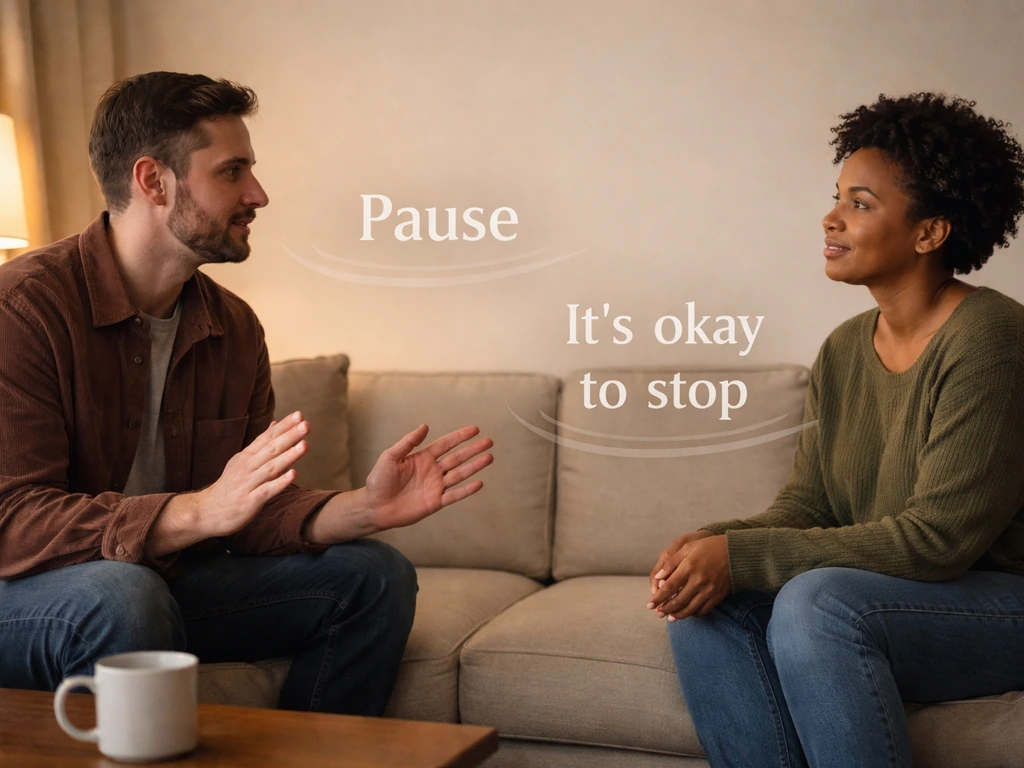
Awkwardness is almost guaranteed the first time this kind of conversation comes up, and that's not a sign it's going badly. It's a sign that something real and vulnerable is being touched. The important thing is not to let the discomfort become a reason to shut it down. RAINN's consent guidance frames boundary-setting as an ongoing conversation where both people feel safe and heard, that means being able to pause, reconsider, and return to the topic rather than feeling pressured to resolve everything in one go.
On consent specifically: if you're having a birds-and-bees conversation that involves any kind of sexual decision-making, make sure both people are agreeing freely. blank" rel="noopener noreferrer">Consent isn't valid if someone is being pressured, manipulated, or if they feel they can't say no without consequences. Planned Parenthood's guidance is direct, if you're not sure whether someone is comfortable, ask. If you have heard the slang phrase "shagging me bird," the meaning is usually a cheeky, sexual reference to a partner. If they don't say yes, stop. That applies whether you're sixteen or forty-six.
If the conversation stalls or turns into defensiveness or contempt (dismissing the other person's concerns as silly or dramatic), that's a signal to pause and try again later rather than push through. According to Gottman research, those communication patterns, contempt, defensiveness, stonewalling, are more corrosive to relationships than the original topic ever would be. A birds-and-bees conversation that gets stuck in those dynamics isn't really a birds-and-bees conversation anymore. It might be worth naming that and agreeing to come back to it with a cleaner slate.
If awkwardness comes from not knowing where to start, try beginning with something very low-stakes: "Is this something you feel comfortable talking about?" or "I want to make sure we're on the same page, can we talk about this for a bit?" Those openers signal good faith and give the other person room to engage at their own pace. The goal is always the same: both people leave feeling heard, respected, and clearer than they were before, not pressured, confused, or shut down. That kind of thoughtful communication is also what helps you cover the used meaning behind the phrase without awkwardness or confusion heard, respected, and clearer.
One last thing worth naming: if someone is using "the birds and the bees" as a way to avoid a genuine problem in a relationship (not just the occasional nervous joke, but a persistent pattern of dodging real intimacy conversations), that evasion is worth addressing directly. Sometimes the phrase itself is a distraction from a harder conversation that really does need to happen. Knowing the difference between a soft opener and a deflection is just as important as knowing how to have the conversation itself.
FAQ
If my partner says, “the birds and the bees,” does it always mean sex?
Not always. In adult relationship talk it usually signals a desire to discuss intimacy or sexual expectations, but it can also mean discussing boundaries, consent, contraception, emotional readiness, or how you both want closeness. The safest approach is to ask what they mean specifically, for example, “Is this about comfort, desire, or something else?”
How can I tell whether it’s a real conversation invite or just a way to shut down?
Look at what happens next. A genuine invite keeps space for “yes, no, and let’s talk,” and it includes curiosity about your feelings. A shutdown pattern uses the phrase to end the topic, laugh it off repeatedly, or redirect you when you bring up concrete concerns. If it keeps avoiding specifics, treat it as avoidance, not a neutral opener.
What should I say if I’m uncomfortable or not ready to talk about sex?
You can set a boundary while staying respectful. Try, “I want to talk, but not right now, and I need it to feel calm and judgment-free.” You can also propose timing, “Can we pick a time later this week?” The key is to avoid agreeing to talk just to keep the peace.
Is there a “right time” to bring it up if we just had an argument?
Generally no, not immediately. After a fight, emotions are often too high for a productive intimacy conversation. If “birds and bees” comes up in the middle of tension, pause and agree to revisit when you’re both regulated, for example, “I’m not able to do this well tonight. Can we revisit tomorrow?”
What if the conversation turns into pressure or guilt?
Pause the interaction and name the issue. Pressure can sound like “You always refuse” or “Why can’t you just try?” Consent is freely given, and coercion invalidates any “agreement.” A practical script is, “I’m not comfortable, and I need us to slow down. We can talk about what would feel okay to you.”
How do we handle it if one partner wants the talk and the other avoids it?
Try a low-friction format instead of forcing a big talk. You can suggest a gradual approach, like one question at a time, or a short check-in during a calm moment. If one person never engages, it may help to agree on a process, such as discussing only boundaries first, then moving toward preferences later.
Can “birds and bees” be a helpful way to discuss contraception or safety?
Yes, and it’s often a smarter starting point than discussing “mechanics.” You can frame it as mutual planning: STI testing, condom use, pregnancy prevention, and what you both want to do if an accident happens. Safety topics are relationship topics, even if they are not explicitly romantic.
What if we want to talk about intimacy but we do not have the same definition of it?
Define the terms before diving in. Intimacy can mean emotional closeness, touch, sexual activity, or communication. Ask a clarifying question such as, “When you say intimacy, what does that look like for you day to day?” This prevents talking past each other.
What are some common mistakes people make when using the phrase as an opener?
The biggest mistakes are assuming everyone means the same thing and skipping consent about the conversation itself. Another common issue is “performance mode,” where someone tries to deliver a perfect script rather than listening. Aim for specific questions, invite their turn to speak, and check whether they feel safe to answer.
How often should couples have this kind of check-in?
There is no single schedule, but many couples benefit from periodic, lighter check-ins rather than waiting for a crisis. A practical approach is to do a brief “what’s working and what’s not” conversation occasionally, then go deeper only when needed, for example, when comfort, desire, or life circumstances change.
What if the other person mentions the slang “shagging me bird”?
It’s typically a flirtatious, sexual reference. The practical decision aid is to match the tone only if you also feel comfortable. If you do not want sexual talk, say so clearly. If you are unclear what they mean, ask for clarification before moving forward, and do not treat their joke as consent.
What should I do if contempt, defensiveness, or stonewalling shows up during the talk?
Stop and take a break, then revisit later. Those dynamics usually damage trust more than the original topic does. You can propose a reset with a clear boundary, like, “We’re getting heated. Let’s pause for tonight and come back when we can speak respectfully.” If it keeps recurring, consider couples counseling.
Next Article
Honey Bird Meaning: Symbolism, Species Links, and How to Tell
Honey bird meaning: learn if it refers to honeyguide birds or symbolic sweetness, allure, guidance, and how to tell fast