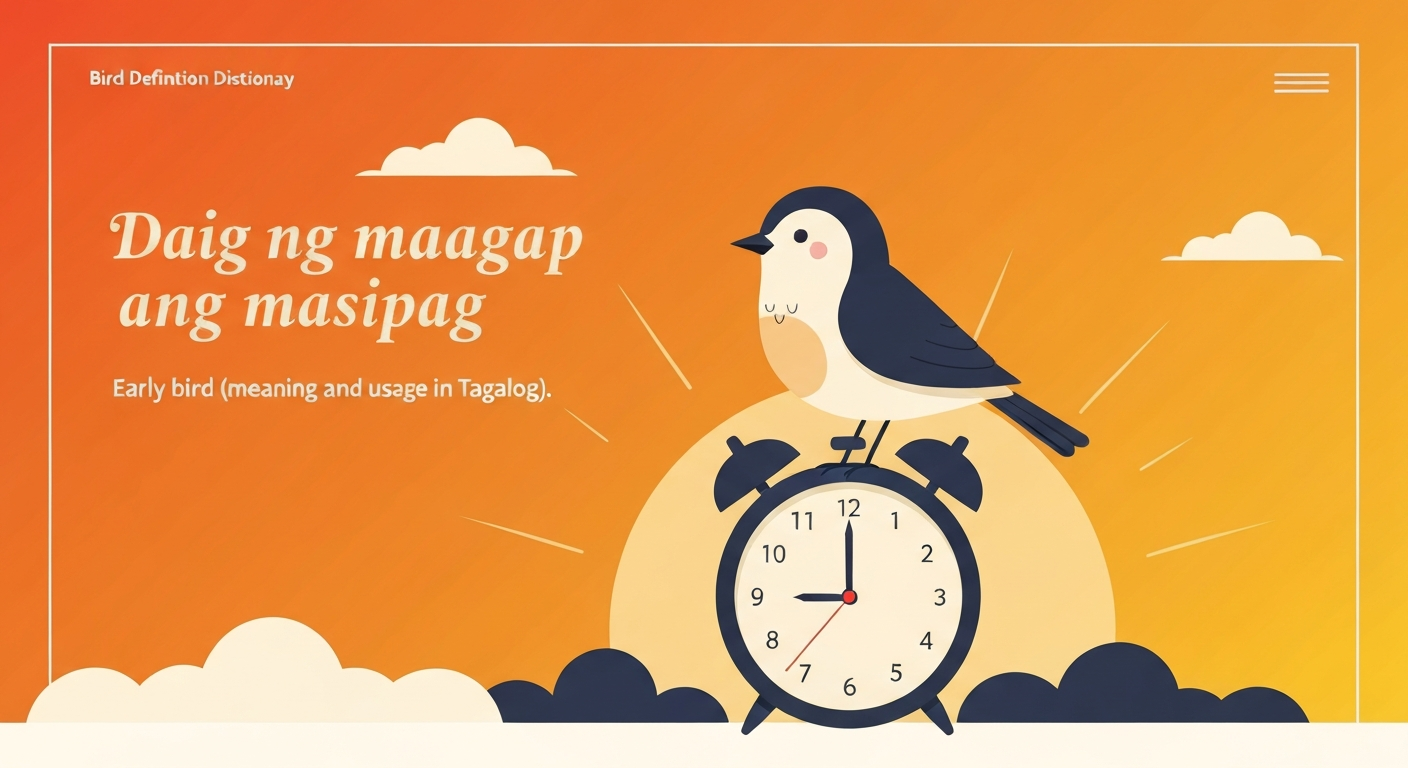
An 'early bird male' is simply a man described by the common English idiom 'early bird,' meaning he gets up early, arrives ahead of others, or acts before most people do. The label carries no special male-specific meaning: it is a gender-neutral term that happens to be applied to a man. What gives it color is the proverb behind it, 'the early bird catches the worm', which frames early rising as a competitive advantage, and that framing can shade the phrase with admiration, teasing, or practical respect depending on context. Dictionary.com (American Heritage idioms content) records the proverb 'the early bird catches the worm', noting its practical counsel about initiative and listing common variants such as 'gets the worm' Dictionary.com (American Heritage idioms content) — 'the early bird catches the worm'.
Early Bird Male Meaning: Definition, Uses & Examples


Quick Definition: Literal and Figurative Meanings
At its most literal, 'early bird' is a noun phrase for a person who rises or arrives unusually early. Merriam-Webster and Collins both record this as the primary sense, and corpus examples back it up with plain predicative sentences like 'He is an early bird' or 'She's always been an early bird.' No ornithology required.
The figurative sense stretches the idea from clock-watching to competitive advantage. Cambridge Dictionary defines 'the early bird catches the worm' as meaning that whoever acts first gains the most benefit. In everyday speech, calling someone an early bird can mean they literally wake at 5 a.m., or it can compliment their habit of getting ahead, arriving first at the job site, submitting applications before the deadline, or claiming the best seat at an event.
A third, commercial sense has grown up around the idiom too. Collins notes collocations like 'early-bird discount' and 'early-bird special,' meaning a reduced price or bonus reserved for people who book, register, or buy in advance. You will see this on everything from concert ticket pages to restaurant menus offering a cheaper set meal before the dinner rush. The idiom has fully crossed from folk wisdom into marketing language.
| Sense | Meaning | Example context |
|---|---|---|
| Literal (chronotype) | A person who wakes or arrives early | "He's an early bird — in the office by 6 a.m." |
| Figurative (proverbial) | Someone who gains advantage by acting first | "Buy now; the early bird gets the best seats." |
| Commercial | An early-purchase discount or offer | "Early-bird tickets: $25 before July 31." |
| Stag/event ticket | A discounted single-male entry tier | "Early Bird Stag Pass" on event platforms |
| Sports/football | An early-season signing, fan, or kickoff reference | "He was an early bird signing for the club." |
Origin and Etymology of "Early Bird"
The proverb 'the early bird catches the worm' has a traceable paper trail going back to at least 1636, when it appeared in William Camden's Remaines. John Ray then included it in his influential A Collection of English Proverbs in 1670, which cemented it in the English canon. From there, proverb scholar Wolfgang Mieder traces its spread into many other languages as a shared piece of folk wisdom about initiative and timeliness.
The shortening to just 'early bird' as a standalone noun came naturally, English loves to clip proverbs into convenient labels. By the 19th century, you could call someone 'an early bird' without invoking the worm at all; the meaning was self-contained. Herman Melville used the phrase in Moby-Dick, and Victorian proverb dictionaries recorded 'Tis the early bird catches the worm' as a fixed gnomic line. It was already common currency by the time anyone thought to ask where it came from.
The underlying metaphor borrows from genuine bird behavior: many bird species do forage most actively in the early morning hours, so the original image was observationally grounded, even if the worm-catching framing is a little more poetic than scientifically precise. That grounding in nature is part of why the proverb felt trustworthy enough to survive four centuries.
Symbolic Resonance and Cultural Associations
Across cultures, early-rising birds have long been symbols of diligence, readiness, and moral virtue. The rooster crowing at dawn is the most obvious example, in many traditions it signals not just the time but a call to action. The 'early bird' idiom taps into that symbolic tradition, associating the person with alertness and initiative rather than sloth or complacency.
In Anglo-American culture, the proverb carries a Protestant-work-ethic flavor: early rising is coded as morally good, industrious, and deserving of reward. That is worth noting because it means calling a man an 'early bird' is often quietly complimentary, even when it sounds offhand. It is a small but meaningful character endorsement. Compare this with the Tagalog proverb tradition (see below), where a functionally equivalent saying carries similar weight in Filipino culture.
The flipside also exists in popular culture. The counter-proverb 'the early bird gets the worm, but the second mouse gets the cheese' gently punctures the wisdom, suggesting that being first does not always mean being smart. This variant is well-documented (Barry Popik traces it in American humorist sources) and has its own life in memes and motivational-poster parody. So the idiom exists in a lively cultural conversation with its own ironic shadow.
"Early Bird" When Applied to a Man, Gendered Connotations
Here is the honest answer: major dictionaries and proverb scholarship do not record any distinct gendered meaning when 'early bird' is applied to a man. The term is grammatically and semantically neutral. A quick check of lexicographic literature, including Mieder's paremiological work, finds no evidence that the phrase carries different connotations for men versus women.
In practice, though, the label does pop up in male-coded contexts that give it a particular flavor. Sports journalism applies it readily to male athletes and coaches, a Buffalo Bills news profile, for example, described a player as 'an early bird and a hard worker,' linking the term with masculine work-ethic virtues. In that context, 'early bird' is less about sleep schedules and more about competitive dedication.
When a man is teased for being an early bird, getting up at dawn on a weekend, arriving first to a party, or queuing before a store opens, the label is usually affectionate rather than critical. It signals predictability and conscientiousness, which can read as endearing or slightly nerdy depending on the social circle. There is no sting to it, but there is gentle humor in it.
- "My dad is the classic early bird male — breakfast on the table at 5: 30, no alarm needed."
- "He's an early bird and a hard worker." (sports profile usage)
- "You're such an early bird — you were already at the venue when the doors opened."
- "Early bird pricing ends tonight, so he booked his ticket at midnight just to be safe."
Early Bird Couple, Relationship Uses and Dynamics
When 'early bird' moves into relationship language, the most common use is the shared-chronotype description: a couple who are both early risers will often say 'we're both early birds' as a point of compatibility. Podcasts, lifestyle blogs, and community forums use this phrasing naturally, and it carries warm, domestic connotations, shared morning routines, coffee before the kids are up, early weekend hikes.
The commercial sense layers on top of that. Event platforms regularly list 'Early Bird: $150 per couple' as a pricing tier, meaning couples who book ahead pay less. In this context 'early bird' signals financial savvy as much as chronotype. The two meanings blur pleasantly: being an early bird couple sounds like a lifestyle choice that also happens to save you money.
Relationship compatibility discussions sometimes contrast the early bird with the night owl. An 'early bird male' partnered with a night-owl female (or vice versa) is a recognized scheduling tension in couples advice literature, where the mismatch in peak energy times can affect everything from morning conversations to weekend plans. So the label does quiet work in framing relationship dynamics, even when nobody is using it academically. If you want a deeper look at how couples navigate these dynamics, the early bird couple topic is its own rich area. For a deeper look at how couples navigate these dynamics, see early bird couple meaning.
Early Bird Stag, Solo-Male Uses and Social Contexts
The phrase 'Early Bird Stag' operates in two quite different worlds, and both are worth knowing about.
In event and nightlife ticketing, 'stag' is a term for a solo male attendee, as opposed to a couple, group, or mixed ticket category. Event platforms including BookMyShow and Townscript list 'Early Bird Stag' or 'Early Bird Stag Male' as a specific ticket tier, meaning a discounted entry price for a single man who purchases early. It is purely commercial: 'early bird' marks the timing of purchase, 'stag' marks the solo-male attendance category. You will see this most often on listings for club nights, festivals, and entertainment events, particularly in India and the UK.
In a completely different register, 'early bird stag' has a specific meaning in Philippine gamefowl culture. In sabong (cockfighting) circles and through organisations like FIGBA (the International Federation of Gamefowl Breeders Association), an 'Early Bird Stag Derby' is a competitive event where 'stag' refers specifically to a young male fighting bird and 'early bird' marks an early-season or early-entry category for that class. The FIGBA BAKBAKAN Early Bird Stag Derby is a named competition, not just a ticket tier. The FIGBA BAKBAKAN Early Bird Stag Derby is listed by FIGBA as an Early Bird Stag competition. This usage is quite niche but well-documented in Philippine breeding and competition communities.
Both senses share the same surface phrase but land in completely different contexts. If you are looking up 'early bird stag meaning' to understand an event ticket, the ticketing sense is almost certainly what you need. If the source is a Filipino gamefowl forum or competition listing, the derby sense applies. The early bird stag topic covers both in more detail.
Sports and Football Uses, Fans, Tickets, Kickoff, and Contextual Meanings
Football and sports contexts use 'early bird' in at least three distinct ways, and mixing them up is easy if you are not paying attention to context.
- Early-bird ticket sales: clubs and venues offer discounted tickets to fans who buy before a set deadline, often weeks or months before the match. This is the same commercial sense as any other early-bird discount, applied to football.
- Early-bird signings: a transfer window 'early bird signing' describes a club or player who completes a deal notably before the rest of the market moves. It is a complimentary label implying strategic foresight.
- Early kickoff: though less idiomatic, 'early bird' occasionally appears in fan writing to describe attending or watching an early-morning kickoff, particularly in the context of international tournaments or Premier League matches broadcast at unusual hours in other time zones.
- Player or staff profiles: as noted above, sports journalism applies 'early bird' to individual male athletes and coaches as a character description, signalling a strong work ethic and disciplined daily routine.
In fan culture, especially online communities, calling yourself an 'early bird' around match day can mean anything from 'I booked my seat before prices went up' to 'I always arrive at the ground two hours before kickoff.' The phrase does useful double duty as both a self-description and a mild brag. For a fuller breakdown of how 'early bird' functions specifically in football language, that topic has its own dedicated entry worth reading alongside this one. For a fuller breakdown of its uses in match-day, ticketing, and fan contexts, see what does 'early bird' mean in football.
The Tagalog Connection
Filipino has a direct and widely used translation of the proverb: 'Ang maagang ibon ay nakakahuli ng uod,' which means literally 'The early bird catches the worm.' Language learning resources, bilingual proverb flashcards, and educational apps all present this as the functionally equivalent Filipino form. It carries the same practical wisdom about acting early to gain an advantage, and it fits naturally into Filipino cultural emphasis on diligence and foresight.
In everyday Filipino-English code-switching, 'early bird' is used in English form in urban settings, while the Tagalog proverb appears in more formal or traditional contexts. Both forms are understood by most Filipino English speakers. The meaning of 'early bird male' in Tagalog contexts does not diverge from the English, the same gender-neutral, diligence-coded sense applies. If you are researching the Tagalog dimension more specifically, the early bird meaning in Tagalog entry goes deeper into regional proverb use and translation nuances.
Synonyms, Slang, and Usage Tips
If you want to vary the phrase, a few alternatives carry similar meaning. 'Morning person' is the most direct synonym for the chronotype sense. 'Go-getter' picks up the proactive, competitive-advantage connotation. 'Lark' is the more technical chronobiology term (as opposed to 'owl'), and it sometimes appears in lifestyle and psychology writing about sleep schedules.
- Morning person — neutral, chronotype-focused
- Lark — slightly technical, used in sleep science and lifestyle writing
- Go-getter — emphasizes initiative and competitive drive
- First mover — business and strategy contexts
- Keen bean — informal British slang with a similar 'eager and early' flavor
Usage tip: 'early bird' works as a noun ('He's an early bird'), a modifier ('early-bird pricing'), and occasionally an adjective ('an early-bird mentality'). When writing about a specific man, the predicative form, 'he is an early bird', is the most natural and carries the warmest, most neutral tone. Avoid 'early bird male' as a standalone adjective phrase in prose; it sounds like a ticket category rather than a character description.
FAQ
Search‑friendly title and meta description to use for an entry on “early bird (male meaning)”
Title: "Early Bird — Meaning, Origin, and What It Means When Said About a Man"; Meta description: "Clear definition and origin of 'early bird,' how the idiom applies to men, couple and solo uses, Tagalog translation and proverb, plus sports and ticketing examples."
What is the literal definition of “early bird”?
Literal noun sense: a person who gets up, arrives, or acts early (e.g., 'He’s an early bird'). Dictionaries list this as the primary, non‑figurative meaning.
What is the figurative/proverbial meaning and origin of “early bird”?
Figurative/proverbial sense: derived from the proverb 'The early bird catches the worm' — meaning whoever acts first gains an advantage. The proverb is recorded in English from at least the 17th century (collected by John Ray and discussed in proverb scholarship).
How is the label used when applied specifically to a male person?
'Early bird' applied to a man is standard, idiomatic, and typically neutral: it describes his habit, chronotype, or habit of arriving/acting early. Lexicographic and corpus evidence shows routine use with male referents (e.g., 'He’s an early bird'). There is no reputable evidence that the idiom systematically carries special gendered implications when used about men.
What cultural or symbolic connotations does “early bird” carry?
Culturally the idiom signals punctuality, initiative, diligence, or opportunism (positive in contexts praising industriousness; sometimes neutral or ironically critical). Symbolically it draws on animal imagery—birds seeking food early—to encourage timeliness and action.
How is 'early bird' used in relationship contexts (early bird couple)?
Literal/shared chronotype: couples say 'we’re both early birds' to describe similar sleep/work routines. Commercial/event contexts use 'early bird' pricing or ticket tiers for couples (e.g., 'Early Bird: $150 per couple'). In relationship writing it’s mainly descriptive and neutral—sometimes framed as a compatibility trait.
Early Bird Meaning in Tagalog: Translation & Usage Guide
Alamin ang ibig sabihin ng 'early bird' sa Tagalog: literal 'maagang ibon', idiomatikong 'maagang gumigising' at mga kar