The bird you can be proverbially as bald as is the coot. Specifically, the idiom is "as bald as a coot," and it means completely bald, used casually and often with a touch of humor when describing someone who has lost all their hair. If you've encountered this phrase as a puzzle or riddle, the answer is straightforward: the coot wins every time.
A Bird You Can Be As Bald As: Meaning, Origin, and Birds

Marcus Whitmore
14 Apr 2026
The bird behind the proverb
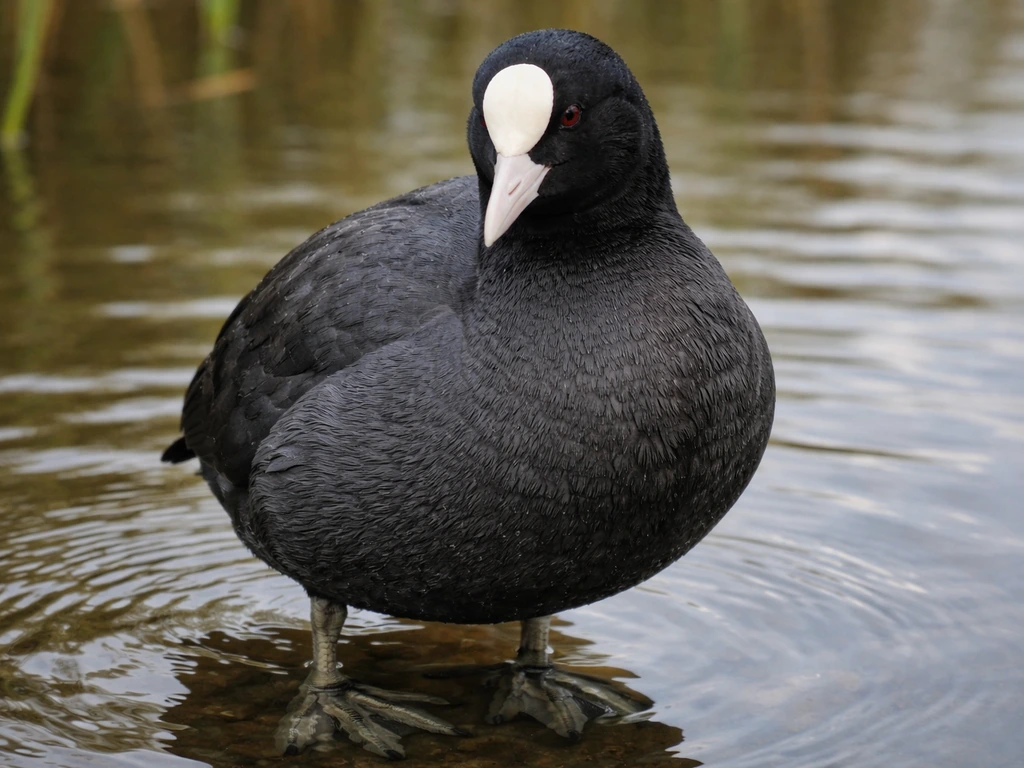
The coot (Fulica atra) is a waterbird in the family Rallidae, common across the UK and much of Europe. It's stocky, mostly dark-feathered, and lives on lakes, ponds, and slow rivers. What makes it instantly recognizable is a bright white patch above its bill, called a frontal shield. That patch is the whole reason this bird ended up in an idiom about baldness. If you'd like more background on the coot as a species and what it symbolizes beyond this phrase, the deep dive on bald bird meaning covers exactly that territory.
It's worth noting that the bald eagle sometimes gets pulled into conversations about birds and the word "bald," but that's a different story entirely. The bald eagle is called bald because of its striking white head and tail feathers, not because it lacks feathers. As the OUPblog's etymology coverage points out, "our great bald eagle is not 'bald' either" in the way the coot appears to be. The coot's simile has a much more direct visual logic behind it.
What "as bald as" actually means in tone and use

"As bald as a coot" is labeled UK informal by Cambridge Dictionary, and that label tells you a lot about how to read it. This isn't a formal or medical description of hair loss. It's the kind of thing someone says at a family gathering or in a pub conversation, usually with a grin. The tone is casual and often gently teasing, though it can shade into affectionate or even self-deprecating depending on who's saying it and about whom.
Cambridge's example sentences nail the register perfectly: "When he took off his hat, we saw that he was as bald as a coot!" and "He was skinny, bald as a coot, and he didn't have a tooth in his head." Both sentences are descriptive rather than cruel, but they're clearly not formal. The exclamation mark in the first one practically delivers the comic timing for you. This is a phrase for everyday speech, not a medical chart or a polished essay.
Where the phrase comes from
The idiom is genuinely old. The Oxford English Dictionary traces "as bald as a coot" back to at least 1430, making it one of the longer-lived animal similes in the English language. An early written example is attributed to the 15th-century poet John Lydgate, who wrote the line "And yet he was as bald as is a coote" in what later sources connect to his Chronicle of Troy. The spelling "coote" is the period form of "coot," so there's no mystery about the bird intended.
What's interesting is how stable the phrase has been over six centuries. The core structure ("as bald as a coot") hasn't drifted the way many idioms do. It arrived in the 15th century pointing at a bird with a white forehead patch, and it's still doing exactly the same job today. Literary appearances in later centuries reinforced it, including uses in prose where characters are described as "as bald as a coot" in ways that signal age, hard living, or comic appearance.
Why the coot actually looks "bald"
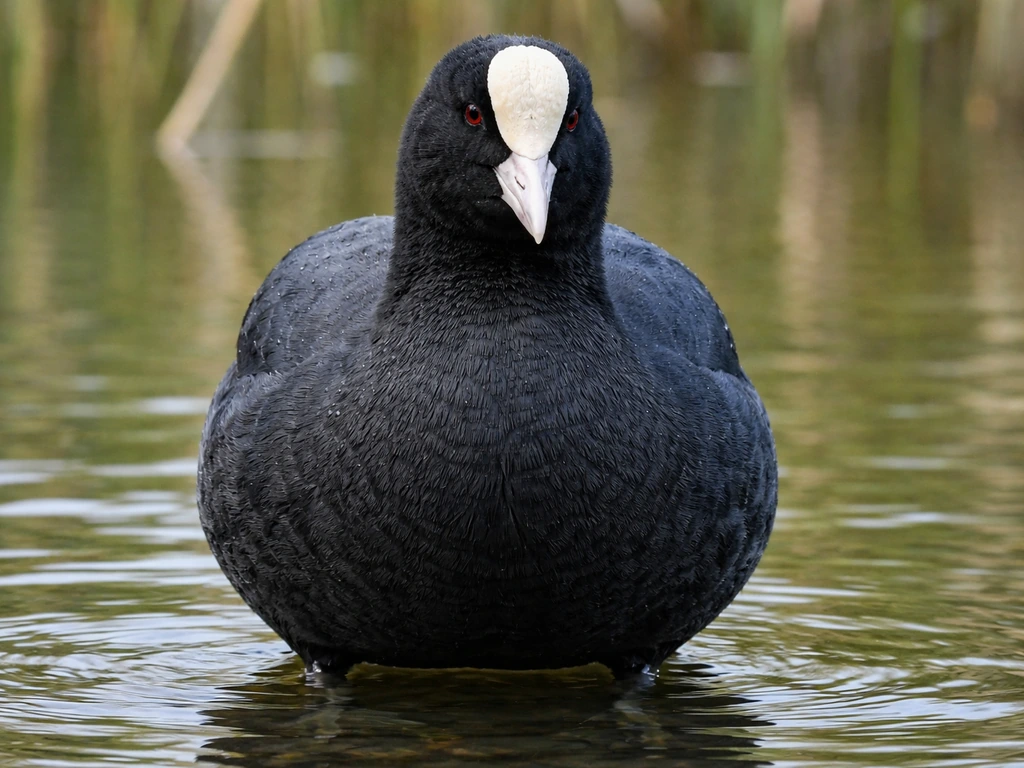
Here's the part that surprises most people: the coot is not literally featherless. It has plenty of feathers. What it has is a white frontal shield, a fleshy, featherless plate above the bill that extends up onto the forehead. Against the bird's dark plumage, that white patch stands out like a bare patch of skin on a head that would otherwise be fully covered. To a human observer, especially one glancing at a pond, it reads visually as a bald spot.
The Wildlife Trust for Bedfordshire, Cambridgeshire, and Northamptonshire explains this clearly in their coot identification notes, and the British Library's material on coot calls makes the same point: it's the white frontal shield on a dark body that creates the impression of baldness, not an absence of feathers. So the idiom is built on a visual trick. The bird looks bald from a distance; it isn't bald in any strict biological sense. That gap between appearance and reality is actually what makes the phrase work as a figure of speech, because it captures how "completely bald" registers visually to an observer rather than measuring hair follicles.
Regional and variant versions
The coot version is firmly British. If you're in the United States and you use "as bald as a coot," people will probably understand you, but they'll also look at you slightly sideways because the natural American equivalent is "as bald as a cue ball." Cambridge Dictionary documents both, labeling them as direct regional counterparts: UK informal uses the coot, US informal uses the billiard ball. The meaning is identical; only the reference object changes.
Australian English goes its own direction. Among the colorful Australian animal similes, "as bald as a bandicoot" has been recorded, with the bandicoot (a small marsupial, not a bird) standing in for the coot. Australian National University's research on Australian words and idioms includes this in lists of emblematic local similes. It's a useful reminder that this type of "as [adjective] as a [animal]" construction is a template that different cultures fill in with locally familiar creatures.
| Region | Phrase | Reference object | Register |
|---|---|---|---|
| UK | As bald as a coot | Coot (bird) | Informal/humorous |
| US | As bald as a cue ball | Billiard ball | Informal/humorous |
| Australia | As bald as a bandicoot | Bandicoot (marsupial) | Informal/humorous |
How to use it (and how to read it) in conversation
Using "as bald as a coot" well is mostly about context and delivery. It works in descriptive storytelling ("By the time he was forty, he was as bald as a coot"), in affectionate ribbing ("Don't worry, your grandfather was as bald as a coot at your age"), and in self-deprecating humor ("I'll be as bald as a coot by next summer at this rate"). What it doesn't fit is formal writing, professional settings, or any context where the person being described would find it hurtful.
When you hear it, the interpretation is simple: the person being described has no hair, or very close to none. The simile isn't making a judgment beyond that. It's a colorful way of saying "completely bald" with a bit more personality than the plain adjective. You can read it as neutral observation, gentle teasing, or self-deprecating humor depending on who's speaking and the tone of the conversation around it. Think of it the way you might think of "as free as a bird" meaning, another bird-based simile that does its work through a vivid image rather than a literal statement.
- Descriptive storytelling: "By the time he retired, he was as bald as a coot and proud of it."
- Gentle teasing among friends: "You'll be as bald as a coot before you're thirty if you keep stressing like that."
- Self-deprecating humor: "I took off my hat and the photo was ruined. As bald as a coot."
- Literary or narrative description: "He was as bald as a coot, sharp-eyed, and not a man you'd want to argue with."
The coot's symbolism and cultural life
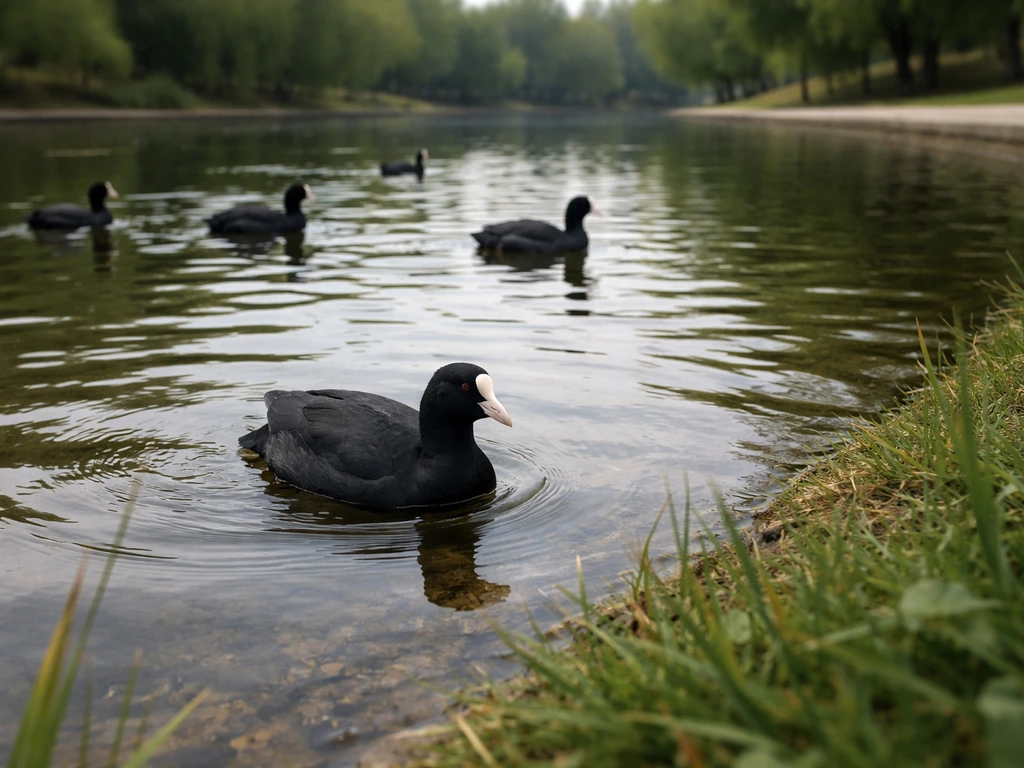
Beyond the baldness phrase, the coot carries a modest but interesting symbolic weight in British culture. It's a common sight on urban ponds and park lakes, which makes it a familiar, even slightly comic bird in the British imagination. It's not glamorous like a swan or dramatic like a heron. It's a bit scrappy, a bit comical-looking, and it has a reputation for quarrelsome behavior. Birdwatchers often note that coots are territorial and aggressive despite their round, somewhat endearing appearance.
Culturally, "coot" has also become an informal term for an old or odd person, particularly in the phrase "old coot." This isn't directly connected to the baldness idiom, but it does suggest that the bird has settled into English as a mild term for someone slightly eccentric or past their prime, which fits loosely with the baldness association. Both usages lean into the bird's unglamorous, everyday quality.
The coot's symbolism doesn't carry the weight of, say, an eagle or an owl, but it has a peculiar staying power in ordinary language. Some bird expressions fade because the bird becomes unfamiliar to urban populations, but the coot has survived partly because it is genuinely common on British waterways and partly because the phrase itself is so satisfying to say. Other bird-based expressions stay alive for stranger reasons, including the curious case of "sober as a bird" meaning, which connects avian behavior to human states in an equally unexpected way.
There's something worth noticing in how the coot's appearance ended up in the language at all. Humans have always watched birds closely, and the ones that look most human (upright posture, distinctive head markings, visible "expressions") tend to get recruited into idioms about human appearance and behavior. The coot's white forehead patch reads almost like a caricature of a bald human head seen from a distance, and that visual joke stuck for six hundred years. It's a small example of how much bird-watching has shaped the way English speakers talk about themselves. That same tendency to read human qualities into bird behavior is what makes a phrase like "be as a bird perched on a frail branch" meaning feel so intuitively resonant, even across very different cultural contexts.
Related "bald as" and bird similes worth knowing
Once you know "as bald as a coot," you're better equipped to read the whole family of bird-based similes in English. These phrases all follow the same template: "as [quality] as a [bird or animal]." The animal is chosen because its appearance or behavior provides a vivid, recognizable image for the quality being described. The coot supplies visual baldness; other birds supply speed, freedom, grace, or foolishness depending on the phrase.
- As bald as a coot (UK): completely bald; informal and humorous
- As bald as a cue ball (US): the direct American equivalent; same meaning, no bird involved
- As bald as a bandicoot (Australia): regional variant using a local animal
- As free as a bird: completely unrestrained or unburdened
- Old coot: informal term for an eccentric or cantankerous older person, derived from the same bird
Knowing which bird sits at the center of the proverb, why it looks the way it does, and how the phrase has traveled across six centuries and multiple regional varieties gives you everything you need to use or interpret it confidently. The answer to the riddle is the coot, the phrase means completely bald, it's been in the language since at least 1430, and it earned its place there because a small waterbird with a white forehead patch looked, to generations of English speakers, exactly like a person with no hair on their head.
FAQ
Does “as bald as a coot” mean bald or just thinning?
It usually does not mean “partly bald” or “thinning,” it means essentially no hair at all. If you want a more moderate meaning, English speakers more often choose phrases like “balding” or “starting to thin,” because “as bald as a coot” sounds like a fully rounded, finished bald look.
Can I use the phrase without mentioning the coot?
It will sound natural even if you do not mention the bird, for example “You will be as bald as a coot by next year.” However, if you are writing for readers who may not know the idiom, adding a brief clarifier helps, like “(that is, completely bald).”
Is it okay to say “as bald as a coot” at work or around someone I don’t know well?
Yes, but use caution with self-directed teasing in professional or sensitive settings. The phrase is usually friendly, but it can still land as an appearance jab if the person has reasons to find baldness upsetting, so tone and audience matter more than the literal meaning.
How do I say the same thing in more formal English?
For formal writing, it is generally better to avoid it and switch to neutral language such as “completely bald,” “fully bald,” or “has no hair.” The idiom’s casual, humorous register is the reason it is best kept for everyday conversation, not polished reports.
Can I use the idiom when talking about hair loss as a medical issue?
Use it to describe current or developing appearance, not as a clinical forecast. If you want to talk about medical hair loss, stick to terms like “hair loss” or “alopecia,” because idioms can unintentionally sound dismissive or overly comic in health contexts.
What should I use in American English, and will UK phrases confuse US readers?
In the US, many readers will expect “as bald as a cue ball” if they know the idiom at all. Both convey the same idea, but mixing regions can distract some audiences, so for an international audience pick one and keep it consistent.
Is it acceptable to tweak the bird, or does it have to be exact?
Yes, you can adapt the structure for other contexts, but keep it clear and avoid sounding ironic. For example, “as bald as a cue ball” is understood as the idiom, while inventing a new animal or swapping in an unfamiliar species can make the joke fail.
Does “as bald as a coot” also imply someone is old or eccentric?
It is mainly about appearance, not personality. If you are also trying to convey “odd” or “past their prime,” “old coot” is the phrase that carries that extra nuance, while “as bald as a coot” stays narrowly focused on hair.
Can I use the idiom in a description of a real coot I’m writing about?
Avoid it for literal statements about animals. The coot looks bald from a distance due to its white frontal shield, but it is not featherless, so using the idiom as if the bird truly lacks feathers can be factually wrong in wildlife descriptions.
How can I deliver it kindly when someone is self-conscious about being bald?
If you want to be extra polite, frame it as observation plus reassurance, like “It’s not a big deal, you just look bald in that way people joke about.” That keeps the humor without making it sound like you are teasing the person for real.
Next Article
As Free as a Bird Meaning: Idiom Explained + Examples
Meaning of as free as a bird: not controlled or worried. Plus variants and real example sentences for natural use.