"Sober as a bird" means completely sober, not drunk at all. It's a fixed simile in the "as X as Y" family of expressions, sitting alongside the better-known "sober as a judge." The twist is that it's almost always used sarcastically or humorously, often by someone who is very much not sober, which gives the phrase a winking, self-aware quality that "sober as a judge" doesn't quite have. The phrase is often used with a wink, since being “as bald as a bird” would be a very different kind of image.
Sober as a Bird Meaning: Usage, Origin, and Examples

Marcus Whitmore
26 Apr 2026
What it actually means day to day

At face value, "sober as a bird" describes a person who is clear-headed, calm, and completely free of alcohol or intoxicants. The "as X as Y" construction is one of English's oldest simile patterns, and this phrase slots into the sobriety end of a spectrum that includes the opposite ("drunk as a skunk") on the other side. WIRED's language column placed both expressions in the same family of fixed drunkenness and sobriety comparisons, which is a useful way to think about it: they're two poles on the same sliding scale.
In practice, though, the phrase lands very differently depending on who's saying it and how. If someone says "I'm sober as a bird" with a straight face, they mean exactly that: I have not been drinking. But the phrase has a well-documented sarcastic life, too. Urban Dictionary captures this well, noting that "sober as a bird" often shows up in dialogue where the speaker is clearly not sober, using the expression as a kind of ironic protest. The Super Troopers movie quote, "Oh, hey, I am sober as a bird," is probably the most recognizable pop-culture instance of exactly this dynamic: someone insisting on their sobriety in a way that immediately signals the opposite.
Tone and context: when people actually say it
This phrase lives primarily in casual speech, not formal writing. You're much more likely to hear it at a party, in a comedy script, or in a text message than in an editorial or a work email. The tone is almost always light: either genuinely jokey ("don't worry, I drove here, I'm sober as a bird") or sarcastically self-deprecating (said while holding a drink).
Because it sits next to the more authoritative "sober as a judge," choosing "sober as a bird" over that version is itself a kind of tonal signal. Oxford Learner’s Dictionaries also gives the simile “He was as sober as a judge (= completely sober)” as a usage reference.
You're being playful. You're not making a legal deposition.
That said, there's nothing grammatically or semantically wrong with using it sincerely. The core meaning is the same as its more formal cousin: completely, unambiguously sober. The bird just brings a lighter, less solemn energy to the claim.
Where did "sober as a bird" come from, and why a bird?
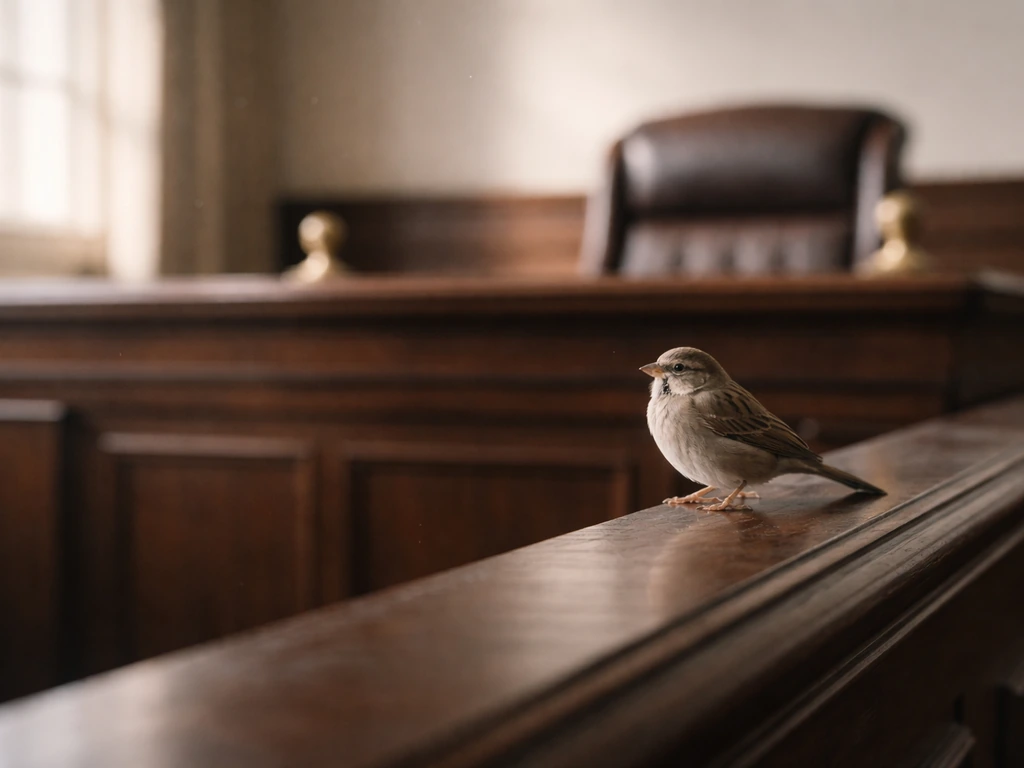
The ancestor of this phrase is almost certainly "sober as a judge," which Merriam-Webster defines as "not at all drunk: completely sober" and the OED cites as an established English simile meaning the same thing. "Sober as a judge" has been around for centuries and trades on the image of a judge as the embodiment of gravity and clear-headedness. "Sober as a bird" likely evolved as a lighter, more playful riff on that same pattern, swapping the solemn authority figure for something nimble, quick, and alert.
Why birds specifically? Birds carry a long symbolic association with clarity, lightness, and sharp perception across many cultures and languages. A bird in flight is precise and quick-eyed, the opposite of the stumbling, blurred state of intoxication. There's also something about the way birds move, darting and exact, that reads as sober in the most literal visual sense. English has a deep well of bird idioms ("a bird's-eye view," "as the crow flies," and others documented by BBC Learning English) that consistently map birds onto ideas of precision, perspective, and freedom. The sobriety simile plugs right into that existing symbolic logic.
Mix-ups to watch out for
The most common source of confusion is conflating "sober as a bird" with other bird idioms that have completely different meanings. "[As free as a bird](/freedom-bird-meanings/as-free-as-a-bird-meaning)," for instance, means liberated and unrestrained, with no sobriety connotation whatsoever. Cambridge Dictionary and Merriam-Webster both list it as a standalone idiom about freedom and independence. Mixing the two up would be an easy mistake if you only half-heard or half-remembered the phrase.
A second mix-up is literal interpretation: some people, especially non-native English speakers, read "sober as a bird" and wonder whether actual birds have some reputation for sobriety or intoxication. Some people also look up the bald bird meaning as a related bird-based phrase, but here the “bird” is purely figurative for the simile’s tone. (They don't, at least not in any standard folklore sense.) The bird here is purely a vehicle for the simile's tone and imagery, not a factual claim about avian behavior.
Third, there's the animal swap confusion. English has many "as drunk/sober as a [animal]" constructions, and people sometimes scramble the animals. "Drunk as a skunk" and "sober as a bird" are the natural pair, but you'll occasionally hear someone use the wrong animal or construct a hybrid phrase. If you hear a variation that doesn't quite sound right, the safest check is whether the comparison makes emotional and tonal sense: does the animal chosen feel light and clear (bird, judge) or comedically excessive (skunk)?
How to use it correctly: examples and alternatives
Here's how the phrase sounds in actual sentences, across the tonal range it covers:
- Sincere use: "I only had water all night, I'm sober as a bird, I can absolutely drive."
- Ironic/joking use: "Three cocktails in, and she looks at me and goes, 'Don't worry, I'm sober as a bird.'"
- Descriptive third person: "He was sober as a bird the whole weekend, didn't touch a drop."
- Written/informal dialogue: "'You okay to handle this?' / 'Sober as a bird, let's go.'"
If you want to swap it out for something with the same meaning but a different flavor, your clearest alternatives are:
- "Sober as a judge" (more formal, more authoritative, less playful)
- "Stone-cold sober" (emphatic, very common in casual American English)
- "Completely sober" or "totally sober" (plain, no ambiguity)
- "Not a drop" or "stone sober" (informal shorthand)
If someone uses "sober as a bird" ambiguously and you can't tell if they're being sincere or ironic, the context is usually your guide. Are they visibly impaired? Is it a comedic situation? The phrase's sarcastic reputation is strong enough that a little skepticism is warranted when you hear it.
Why birds and sobriety fit together symbolically
Birds show up in idioms of clarity and precision for a reason. Across cultures, birds are associated with heightened awareness: they're alert, their vision is sharp, and their movements are deliberate. A bird perched and watchful is the image of attentiveness, the opposite of the heavy, uncoordinated state that alcohol produces. The phrase "be as a bird perched on a frail branch" is another way to describe someone in a precarious, easily shaken state bird perched and watchful.
This symbolic logic runs through bird language more broadly. "A bird's-eye view" means perfect, elevated clarity. "As the crow flies" means the most direct, unobstructed path. Even expressions about freedom, like "as free as a bird," connect to this quality of lightness and unencumbered movement.
Britannica Dictionary’s bird entry also includes the idiom reference “(as) free as a bird,” showing that this bird-based freedom simile is a fixed expression as free as a bird. Sobriety slotted naturally into this symbolic cluster because it's the human state that most resembles what birds seem to embody: alert, precise, light.
This is part of what makes bird idioms so durable in English. They're not arbitrary. The bird as a symbol does consistent work across many different expressions, carrying ideas of freedom, perspective, directness, and clarity wherever it lands. "Sober as a bird" is just one more phrase in that long tradition, and once you see the underlying symbolic logic, it makes complete intuitive sense.
Quick reference: meaning, do/don't, and next steps
| Category | Details |
|---|---|
| Core meaning | Completely sober, not drunk at all |
| Typical tone | Casual, playful, often ironic or self-deprecating |
| Register | Informal speech; not suited to formal writing |
| Closest relative | "Sober as a judge" (same meaning, more formal) |
| Common confusion #1 | Mixing it up with "as free as a bird" (freedom, not sobriety) |
| Common confusion #2 | Literal interpretation (birds have no real sobriety reputation) |
| DO | Use it in casual conversation, humor, or ironic contexts |
| DON'T | Use it in formal writing or when you need to be taken seriously |
| If heard ambiguously | Check context: sincere claim, or sarcastic deflection? |
The clearest next step is to practice distinguishing this phrase from its close neighbors. "Sober as a bird" means sober. "As free as a bird" means free. "As the crow flies" means by the most direct route. Each bird phrase does its own specific work in English, and keeping those lanes separate is really all you need to use and understand this one correctly. The next time you hear someone say "I'm sober as a bird," you'll know exactly what they mean, and you'll have a pretty good sense of whether to believe them.
FAQ
How can I tell if “sober as a bird” is sincere or sarcastic?
If you are unsure whether someone is joking, look at immediate context markers like holding a drink, being loud or unsteady, or the surrounding dialogue setting a comedy tone. A straight “I’m sober as a bird” response with no performance cues is more likely sincere than sarcastic.
Is it okay to use “sober as a bird” in formal writing?
The phrase is typically used in casual, spoken English, often as a response to a question or accusation about drinking. In formal writing, you can sound more natural using “completely sober” or “not under the influence,” especially when you need to be unambiguous.
Can I use “sober as a bird” to describe someone’s state after a medication or event?
Yes, it can be used about situations rather than people, for example “The bartender kept him sober as a bird after the medication,” but this will still read as casual and slightly theatrical. In healthcare or legal contexts, prefer precise wording like “no intoxication observed.”
What’s the difference between “sober as a bird” and “as free as a bird”?
Don’t confuse “sober as a bird” with “as free as a bird,” which means unrestrained or independent. If you mix them up, you’ll end up with the wrong meaning entirely, since “free” has nothing to do with alcohol.
Does “sober as a bird” only mean not drunk, or can it mean not high either?
It usually implies alcohol intoxication, but it can broadly mean “not impaired by any intoxicants” depending on tone. If you mean drugs specifically, “sober” can still work, but using “fully clear-headed” or “not under the influence” may reduce misunderstanding.
Can I vary the wording, like “act sober as a bird” or changing the animal?
You can stress it for effect, but don’t alter the core structure too much. Common variations like changing the verb to “act” or “seem” work in casual speech, but swapping the bird for a different symbol usually breaks the intended idiom feel.
What’s the tone difference between “sober as a bird” and “sober as a judge”?
The closest “as X as Y” cousin you’ll hear is “sober as a judge.” Choosing “sober as a bird” generally signals a lighter, more playful tone, while “judge” sounds more solemn or matter-of-fact.
If someone says they’re “sober as a bird,” can I rely on it for safety decisions like driving?
If the speaker is talking about driving, it can come across as a serious claim even when said jokingly. If safety matters, treat it as a statement that needs verification, for example whether they are fit to drive, rather than trusting the idiom as proof.
Next Article
A Bird You Can Be As Bald As: Meaning, Origin, and Birds
Meaning and origin of the proverb about being as bald as a specific bird, plus symbolism and usage examples.