
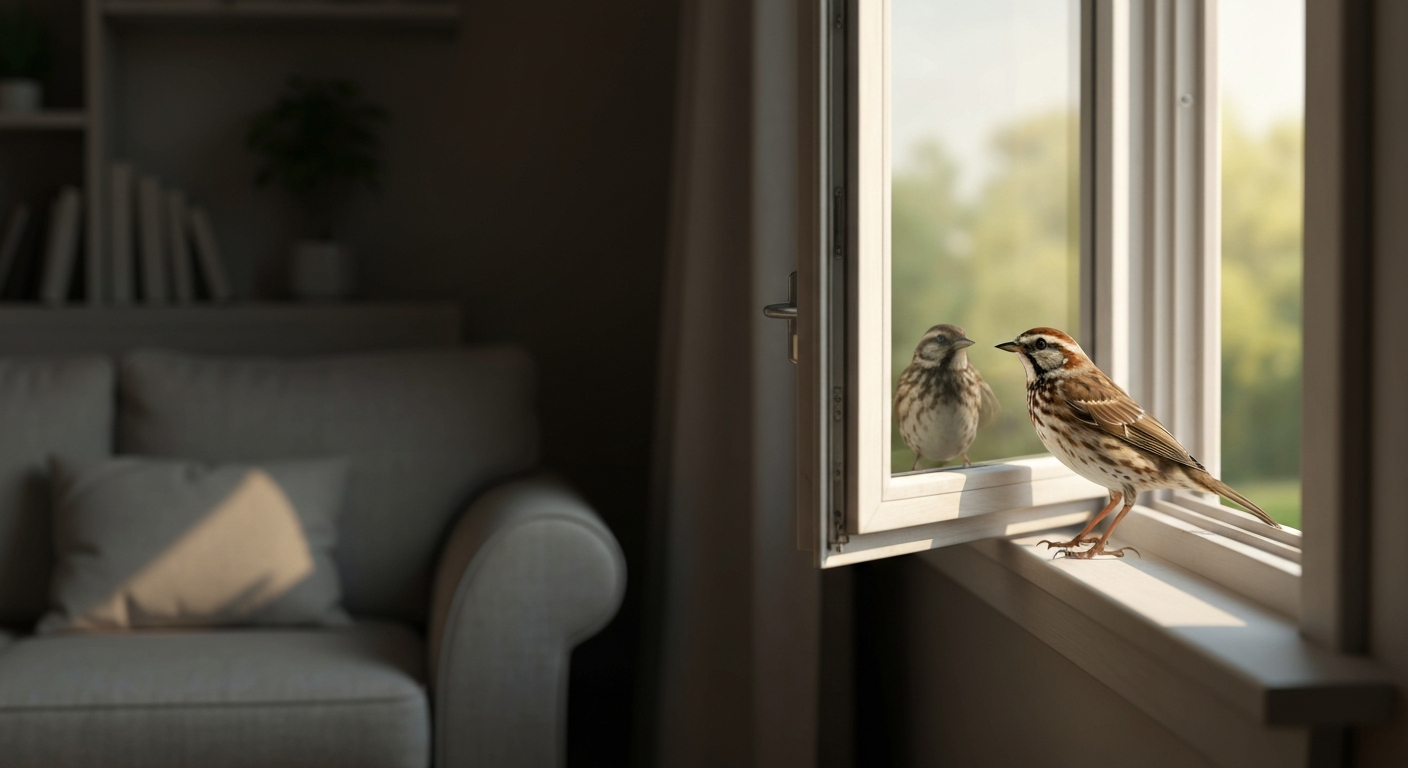
A bird in your room is almost always there by accident. It flew through an open window or door, got disoriented by glass or indoor light, came in through a chimney or vent, or is a young fledgling that wandered too far from its nest. Most of the time the bird is unhurt and just needs a calm, clear path back outside. The symbolic meanings attached to indoor birds, whether omens of death, messengers from the dead, or signs of good fortune, are ancient and genuinely fascinating, but they exist alongside a much more practical reality: a frightened bird trapped indoors can injure itself, and the faster and calmer you help it leave, the better the outcome for everyone.
Bird in Room Meaning: Causes, Symbols, Safety, Dreams & Care

Marcus Whitmore
12 Aug 2026
Why birds end up inside rooms in the first place
Understanding the actual reason a bird entered is useful both practically and symbolically, since the circumstances say a lot about what kind of bird it likely is and how you should respond. Most indoor bird visits come down to a short list of causes.
Open doors, windows, chimneys, and vents
This is the most common route. A screen door left open for a few seconds, a chimney with no cap, an attic vent with a broken screen, a basement window propped open in summer: birds find gaps that humans barely notice. House sparrows, starlings, and swifts are especially adept at exploiting small openings, and chimney swifts (as the name suggests) have been nesting in chimneys for centuries. A bird that arrived this way is typically healthy, just disoriented, and will leave just as easily if you open a large window or exterior door and reduce distractions.
Glass and light confusion
Window glass is genuinely one of the most lethal traps humans have ever inadvertently created for birds. Researchers estimate that window and building collisions kill hundreds of millions to roughly one billion birds annually in North America alone, making it one of the leading sources of human-caused avian mortality. For more on causes and prevention of window strikes, see Why Birds Hit Windows, and How You Can Help Prevent It, All About Birds (Cornell Lab) Why Birds Hit Windows—and How You Can Help Prevent It — All About Birds (Cornell Lab). Birds don't perceive glass as a barrier: a window reflecting sky or trees looks like open space to fly through, and a glass door into a sunlit room can look like a passageway. Artificial indoor lighting at night compounds the problem enormously. During migration peaks, urban lights disorient nocturnal migrants so severely that birds circle illuminated buildings for hours before colliding or dropping in exhaustion. If a bird suddenly appeared in your room at night or flew in after a loud thud, glass or light confusion is almost certainly involved.
Fledglings and young birds exploring
In late spring and early summer, fledgling birds leave the nest before they're fully competent fliers. They're designed to hop around at ground level and take short test flights, which sometimes carries them through open doors. A fledgling looks alarming: it's scruffy, may have a short or stubby tail, seems to have no idea what it's doing, and often calls persistently. This is normal. It is not abandoned. Its parents are almost certainly nearby and still feeding it. Unless it's visibly injured, a fledgling found indoors needs to be gently guided back outside rather than kept or 'rescued.'
Seeking food, plants, or shelter
Large indoor plants, fruit bowls, seed left out on counters, or pet food near an open door can attract birds. House sparrows and pigeons in particular are opportunistic and bold. A bird that appears to be deliberately foraging rather than panicking is probably a species comfortable around human habitation and may have been entering the same way for days without you noticing.
Injured, ill, or escaped pet birds
A bird that appears calm but cannot fly, or that sits huddled and puffed up on the floor, is likely sick or injured. A window strike can cause concussion-like symptoms that make a bird appear docile. And occasionally the indoor bird isn't wild at all: escaped budgerigars, cockatiels, and parakeets regularly end up in wrong rooms or wrong houses, especially in warm months when windows stay open. Escaped pet birds tend to be less panicked than wild birds and may approach people or perch calmly on furniture.
Identifying the bird and checking its condition
Before doing anything else, take 30 seconds to look at the bird without approaching it. Size, body shape, bill shape, and basic color pattern are usually enough to get a rough ID, and a rough ID tells you a lot about how to handle the situation. The Cornell Lab's Merlin Bird ID app is the fastest tool I know: you can answer five simple questions (or upload a photo) and get a solid species match in seconds. Sibley's guides, both the app and print versions, are excellent for confirming size and shape comparisons, while eBird's range maps tell you whether a given species is expected in your area at this time of year. The Sibley eGuide to Birds (Sibley Guides) offers searchable illustrations, comparison tools, and range information that are especially useful for confirming size, shape, and plumage during quick field identifications The Sibley eGuide to Birds (Sibley Guides) — identification tools and guidance.
Once you have a rough ID, assess the bird's behavior. A bird that is flying around erratically but otherwise alert is probably fine and just needs a way out. A bird sitting still on the floor, tilting its head to one side, pressing itself into a corner, showing labored breathing, or holding one wing lower than the other needs more careful attention. Look specifically for: visible bleeding, a drooping or asymmetrical wing, inability to stand or perch, open wounds, discharge from eyes or nares, or rhythmic seizure-like tremors. Any of these signals shifts the situation from 'help it find the exit' to 'this bird needs professional care.'
How to safely remove a bird from a room
The core principle is: calm, dark, open. Birds panic in bright, chaotic environments and calm down in dim, quiet ones. Most indoor birds can be guided out in under ten minutes if you work with that biology rather than against it.
- Clear the room of other people and pets immediately. A cat in the room, or a dog barking, turns a manageable situation into a dangerous one for the bird.
- Close interior doors so the bird is contained in one room only. This prevents it from getting deeper into your home.
- Open the largest window or exterior door in the room as wide as possible. Remove or push aside any fly screens on that opening.
- Close or cover all other windows. Birds fly toward light, and multiple light sources cause confusion. If the room has curtains, draw them across every window except the one exit you want the bird to use.
- Turn off interior lights and step back or leave the room entirely. Give the bird 10 to 15 minutes of quiet. In most cases it will find the opening on its own.
- If the bird is still in the room after 15 minutes, you can gently herd it toward the open window by moving slowly from the opposite side of the room, raising your arms to guide rather than grab.
- If the bird has landed on a surface and seems calm, you can drape a lightweight, breathable cloth (a clean dish towel works well) gently over it, cup your hands loosely around it through the cloth, and carry it directly outside. Release it at ground level in a sheltered spot, not from height.
What not to do: don't chase, shout, or wave objects. Don't try to grab a bird in full flight. Don't offer food or water during the process. A bird that has just hit glass and appears stunned should be left alone in a quiet space for 15 to 30 minutes before you attempt to move it: the stunned state is often temporary, and many birds recover completely if given that window of calm.
Special situations: injured birds, fledglings, and escaped pets
Window-strike recovery
A bird that has struck a window and is stunned but breathing should be gently placed in a shoebox or paper bag lined with a soft towel. Make several small air holes in the lid or top, close the box, and put it somewhere dark and quiet at roughly room temperature. After 15 to 30 minutes, take the box outside, open it at ground level in a sheltered garden spot, and step back. If the bird flies away strongly, that's the end of it. If it remains dazed, sits with eyes closed, or cannot fly after 30 minutes total, contact a permitted wildlife rehabilitator. Do not force food or water at any stage: a stunned bird cannot swallow safely and may aspirate liquid into its lungs.
Fledglings on the floor
If you find a feathered (not naked or barely-feathered) fledgling indoors, gently carry it outside and place it in a nearby shrub or on a low branch in a sheltered spot near where you found it. Keep cats and dogs away for a few hours. The parents will return. If the bird is naked or has only sparse pin feathers, it has fallen from its nest prematurely and does need rehabilitator assistance.
Escaped pet birds
An escaped budgerigar or cockatiel found indoors is not subject to the same wildlife laws as a native migratory species. Still, handle it calmly. Many pet birds will step onto a finger or perch if you offer one slowly and speak softly. Post on local community boards and lost-pet sites immediately, since escaped pet birds often travel surprisingly far. If it's your own escaped bird, draping the cage near the bird's location and letting it find its way back on its own is often the least stressful approach.
When to call a wildlife rehabilitator, vet, or animal control
The decision is simpler than it might seem. Call a permitted wildlife rehabilitator or veterinarian if the bird shows any of the following: visible bleeding, a drooping or broken wing, inability to stand or perch for more than a few minutes, labored or audible breathing, open wounds, head tilt or involuntary movement, or continued incapacitation beyond 30 minutes after a window strike. The same applies if you find a bird that is extremely thin, heavily parasitized, or has been mauled by a cat (even without visible wounds: cat punctures introduce bacteria that kill birds rapidly without treatment).
Under U.S. federal law (the Migratory Bird Treaty Act, enforced by U.S. Fish and Wildlife Service under 50 CFR), nearly all native wild birds are legally protected. You cannot keep, transport, or possess a migratory bird without a permit. However, federal regulations include what amounts to a Good Samaritan exception: you may pick up a sick, injured, or orphaned migratory bird without a permit for the sole purpose of immediate transport to a licensed wildlife rehabilitator or veterinarian. The key word is immediate. You are a temporary transporter, not a caretaker. Veterinarians may stabilize a migratory bird without a federal rehabilitation permit but must transfer it to a permitted rehabilitator within 24 hours. Transport across state lines requires additional paperwork, and birds must generally be released in the state where they were found.
To find a permitted rehabilitator near you in the U.S., the Animal Help Now service (ahnow.org) provides a searchable database by location. Your state wildlife agency and USFWS regional office can also direct you. When you call, have ready: the species (or your best description), the circumstances of how you found it, the bird's current condition and behavior, and your location.
A brief note on health precautions: for most people, a brief indoor encounter with a wild bird carries minimal zoonotic risk. That said, the CDC advises basic hygiene after handling any wild bird: wash hands thoroughly, avoid touching your face, and don't handle dead birds or accumulated droppings without gloves and, where dust may be aerosolized, an N95 respirator. Avian influenza (HPAI H5Nx) presents a low risk to the general public from incidental contact, but people who handle birds frequently should follow current CDC guidance. Psittacosis (from inhaling dried droppings or secretions of infected birds) is uncommon but documented and worth knowing about. For cleanup of bird droppings, especially accumulated material, NIOSH recommends wetting the area before removal to suppress dust and using appropriate respiratory protection.
Keeping birds from entering rooms in the future
Prevention is genuinely straightforward and most measures cost very little. The main goals are: close obvious entry gaps, make glass visible to birds, and reduce light attraction during migration.
- Fit fly screens or mesh on all openable windows and exterior doors, and check existing screens for holes or gaps every spring.
- Cap chimneys with commercially available chimney caps that allow ventilation but exclude birds.
- Seal gaps around pipes, vents, and eaves where birds might nest or enter.
- Apply bird-collision deterrents to the exterior surface of large windows: patterned window film, evenly-spaced exterior decals (spacing of 2 inches or less vertically and 4 inches or less horizontally is the evidence-supported standard for most species), or external netting. Note that decals on the inside surface of glass are much less effective than exterior treatments.
- Move bird feeders either very close to windows (within 3 feet, so birds can't build up enough speed to be seriously injured if they do hit) or far away (more than 30 feet), since feeders at mid-distance create the highest collision risk.
- Move large indoor plants away from windows visible to birds outside, as they attract birds toward glass.
- During spring and autumn migration peaks, close curtains at night and turn off nonessential exterior and interior lights facing outward. This is the core of 'Lights Out' programs, which have strong empirical support for reducing disoriented-migrant fatalities around buildings.
- Use BirdCast migration forecasts (BirdCast.info, produced by Cornell Lab) to check high-migration nights in your area: those are the nights when extra precautions matter most.
What a bird in a room has meant across cultures
Before screens and glass were common, a bird entering a house was a genuinely unusual event, unusual enough that it demanded interpretation. Most cultures developed rich explanatory frameworks for it, and those frameworks are still alive in the way people react when it happens today.
Death omens and household messengers
The most widespread Western superstition is that a bird entering a house, especially a robin or a sparrow hitting a window, foretells a death in the family. This belief appears across British, Irish, German, Scandinavian, and American folk traditions and almost certainly predates written records. The most likely origin is simply the rarity and suddenness of the event: in pre-industrial homes with small windows and few openings, a bird flying indoors was so unusual that it demanded explanation, and death was the most dramatic and memorable one. A bird striking a window and dying was even more alarming. Over many generations of confirmation bias, those who remembered the 'death omen' incidents outnumbered those who forgot the many occasions where nothing followed.
Specific birds carry specific weight. In British tradition, a robin indoors signals a death nearby. An owl entering or calling at a window is widely read as a death omen across European, Native American, and some Asian traditions (though 'owl at the window' is distinct from 'owl in the room'). Blackbirds entering houses appear in Appalachian and Southern American folklore as harbingers of illness or death. A white bird, in some Celtic traditions, is a soul or psychopomp figure. In contrast, a swallow nesting in the eaves or entering briefly is often considered deeply good luck in British, European, and Chinese folk belief.
Good luck, abundance, and blessings
Not every cultural reading of an indoor bird is dark. In some Chinese traditions, a bird entering the home, particularly a sparrow in spring, brings news of good fortune or an upcoming marriage. In Philippine and some Southeast Asian traditions, a bird in the house is welcomed as a visiting ancestor or benign spirit. Several Indigenous North American traditions treat certain birds as positive messengers from the spirit world rather than as omens of harm, though which species and contexts determine the meaning vary enormously by specific nation and tradition. The point worth holding onto is this: the same event, a bird in your room, carries opposite symbolic weight depending on where and when you grew up. There is no universal meaning.
Religious and spiritual readings
In Christian iconography, birds particularly doves and swallows represent the soul, the Holy Spirit, or divine presence. A bird entering a room is sometimes interpreted by believers as a sign of spiritual visitation or a message from a deceased loved one. This reading is common in contemporary popular spirituality across multiple traditions and frequently appears in online discussions about what a bird in a room 'really means.' In Yoruba and derived traditions (Candomble, Santeria, Vodou), birds have specific associations with orishas and lwa, and an unexpected bird visit can carry ritual significance interpreted by practitioners within those frameworks. Celtic traditions associated birds with the Otherworld and saw them as soul-carriers or guides, which feeds directly into the 'bird as deceased relative' interpretation still common in Ireland and Scotland today.
Birds in rooms in dreams: what they might mean
Dreaming of a bird inside a house or room is a fairly common dream motif, and various interpretive frameworks exist for reading it. In Jungian analysis, birds in dreams typically represent the psyche, spirit, or the animating, upward-striving parts of the self. A bird trapped in a room is often read as an aspect of the self that feels constrained or is seeking expression. A bird that cannot find the window might represent an idea, ambition, or emotional truth that the dreamer has not yet found a way to express or release. A bird that flies out successfully often reads as resolution, liberation, or a breakthrough.
In less formal popular dream interpretation, which draws on older symbol dictionaries and folk belief, a bird in your house in a dream is frequently associated with news arriving, a message from the unconscious, or the presence of someone no longer living. Whether you find any of this resonant is largely a question of what framework, if any, you bring to dream interpretation. The honest answer is that dreams are personal and contextual: a bird in a room dream means something different to an ornithologist than to someone who just lost a grandparent. The most useful Jungian-style question to ask yourself is simply: what did the bird seem to represent? Was it free or trapped, calm or frightened, familiar or strange? Those details carry more interpretive weight than the bird species itself.
Birds indoors in literature, art, and the Brancusi connection
The image of a bird inside a domestic space has been used by writers and artists as a symbol of the untameable, the spiritual, or the dangerously beautiful since at least the Romantic period. Edgar Allan Poe's raven entering through a window and refusing to leave is arguably the most famous literary version: the bird arrives from 'the Night's Plutonian shore,' meaning from the realm of death, and its most famous word, 'Nevermore,' is delivered from inside the narrator's chamber. The bird doesn't bring a message so much as it becomes a mirror for the narrator's grief. Emily Dickinson used birds extensively as figures for hope, the soul, and creative energy, frequently placing them in domestic or interior settings.
In visual art, the bird in an enclosed space is often used to explore the tension between freedom and captivity, the spiritual and the material. This is where it's worth pausing on Constantin Brancusi's famous sculpture series, 'Bird in Space,' which this site covers in its own dedicated entries. For a detailed discussion of Brancusi's 'Bird in Space' meaning, see the dedicated entry on this site. For a focused discussion of the sculpture's intended meaning, see the site's Bird in Space sculpture meaning entry. Brancusi wasn't representing a specific species of bird in a room or cage. He was attempting to capture the pure sensation of flight itself, stripping the bird down to a single upward-thrusting form that removes every material detail and leaves only the essence of aspiration and movement. It is, in a sense, the artistic opposite of the trapped-bird image: rather than a living creature constrained by walls, it is flight freed from the body entirely. The Brancusi 'Bird in Space' entries on this site explore the sculpture's intended meaning, its legal history (U.S. customs once famously refused to classify it as art), and its cultural legacy in more depth.
On a lighter note: if you've landed here because you were searching for the 'drinking bird,' that endlessly bobbing toy bird that appears to drink water, that's a different kind of bird-in-room with its own entry on this site explaining the thermodynamic physics behind it. The drinking bird is, in its own low-key way, a meditation on perpetual motion and the illusion of life, which isn't entirely unrelated to what a real bird indoors makes you feel.
Quick action checklist
Here is a consolidated summary of what to do, organized by time frame.
| When | Action | Notes |
|---|---|---|
| Right now | Remove pets and other people from the room | Reduces panic for bird and risk of injury |
| Right now | Close interior doors; open one large exterior window or door wide | Single clear exit point works best |
| Right now | Darken all other windows; turn off interior lights; leave quietly | Birds fly toward the brightest light source |
| After 10–15 min | If bird is still inside, slowly herd it toward the open exit or drape a cloth over it and carry it outside | Move slowly; no sudden gestures |
| After window strike | Place bird in a ventilated, cloth-lined shoebox in a dark, quiet place for 15–30 min, then release outside | Do not force food or water |
| If still stunned after 30 min | Contact a permitted wildlife rehabilitator or veterinarian | Use Animal Help Now (ahnow.org) to locate one |
| If bird shows injury signs | Contain quietly, call rehabilitator immediately; transport as instructed | Signs: bleeding, drooping wing, inability to stand, labored breathing |
| For a fledgling | Place outside in a sheltered spot near where found; keep pets away | Do not 'rescue' a healthy feathered fledgling |
| After the bird leaves | Wash hands; clean droppings with damp cloth and discard (N95 if heavy accumulation) | Basic hygiene; see CDC guidance for larger cleanups |
| Within the week | Check for and seal the entry point: screen gaps, chimney, broken vent | Prevents repeat visits |
| This season | Apply exterior window film or decals if glass collisions are recurring | Exterior placement is more effective than interior |
FAQ
Quick answer: Why might a bird be in my room and what does that experience mean right now?
Literally: a bird in your room is most often accidental or situational — it flew in through an open door/window, was attracted or disoriented by reflections or lights, wandered in while foraging (indoor plants/food), is a fledgling learning to fly, or is injured/ill and seeking shelter. Symbolically: many cultures read an indoor bird as a message, omen, or sign (see cultural/religious entry below), but the immediate priority is safety for you and the bird. Practical next step: calmly contain/quiet the space, assess whether the bird is stunned or injured, and follow humane removal steps (cover gently, place in ventilated box, keep dark and warm) or call a permitted rehabilitator/veterinarian if the bird appears wounded or remains incapacitated beyond ~30 minutes.
Literal reasons birds enter rooms and quick identification clues
Common literal causes: open doors/windows/chimneys, transparent glass and reflections (they try to fly through habitat reflections), indoor lights at night that disorient migrating birds, nearby feeders/houseplants/food, juvenile dispersal (fledglings) and illness/injury. Identification clues: size, silhouette (songbird vs. dove vs. raptor), beak shape, leg length, plumage color/pattern, behavior (alert and mobile vs. sluggish/stunned). For fast ID use apps/resources like Cornell Lab All About Birds, Merlin, eBird, Sibley/Peterson guides and note time of day and local migration forecasts (BirdCast) to narrow species.
Cultural, religious and symbolic meanings (origins and common superstitions)
Across cultures birds symbolize freedom, souls, messengers, omens or transitions. Examples: Christian traditions sometimes view birds as symbols of the Holy Spirit or souls; in some Indigenous and shamanic traditions specific birds (e.g., raven, eagle) carry clan or spirit meanings; in folklore a bird inside a house could signal a visitor, death, luck, or a forthcoming change — interpretations depend on species, context and culture. Origins: many symbolic meanings arise from observable bird traits (song, flight, migration) and the human tendency to link unusual events to messages. Common superstitions include: a bird hitting a window as an ill omen, a bird perched indoors signaling a death in the family (varies widely), or a small bird in the home as good luck — none are universal or evidence‑based. If you want culturally specific meanings, consult authoritative cultural or religious sources tied to the relevant tradition.
Dream and literary interpretations
Dream interpretation is subjective: psychodynamic and Jungian readings often see birds as symbols of freedom, aspiration, spiritual messages, unconscious thoughts, or emotions seeking expression; a bird trapped inside in a dream may represent suppressed feelings, obstacles to expression, or a sense of confinement. Literary uses vary: poets and authors use birds allegorically (e.g., to represent spirit, poet’s voice, exile, or political themes). A concrete example of artistic reference: Constantin Brancusi’s sculpture 'Bird in Space' abstracts flight and uplifting form — often cited in art discussions about the idea of flight rather than literal anatomy.
Immediate, humane, safety‑focused steps if you find a bird in your room
1) Stay calm, keep people and pets away and reduce noise/light. 2) Close interior doors to confine the bird to one room and open exterior doors/windows to provide a clear escape route; move slowly. 3) If the bird is active and can see an exit, give it space and time to leave. 4) If the bird is stunned/injured: approach slowly, cover it with a lightweight cloth or towel, gently place it in a ventilated shoebox lined with a soft towel, keep the box dark and warm for 15–30 minutes, then open outdoors and allow it to fly away if able. 5) Do NOT force food/water, do not attempt complicated medical care, and minimize handling. 6) If droppings or contamination are present, avoid aerosolizing dust when cleaning (wet before removal) and follow CDC guidance for heavy contamination cleanup and PPE when appropriate.
Signs you should contact a wildlife rehabilitator or veterinarian right away
Contact a permitted wildlife rehabilitator or veterinarian if the bird shows: obvious bleeding or open wounds; broken wing/leg or deformed posture; inability to perch or stand; labored breathing; neurological signs (head tilt, seizures, lack of coordination); remains stunned/incapacitated beyond ~30 minutes; or if it is an orphaned nestling you cannot safely reunite with its nest. If unsure, call a local rehab center, wildlife hotline, or Animal Help Now for triage advice and nearest permitted rehabilitator.
Next Article
Brancusi Bird in Space Meaning: Flight, Form, and Law
Explore the meaning of Brancusi's Bird in Space: form, intent, versions, legal saga, and symbolic flight.