A jaybird is simply a jay, any member of the crow family (Corvidae) commonly called a jay, and in North America the word most often points to the Blue Jay (Cyanocitta cristata), though Steller's Jay and the various scrub-jays earn the nickname too. The compound word 'jaybird' has been around in English since at least 1661, and while it adds nothing biological beyond 'jay,' it gave the language one of its most memorable idioms: 'naked as a jaybird.' If you searched for 'jaybird bird meaning,' you are probably looking for one of two things: the actual bird, or the cultural and linguistic life the word has built up over several centuries.
Jaybird Bird Meaning: Definition, History, Symbolism

Marcus Whitmore
9 Aug 2026
Pronunciation and where the word came from
Pronounced JAY-burd (IPA: /ˈdʒeɪˌbɜːrd/), with the stress firmly on the first syllable, 'jaybird' is simply 'jay' plus 'bird' run together as a compound. The stress pattern and pronunciation are consistent across American and British English, though the word itself is far more common in American speech. Merriam-Webster notes the first known use as 1661, and Collins traces the compound to the period 1655 to 1665. Collins English Dictionary lists the entry JAYBIRD definition in Collins English Dictionary and dates the compound to about 1655–65.
The root word 'jay' is older still. English borrowed it from Old North French 'gai' (also rendered as Old French 'jai'), which referred to the bird in medieval Europe. The word is almost certainly echoic, that is, it imitates, or at least evokes, the harsh, nasal call the bird makes. The Latin form was 'gaius' or 'gāia.' By the early 1700s, English speakers in North America were applying the name to the New World blue jays they found in the forests, and 'jaybird' became the casual, colloquial form of the name, especially in American regional speech where tacking 'bird' onto an animal name was a common folk habit.
The actual birds people call 'jaybird'
Biologically, 'jaybird' does not name a single species. It is a folk label that attaches to several members of the family Corvidae, the same large family that includes crows, ravens, and magpies. In North America, three groups carry the 'jay' label most often.
Blue Jay (Cyanocitta cristata)
The Blue Jay is the bird most Americans picture when they hear 'jaybird.' It lives across eastern and midwestern North America, is comfortable in backyards and suburbs as well as forests, and is listed by the IUCN as Least Concern with a large, generally stable range. Its bold coloring and loud personality make it hard to ignore and easy to remember.
Steller's Jay (Cyanocitta stelleri)
Steller's Jay takes over where the Blue Jay leaves off, occupying western coniferous forests and mountain habitats from Alaska down into Central America. Its black-and-blue coloring is striking, and its raspy, varied calls have earned it the same noisy reputation as its eastern cousin. Population trends are generally stable, though Audubon's climate modeling has flagged projected range shifts worth watching. The Steller's Jay, Audubon Field Guide (species notes) reports generally stable populations across much of its range while flagging projected climate-driven range shifts as a concern Steller's Jay — Audubon Field Guide (species notes).
Scrub-jays (Aphelocoma spp.)
The 'scrub-jay' category is actually several distinct species, not one. Modern checklists from the IOC and Cornell treat the California Scrub-Jay, Woodhouse's Scrub-Jay, Island Scrub-Jay, and Florida Scrub-Jay as separate species under the genus Aphelocoma. The Florida Scrub-Jay (Aphelocoma coerulescens) is federally threatened due to severe habitat loss, making it the most conservation-sensitive of any bird casually lumped under 'jaybird.' All scrub-jays lack the heavy black necklace of the Blue Jay and tend toward blue-and-gray tones.
A note on corvid taxonomy
It is worth knowing that 'jays' are not a single, unified evolutionary branch within Corvidae. Molecular phylogenies show that the birds we call jays span multiple lineages, New World jays (Aphelocoma, Cyanocitta) sit in a different part of the corvid family tree than Old World jays like the Eurasian Jay (Garrulus glandarius). The name is more of a folk grouping based on shared appearance and behavior than a strict taxonomic category.
Quick field-guide reference
| Species | Key ID features | Range | Voice | Conservation status |
|---|---|---|---|---|
| Blue Jay (Cyanocitta cristata) | Blue crest, bold black necklace, white underparts | Eastern/midwestern North America | Loud 'jeer,' whistles, raptor mimicry | IUCN Least Concern |
| Steller's Jay (Cyanocitta stelleri) | Blue body, black head and crest, no white | Western North America, montane forests | Raspy harsh calls, varied notes | Generally stable; climate impacts projected |
| California Scrub-Jay (Aphelocoma californica) | Blue-and-gray, no crest, no heavy necklace | Western North America, scrub/chaparral | Harsh 'shreep' and varied calls | IUCN Least Concern |
| Florida Scrub-Jay (Aphelocoma coerulescens) | Blue-and-gray, pale forehead, no crest | Florida only (scrub habitat) | Low hoarse calls | Federally Threatened (US) |
Behavior worth knowing
- Blue Jays cache acorns and seeds, often in loose soil, making them important dispersers of oak trees.
- Both Blue Jays and Steller's Jays mimic the calls of hawks, possibly to alert flock mates to danger or to scatter competitors at food sources.
- Florida Scrub-Jays are cooperative breeders — offspring from previous years help raise younger siblings, a behavior that has made them subjects of long-term behavioral research.
- Scrub-jays in the Aphelocoma group are notably bold around humans, sometimes taking food from hands.
- All of these jays are omnivores: acorns, seeds, insects, berries, and occasionally the eggs or nestlings of other birds.
- Jays in general are highly social and vocal, living in family groups or loose flocks and using a wide repertoire of calls to communicate.
What jaybirds symbolize, and how much we can actually say
Bird symbolism is genuinely interesting, but it is also an area where overconfident claims pile up quickly. Here is what can be said with reasonable confidence about jays in folklore and culture, alongside some honest notes about where evidence gets thin.
In many Indigenous North American traditions, the Blue Jay appears as a trickster figure or a noisy, attention-seeking character, not unlike the crow or raven in other traditions. Its boldness and vocal nature made it a natural subject for stories about animals that talk too much, boast, or cause mischief. These associations are documented across several oral traditions, though the specific stories and interpretations vary widely by nation and community, so treating 'the Native American meaning of the jay' as a single fixed idea flattens a much more complex and varied cultural landscape.
In European folk belief, jays (particularly the Eurasian Jay) were sometimes associated with craftiness and theft, partly because they steal eggs and cache food. Some older English folklore linked jays to the devil, a connection that may have contributed to the negative overtone in words like 'jay' used to mean a foolish or naive person (see the idioms section below). However, these associations are recorded inconsistently, and it would be overreaching to call them universal.
In American folk religion and spiritual traditions of more recent vintage, including some New Age and animal-spirit frameworks, the Blue Jay is described as a symbol of clarity, communication, and assertiveness. These interpretations are popular online but largely lack historical folk roots. They reflect modern symbolic thinking rather than documented historical belief systems, so they are worth noting as contemporary cultural meaning without being presented as ancient wisdom.
In visual art and literature, the Blue Jay's striking blue and white plumage has made it a recurring subject. It appears in paintings, quilts, prints, and decorative arts across North America, usually for its ornamental beauty rather than deep symbolic weight. Harper Lee's 'To Kill a Mockingbird' famously uses the mockingbird as a symbol, and mentions of jays in the same cultural space tend to occupy the role of the ordinary, noisy, imperfect world by contrast.
Idioms, slang, and how people actually use 'jaybird'
'Naked as a jaybird' is by far the most common English idiom using this word. It means completely naked, without any clothing at all. The phrase is thoroughly American and is found across regional dialects from the South to the Midwest. Why naked? The most plausible explanation is that a newly hatched jay, like most altricial songbirds, is born without feathers, entirely bare and helpless. The image of a naked hatchling stuck, even if most adults using the phrase have never thought about it. The idiom appears in print from at least the early 20th century and remains in common use today.
Beyond that idiom, 'jaybird' has a looser, chiefly American colloquial sense of simply referring to a person who is talkative, noisy, or foolish, mirroring the older use of 'jay' on its own. In 19th-century American slang, a 'jay' could mean a naive country person, a rube, or someone easily fooled. 'Jaywalk' (crossing a street illegally) preserves this sense: a 'jay' pedestrian was someone so unsophisticated they did not know how to navigate city traffic. These uses are now largely historical or at least background knowledge for most speakers, though 'jaywalk' is still very much alive.
Some dictionaries and slang references record 'jaybird' as a mild term of address or mild insult (something like 'you jaybird!'), but these uses are rare, informal, and strongly regional. If you encounter them outside the American South or Midwest, they may need explanation.
Example sentences
- "He ran out of the locker room naked as a jaybird before anyone could stop him." (Common American idiom — widely understood.)
- "That old jaybird on the corner has an opinion about everything." (Regional, informal — talkative or noisy person.)
- "The jaybird in the oak tree has been scolding the cat for ten minutes." (Literal use — referring to the bird.)
- "Don't jaywalk — you'll get a ticket." (Related slang — different word, same folk etymology root.)
Historical and cultural appearances
The Toronto Blue Jays, Major League Baseball's Canadian franchise founded in 1977, took their name from the Blue Jay and are probably the most globally recognized use of 'jay' as a cultural symbol in the English-speaking world today. The name was chosen through a fan contest and reflects the bird's status as a recognizable, colorful North American species.
The University of Kansas uses the Jayhawk as its mascot, a mythological bird combining features of a jay and a hawk. The term 'Jayhawker' predates the university: it was used during the 1850s and 1860s in the violent political conflict over Kansas statehood (the period known as 'Bleeding Kansas'), where pro-Union guerrilla fighters called themselves Jayhawkers. The jay component of the name likely carried the 'bold and aggressive' connotation. This is a historically significant and documented use of jay imagery in American political history.
In music, 'Jaybird' appears as a nickname, a song title, and a band name in American folk, blues, and country traditions. The most notable is probably 'Jaybird' as a folk expression in older American English song traditions, where birds in general served as common subjects and symbols. The name has also been used for products, from wireless earbuds (the Jaybird brand) to sports equipment, borrowing the bird's associations with speed, sharpness, and a bold profile.
The word 'jay' also has a documented use in Australian English as slang for a joint (a marijuana cigarette), though this is an entirely separate etymology from the bird-derived sense and is not connected to 'jaybird' in any meaningful way. It is worth knowing if you encounter 'jay' in a different context.
Jaybird vs. similar search terms: what people often confuse
Several bird-related search terms get mixed up with 'jaybird' because they sound vaguely similar, share a 'bird' suffix, or appear in the same kind of slang and idiom searches. Here is a clear breakdown.
| Term | What it actually means | Why people search it | How it differs from 'jaybird' |
|---|---|---|---|
| jury bird | A slang or informal term, sometimes used in legal/prison contexts or as a folk expression; also a possible mishearing or variant spelling | People searching for bird-related slang or unusual idioms may type this | Not related to jays or corvids; a separate slang entry with its own origin |
| lbj bird | A colloquial nickname or abbreviation used in birdwatching for hard-to-identify 'little brown jobs' — small, drab birds that resist easy ID in the field | Birders and beginners searching for what 'LBJ' means in birdwatching jargon | Completely different origin and meaning; describes any small unidentified bird, not a specific species like the jay |
| lek bird | A 'lek' is a communal display ground where male birds gather to compete for mates — grouse, prairie chickens, and manakins are classic examples | People curious about bird mating behavior or who encountered the term 'lekking' | A behavioral/ecological term, not a bird name; jays do not lek |
| yahoo bird | Possibly a folk name or dialectal term for a bird with a loud, distinctive call (the yellow-billed cuckoo is sometimes called this in parts of the American South) | Curiosity about unusual folk names for birds or regional dialect | A different bird entirely; shares only the 'loud, conspicuous bird' quality with jays |
If you landed on this page looking for one of those terms, the entries for jury bird, lbj bird, lek, and yahoo bird are each worth consulting separately, as they have their own distinct definitions and cultural contexts.
Practical guidance for writers and communicators
If you are writing about the bird, 'Blue Jay,' 'Steller's Jay,' and the scrub-jay species names are capitalized when used as proper species names, following standard ornithological convention. 'Jay' on its own as a common noun is lowercase in general prose. 'Jaybird' is also lowercase unless it starts a sentence or appears in a title.
The plural is 'jaybirds', no apostrophe, no irregularity. In formal or scientific writing, use the accepted species names (Blue Jay, Steller's Jay, California Scrub-Jay) rather than the catch-all 'jaybird,' which is informal and imprecise. In casual or creative writing, 'jaybird' works well and carries warmth and Americana.
When using 'naked as a jaybird,' you can use it confidently in American English contexts, it is widely understood. In British or international English, it may need a brief gloss or could be swapped for 'naked as the day he was born' or simply 'completely naked.' The idiom does not translate idiomatically into most other languages.
- Use 'Blue Jay' (capitalized, two words) for the species in formal or birdwatching contexts.
- Use 'jaybird' (lowercase, one word) for the informal, colloquial, or idiomatic sense.
- Avoid treating 'jaybird' as a precise species name — it is a folk label covering several corvids.
- In American English writing, 'naked as a jaybird' is natural and idiomatic; in other varieties, prefer a plain alternative.
- If you mean the trickster or symbolic bird in Indigenous storytelling, be specific about which tradition you are referencing rather than generalizing.
- The slang sense of 'jay' as a naive person is historical and mostly obsolete in direct use, though it survives in 'jaywalk.'
Image suggestion
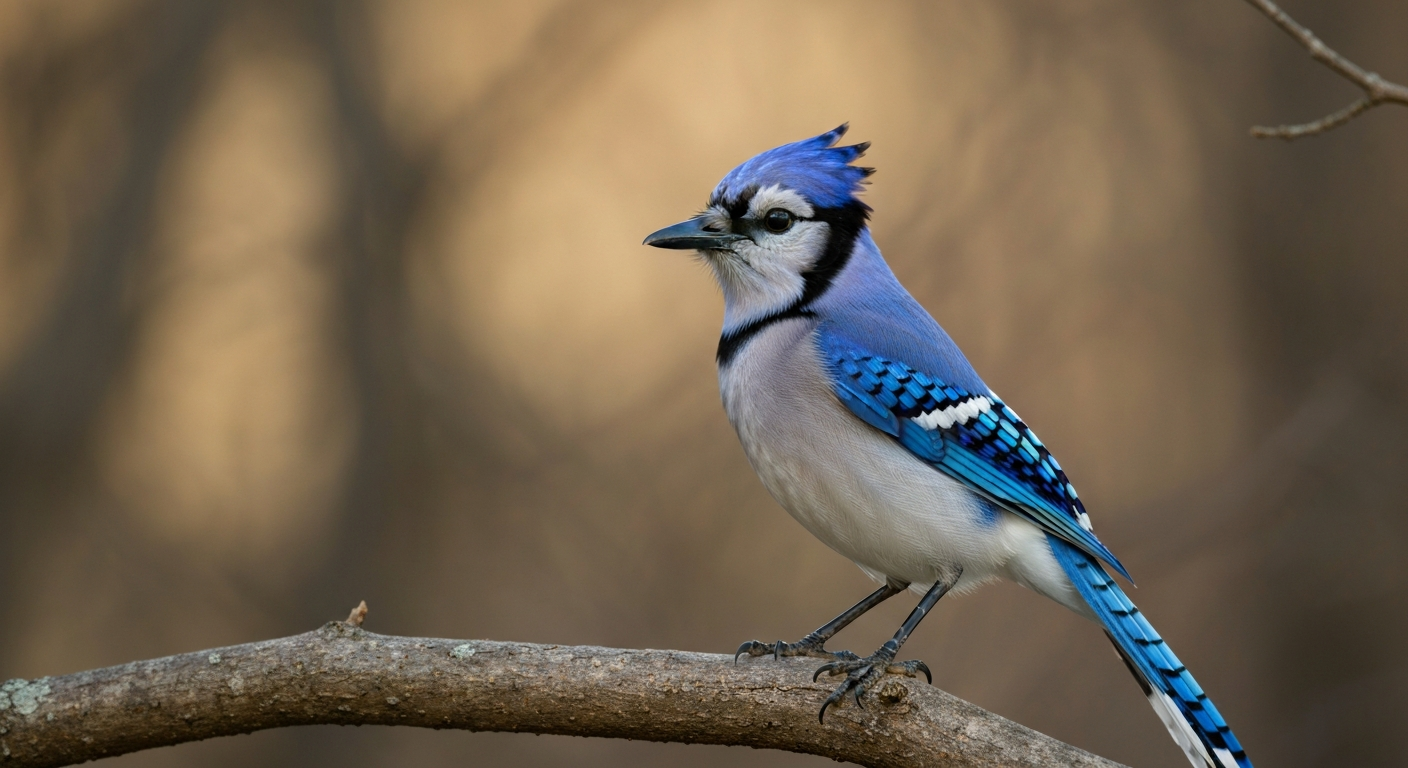
Recommended image: a close-up photograph of a Blue Jay (Cyanocitta cristata) perched on a branch or feeder, showing the full blue crest, black necklace, white underparts, and bold patterning clearly. A natural outdoor setting with soft background blur works best. Suggested caption: 'A Blue Jay (Cyanocitta cristata), the bird most often called a jaybird in North American English. Its bold coloring and loud calls made it a natural subject for folk names and idioms.' Place the image near the top of the natural-history section, ideally just before or after the field-guide table. Use descriptive alt text: 'Blue Jay perched on a branch showing blue crest and black necklace markings.'
Related entries worth exploring
Several Bird Definition Dictionary entries connect naturally to the themes in this article. The jury bird entry explores a separate piece of bird-related slang with its own folk origins. The lbj bird entry explains one of birdwatching's most useful (and self-deprecating) bits of jargon. The lek entry goes deeper into bird display behavior, which is fascinating context for understanding how birds compete and communicate. For the lek bird meaning, see the lek entry on bird display behavior. And the yahoo bird entry traces a vivid folk name for a bird defined by its call, a nice parallel to the jay's own echoic name. Each of those entries stands alone but together they sketch out the broader world of informal and folk bird language that 'jaybird' belongs to.
FAQ
Quick answer: What does 'jaybird' mean literally and figuratively?
Literal (concise): A jaybird is any bird commonly called a “jay,” members of the family Corvidae such as the Blue Jay, Steller’s Jay, and several scrub‑jays. Figurative/idiomatic (concise): In English, chiefly American, “jaybird” names the bird and appears in idioms (notably “naked as a jaybird,” meaning completely naked). Dictionary attestations for the compound date to the mid‑1600s.
Natural history overview: Which birds are commonly called “jaybird”?
Short summary: “Jaybird” is an informal way to refer to birds called jays. Key examples: - Blue Jay (Cyanocitta cristata): eastern and central North America; blue crest, black necklace, varied loud calls, omnivorous diet, caches acorns; IUCN: Least Concern. - Steller’s Jay (Cyanocitta stelleri): western North America; blue body with dark/blackish head and crest; bold at feeders, raspy calls. - Scrub‑jays (Aphelocoma spp.): a group of New World species (California/Western, Florida, Island scrub, etc.); some are cooperative breeders (e.g., Florida Scrub‑Jay) and one (Florida) is federally threatened due to habitat loss. Caveat: “jays” appear in several lineages worldwide; they are not a single monophyletic group and different regions use the name for different species.
Etymology and pronunciation: Where does the name 'jay'/'jaybird' come from and how is it pronounced?
Etymology (brief): English jay comes from Old North French gai/jai, ultimately echoic of the bird’s call. The compound jaybird (jay + bird) is recorded from the mid‑17th century. Pronunciation: Standard English stress on the first syllable: JAY‑bird (IPA: /ˈdʒeɪˌbɜːd/ or US /ˈdʒeɪˌbɜrd/). Dictionaries provide audio for reference.
Symbolism and cultural meanings: What does a jay or “jaybird” symbolize?
Documented symbolic meanings (measured summary): - Personality traits: In popular symbolism, jays are often associated with boldness, loudness, curiosity, intelligence, and trickiness because of their vocal behavior and bold foraging. - Folklore and regional beliefs: Folklore sometimes casts jays as talkative messengers or boasters; specific meanings vary by culture and are often anecdotal. - Religious and artistic uses: Jays appear in literature, children’s stories, and visual art as colorful, conspicuous characters; specific religious symbolism is limited and not widely documented. Notes on evidence: These symbolic attributions are cultural and variable; avoid stating them as universal truths. When evidence is uncertain or regionally specific, flag it as such.
Idioms, slang uses, and example sentences: How is 'jaybird' used idiomatically?
Most common idiom: “naked as a jaybird” — chiefly American, meaning completely naked. This idiom is attested historically; its literal origin is uncertain (possibly humorous contrast between a feathered bird and nakedness). Other uses and rarity: “Jaybird” as a general informal name for someone talkative, flashy, or bold occurs in dialectal or literary contexts but is less common than the idiom above. Some regional slang senses are uncertain—flag these as regional/uncertain when encountered. Example sentences: - “He walked into the room naked as a jaybird.” (idiom) - “Don’t be such a jaybird at the meeting—boasting won’t help.” (informal, dialectal; rarer) Note: Always indicate regionality where sources show it (e.g., chiefly American for the idiom).
Notable historical and cultural uses: Where has 'jaybird' appeared in culture, politics, and organizations?
Neutral summary of notable uses: - Music and entertainment: “Jaybird” or “Jaybirds” has been used as band names and in song titles and lyrics (various regional artists). - Organizations and mascots: Local sports teams, clubs, and school mascots sometimes adopt “Jay(s)” or “Jaybird(s)” because of the bold, colorful bird imagery. - Political references: Historically, “Jaybird” has appeared in local political labels (e.g., the Jaybird Democratic Association in Texas in the late 19th/early 20th century); treat such uses neutrally and provide context if writing specifics. Guidance: These cultural uses are diverse and local; verify specific claims with historical sources before asserting significance.
Next Article
Lek Bird Meaning: What Lek Means in Birds and Symbolism
Understand lek in birds and symbolism: mating display grounds, courtship behavior, and how to identify the bird context.