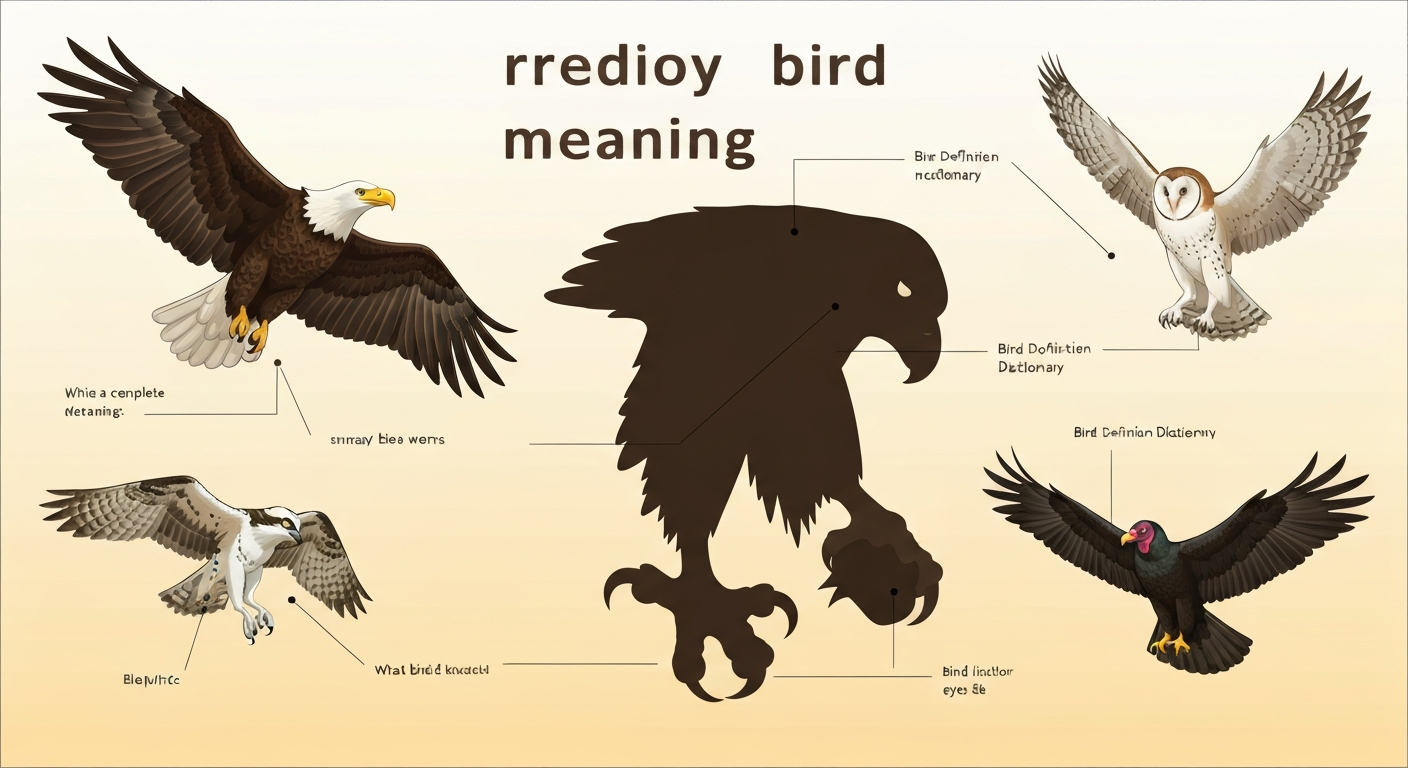
In songs, 'bird of prey' almost always means one of two things: a literal raptor used as a vivid image of power, danger, or freedom, or a metaphor for a predatory person, usually someone who pursues, controls, or consumes another. Which reading fits depends entirely on the song's context, and this guide gives you the tools to figure that out for any lyric you're trying to decode.
Bird of Prey Song Meaning: Literal, Metaphor, and Symbolism

Marcus Whitmore
20 Jul 2026
Why 'bird of prey' keeps showing up in lyrics
There's something almost irresistible about the phrase. It's compact, vivid, and carries a full suite of associations, speed, height, sharp vision, sudden violence, and a kind of cold elegance, all in four syllables. Songwriters have been reaching for raptor imagery for decades, from Jim Morrison's brooding spoken-word piece 'Bird of Prey' on the Doors' posthumous An American Prayer (1978) to Uriah Heep's heavy rock track of the same name, through Fatboy Slim's 'Sunset (Bird of Prey)' in 2000, and more recently the Pixies' 2019 track on Beneath the Eyrie. Each of those songs uses the phrase differently, which is exactly why it's worth unpacking carefully.
This entry covers the literal biological meaning of 'bird of prey' and 'predatory bird,' how the phrase functions as figurative language in song lyrics, the emotional tones and narrative roles it typically plays, and specific pointers for contexts that readers search most often, including Eurovision and Ziferblat references. It also gives you a practical checklist you can apply to any lyric you encounter. Where interpretations are speculative, this article flags them clearly rather than presenting guesswork as fact.
The short version: main takeaways
- Literally, a 'bird of prey' (synonym: raptor) is a bird that hunts and kills animals for food, using talons and a hooked beak. Think eagles, hawks, falcons, owls, and harriers.
- In songs, the phrase is most commonly a metaphor for a predatory person, a dominating force, or an overwhelming emotional state.
- The emotional tone can swing between menace and majesty — sometimes the same image conveys both in the same song.
- Verified artist intent (from interviews or press statements) should always take priority over symbolic inference.
- When a song names a specific raptor (eagle, hawk, falcon), each species brings its own additional connotations worth checking.
- Eurovision and Ziferblat's 'Bird of Pray' (Ukraine, 2025) is a documented recent example where the phrase appears in a high-profile pop context — but song meaning should be read against confirmed performance context and any available artist statements, not assumed.
- A step-by-step interpretive checklist at the end of this article can be applied to any 'bird of prey' lyric you encounter.
What 'bird of prey' actually means, biologically
Merriam-Webster defines 'bird of prey' as a bird that captures and feeds on other animals, and Cambridge Dictionary gives the same essential definition: a bird that kills and eats other animals. The technical synonym preferred by ornithologists is 'raptor. State of the World's Raptors 2025, Chapter: Evolution of Diet (Peregrine Fund) documents how ornithologists delimit 'raptors' and which groups are conventionally included or excluded in scientific lists blank" rel="noopener noreferrer">State of the World's Raptors 2025 — Chapter: Evolution of Diet (Peregrine Fund). ' The Peregrine Fund's 2025 State of the World's Raptors documents how scientists delimit the group: raptors have talons adapted for seizing prey, a hooked beak for tearing flesh, and typically sharp, forward-facing eyesight. The category conventionally includes eagles, hawks, falcons, harriers, ospreys, kites, and most owls, though scientific usage and common usage don't always align perfectly on the edges of that list.
Understanding the biological reality is surprisingly useful when reading lyrics, because good songwriters tend to pick specific raptor traits deliberately. The Red-tailed Hawk, for example, is known for soaring broadly and perching in exposed positions while it surveys territory, behaviors that map neatly onto metaphors of surveillance, vigilance, or dominance. The Peregrine Falcon reaches extreme speeds during its hunting dive (the 'stoop'), making it a natural image for decisive, unstoppable attack. The Great Horned Owl hunts silently at night, which explains why owls in song tend to connote secrecy, ominous watchfulness, or things hidden in darkness. These aren't arbitrary associations: they trace back to real behavioral traits.
How the phrase works in song lyrics
When 'bird of prey' appears in a lyric, it's rarely there just to describe a bird. The phrase operates as a compressed metaphor: it borrows the raptor's entire behavioral profile and pins it onto something else. That something else is usually a person (a lover, an enemy, a predatory authority figure), an emotional state (obsession, grief, rage), or the singer's own self-image (I am the bird of prey; I am the one hunting or being hunted).
The reason the phrase is so adaptable is that raptors embody moral ambivalence in a way few other animals do. They're beautiful and they kill. They're free and they're ruthless. That double quality means 'bird of prey' can land as either an insult or a compliment depending on who the narrator is and what stance the song takes. A line delivered with admiration reads very differently from the same line delivered as a warning. Tone, melody, and surrounding imagery are the real disambiguators.
Common metaphorical meanings, emotional tones, and narrative roles
Across a wide range of songs and genres, 'bird of prey' imagery tends to cluster around a recognizable set of meanings. Here are the most frequently occurring roles:
- The predatory lover or pursuer: someone who hunts a partner, circles before striking, or exerts control — often with an edge of desire mixed with threat.
- The dominating authority or power figure: a boss, institution, or adversary who surveys from a position of superiority and strikes when advantageous.
- The self as predator: the narrator identifying themselves as dangerous, driven, or operating outside ordinary social constraints.
- The self as prey: the narrator acknowledging they are being hunted, watched, or consumed by a person or force larger than themselves.
- Absolute freedom: the raptor in flight as a symbol of escape from constraint, vulnerability, or social expectations.
- Violence and destruction framed as natural or inevitable: the hunt as metaphor for grief, anger, or loss that feels uncontrollable.
- Nobility and power without moral judgment: in some cultural traditions (discussed below), the raptor signals high status or heroic quality rather than threat.
- Death or the approach of death: some traditions use raptors, particularly owls, as psychopomps or omens — this meaning surfaces occasionally in darker or more symbolically dense lyrics.
Literal vs. metaphorical meanings at a glance
| Aspect | Literal (biological) meaning | Metaphorical (lyric) meaning |
|---|---|---|
| Definition | A bird that hunts and kills animals using talons and a hooked beak (raptor) | A predatory person, force, or emotional state |
| Key physical trait: talons | Anatomical tools for seizing and killing prey | The grip of control, possession, or manipulation |
| Key behavior: soaring/circling | Surveying territory for prey from height | Surveillance, patience before attack, dominance over a situation |
| Key behavior: the stoop (dive) | High-speed aerial attack at prey below | Swift, decisive, overwhelming action; sudden confrontation |
| Key trait: sharp eyesight | Ability to spot prey from great distances | Perceptiveness, unavoidable scrutiny, being seen or exposed |
| Key trait: silent flight (owls) | Nocturnal stealth hunting | Secrecy, hidden threat, things that arrive without warning |
| Moral valence | Neutral — hunting is natural behavior | Ambivalent — can be admirable (strength, freedom) or threatening (predation, control) |
| Examples in natural world | Eagle, hawk, falcon, harrier, owl, osprey | A manipulative lover, an oppressive system, the narrator themselves |
The idiom meaning: 'bird of prey' as figurative language
Both Cambridge and Merriam-Webster acknowledge that 'bird of prey' can be used figuratively to mean a predatory person or agent, someone who preys on others, typically for personal gain or pleasure. That figurative use is old enough to appear in literary texts well before the recording era, and it shows up in everyday speech when someone says, for example, that a salesperson 'circled like a bird of prey' or that a character in a film is 'a bird of prey in expensive shoes.' The idiom keeps the raptor's full behavioral profile intact and simply transfers it to a human context.
What distinguishes 'bird of prey' as an idiom from other bird idioms is the specificity of predation. Calling someone an 'early bird' or saying they 'flew the nest' draws on broad, generic bird behavior. Calling someone a 'bird of prey' carries the precise implication of hunting, targeting, and consuming. It's more pointed and more menacing than most bird idioms, which is why it tends to appear in contexts involving power imbalances: pursuing desire, exerting control, or acting without remorse.
A note on ambiguity: not every use of 'bird of prey' in a lyric is consciously using this idiom. Some songwriters use the phrase primarily for its imagery (the visual of a hawk soaring) and only secondarily for any idiomatic weight. Others lean entirely on the figurative meaning and treat the actual bird as incidental. Without artist comment, you often can't be certain which applies, and sometimes both operate at once. The honest interpretive move is to note which reading the surrounding text best supports, flag the ambiguity, and avoid asserting a single meaning as definitive.
Compared to idioms like 'night owl' (a person who stays up late), 'hawk' (as a verb meaning to watch intently or as a noun for a hawkish political stance), or 'eagle-eyed' (sharp and observant), 'bird of prey' is broader and carries heavier narrative weight. It doesn't describe a single trait; it describes an entire behavioral mode. That range is precisely why it's popular in song titles and choruses. A dedicated look at how this phrase operates as a standalone idiom, separate from song lyrics, is worth exploring in the companion entry on 'a bird of prey idiom meaning' on this site.
Cultural and symbolic meanings across traditions
Raptor symbolism is genuinely cross-cultural, but the meanings are not uniform. In many Western European traditions, the eagle represents imperial power and national strength, it appears on state seals, heraldic devices, and national flags precisely because of those associations. The falcon held a different but equally elevated status in medieval European and Middle Eastern falconry cultures, where training a bird of prey was a marker of aristocratic rank. Falconry's cultural prestige is documented in manuscripts spanning from 13th-century European courts to the Mughal Empire, making the falcon a bird associated with controlled, disciplined power, a slightly more refined image than the raw dominance of the eagle.
In Indigenous North American traditions, raptor symbolism varies widely by nation and cultural context, and specific meanings should not be generalized. Broadly documented examples include the eagle as a messenger to the Creator in some Plains cultures and the hawk as a symbol of clear sight and purposeful action in some Southwestern traditions, but anyone using these references in a lyric analysis should read against specific cultural sources rather than treating 'Native American symbolism' as a single, monolithic category.
In ancient Egyptian tradition, the falcon was directly associated with Horus, the sky deity, and by extension with kingship and divine vision. The pharaoh was understood as the earthly embodiment of Horus, which made the falcon image inseparable from ideas of sovereign power, protection, and the sun's journey. That specific association surfaces occasionally in lyrics or artist visuals with an Egyptian or Afrofuturist aesthetic, it's worth checking whether a given artist is consciously invoking that lineage.
In literary tradition, Ted Hughes's poem 'Hawk Roosting' is the canonical English-language example of a bird-of-prey voice used to express absolute dominance, violence, and the refusal of moral constraint. Critical literature on that poem, including work published in the Ted Hughes Society Journal, documents the associations clearly: the hawk as speaker claims total authority over life and death with no apology. That model, of a raptor as an unapologetic voice of domination, appears to have influenced how songwriters deploy similar imagery. Recent academic work, including an essay in Cambridge Quarterly (2026) on predatory metaphor in early modern essays, further documents how hunting and raptor imagery has been used across Western literary tradition to signal power, moral ambivalence, and the violence of desire.
A fair caution: when you encounter raptor symbolism in a lyric that seems to draw on specific cultural traditions, it's worth checking whether the artist has explicitly connected their work to those traditions. Cross-cultural symbol borrowing happens constantly in pop music, sometimes deliberately and sometimes casually, and conflating unconnected traditions produces interpretations that are more creative than accurate.
How to read specific songs that use the phrase
General songs titled 'Bird of Prey' or using the phrase in a chorus or verse
When a song is titled 'Bird of Prey' or uses the phrase prominently, the first move is to identify who (or what) the bird represents. Is the singer the raptor, or are they the prey? Is the bird of prey a third party, a relationship, an external force? Once you've established that positional question, the metaphorical meaning usually becomes much clearer. Uriah Heep's 'Bird of Prey' (1970, from the U.S. release of Very 'Eavy... Very 'Umble) is a documented case where the phrase describes a dangerous and seductive person, historical reviews and AllMusic documentation confirm the song's basic thematic territory, though fine-grained interpretive claims should still be treated as reading rather than fact.
Jim Morrison's 'Bird of Prey' on An American Prayer (1978) is a spoken-word piece delivered in Morrison's characteristic late-period style. MusicBrainz and Wikipedia both document the track listing and release context. The imagery is dense and deliberately associative, so multiple readings coexist, and that's probably intentional. Fatboy Slim's 'Sunset (Bird of Prey)' (2000) samples Morrison's recorded vocal and recontextualizes it within a beach-inflected electronic track. Documented discographies confirm the sampling and credit; what the sampling does to the meaning is a legitimate interpretive question, but claims about what Morrison 'meant' should be grounded in what he actually said or wrote, not inferred purely from the sample's new context.
The Pixies' 'Bird of Prey' from Beneath the Eyrie (2019) has some journalist interview coverage (including in The Independent) that connects the song's raptor imagery to personal and relational themes. That's the kind of artist-confirmed context that should anchor any interpretation. Reading the lyrics through the raptor metaphor (predatory relationship, consuming anger, helplessness as prey) works consistently with the available interview material, but interview-based claims should still be characterized as the artist's stated intent rather than objective meaning.
Eurovision references: how to analyze context and avoid unverified claims
Ziferblat's 'Bird of Pray' (note the spelling: 'pray' not 'prey') was Ukraine's entry for Eurovision 2025 and circulated widely in Eurovision press coverage and on official Eurovision platforms including eurovision. See the eurovision.com story 'Ukraine 2025: 10 'Vidbir' songs released, Ukraine 2025: 10 'Vidbir' songs released, eurovision.com (lists Ziferblat 'Bird of Pray')' for documented coverage of Ziferblat's 'Bird of Pray' in the Eurovision 2025 selection blank" rel="noopener noreferrer">Ukraine 2025: 10 'Vidbir' songs released — eurovision.com (lists Ziferblat 'Bird of Pray'). com and Eurovoix reporting. That documentation establishes the song's existence and Eurovision context firmly. The spelling variation, 'Bird of Pray' rather than 'Bird of Prey', is deliberate and meaningful: it shifts the phrase away from predation and toward supplication or spiritual address. Whether the song treats the bird as an object of prayer, uses the predatory bird image in a devotional context, or plays on the homophony of 'prey' and 'pray' as a pun is best determined by reading the actual lyrics and any available artist commentary from Ziferblat themselves. There is a full dedicated entry on this site covering the Eurovision and Ziferblat angle in more depth, under 'bird of prey Eurovision meaning' and 'bird of prey Ziferblat meaning.'
When a song names a specific raptor: eagle, hawk, or falcon
If a lyric specifies a raptor species rather than using the generic 'bird of prey,' that specificity is usually meaningful and worth unpacking. Eagles in Western pop and rock typically carry national, heroic, or epic connotations, the scale and majesty of the bird tends to push meanings toward grandeur or ambition. Hawks, particularly in North American folk and country traditions, often carry connotations of keen observation and predatory focus. Falcons, especially the Peregrine, connote speed and precision: the Peregrine's hunting stoop is among the fastest movements of any animal, which makes it a natural image for decisive, unstoppable action. Owls, as noted above, tend to map onto secrecy, nocturnal threat, and ominous knowledge. When you encounter a named species, it's worth looking up that bird's documented behavioral traits alongside whatever cultural associations the artist's tradition would most likely invoke.
A practical framework: how to interpret any 'bird of prey' lyric
- Establish the literal anchor: identify whether the lyric is describing an actual bird, using the phrase metaphorically, or both simultaneously. Look at surrounding lines for concrete bird imagery (wings, flight, talons, sky) versus human behavioral descriptions (watching, circling, seizing).
- Identify the positional relationship: who is the bird of prey in the lyric? Is it the singer, the subject (a lover, enemy, authority), or an external force? Is the singer the prey? This single question resolves most interpretive ambiguity.
- Check the emotional register: is the tone admiring, fearful, angry, resigned? The same predator image reads very differently in a defiant anthem versus a lament. Melody and key can guide this as much as the words themselves.
- Look for supporting imagery: raptors in songs rarely appear alone. Words like 'circling,' 'diving,' 'perched,' 'talons,' 'shadow,' 'sky,' or 'hunt' all reinforce the metaphor and help narrow the intended meaning.
- Verify with primary sources: search for lyrics databases (Genius, LyricFind) to confirm exact wording. Check MusicBrainz for songwriting credits and release context. Search for interviews, press releases, or reviews where the artist or producer has commented on the song's meaning.
- Flag what you can't verify: if you're making an interpretive leap — connecting the lyric to a cultural tradition, literary precedent, or biographical event — name it as your reading, not as established fact. Use language like 'this may suggest' or 'one plausible reading is' rather than 'the song is about X.'
- Consider the genre and tradition: a 1970s heavy rock song, a 2000 big-beat electronic track, and a 2025 Eurovision entry will draw on different symbolic vocabularies even if all three use the same phrase. Genre context shapes which meanings are most accessible to an intended audience.
- Cross-check species-specific meanings: if the lyric names a specific raptor, consult species accounts (Cornell Lab's All About Birds, Audubon's field guides) for behavioral traits and check those against any cultural symbolism documented in the artist's tradition.
How to flag speculation and where to look for verification
Lyric interpretation is legitimate analytical work, but it goes wrong when readers (or writers) present inferences as facts. A few practical habits keep things honest. When you state a meaning, ask yourself: is this supported by the lyrics themselves, by documented artist commentary, or by a verifiable cultural tradition? If the answer is 'none of the above, but it fits the metaphor,' that's a speculative reading, which is fine, but label it as such.
For verified meanings, the most reliable sources are: the artist's own interviews and press statements (check music press archives, official artist sites, verified social media); music journalism from publications that covered the release at the time; lyrics databases like Genius, used to confirm exact wording but not to take annotations as authoritative; and musicological or literary scholarship when it directly addresses the song or the symbolic tradition the song draws on. Lyric databases often include crowd-sourced annotations that mix interpretation with fact, so treat annotations as hypotheses to test rather than conclusions to cite.
Images that help bring the meaning to life
Visual accompaniment genuinely improves a 'bird of prey' explainer because so much of the metaphor is rooted in visible behavior. Useful image ideas include: a Red-tailed Hawk perched on a high post, surveying open ground (captions can note the surveillance and dominance resonance); a Peregrine Falcon mid-stoop, wings folded in a dive (caption: the speed and decisiveness that make peregrines a natural metaphor for decisive attack); an eagle soaring against an open sky (for sections on freedom, nobility, and the national symbolism of eagle imagery); and a Great Horned Owl against a night backdrop (to accompany sections on nocturnal threat, secrecy, or ominous watchfulness). Album cover art for documented songs, An American Prayer, Beneath the Eyrie, and any available Eurovision performance stills for Ziferblat, would serve the case-study sections directly and help readers connect abstract meaning to a specific musical context they may already know.
More to explore on Bird Definition Dictionary
If this entry raised questions about specific uses of the phrase, a few companion entries on this site go deeper on each angle. The entry on 'a bird of prey idiom meaning' covers the figurative English idiom in detail, separate from its song uses, and compares it to related bird idioms in everyday speech. The 'bird of prey Eurovision meaning' entry focuses specifically on the Eurovision Song Contest context and what the phrase signals in that competitive, pan-European pop environment. The 'bird of prey Ziferblat meaning' entry handles Ukraine's 2025 Eurovision entry and the deliberate 'pray' spelling in more depth. And the 'predatory bird meaning' entry expands on the biological and symbolic definitions of the category as a whole, which is useful background for anyone wanting the full cultural picture before attempting lyric analysis.
For further reading outside this site: Cornell Lab's All About Birds (allaboutbirds.org) is the most accessible starting point for verified species traits; the Audubon Society's field guide pages supply additional behavioral data; and the Ted Hughes Society's published materials are freely searchable for anyone wanting to understand how bird-of-prey imagery has been handled in literary criticism, which transfers usefully to close reading of song lyrics.
Quick interpretive checklist before you finish
Before you settle on a reading of any 'bird of prey' lyric, run through these questions: Who is the raptor in this song, and who (if anyone) is the prey? Is the tone admiring, threatening, or something more ambivalent? Does the lyric name a specific species, and if so, do that bird's documented traits sharpen the meaning? Have you found a primary source (interview, press note, or album liner) that confirms or guides the interpretation? And finally: are you presenting your reading as established fact, or as a well-supported interpretation? Getting those five questions answered honestly puts you well ahead of most lyric explainers online, and it keeps the analysis both useful and trustworthy.
FAQ
What is a good search‑friendly title and a concise meta description for this article?
Title: "Bird of Prey Song Meaning: Literal, Idiomatic, and Cultural Uses in Lyrics". Meta description (≤160 chars): "Explain how 'bird of prey' works in songs — literal raptor facts, lyrical metaphors, cultural symbolism, and a practical decoding guide."
What is the literal/biological definition of "bird of prey" (predatory bird)?
Literally, a "bird of prey" (or raptor) is a bird that captures and feeds on other animals, equipped with strong talons and a hooked beak. This is the mainstream dictionary and ornithological sense used as the baseline for metaphorical readings.
How does the phrase "bird of prey" typically function in song lyrics?
'Bird of prey' in lyrics commonly stands for traits associated with raptors: hunting, surveillance, speed, dominance, danger, or loneliness. Songwriters use it to suggest a predatory person or situation (ruthless lover, exploitative force), an emotional tone (threat, awe, longing), or a narrative role (pursuer, observer, transformative figure).
What are concrete ways literal bird traits map to common metaphorical meanings?
Common mappings: talons/hooked beak → aggression or harm; soaring/flight → freedom, perspective, or escape; stoop/dive → sudden attack or decisive action; nocturnal hunting (e.g., owls) → secrecy, watchfulness, the uncanny; visible perch/scan (e.g., hawks) → surveillance or control.
How should I approach interpreting a song titled or referencing "bird of prey" (practical steps)?
Step 1: Read the lyric in full for context (scene, narrator, tone). Step 2: Check whether the bird image is literal or symbolic in surrounding lines. Step 3: Identify which raptor traits the lyric highlights (speed, watching, attacking). Step 4: Consider narrator perspective—victim, admirer, predator. Step 5: Look for author/artist notes or interviews to confirm intent; if none, offer multiple plausible readings and flag speculation.
Can you give short case‑study pointers for songs that use the phrase (without asserting unverifiable claims)?
Pointers: For Jim Morrison/The Doors 'Bird of Prey' — treat the lines as poetic fragments; cite recorded release and note how later samples recontextualize meaning. For Fatboy Slim's 'Sunset (Bird of Prey)' — emphasize sampling reshapes tone and genre. For Pixies' 'Bird of Prey' — use published band interviews to link raptor imagery to anger/relationship themes rather than asserting fixed meaning. For Eurovision/Ziferblat references — rely on official Eurovision materials and artist statements to situate the phrase in performance context.
Next Article
Predatory Bird Meaning: Definition, Uses, Symbolism & Tips
Predatory bird meaning: clear definition, key traits & species, idioms, song/venue uses, symbolism, & translation tips.