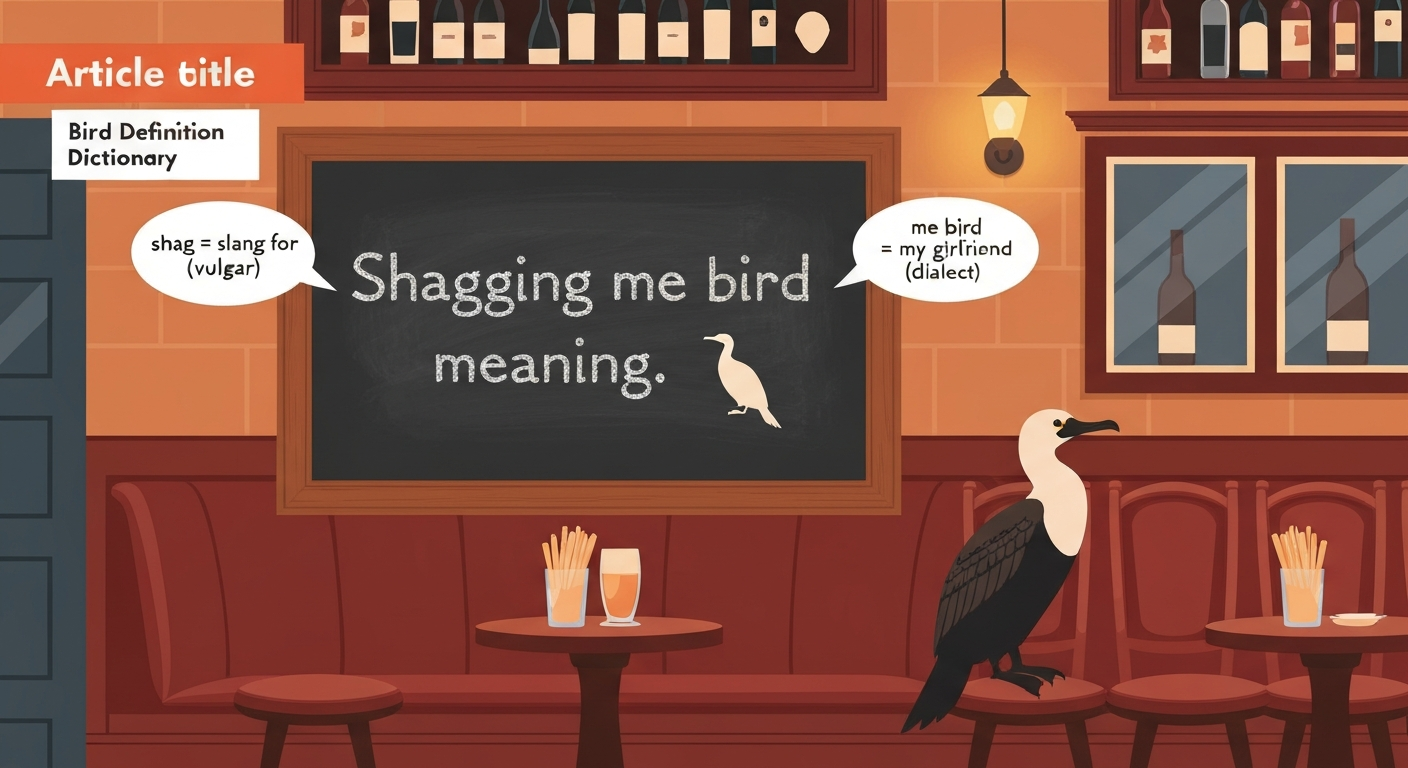
"Shagging me bird" is a British and Irish slang phrase meaning "having sex with my girlfriend" (or, more loosely, "my woman"). "Shagging" is a vulgar but widely understood verb for sexual intercourse, and "me bird" is dialectal for "my girlfriend" or "my girl," with "me" standing in for "my" the way speakers from Northern England, Scouse Liverpool, and Hiberno-English (Irish) dialects naturally say it. Hear it in a pub conversation and you'll know exactly what someone means, though the tone can range from boastful to furious to a flat-out joke depending on who's talking.
Shagging Me Bird Meaning: Slang, Origins, Examples, Cautions

Marcus Whitmore
4 Aug 2026
What the phrase means in plain terms
The full phrase, written out and unpacked, is: "[Someone is] shagging [i.e., having sex with] me [my] bird [girlfriend/woman]." It is almost always used in the first person ("me bird" = the speaker's own girlfriend or partner) and appears most often as an accusation directed at a third party, a boast about one's own situation, or a punchline in banter. It is informal and vulgar by any register standard, and falls squarely into the category of taboo slang in most dictionaries, though that does not stop it appearing in sports interviews, TV subtitles, and social media posts on a regular basis.
Breaking down "shagging": the verb
"Shag" as a verb meaning to have sexual intercourse is recorded in British and Irish informal English by all major dictionaries, including Cambridge, Collins, and Oxford Learner's, which mark it consistently as rude or vulgar. Collins describes it plainly as a taboo British slang verb meaning to have sex with someone. Oxford Learner's notes a long lexicographic history for the sexual sense, meaning this is not recent internet slang but a well-established, if coarse, entry in the English language.
It's worth flagging that "shag" has a completely separate, entirely innocent meaning as the name of a seabird, a member of the cormorant family found around the coastlines of Britain and Ireland. If you're on a birdwatching site, "shag" is just a bird. In a pub conversation, the context makes the meaning unmistakable. The seabird sense also turns up in phrases like "shag colony" in wildlife reporting, which can produce unintentionally comic headlines for those whose minds go straight to the slang.
Breaking down "bird": the slang noun
In UK and Irish English slang, "bird" frequently means a woman, a girl, or specifically a girlfriend. Cambridge Dictionary records this usage as informal British and Irish English. The Irish government's own lexical resource (Foclóir) acknowledges the informal sense of "bird" meaning a woman while also flagging that it can be considered offensive in some contexts. The Irish government's lexicon, Foclóir (Foras na Gaeilge), records an informal/very informal sense of “bird” meaning “a woman” and explicitly flags this usage as potentially offensive in certain contexts Foclóir (Foras na Gaeilge) records an informal/very informal sense of “bird” meaning “a woman” and flags it as potentially offensive in some contexts.. The word's use for women has a long history in British slang, but its acceptability is genuinely contested. A UK employment tribunal ruled that calling women "birds" in the workplace is "plainly sexist," and legal commentary following that ruling advised employers to treat the term as potentially discriminatory when used in professional settings.
In the specific context of "me bird," the possessive makes the meaning more specific: not just any woman, but the speaker's own girlfriend or female partner. The phrase is possessive and relational, not a generic label for women. That distinction matters for interpretation, though it doesn't neutralize the underlying sexist framing that critics of "bird" (for women) point to.
Why "me" instead of "my": regional dialects explained
The spelling "me bird" rather than "my bird" is what linguists call eye dialect, a written attempt to capture actual speech. Using "me" as a possessive pronoun ("me mum," "me mates," "me bird") is a well-documented feature of several English dialects. Dialectologist Peter Trudgill's work on English dialects, and phonetic research on Tyneside English (by the University of Sheffield), both record this non-standard possessive as common across Northern England, Liverpool (Scouse), Hiberno-English in Ireland, and to a lesser degree in some Australian informal registers. When you see "me bird" written down, it's almost always a signal that the speaker (real or fictional) is being placed in one of those dialect traditions, or that the writer is representing casual, working-class northern or Irish speech.
Regional and historical spread: UK, Ireland, and Australia
| Region | "Shag" (sexual sense) | "Bird" (woman/girlfriend sense) | "Me" for "my" (dialect) |
|---|---|---|---|
| Northern England (inc. Liverpool/Scouse) | Widely used, very familiar | Common and recognised | Very common; classic dialect feature |
| Southern England / London | Understood universally; somewhat less frequent | Used but increasingly contested | Less typical; mostly imported from northern dialects |
| Ireland (Hiberno-English) | Used and understood; marked as informal/taboo | Recorded as informal; flagged as potentially offensive | Common in informal speech |
| Scotland | Understood; less distinctively "Scottish" than other dialect words | Used, though "lassie" and "lass" more typical | Occurs informally |
| Australia | Understood, though American-influenced alternatives compete | Used informally in some registers | Appears in some Australian informal speech |
The phrase as a complete unit, "shagging me bird," reads and sounds most naturally as British or Irish English. Australian readers and speakers will understand it immediately, but the full collocation feels distinctly UK or Irish in flavour. The combination of the dialectal "me," the slang verb "shag," and the slang noun "bird" for girlfriend all clustering together gives the phrase a very specific sociolinguistic fingerprint.
Where the phrase comes from: etymology with appropriate caution
Pinning down precise origins for phrases like this is always tricky, and I'd rather be honest about uncertainty than give you a neat but unsupported story. What the lexicographic record does show clearly is that both "shag" (sexual sense) and "bird" (woman) have long-standing histories in English slang, not recent coinages. Oxford Learner's describes the sexual sense of "shag" as long-established in English lexicography. The "bird" sense for women appears in British slang dictionaries going back well into the 20th century. The possessive "me" for "my" is even older, reflecting phonological patterns that survive from earlier English and persist in high-frequency spoken words in regional dialects. The specific phrase "shagging me bird" is not a coined idiom with a known invention date; it's a natural assemblage of these existing slang units that turns up in TV scripts, sports commentary, and casual conversation whenever speakers draw on that dialect vocabulary.
How the phrase is actually used: intent and tone
The same four words can carry very different meanings depending on who says them, to whom, and why. Pragmatics research (the academic study of how context shapes meaning) confirms that identical wording can index completely different stances: accusation, boast, insult, or pure comedy. Here are the four main uses you'll encounter:
- Accusation: The speaker is confronting or complaining about a third party who has slept with their girlfriend. The tone is angry or aggrieved. ("He's only been shagging me bird behind me back.")
- Boast: The speaker is bragging, usually to friends, about an ongoing or new sexual relationship with their girlfriend. Tone is proud or laddish. ("Living the life, mate. Shagging me bird every weekend.")
- Insult or taunt: Directed at someone as an aggressive provocation, claiming to have had or be having sex with their girlfriend. Tone is confrontational and deliberately offensive. ("What are you gonna do about it? I've been shagging your bird.")
- Joke or punchline: Used in banter, comedy, or as a punchline with no literal claim intended. Tone is self-aware and humorous. ("What's your hobby? Shagging me bird and watching football.")
A real-world example that went mildly viral illustrates the comic register: UFC fighter Paddy Pimblett shared an anecdote about a young fan greeting him with the phrase in what was clearly an attempt at laddish banter rather than a genuine accusation. That story circulated in sports media, and the reaction was largely amused, which shows how the phrase can function as a kind of blunt comedic shorthand in certain cultural spaces. Context is everything.
Example sentences by intent and register
| Intent | Register | Example sentence |
|---|---|---|
| Accusation | Angry, informal | "I can't believe it — Dave's been shagging me bird while I was working nights." |
| Accusation | Confrontational, direct | "You've been shagging me bird, haven't you? Don't lie to me." |
| Boast | Laddish, casual | "Brilliant weekend, lads. Went the match Saturday and spent Sunday shagging me bird." |
| Boast | Playful, self-deprecating | "What have I got to complain about? Decent job, shagging me bird regular — life's alright." |
| Insult / taunt | Aggressive, provocative | "Go on then, what are you gonna do? I've been shagging your bird for months." |
| Joke / banter | Comic, self-aware | "Man of the year award goes to me. Reason? Shagging me bird and still making it to kickoff on time." |
| Misheard lyric / confusion | Bewildered, online | "Wait, did that song just say 'shagging me bird'? I've been singing the wrong words for years." |
When the phrase is offensive and what to do about it
There are a few layers to the offensiveness question here. First, "shag" as a verb is vulgar and sexually explicit regardless of context; most people would not use it in formal or mixed company. Second, referring to a woman as "me bird" or "your bird" has been ruled by a UK employment tribunal as potentially sexist, specifically because it reduces a woman to a possessive object labeled with an informal animal-derived term. Legal commentary following that ruling advised organisations to treat the term as potentially discriminatory when used in workplaces or directed repeatedly at an employee. Interpretation and workplace implications, Independent coverage of the tribunal and pragmatics literature show that "bird" can be affectionate, neutral, or demeaning depending on register and relationship, and thus advise treating it as potentially offensive in workplace or institutional contexts Interpretation and workplace implications — Independent coverage of tribunal + pragmatics literature. Third, the taunt version of the phrase, where someone claims to have been sleeping with another person's girlfriend, is designed to be aggressive and degrading to everyone involved.
In practice: if you encounter it in a pub conversation among friends who know each other, it's probably banter. If you encounter it in a workplace, a public institution, or directed at you personally in an aggressive way, it is reasonable to treat it as offensive language. There is no single answer here because the phrase genuinely operates across a wide range of registers.
Neutral alternatives if you need them
If you want to talk about roughly the same thing without the vulgar or sexist framing, here are some register-adjusted alternatives depending on what you're actually trying to say: For another relevant comparison, see the bird and the worm the used meaning.
- "He slept with my girlfriend" — neutral, standard English, clearly understood
- "He's been seeing my girlfriend behind my back" — slightly softer, implies an ongoing situation
- "He hooked up with my partner" — informal but not vulgar; "partner" is gender-neutral
- "He's been messing about with my girlfriend" — British-sounding but avoids the explicit verb
- "He betrayed me with my girlfriend" — formal and direct about the relational harm
How this connects to other bird language and idioms
"Bird" in British slang is just one thread in a much larger web of bird-related language. The way birds get woven into idioms, slang, and symbolic meanings across English is genuinely fascinating and often surprising. The romantic and sexual side of bird language, for instance, connects directly to the tradition explored in entries about what birds and bees mean in a relationship, where birds serve as one of the two classic euphemisms for explaining reproduction and attraction to children and adults alike. That usage is softer and more metaphorical than the blunt slang of "shagging me bird," but both sit in the same broad cultural space where birds become stand-ins for human relationships and sexuality.
There's also an interesting contrast with phrases like "honey bird," where birds carry affectionate and tender associations rather than crude ones. Equally, the darker symbolic territory covered by snake and bird imagery across cultures shows how birds can represent innocence, vulnerability, or freedom depending on what they're paired with. For related cross-cultural symbolism, see the entry on snake and bird meaning which explores how snakes and birds are paired in myths and imagery. And if you've ever puzzled over a lyric or line involving birds, the kind of reading the phrase "the bird and the worm" requires (where the worm is often a metaphor for something much heavier than a garden invertebrate) shows how quickly bird language shifts between the literal and the deeply symbolic. The slang of "me bird" is working in a completely different register to all of that, but it's all part of why bird language keeps showing up in human speech: birds are small, visible, familiar, and endlessly available as metaphors. For another relevant comparison, see honey bird meaning.
Quick practical guide: how to interpret the phrase when you hear it
- Listen for tone first. Angry? It's probably an accusation. Laughing? It's probably banter or a boast. Aggressive and directed at you? It's a taunt.
- Consider the setting. A pub among friends is a different context to a workplace or a public forum.
- Note the dialect. If the speaker is clearly from Northern England, Liverpool, or Ireland, "me bird" is natural dialect; elsewhere it might be an affectation or an imitation.
- Don't assume it's literal. Especially online, the phrase often appears in jokes, memes, and comedic contexts where no actual girlfriend is being discussed.
- If it's directed at you in a way that feels like harassment, you are entitled to treat it that way. UK law supports this position.
FAQ
Quick answer — What does "shagging me bird" mean in one line?
Quick answer: In informal UK/Irish/Australian English, "shagging me bird" most commonly means "having sex with my girlfriend/partner/woman" ("shagging" = sexual intercourse; "me bird" = my woman), though literal readings (someone having sex with an actual bird) are possible but rare and usually joking; see dictionary and dialect sources for senses.
What does each word mean here — a careful word‑by‑word breakdown?
Word breakdown: "shagging" — slang/vulgar verb meaning to have sexual intercourse (recorded in major dictionaries such as Cambridge, Collins, Oxford). "me" — non‑standard spelling/pronunciation of "my" used in many regional dialects (written to represent speech). "bird" — colloquial British/Irish noun for a woman, girlfriend, or girl (informal; can be affectionate or dismissive). Together they form an informal declarative meaning someone is having sex with the speaker's female partner.
How do I tell literal versus figurative uses?
Literal vs figurative: Check context and plausibility. If said in casual conversation about a partner or as boast/insult, it’s slang for sex. If said in a wildlife or abuse report context it might be literal (though that would be an animal‑abuse claim and serious). Tone, setting (pub banter vs formal workplace), and co‑text (mentions of people vs animals) determine the reading. Pragmatics research shows identical wording can index different stances depending on context.
How is the phrase used regionally — UK, Ireland, Australia?
Regional notes: The sexual sense of "shag" and the 'woman' sense of "bird" are strongest and most idiomatic in UK and Irish English. The orthographic/phonetic "me" for "my" appears in many UK regional dialects (Northern England, Liverpool), in Hiberno‑English, and in informal Australian registers. Usage examples in media and subtitles reflect these regional patterns (see dialect studies and dictionaries).
Are there historical or origin notes I should know?
Origin notes (cautious): Dictionaries record "shag" as an old-established sexual slang sense and separately as a seabird name; the sexual sense is long attested in English lexicography. The possessive "me" reflects dialectal pronunciation preserved in writing. Exact origin of the collocation "shagging me bird" is not attributable to a single source; attested examples appear in modern dialogue, media, and online posts. (Sources: Cambridge, Collins, Oxford; dialect literature.)
When is the phrase offensive or problematic?
When offensive: "Bird" used for women can be affectionate but also sexist or demeaning depending on context, tone, frequency, and audience. In workplaces or targeted harassment it may count as sexist harassment (legal commentary and tribunal rulings have treated similar usages seriously). The sexual verb "shag" is vulgar and can be inappropriate in formal settings. Treat combination as potentially offensive in professional or mixed‑company contexts.
Next Article
What Does Bird and Bees Mean in a Relationship?
Meaning of bird and bees in a relationship, how to respond, and steps to talk about sex, attraction, and boundaries.