When someone says 'she is an early bird,' they mean she gets up early, starts things before most people do, and often gains an advantage because of it. It's a compliment most of the time, painting a picture of someone punctual, proactive, and generally ahead of the curve. The phrase works whether she's the first one at the office every morning or just the person who always snags the last good parking spot.
She Is an Early Bird Meaning and How to Use It

Marcus Whitmore
6 Jun 2026

What 'an early bird' actually means

The term 'early bird' has two closely related meanings that dictionaries have been tracking since at least 1830. Merriam-Webster gives it as (1) an early riser, and (2) someone who arrives early, especially before possible competitors. Cambridge adds a third angle: a person who does something before other people do. So it's not just about what time you roll out of bed. It carries a built-in implication of initiative, of getting somewhere or doing something while others are still warming up.
You'll also see it used as an adjective in everyday life: 'early-bird discount,' 'early-bird tickets,' 'early-bird special at the diner.' These uses reinforce the same idea that showing up early earns you something the latecomers don't get. The label carries that same logic when it's applied to a person.
What 'she is an early bird' says about her personality
Calling someone an early bird is a shorthand personality sketch. It implies she is disciplined enough to get up before she has to, organized enough to be somewhere ahead of schedule, and motivated enough to start things while others are still hitting snooze. Oxford Learner's Dictionaries even labels 'early bird' as humorous in tone, which is telling. It's the kind of thing you say with a friendly nod, maybe even a little affectionate teasing, because in most cultures there's a recognized virtue in being that person. That initiative is also the core idea behind the proverb [early bird gets the worm](/early-bird-meanings/early-bird-gets-the-wood-on-meaning), where getting there first leads to the best outcome.
Beyond just waking up early, the phrase implies she tends to take action first. She's the one who books the best table, finishes the project ahead of deadline, or arrives at the concert hall before the line forms. The personality traits bundled in here are: punctuality, self-discipline, proactiveness, and a light competitive edge. It's a flattering label, even if the person being described would rather sleep in.
The 'early bird gets the worm' connection
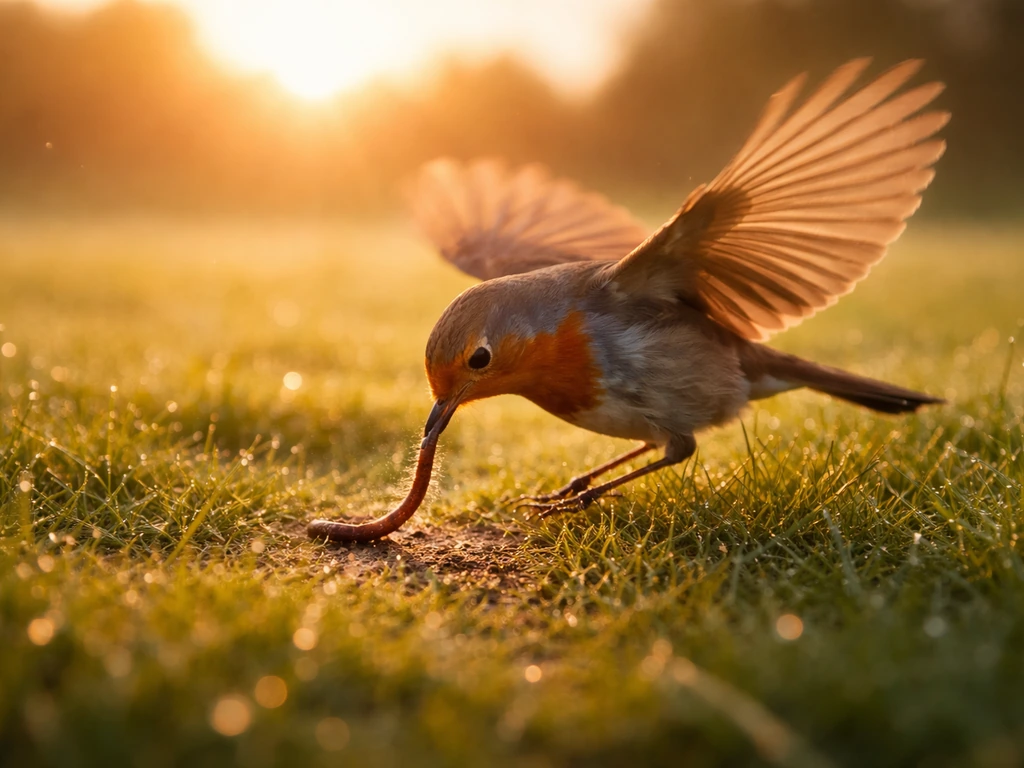
You can't talk about 'early bird' without bumping into the proverb behind it. Merriam-Webster traces the term directly to 'the early bird catches the worm,' and Cambridge defines that proverb plainly: the person who arrives first is the one who is successful. The USC Digital Folklore Archives frames it as the idea that 'a successful day starts early, before anyone else wakes up.'
When you call someone an early bird, you're invoking all of that meaning in a compact two-word package. You're not just saying she wakes up at 6 a.m. You're saying she's the bird that got the worm. She moved first, so she got the reward. The proverb has been baked into the phrase for nearly two centuries, which is why 'early bird' feels like more than just a time-of-day description. There's a whole story inside it. The sibling topic covering 'early bird gets the worm meaning' goes deep on the full proverb if you want to explore that side further.
How the phrase sounds in real conversation
The tone of 'she is an early bird' shifts depending on context, but it's almost never negative. Here are the three main flavors you'll hear it in:
- Genuine praise: 'She's always an early bird, which is why she never misses a deadline.' This is straightforward admiration for her habits.
- Affectionate teasing: 'Oh, she's such an early bird. She was already on her third cup of coffee when I walked in at 8.' This pokes fun gently, with no real criticism behind it.
- Encouraging observation: 'She's an early bird, so she'll get the good spots at the market.' Here it's almost predictive, noting that her habit will pay off.
What you almost never hear is 'she's an early bird' said with contempt. Compare that to calling someone a night owl, which is sometimes framed apologetically ('she's a night owl, so don't call before noon'). The early bird label carries cultural approval in most English-speaking contexts. It's the kind of thing that lands as a compliment even when it's delivered casually.
Examples you can use right now
Here's how the phrase works in real sentences. Notice that it fits naturally in both present and past tense, and it can describe a morning habit or a broader pattern of getting things done early.
- 'She's such an early bird. She had the whole report finished before anyone else even logged on.'
- 'I'm not surprised she got front-row seats. She's an early bird, so she was in line at 7 a.m.'
- 'My aunt is an early bird. She gardens before sunrise and has breakfast ready by the time everyone else wakes up.'
- 'If you need someone at the 6 o'clock meeting, ask her. She's an early bird and actually enjoys that time of day.'
- 'She used to be a late sleeper, but after switching jobs she became a real early bird.'
You can also flip the structure slightly: 'She's always been an early bird,' 'She's a total early bird,' or 'She's something of an early bird.' Each version works naturally in spoken English. The phrase is colloquial and flexible. Avoid using it in formal writing where precision matters more than color, but in conversation and casual prose it fits well.
Alternatives and related idioms worth knowing
If 'early bird' doesn't feel like the right fit for the moment, several close alternatives carry the same core meaning with slightly different shading.
| Phrase | Core meaning | Tone |
|---|---|---|
| Early riser | Gets out of bed early | Neutral, factual |
| Morning person | Prefers and thrives in the morning | Personality-focused, neutral |
| Lark | Up early, cheerful in the morning (British English) | Slightly poetic or playful |
| Up and at 'em | Gets going early and energetically | Enthusiastic, motivational |
| Early bird | Gets up or arrives early, gains an advantage | Warm, slightly humorous |
'Early riser' is the most direct swap and works in nearly any context where you'd use 'early bird. Cambridge Dictionary defines “early riser” as “a person who usually gets out of bed early.
”. ' Collins Dictionary uses it the same way: 'He'd always been an early riser. ' The difference is that 'early bird' carries the proverb's implication of advantage, while 'early riser' is more purely descriptive. 'Morning person' focuses on preference rather than habit.
And 'lark' is a lovely British English option that's worth knowing, though it might get you a puzzled look in some American conversations. There's also more to explore in topics like 'morning bird meaning' and 'he is an early bird figurative language' if you want to dig into related expressions.
The bottom line: 'she is an early bird' is a warm, practical idiom that tells you something real about a person's habits, their relationship with time, and often their approach to getting things done. It's friendly, it's culturally loaded in the best way, and once you know the worm story behind it, you'll never hear it the same way again. The phrase “day bird meaning” is often used online to refer to similar ideas about someone who rises and acts early early bird.
FAQ
When does “she is an early bird” sound like more than just “she wakes up early”?
Use it when the “advantage” is reasonable, not just when she wakes up early. For example, “She’s an early bird, so she always gets the best seat” makes the benefit explicit, while “She’s an early bird” alone can sound slightly incomplete if nothing changes because of the timing.
Can “she is an early bird” ever come off as rude or sarcastic?
Most of the time it is meant positively or playfully, but context can tilt it. If you say it to someone who is late and overwhelmed, it can feel like a gentle jab, so soften it with warmth like “She’s an early bird, and it helps her stay organized.”
Is it appropriate to use the phrase if she’s up early but seems tired?
Yes, but watch the framing. Calling someone an early bird when they are routinely exhausted can sound like you are praising their schedule at their expense. In that case, consider “She’s a morning person” or “She likes to start early” to avoid implying discipline at all costs.
Should I use “she is an early bird” for one day or only for ongoing habits?
You can describe patterns with “She is/was an early bird” for habits, but for a one-off event use a different structure, like “She got there early” or “She was up early today.” The idiom is best for repeat behavior.
How can I adapt the phrase when her early schedule only happens part of the time (weekdays, busy season, holidays)?
It works with seasons and schedules if you keep the idea of acting first. “She’s an early bird during busy season” or “She’s an early bird on weekdays” makes the time window clear and prevents confusion.
Is it better to use exact times instead of the idiom in workplace writing?
Avoid formal, business-technical contexts where people expect precise time language. If you need clarity, use exact timing: “She arrives at 7:30 a.m.,” then you can optionally add the idiom in casual conversation.
Do I need to add qualifiers when using it in a group setting with different time zones or schedules?
In American English, “night owl” sometimes gets a softer, humorous qualifier (like “don’t call before noon”). “Early bird” usually does not require a qualifier because it signals advantage, but if your setting is sensitive (for example, remote teams across time zones), add a specific reason for why early is helpful.
What’s the difference between “early bird” and “early riser” when describing someone?
“Early bird” and “early riser” overlap, but “early bird” commonly carries the “gets the benefit because she moves first” vibe. If you want to emphasize preference without the advantage, “early riser” or “morning person” is usually the safer choice.
Can I use “early bird” figuratively for school or work progress, not literally mornings?
Yes, as long as the target behavior fits “arrives/starts before others.” For example, “She’s an early bird with deadlines” can work, but avoid using it for unrelated traits like personality in general unless there is a time-related action behind it.
How do I know whether “she is an early bird” is the right idiom for what I mean?
A quick check is to ask, “Is she consistently doing something first, and does that lead to a better result?” If the answer is yes, the idiom fits. If not, rephrase to something like “She tends to arrive early” or “She’s motivated to start ahead of time.”
Next Article
He Is an Early Bird: Meaning, Figurative Use, and Nuances
Understand he is an early bird figurative meaning, context, and how it differs from related phrases and idioms.