If you searched 'flicker bird meaning,' you're most likely asking about one of two things: the Northern Flicker, a striking North American woodpecker (Colaptes auratus) with real symbolic weight in Indigenous traditions and modern spirituality, or the word 'flicker' itself as a metaphor for brief, unstable, or intermittent presence. Both are worth unpacking, and honestly they connect in interesting ways. This guide covers both angles so you can take whichever meaning actually applies to your situation.
Flicker Bird Meaning: Northern Flicker Symbolism and Sightings

Marcus Whitmore
15 May 2026
First, let's clarify what 'flicker bird' actually refers to
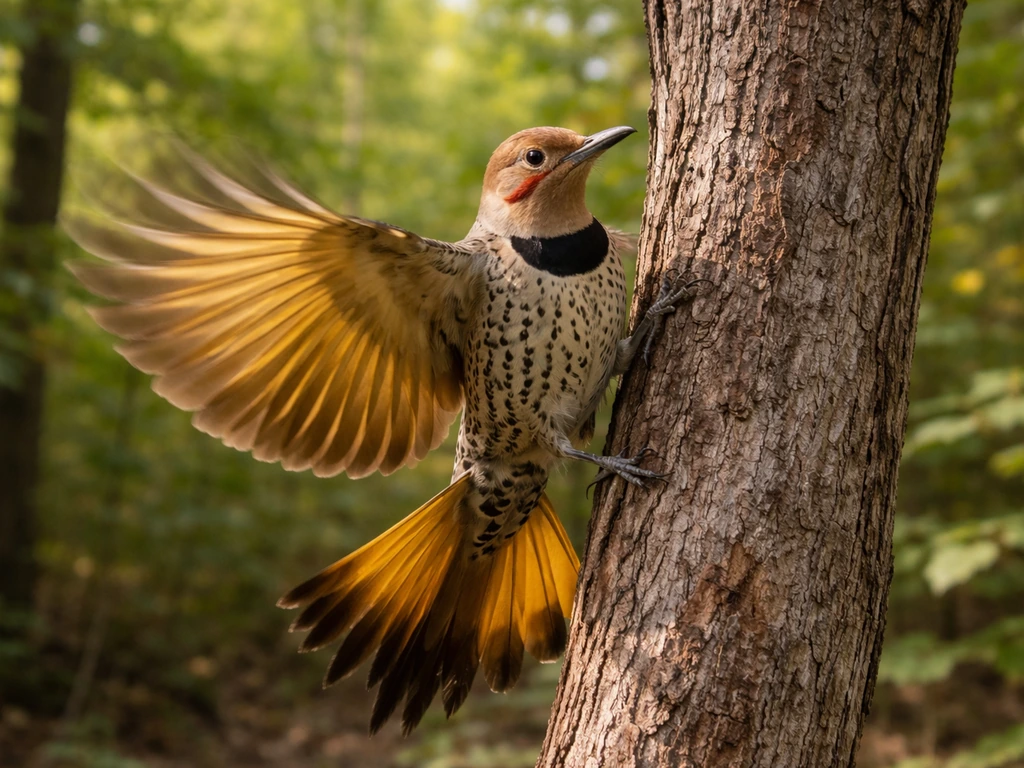
The Northern Flicker is a real, specific bird species. In everyday birding shorthand, people call it simply 'the flicker,' which is where the search term 'flicker bird' comes from. It belongs to the woodpecker family and is one of the most recognizable birds in North America. Some readers might arrive at this topic thinking 'flicker' is just a poetic or metaphorical word for a fluttering, briefly visible bird in general, but it's actually a proper common name with a specific species behind it.
That said, the word 'flicker' does carry a well-established metaphorical meaning in English, independent of the bird. Merriam-Webster defines it as a sudden brief movement or a momentary variation in light or appearance, and Cambridge Dictionary gives examples like candles flickering in a breeze. Merriam-Webster defines flicker as a sudden brief movement or momentary variation in light or appearance defines it as a sudden brief movement or a momentary variation in light or appearance. So when you encounter 'flicker' in a poem, a dream, or a phrase someone says to you, it might be drawing on the bird's symbolism, or it might be invoking that sense of brief, unsteady presence. Sometimes it's both at once.
The Northern Flicker: what it looks like and where you'll find it
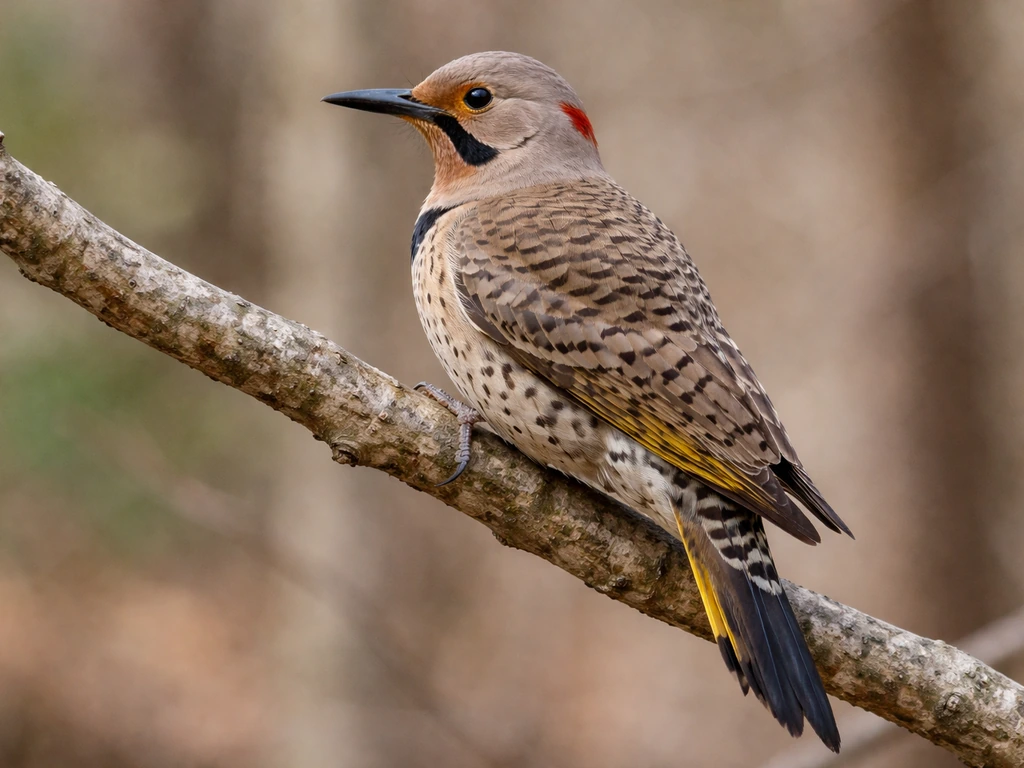
The Northern Flicker is a fairly large woodpecker, running about 11 to 12 inches long with a wingspan of 17 to 20 inches and weighing in around 4 to 6 ounces. It has a slim, rounded head, a slightly downcurved bill, and a long tail that tapers to a point. The overall body is brown and heavily barred, but the real showstoppers are the field marks you catch in flight: a bright white rump flash and, depending on where in North America you are, either vivid yellow or vivid red under the wings and tail.
Eastern birds (the 'yellow-shafted' form) show bright yellow under the wings and tail, while western birds (the 'red-shafted' form) flash salmon-red in the same spots. That sudden burst of color as the bird takes off is part of what makes it so visually arresting, and it's relevant to the symbolism too. Both forms also have distinctive head markings, including a red or black 'mustache' stripe and a spotted breast that gives it a polka-dotted belly look up close.
One thing that makes flickers unusual among woodpeckers is that they spend a lot of time on the ground. They forage primarily for ants and beetles by probing the soil, so you'll often see them in open or semi-open habitats: grassy areas, open woodlands, parks, suburban yards, and along roadsides in forested areas. The U.S. National Park Service also notes that Northern Flickers are unusual among woodpeckers because they forage primarily on the ground for ants and beetles and are often spotted in semi-open areas along forest roads semi-open habitats: grassy areas, open woodlands, parks, suburban yards, and along roadsides in forested areas. They need at least some open ground to feed. When they do go to trees, you might hear their loud, rapid drumming, about 25 strikes per second in one-second bursts, which can sound almost metallic when they choose a drainpipe or gutter over a tree trunk.
What the flicker symbolizes: themes across cultures and traditions
Across different cultural and spiritual traditions, the Northern Flicker consistently shows up as a symbol of a few interconnected themes. No single interpretation is 'the correct one,' but there's a recognizable cluster of meanings that makes sense when you look at the bird's actual behavior and appearance.
- Awareness and emotional grounding: the flicker's habit of staying close to the earth, literally feeding on the ground, maps onto ideas of staying present and grounded rather than flying above your problems.
- Wisdom and good fortune: the Cheyenne held the flicker as a symbol of wisdom and good fortune, and that association appears across several Plains traditions, often connected to the bird's striking colors being seen as a sign of something significant.
- Persistence and self-expression: the flicker's drumming, loud and rhythmic and hard to ignore, is frequently used as a metaphor for the importance of making yourself heard even in environments that aren't set up for you. Woodpeckers are persistent by nature; flickers especially so.
- Change and transition: the flicker's sudden flash of color when it takes flight, here and then gone, is easy to read as a symbol of brief but important moments of change or illumination.
- Movement between worlds: in some Indigenous storytelling contexts, birds that move between ground and sky, like the flicker does, carry associations with bridging different states of being or carrying messages between realms.
These themes aren't exclusive to any one culture, and they're not scientifically provable. They're frameworks that people find genuinely useful for reflection, and understanding where they come from makes them more meaningful rather than less.
How 'flicker' works as a word in language and metaphor
Even outside the bird context, 'flicker' is a rich word in English. It describes something that's present but unstable, visible but fleeting, alive but barely. 'A flicker of hope,' 'a flicker of recognition,' 'the candle flickered and went out.' These phrases use the word to describe something that could go either way, a possibility that hasn't fully arrived yet. That's a distinct but complementary meaning to the bird symbolism.
In writing, poetry, or storytelling, when someone uses 'flicker' in a bird-adjacent context, they're often layering both meanings intentionally. The actual Northern Flicker's flash of color in flight is almost literally a flicker in the visual sense, so writers working with bird imagery find it unusually on-the-nose. If you're reading a passage where a flicker appears, it's worth asking whether the author is signaling a moment of brief insight, a warning, or a transition that's fragile but present.
It's worth noting that 'flicker' as a metaphor lives in a different neighborhood than expressions like 'flipping the bird' or 'flip the bird,' which are slang gestures with no connection to the Northern Flicker at all. Those phrases are about an entirely different kind of bird-related expression. The flicker as a metaphor is softer, more introspective, and almost always about something transient or just-barely-there.
What to make of a flicker sighting (without overdoing it)
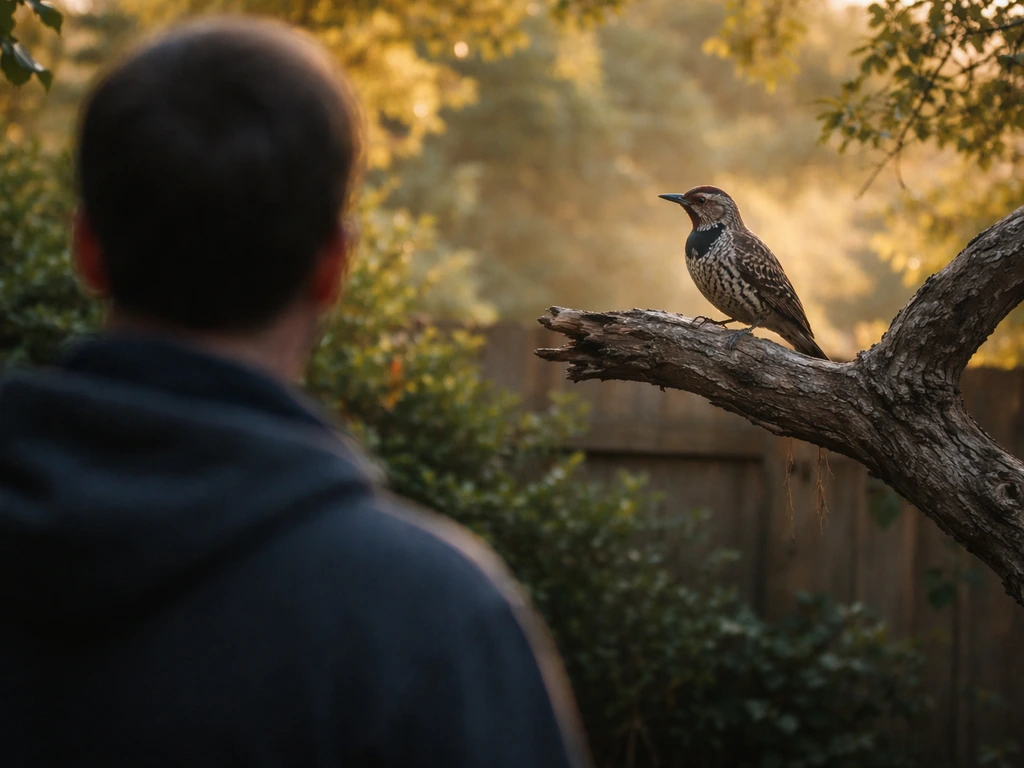
A lot of people search for 'flicker bird meaning' because they just saw one and felt like it meant something. If you meant the phrase “flip me the bird meaning,” that’s a different expression altogether, usually tied to sarcasm or dismissal rather than the symbolism of a Northern Flicker flicker bird meaning. That's a completely reasonable instinct. The honest answer is: it might mean something personally significant to you, or it might just be a woodpecker looking for ants. Both can be true at the same time.
The most useful approach here is to treat the sighting as an invitation to reflect rather than as a guaranteed sign. Ask yourself what was happening in your life when you saw it. Were you thinking about a decision you've been putting off? Feeling stuck or restless? Noticing something you've been ignoring? The flicker's symbolic associations with awareness, persistence, and transition can serve as useful prompts for whatever's already on your mind. That's not magical thinking; it's just using a striking natural moment as a reflective anchor.
If you dreamed about a flicker, similar principles apply. WebMD's guidance on dream interpretation is clear that dream dictionaries aren't precise diagnostic tools, and the Cleveland Clinic notes that dream meaning is deeply subjective. What matters most is what the bird meant to you in the dream, how it felt, and what associations it brings up personally. Journaling the details right after waking is the most practical thing you can do to work with it.
How to confirm you're actually looking at a flicker
Before you lean into the symbolism, it helps to know you're actually seeing a flicker and not a similar species. Here are the key field marks to look for:
| Feature | What to look for |
|---|---|
| Size | Larger than a robin, smaller than a crow: about 11–12 inches long |
| Wing/tail flash in flight | Bright yellow (East) or salmon-red (West) under the wings and tail |
| Rump | Distinctive white rump patch visible from behind in flight |
| Belly | Heavily spotted with black dots on a tan/buff background |
| Bill | Slightly downcurved, not as straight as most woodpeckers |
| Behavior | Frequently on the ground, probing for ants; also drums loudly on trees or metal |
| Habitat | Open or semi-open areas: yards, parks, roadsides, open woodlands |
The bird most commonly confused with a flicker is the red-bellied woodpecker, which is smaller and has a barred black-and-white back without the flicker's spotted belly or colored wing shafts. Pileated woodpeckers are another comparison point: they're much larger and have a dramatic red crest. If your bird was on the ground, that alone is a strong flicker indicator, since most woodpeckers stick to trees.
How to actually use this meaning: writing, dreams, and reflection

If you're a writer using flicker imagery in a story or poem, the bird gives you a lot to work with. Its visual flash suggests revelation or a moment of sudden clarity. Its ground-feeding habit suggests someone who stays rooted even when their talents are unusual or unexpected. Its drumming persistence suggests a character who keeps making themselves heard even when the environment resists them. You don't have to use all of these at once; pick the one that fits your narrative and build from there.
If you're working through a personal experience and a flicker sighting or dream felt significant, try writing down exactly what you noticed: the colors, what the bird was doing, where it showed up, and what you were thinking about at the time. Then map those details against the symbolism themes above. The awareness and grounding theme is probably the most universally applicable, since flickers literally stay close to the earth while being capable of dramatic color and sound. That tension between being grounded and being vivid is worth sitting with.
If the word 'flicker' appeared in a phrase or expression you're trying to understand rather than a literal bird sighting, revisit the metaphor section above. In some slang contexts, people also ask about the “flip them the bird” meaning, which is about telling someone off flip them the bird meaning. A flicker in language almost always signals something fragile, brief, or at the edge of disappearing. That meaning is consistent whether it shows up in a poem, a conversation, a lyric, or a piece of dialogue, and it's worth reading it with that lens of 'almost, but not quite there yet. You may also be wondering about the phrase “flip a bird” meaning, which is a totally different kind of expression than “flicker” symbolism flip a bird meaning. '
From here, the best next steps are simple: if you want to go deeper on bird symbolism, explore other entries on species that carry similar themes of transition and persistence. If you're curious about the phrase-level meanings of bird-related expressions more broadly, entries on idioms like 'flip the bird' and related expressions are a good contrast because they show how differently the same word 'bird' can operate in English depending on context. And if you're doing ongoing reflection work, give yourself a few days after a sighting or dream before drawing firm conclusions. The meaning tends to clarify on its own.
FAQ
How can I tell whether I actually saw a Northern Flicker (not a red-bellied or other woodpecker) when I’m trying to interpret it spiritually?
Use two quick checks: look for the spotted belly look and the colored wing or tail shaft flashes in flight. Also, if it spent a lot of time probing the ground for ants or beetles, that strongly favors Northern Flicker over species like red-bellied or pileated, which are less often “ground heavy.”
If “flicker” is a metaphor, how do I decide whether the meaning should be about the bird or about brief, unstable presence?
Ask what context delivered the word. If you saw the bird itself, your interpretation can lean on the creature’s behavior (ground foraging, bold color flash). If the word appeared in a sentence, poem, or dream, focus on whether it described something momentary or wavering, since the metaphor often carries that meaning independently of the species.
What if I only saw the bird once and it was gone quickly? Does that make the “flicker” sign stronger or weaker?
A fleeting sighting usually fits the metaphor side (brief, at-the-edge-of-arriving), but it does not automatically increase “significance.” Treat it as a prompt to review what was on your mind at that moment, rather than assuming the intensity of the sighting changes the reliability of the message.
Are Northern Flickers more likely to appear during certain seasons or times that could affect “meaning” I attach to the sighting?
Yes, their visibility often changes with daylight and habitat activity. If you mainly notice them in warmer months when ground foraging is more frequent, that can explain repeat sightings without any special omen. If you see one in an unusual time or place, that is the moment to reflect more specifically on why it stood out.
What are common mistakes people make when interpreting a “flicker bird” sign?
Two frequent errors are over-literalizing (assuming one sighting guarantees a specific outcome) and ignoring practical context (weather, nearby food sources, or migration timing). A better approach is to write down what you felt and what decision or concern was active, then map that to themes like transition, persistence, or awareness.
If the flicker showed up while I was stuck on a decision, what’s a practical way to respond without turning it into magical thinking?
Use it as a timing cue for action: identify the smallest next step you can do in 24 to 72 hours. The “persistence and groundedness” angle fits especially well when you choose a concrete move, like making a call, testing a plan, or reducing one obstacle.
How should I interpret it differently if the flicker was heard (drumming) but not seen clearly?
Hearing without seeing can shift your focus toward persistence and being “noticeable” even when you are partially obscured. If the drumming drew your attention, interpret that as a nudge to keep engaging with something rather than waiting for perfect clarity.
Can dream interpretations based on a flicker be useful if I do not know what I felt in the dream?
It’s still useful, but you need a small recall process. Look for details that are measurable to you (color flashes, whether it was on the ground, how you felt in the scene). The emotional tone is often the deciding factor, so if you truly cannot recall feelings, re-interpret from the actions you remember (movement, urgency, hesitation).
What should I do if I’m worried I’m misreading “flicker bird meaning” because of slang (like ‘flip the bird’)?
Separate “flicker” from “flip” early. Northern Flicker symbolism is about a specific bird and a metaphor for brief, wavering presence, while “flip the bird” is an insult gesture with a different intent. If your source phrase includes “flip” or “bird” as a standalone gesture, it likely is not related to the Northern Flicker.
If I want to confirm the bird species after the fact, what evidence should I record from the sighting?
Record the basics immediately: location type (yard, road edge, open woodland), time of day, whether it was on the ground, and any visible field marks (rump flash, wing or tail shaft color, spotted belly look). Even one or two remembered colors can make your identification much more reliable later.
Next Article
Flip Me the Bird Meaning: What It Says and How to Respond
Meaning of flip me the bird and the gesture, plus how to respond and de-escalate in real conversations.