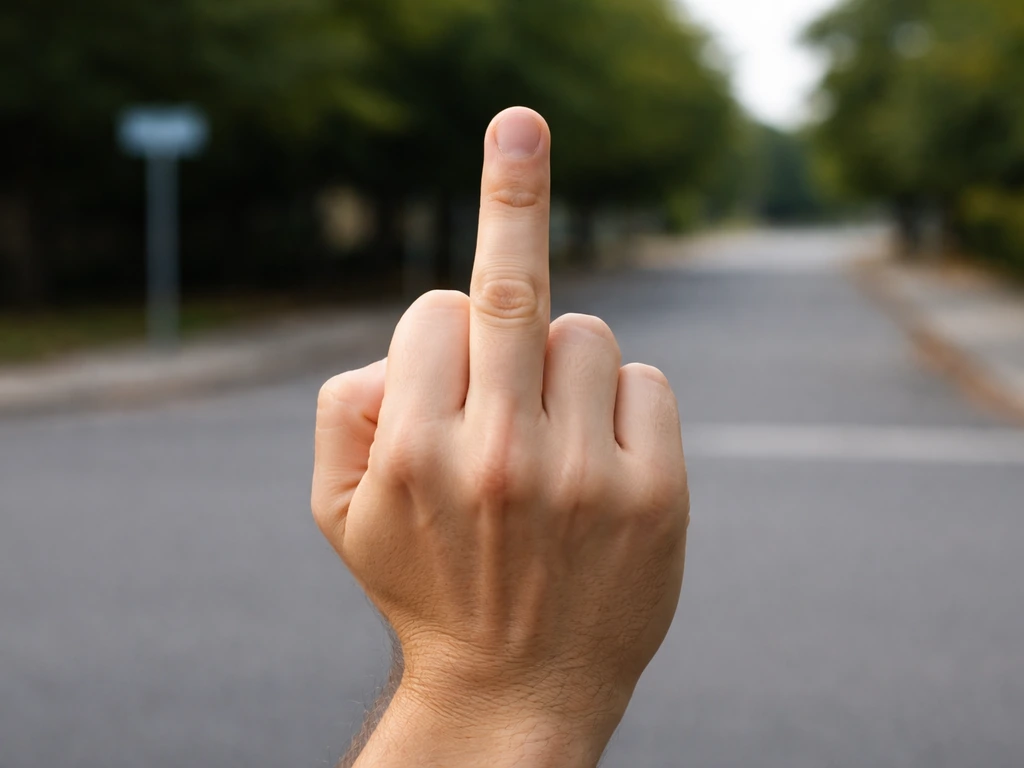
"Flip a bird" means to make the middle-finger gesture at someone: raising the middle finger from a closed fist, back of the hand facing outward, directed at a specific person. It is a deliberate act of contempt, roughly equivalent in meaning to saying "screw you" or "go to hell." Merriam-Webster defines it plainly as showing contempt or anger by turning the back of your hand toward someone and putting your middle finger up. That is the whole gesture, and the phrase "flip a bird" (or more commonly "flip the bird" or "flip someone the bird") is simply the idiomatic English name for doing it.
Flip a Bird Meaning: Rude Gesture Explained and Context

Marcus Whitmore
16 Apr 2026
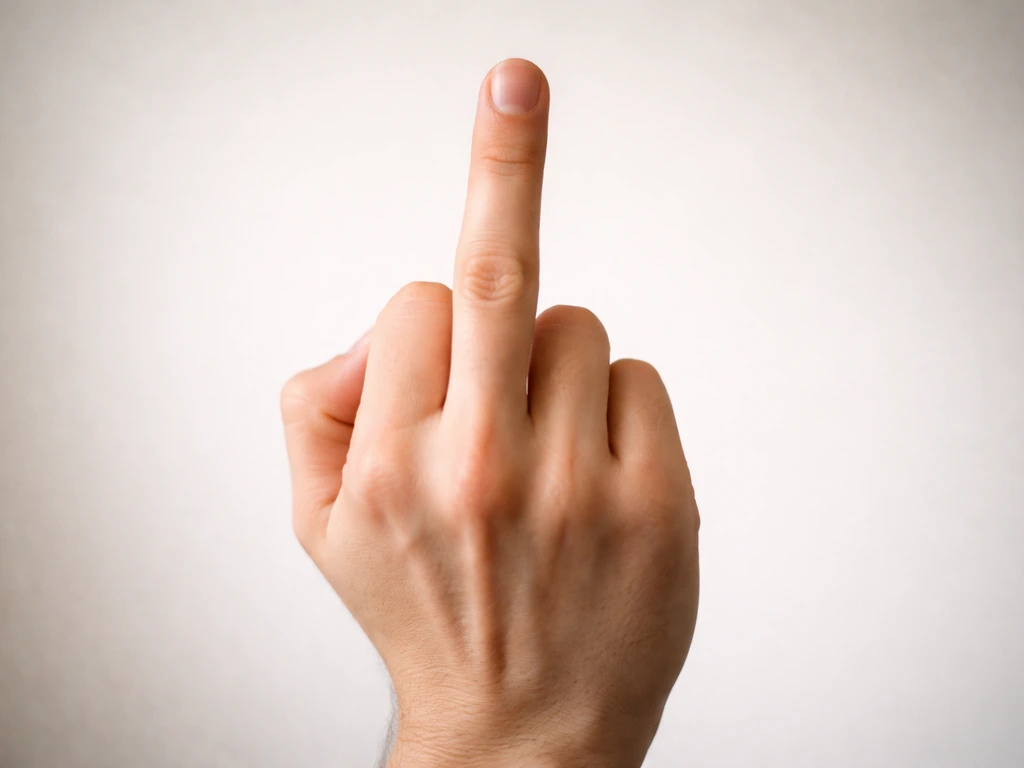
What "flip a bird" actually means
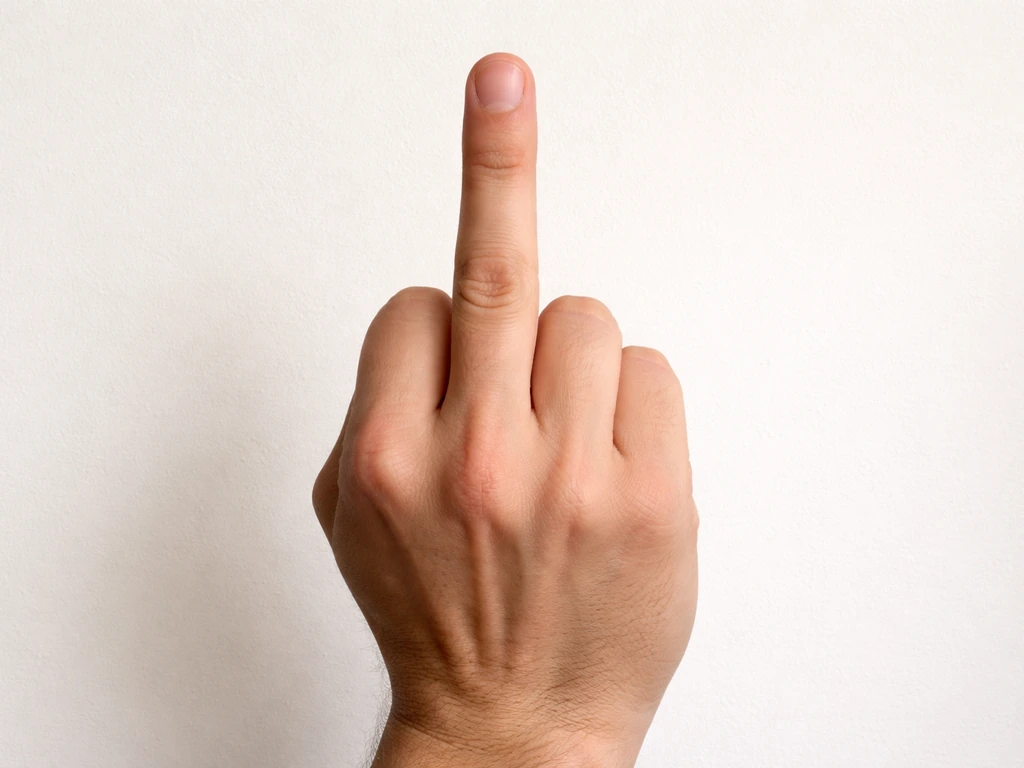
The phrase describes both the physical action and the social message behind it. The physical action is precise: the middle finger extends fully upward while the other fingers curl into the palm, and the back of the hand faces the target. The social message is contempt, hostility, or dismissal. Cambridge Dictionary frames it as something done to show annoyance or contempt toward a person, and Collins describes it as a vulgar gesture of anger and contempt. None of those definitions leave much room for ambiguity. When someone "flips a bird" at you, they are not paying you a compliment.
It is worth knowing the small but real difference between the most common variants. "Flip a bird," "flip the bird," and flip me the bird all describe the same gesture. The "a" version tends to show up in casual speech or when describing the act in the abstract ("he flipped a bird at the referee"), while "flip the bird" and "flip someone the bird" are slightly more standard. The underlying meaning does not change.
What it communicates in conversation
The gesture is a non-verbal stand-in for some of the strongest insults in English. Wikipedia's summary of the finger gesture notes it is roughly equivalent in meaning to "fuck you" or "go fuck yourself," and a law professor quoted by NPR characterized it as an expression of frustration, rage, anger, protest, and disdain. That range is actually useful to keep in mind: it covers everything from someone blowing off steam at a slow driver to a genuinely hostile confrontation.
Tone and intent are everything here. In some friendships, people "flip each other off" as a form of affectionate ribbing, the same way people mock-insult each other in banter. In those cases, no one is genuinely offended because both people understand the register. But the default interpretation should always be hostile unless you have strong evidence otherwise. When a stranger, coworker, or someone you barely know directs the gesture at you, it is an insult, full stop.
Where you'll actually see and hear it

Real-world examples turn up in exactly the situations you would expect. The Guardian covered a story about an MLB player named Tyler Collins who flipped the bird at his own fans during a game, which made headlines precisely because the gesture was so deliberate and public. Sports Illustrated described the same event as Collins extending the middle finger toward fans, linking it to a broader history of similar gestures in professional sports. Both reports used "flipping the bird" as the standard shorthand, which tells you how established the phrase is in everyday English journalism.
Outside of sports, you will encounter the phrase in arguments and road rage incidents, in film and television where it is used for comic or dramatic effect, and increasingly in online spaces. People use the phrase in text conversations ("she literally flipped the bird emoji at me") or describe the gesture in social media posts when recounting a confrontation. In those digital contexts, the phrase functions as a shorthand for hostility even when no actual gesture is visible.
Why is it called a "bird"?
This is the part that gets genuinely interesting from a language standpoint. The connection between a bird and a middle finger is not obvious, and the etymology has a few competing threads. The most widely cited linguistic trail runs back to the mid-1800s, when "give the big bird" was a British music-hall phrase meaning to hiss and boo a performer off stage. The "big bird" there referred to a goose's hiss, which sounds a bit like a crowd jeering. Over time, "getting the bird" came to mean being dismissed or rejected.
By the mid-20th century, that dismissive meaning fused with the emerging slang for the middle-finger gesture itself. Green's Dictionary of Slang traces "flip the bird" to around 1959, and the OED and Historical Dictionary of American Slang cite the "one-finger salute" from 1966 onward. So "bird" in this phrase is not really about any specific species. It is slang built on slang: the original theatrical hiss, layered with a newer gesture that carried the same message of contempt and dismissal. If you are curious about how the same word "bird" shows up in other unexpected linguistic corners, the flicker bird meaning is a good reminder of how differently the word functions when it actually refers to a species versus when it drifts into idiom.
Related phrases and what gets confused
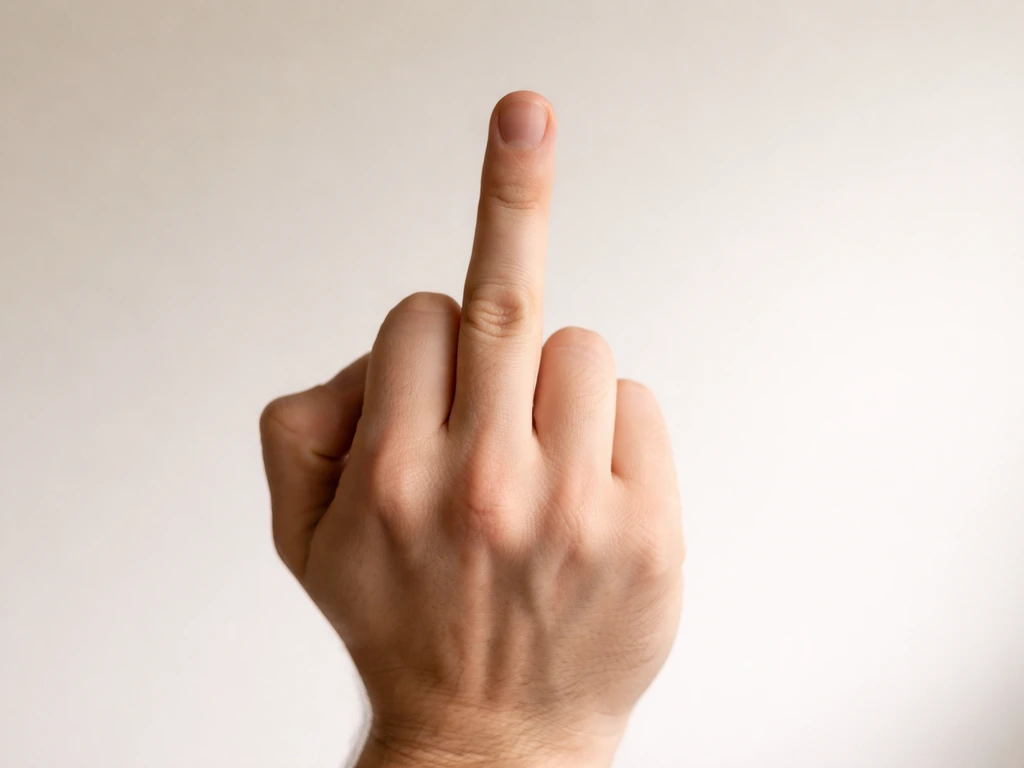
"Flip a bird," "flip the bird," "give the finger," "give the middle finger," "flip someone off," and "the one-finger salute" all refer to the same gesture. They are interchangeable in meaning even if they differ slightly in how they are phrased. Flipping the bird meaning covers exactly the same ground as "flip a bird" meaning, so if you have seen both phrasings and wondered whether they differ, they do not.
The one phrase people sometimes confuse with this is "flip someone the bird" directed at a group, as in flip them the bird meaning. Again, same gesture, same meaning, just with a different pronoun indicating who received it. There is no gestural variation involved.
A genuinely different question is what does flip the bird mean when the phrase shows up in written text without surrounding context. In most cases it still refers to the middle-finger gesture. You would only interpret it differently if the surrounding text were clearly about actual birds, in which case "flip" might describe the motion of a bird changing direction in flight, but that reading is rare and would be very obvious from context.
How offensive is it, really?
By most cultural standards in English-speaking countries, this gesture sits near the top of the rudeness scale. It is not a mild insult like rolling your eyes. In the United States, the United Kingdom, Canada, and Australia, it is broadly understood as a serious act of disrespect, and deploying it in a workplace, toward a stranger, or in a public setting carries real social consequences. The NPR-cited law professor's argument that it has lost its obscene classification in a strict legal sense does not mean it has lost its punch socially. Most people who receive it feel genuinely disrespected.
Cultural variation is real but limited. Wikipedia's overview of obscene gestures notes that in countries like India, Pakistan, and Sri Lanka, the middle-finger gesture carries a similar insulting meaning in social circles exposed to Western culture, though it may be less universally recognized in rural or older populations. In parts of Europe, different gestures carry equivalent weight (the forearm jerk, for instance, in France or Italy), and the middle finger may be recognized but not always feel as visceral. That said, if you are in any doubt, assume the gesture is offensive. The risk of assuming it is not offensive and being wrong is much higher than the risk of treating it as rude when the other person meant it playfully.
Online use adds another layer of complexity. When someone sends the middle-finger emoji or types "I flipped you off" in a comment thread, the legal and platform-level treatment depends on context and jurisdiction. In the UK, for example, the Crown Prosecution Service has guidance on communications that are "grossly offensive," meaning repeated or targeted hostile gestures communicated digitally can cross into actionable territory depending on the circumstances.
How to respond (or not respond)
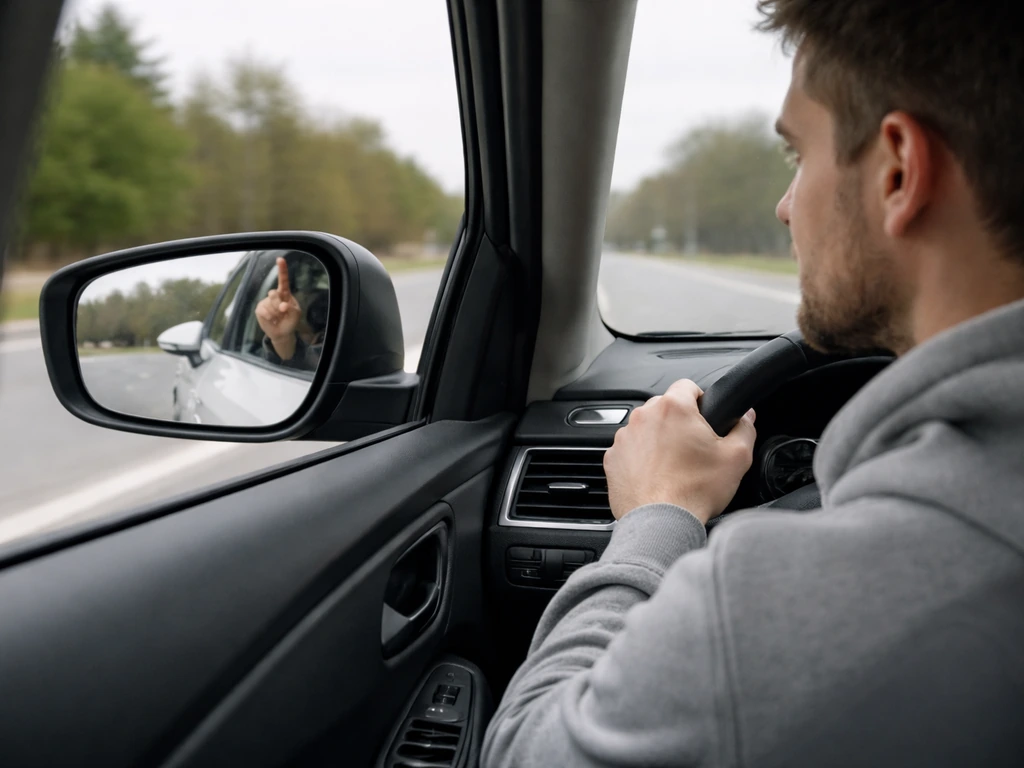
If someone flips a bird at you in person, your best move is almost always to disengage. Escalating with your own gesture or verbal response rarely ends well, and in road-rage situations it can genuinely become dangerous. Take a breath, recognize that the other person is expressing frustration or hostility, and move on. That is not passive; it is practical.
If it happens online, the guidance from Harvard's digital safety research is clear: responding to online harassment can prolong and inflame the incident. The recommended steps are to mute or block the person involved and to document what happened before removing it. The Cyberbullying Research Center reinforces the same approach, specifically advising that you report abusive behavior to the platform, network, or service provider rather than retaliating or simply ignoring it. Right To Be's guidance adds that involving bystanders to help report the behavior to the platform is often more effective than a solo report.
Here is a practical rundown of what to do depending on the situation:
- In person: disengage, do not escalate, remove yourself from the situation if possible.
- On the road: do not make eye contact, do not gesture back, keep driving.
- At work: treat it as a formal conduct issue and document it immediately; report to HR.
- Online: screenshot the post or message first, then mute or block the person, then report to the platform.
- In a media or entertainment context: recognize it as a scripted or staged moment rather than a real-world insult directed at you.
Better ways to express frustration
If you are tempted to flip a bird at someone yourself, it is worth pausing for a second to consider what you actually want to communicate. The gesture signals contempt, but contempt almost never moves a conversation forward. If you are genuinely angry, words tend to be more effective than gestures, both for making your point and for protecting yourself from the fallout.
| Instead of... | Try this | Why it works better |
|---|---|---|
| Flipping the bird at a driver | Honk once and move on | Communicates annoyance without inviting escalation |
| Sending a middle-finger emoji online | State clearly what the other person did that was wrong | Keeps the record on your side if reporting is needed |
| Gesturing at a coworker | Ask for a direct conversation or go to HR | Creates a paper trail and keeps you protected |
| Venting frustration at a stranger | Walk away and vent to a friend later | Zero risk, same emotional release |
The phrase "flip a bird" is colorful, historically layered, and deeply embedded in English slang. But in real life, the gesture it describes is one of the bluntest tools in the social toolkit. Knowing what it means, where it came from, and how to handle it when it comes your way gives you a much cleaner path through the situations where it shows up.
FAQ
Is “flip a bird” less offensive than “flip the bird” or “flip someone off”?
In most everyday English contexts, “flip a bird” and “flip the bird” are the same insult, but the wording alone does not make it less hostile. If the gesture is directed at a person, treat it as contempt, even if the speaker uses a “milder” phrasing in text.
What if someone says they’re “just joking” when they flip a bird at me?
Yes, because the key meaning is the hand signal itself. Even if someone captions it with “just joking,” a stranger or coworker who targets you with the middle finger is still communicating hostility, not a harmless meme.
How should I interpret “flip the bird” in a written post or news caption with no context?
If you hear or read the phrase in a sports or entertainment recap without a video, assume it still refers to the middle-finger gesture, unless the surrounding sentence is clearly about birds. Journalists use “flip the bird” as shorthand even when no bird is visible.
Does “flip them the bird” mean a different gesture than “flip someone off”?
If the gesture is toward a whole group (fans, a crowd, passengers), it’s still the same middle-finger signal, just with a broader target. The pronoun change often reflects who is being addressed, not any different body motion.
If someone says “I flipped a bird at you” online, does that always mean an actual emoji or image was posted?
Often, yes. People may use the phrase to describe online behavior even when they did not post the emoji or finger picture. In that case, “flip a bird” functions as a verbal label for the harassment, and the safest response is to document and report rather than debate meaning.
What’s the safest way to respond if it happens at work or in public?
If you want to respond without escalation, a short, neutral statement like “I’m not okay with that” plus disengaging is usually safer than sarcasm or a counter-gesture. In workplace settings, it also helps to keep records of date, platform, and exact wording.
Can “flipping the bird” lead to real consequences like discipline or complaints?
In the workplace and in schools, it can be treated like harassment or misconduct depending on who directed it, frequency, and whether it created a hostile environment. Even if it is “one incident,” it can still trigger consequences when it targets a person repeatedly or publicly.
Could “flip a bird” ever be non-hostile in real life?
The middle finger is sometimes used in staged contexts, like acting, protests, or coordinated social media posts, but “staged” is only a reasonable assumption when you have strong contextual signals (costume, filming crew, explicit protest message, or a clear caption explaining it). Default to offense if you do not.
How do I judge whether an online “flip the bird” comment is serious enough to report?
If you’re unsure whether a post is “grossly offensive,” look for targeting and intent cues, such as naming you, replying directly to you, or pairing it with threats. Strong targeting plus repetition is the part that typically makes it more reportable than a single vague insult.
What should I document if I need to report an online harassment incident involving “flip the bird” language?
Muting or blocking can reduce exposure quickly, but you should still document first (screenshots, URLs, timestamps) because platforms can remove content. Reporting works best when you include the exact quote and show it was directed at you or your account.
Next Article
What Does Flip the Bird Mean? Gesture and Usage Explained
Learn what flip the bird means, the rude insult gesture behind it, when people use it, and how to respond safely.