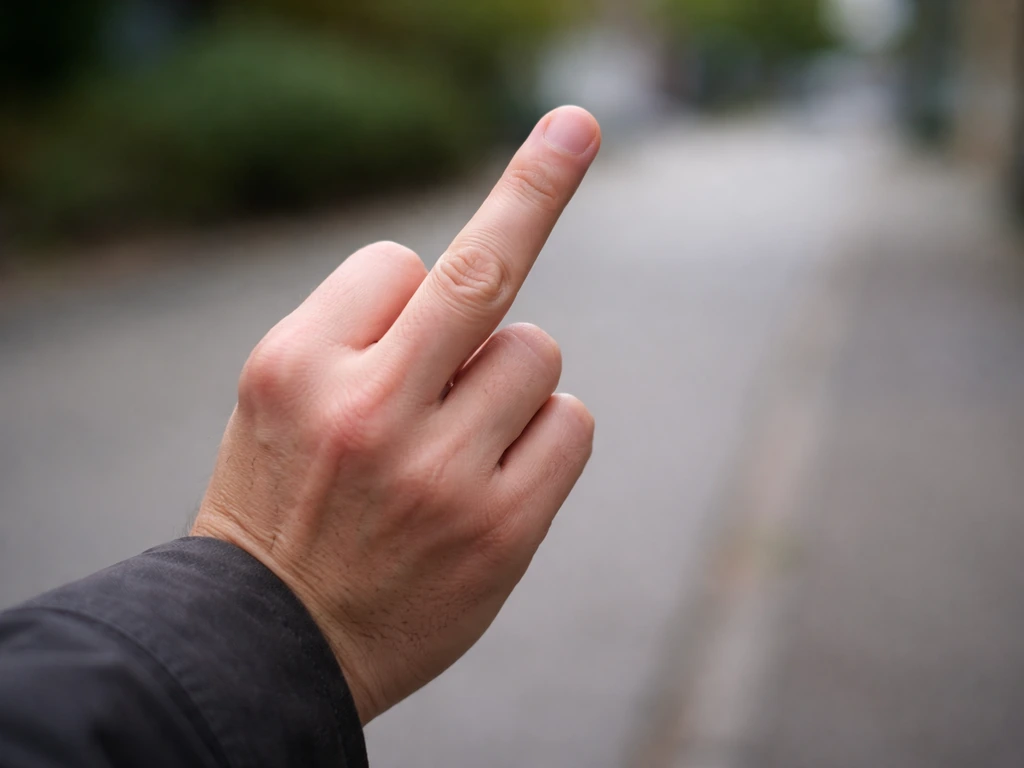
To flip someone the bird means to raise your middle finger at them while keeping your other fingers curled down, a gesture that signals contempt, anger, or defiance. For a concise explanation of the phrase and its usage, see flip the bird idiom meaning. It is US slang at its core, though the expression is widely understood in English-speaking countries worldwide. Merriam-Webster defines it plainly as "to make an offensive gesture at (someone) by pointing the middle finger upward while keeping the other fingers folded down," and Cambridge Dictionary lists it as informal, chiefly American, equivalent to "flip someone off" or "give someone the finger."
Flip Someone the Bird Meaning: Gesture, Origin & Usage Tips.

Marcus Whitmore
13 Jul 2026
Quick definition: what 'flip someone the bird' means
The phrase functions both as a description of a physical act and as a standalone idiom. You can say someone "flipped him the bird" to describe the actual gesture, or you can use it more loosely to mean they showed contempt in a pointed, unmistakable way. Collins Dictionary records the phrase as US and Australian informal, noting it is synonymous with "give the bird" and "give the finger." The word "bird" here is essentially slang for the middle finger itself, so the gesture and the idiom are inseparable.
A few quick example sentences help clarify how the phrase actually moves through speech and writing: "She flipped the cab driver the bird when he cut her off." "He got suspended for flipping his teacher the bird." "I was so frustrated I nearly flipped the whole traffic jam the bird." In each case the meaning is clear: one person directed an offensive middle-finger gesture at another, usually out of irritation, anger, or contempt.
The physical gesture: how it's performed and what it looks like
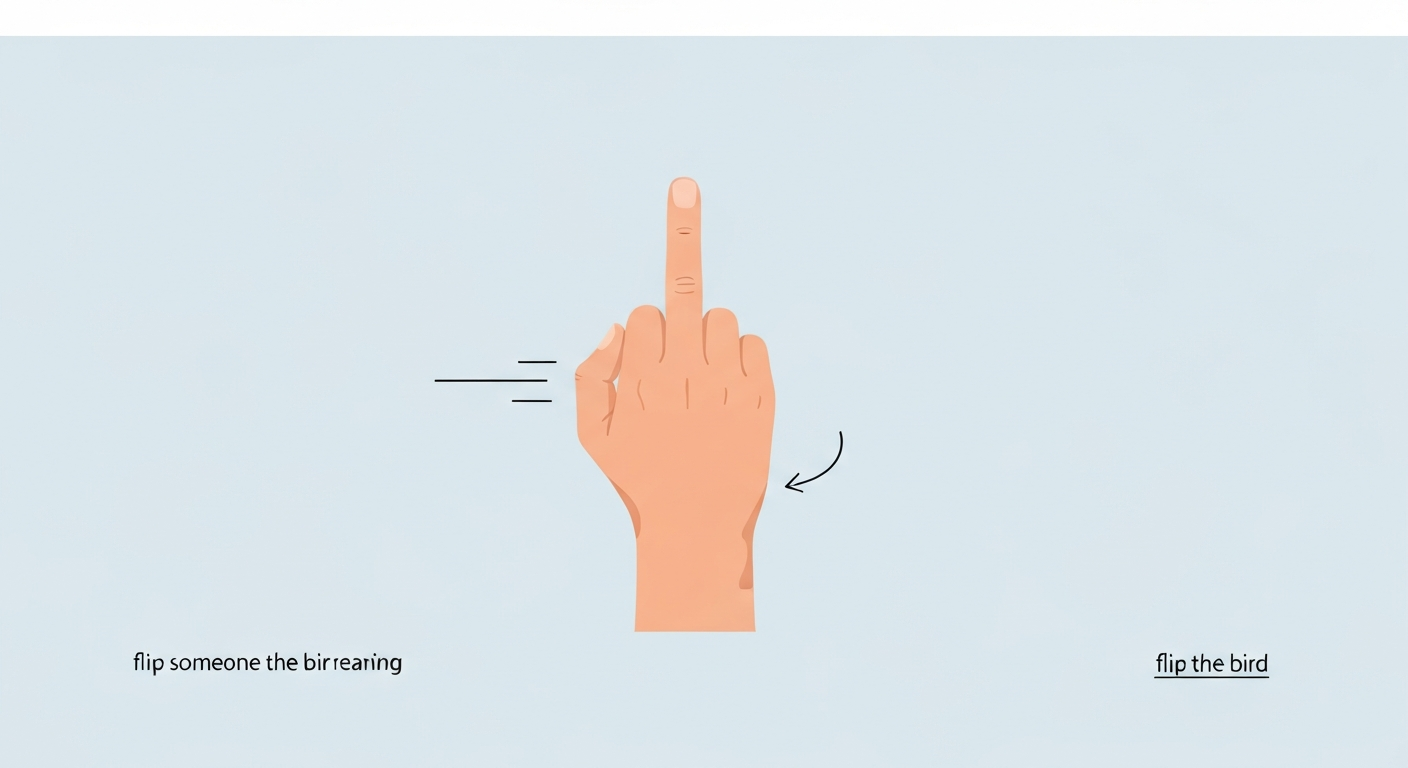
The gesture itself is simple but deliberate. You extend the middle finger upward while the remaining four fingers curl into the palm, often with the thumb tucked or resting flat. The hand is typically thrust outward or upward toward the target, that forward motion is captured in the verb "flip," which conveys a quick, dismissive flick of the hand rather than a slow, ceremonial display. You can flip the bird one-handed while driving, typing, or mid-conversation, which contributes to its casual, spontaneous reputation.
Research published in PLOS ONE (2019) found that contemporary viewers of the middle-finger gesture no longer reliably associate it with its ancient phallic symbolism. Instead, most people process it almost entirely as an emblem of contempt or hostility. In other words, the gesture has evolved from an iconic (image-based) insult into a purely symbolic one, something closer to a rude punctuation mark than a visual reference to anything anatomical. That shift explains why it reads so immediately and universally in American culture today.
Communicative purpose and tone: what flipping the bird actually says
At its most basic level, flipping someone the bird communicates hostility, disrespect, or rejection. It is not a nuanced message, that is precisely the point. The gesture is designed to be blunt, immediate, and impossible to misread. The tone can range from furious (a driver giving the finger after nearly being hit) to sarcastic and playful (friends joking around) to defiant and political (a protester directing it at authorities). Context and facial expression do a lot of the tonal heavy lifting.
Because the gesture is so broadly recognized as offensive, its use carries real social weight. Directing it at a stranger signals aggression and often escalates a conflict. Between close friends it can read as affectionate ribbing, the exact same motion that causes a road-rage incident in one context becomes a laugh between roommates in another. Writers depicting the gesture should think carefully about what they want it to communicate, because readers will pick up on those contextual cues.
- Anger or outrage: most common usage, typically in traffic, sports, or conflict situations
- Defiance: directed at authority figures, institutions, or opponents in protest contexts
- Contemptuous dismissal: used to shut down or reject someone without words
- Playful sarcasm: among friends who understand the ironic register
- Shock or punctuation: as a comedic exaggeration of frustration rather than genuine hostility
Historical origins and earliest citations: what we know (and what's murky)
The middle finger as an obscene symbol has one of the longest documented histories of any rude gesture. Classical sources identify it as the digitus impudicus, literally "the indecent finger" or "shameless finger" in Latin, and Greek and Roman texts record its use as an insult and apotropaic charm. A UC Davis Law Review article, 'Digitus Impudicus: The Middle Finger and the Law,' traces the gesture's legal and cultural history from antiquity, documenting its appearance in Greek and Roman texts as the digitus impudicus blank" rel="noopener noreferrer">UC Davis Law Review article 'Digitus Impudicus: The Middle Finger and the Law'. A review in the UC Davis Law Review on the digitus impudicus traces the gesture's legal and cultural history from antiquity through modern American case law, noting it appears in both Greek comedy and Roman poetry as unmistakably obscene.
The English phrase "the bird," however, took a different route to get here. Etymology sources including the Online Etymology Dictionary trace "the bird" back to 19th-century British theatrical slang: to "give someone the big bird" originally meant to hiss or boo a performer off stage, the sound being compared to the hissing of a goose. Online Etymology Dictionary: bird (sense history) documents the 19th‑century theatrical phrase "give the big bird" meaning to boo a performer, supporting this origin. That theatrical usage survives in British English today, where "get the bird" can still mean to be booed or dismissed. The transfer of "the bird" to specifically mean the middle-finger gesture is a distinctly American development, with the idiom form "flip the bird" becoming widely documented in print from the 1960s onward, though the underlying gesture is, as noted, ancient.
That gap between the ancient gesture and the modern American phrase matters. We can say with confidence that humans have been using the middle finger as an insult for at least 2,500 years, and that the English idiom "flip the bird" in its current meaning solidified in American slang through the mid-to-late 20th century. What we cannot say with certainty is exactly when or how the theatrical "bird" (booing) became the gestural "bird" (middle finger) in American usage, the lexicographic trail goes cold in between.
Close variants and common misspellings
People search for this phrase in a lot of different ways, and several variations have taken on a life of their own. "Flick the bird" is probably the most common nonstandard form, it swaps "flip" for "flick," likely by analogy with the quick wrist motion involved. Language Log commentary and corpus evidence suggest "flick" is an informal folk variant rather than a standard alternative; "flip" dominates in dictionaries and edited prose. Then there is "flip him the bird" (or "flip her the bird," "flip them the bird"), which just specifies the target, same meaning, same gesture, just with a pronoun attached.
"Flippin' the bird" (or "flippin the bird" without the apostrophe) is the gerund or participial form, used when describing an ongoing or habitual action: "She kept flippin' the bird at every car that passed. See the entry on flippin the bird meaning for a concise explanation and usage notes. " It shows up frequently in casual writing and song lyrics. "Flip the bird idiom" itself is a common search phrase used by people who know the expression exists but want to understand it as a piece of language, they're looking for the formal definition.
One genuinely puzzling variant that circulates online is "flip the bull the bird." This likely refers to a rodeo or bullfighting context, a rider or matador gesturing defiantly at a charging bull, but it is sometimes used humorously to describe standing up to something powerful and dangerous. It is a search variant worth acknowledging: if you landed here looking for that specific phrase, the core meaning of the gesture is the same, but the context adds a layer of bravado.
Variants compared: a quick reference
| Variant | Standard? | Register | What's different |
|---|---|---|---|
| flip someone the bird | Yes (standard) | Informal US/Australian | The base idiom; most widely cited in dictionaries |
| give someone the bird | Yes (standard) | Informal US/British | Slightly older phrasing; common in British English too |
| flip someone off | Yes (standard) | Informal US | Drops 'the bird'; same gesture, slightly more direct phrasing |
| give someone the finger | Yes (standard) | Informal US/global English | Uses 'finger' instead of 'bird'; widely understood internationally |
| flick the bird | Nonstandard / folk variant | Casual/online | Swaps 'flip' for 'flick'; not in major dictionaries but widely understood |
| flip him/her the bird | Yes (standard) | Informal US | Same as base idiom with a specified pronoun target |
| flippin' the bird | Yes (gerund form) | Casual/spoken | Present participle; common in speech, song lyrics, informal writing |
| flip the bull the bird | Informal/humorous | Casual/contextual | Specific or figurative context (defying something powerful); same core meaning |
Regional and register differences: who says it, and how
American English is where "flip the bird" lives most comfortably. Across the US, from casual conversation to sports commentary to news reporting, the phrase is the dominant way to describe the middle-finger gesture in informal speech. Collins notes that Australian English uses it too, essentially in the same way. In British English, though, you are more likely to hear "give someone the finger" or "stick two fingers up" (the V-sign being the equivalent British insult), and "give/get the bird" may still carry the older theatrical sense of being booed or dismissed.
In terms of register, this is firmly informal language. You will find it in news articles written in a casual or tabloid style, in fiction dialogue, in song lyrics, on social media, and in spoken conversation. In formal writing, legal documents, or official reports, the phrase gives way to neutral descriptions: "extended the middle finger," "made an obscene hand gesture," or "directed an offensive gesture." Major newspapers like the New York Times alternate between quoting the idiom directly in informal reporting and using euphemistic paraphrase in more formal pieces.
When the gesture shows up in broadcasting and public life
On live television and in broadcast contexts, the gesture triggers a very different set of rules than it does in private speech. Networks and broadcasters operate under FCC indecency guidelines, which means the middle finger is routinely blurred or cut from live broadcasts even when the same action would be completely legal in a private setting. This has led to some memorable broadcast incidents, award show slip-ups, sporting event close-ups, where production teams scramble to catch the gesture before it airs unedited.
Legal and social consequences: is it actually protected?
In the United States, flipping the bird is generally treated as protected speech under the First Amendment. US courts, including multiple federal appellate courts, have ruled repeatedly that a raised middle finger is crude but constitutionally protected expressive conduct. The ACLU has settled cases on behalf of individuals cited for disorderly conduct after directing the gesture at police officers, with judges finding the gesture alone insufficient grounds for a stop or citation. A 2009 ruling by District Judge David Cercone became one of the more widely cited examples of this principle in practice.
That said, "generally protected" does not mean consequence-free. Flipping the bird at an employer, a teacher, or a fellow driver may be legal but can still result in job loss, school suspension, or an escalating confrontation. Context matters enormously. The gesture is also not universally protected: when combined with threatening behavior or language, it can contribute to a legal case against you even if it would not be criminal on its own.
How writers should handle the phrase
If you are writing fiction, journalism, or content that involves someone flipping the bird, you have real options. In dialogue-heavy literary fiction, "flipped him the bird" or "gave her the finger" reads naturally and efficiently, no need to explain. In news copy, many reporters use the idiom directly in informal stories ("the player flipped the bird to the crowd") and shift to neutral description in formal or legal coverage ("the defendant displayed his middle finger"). In children's or family-oriented writing, you obviously avoid the phrase entirely and might describe a character making "a rude gesture" without elaboration.
For language learners and non-native English speakers writing in American English: the phrase is so well understood that it rarely needs glossing for an American audience. If your audience is international, a brief parenthetical ("the middle-finger gesture") alongside the idiom covers your bases without being condescending.
Cross-cultural equivalents: the same message, different hands
One of the genuinely fascinating things about the middle-finger gesture is how many cultures developed their own equivalent, distinct motions that carry the same pragmatic punch. The Greek moutza is an open-palm thrust toward someone's face, and it is considered deeply offensive in Greece and Cyprus. The bras d'honneur (known in Spanish as the corte de mangas, in Italian as the gesto dell'ombrello) involves slapping the inside of the elbow while raising the forearm, a gesture widely understood across France, Spain, Portugal, and Italy as roughly equivalent to "up yours." Then there is the Mediterranean fig sign (mano fico or manu fica), an ancient gesture made by inserting the thumb between the index and middle fingers, which appears in Roman sources as far back as the gesture in Dante's Inferno.
What is striking about all of these, including the American bird, is that none of them travel well across cultural borders. A Greek moutza directed at an American reads as a wave. A bras d'honneur in Japan means nothing. The middle finger, because of American cultural export through film and television, is probably the most globally recognized of the group today, but it is worth knowing that the gesture has deep, independent parallels across cultures, which suggests that humans have a universal impulse to express contempt with their hands, even if the specific shape of that expression varies.
Pronunciation and spoken forms: how people actually say it
In natural American speech, "flip someone the bird" is usually pronounced as a single rhythmic unit without much deliberate emphasis: something like "flip-im-thuh-bird" in fast speech, where "someone" collapses to a pronoun and the whole phrase rolls out quickly. The word "bird" gets a slight stress because it carries the semantic weight. In more emphatic or storytelling contexts, speakers tend to stretch it out: "she literally FLIPPED him THE BIRD right in front of everyone."
The participial form "flippin' the bird" drops the final -g in casual speech, which is why you see it spelled both "flippin' the bird" (with apostrophe) and "flippin the bird" (without) in online writing. Both spellings represent the same pronunciation. Other orthographic variants you might encounter in searches include "flip da bird" (eye dialect), "flip'n the bird," and occasionally "fliping the bird" (a simple spelling error). All of these land on the same meaning.
Synonyms and near-synonyms worth knowing
- flip someone off (US informal, same gesture, slightly more direct)
- give someone the finger (widely understood in most English-speaking countries)
- give someone the bird (slightly older phrasing, still current)
- stick two fingers up at someone (British English, uses the V-sign rather than the middle finger)
- extend the middle finger (formal/neutral, used in legal or journalistic contexts)
- make an obscene gesture (fully neutral, used when the specific gesture does not need to be named)
Where this fits in the wider world of bird idioms
"Flip someone the bird" is one of the more unusual entries in the long catalog of bird-related expressions in English, because the "bird" in question has almost nothing to do with an actual bird. It arrived via theatrical slang, picked up a gestural meaning somewhere in 20th-century American usage, and is now one of the most searched bird-language phrases on the internet. That is worth pausing on: a phrase rooted in the sound a goose makes when an audience is displeased ended up describing one of the most recognized hand gestures in the world. Language takes strange paths.
If this phrase brought you here, the related expressions covered elsewhere on this site are worth exploring. The variants covered in companion entries, including "flick the bird," "flip him the bird," "flippin' the bird," "flip the bird idiom," and even the curious "flip the bull the bird", all trace back to the same gestural core and are treated as standalone entries with their own nuances. Each one is a slightly different lens on the same expressive moment.
FAQ
What does “flip someone the bird” mean (literal gesture and idiom)?
Literal gesture: raising the middle finger while folding the other fingers down—an obscene hand sign used to show contempt. Idiomatic meaning: to insult, express anger or dismiss someone verbally or nonverbally; used as slang for “flip someone off,” “give the finger,” or “give someone the bird.”
What communicative purpose and tone does the gesture/phrase convey?
Purpose: to register strong displeasure, contempt, defiance, or insult. Tone: rude, confrontational, and informal; can be sarcastic or joking among friends but remains coarse. Context (audience, setting, power balance) determines whether it’s playful or aggressive.
What are the historical origins and earliest citations of the phrase?
The idiom traces to theatrical slang from the 19th century—“give the bird” originally meant to boo or hiss performers. The middle‑finger as an obscene gesture has ancient precedents (Greek and Roman references to the digitus impudicus). The specific phrasings like “flip the bird” rose to prominence in 20th‑century English, becoming common in the mid‑1900s and especially visible in US usage by the 1960s.
What close variants, common misspellings, and search errors exist?
Common variants: “flip the bird,” “give someone the bird,” “flip someone off,” “give the finger,” “the bird,” “the finger.” Informal variants: “flip him the bird,” “flippin’ the bird.” Nonstandard or mistaken forms: “flick the bird” (colloquial), search errors like “flip the bull the bird.” Comparison (short): - Standard US: flip the bird / flip someone off - British older sense: give someone the bird (boo) - Nonstandard: flick the bird - Informal contraction: flippin’ the bird
Are there regional or register differences in meaning?
Yes. In contemporary US English the phrase primarily denotes the middle‑finger gesture. In British English, historical/theatrical senses survive where “give the bird” can still mean to boo or jeer a performer. Register: widely informal; newspapers and broadcasters often paraphrase (see portrayal guidance) depending on formality and audience.
How should writers portray the phrase in different contexts?
Informal writing: idiom or direct quote (“flipped the bird,” “flipped him off”) is acceptable. Formal or legal writing: paraphrase descriptively (“extended his middle finger,” “made an obscene gesture”) to avoid coarse language. Journalism: many outlets use the idiom in casual copy but paraphrase in formal reports; attribute quotes where possible and consider audience sensitivity.
Next Article
Flip Him the Bird Meaning: What It Really Says and Why
Meaning of flip him the bird, intent behind the middle-finger insult, where used, and how to respond or de-escalate safe