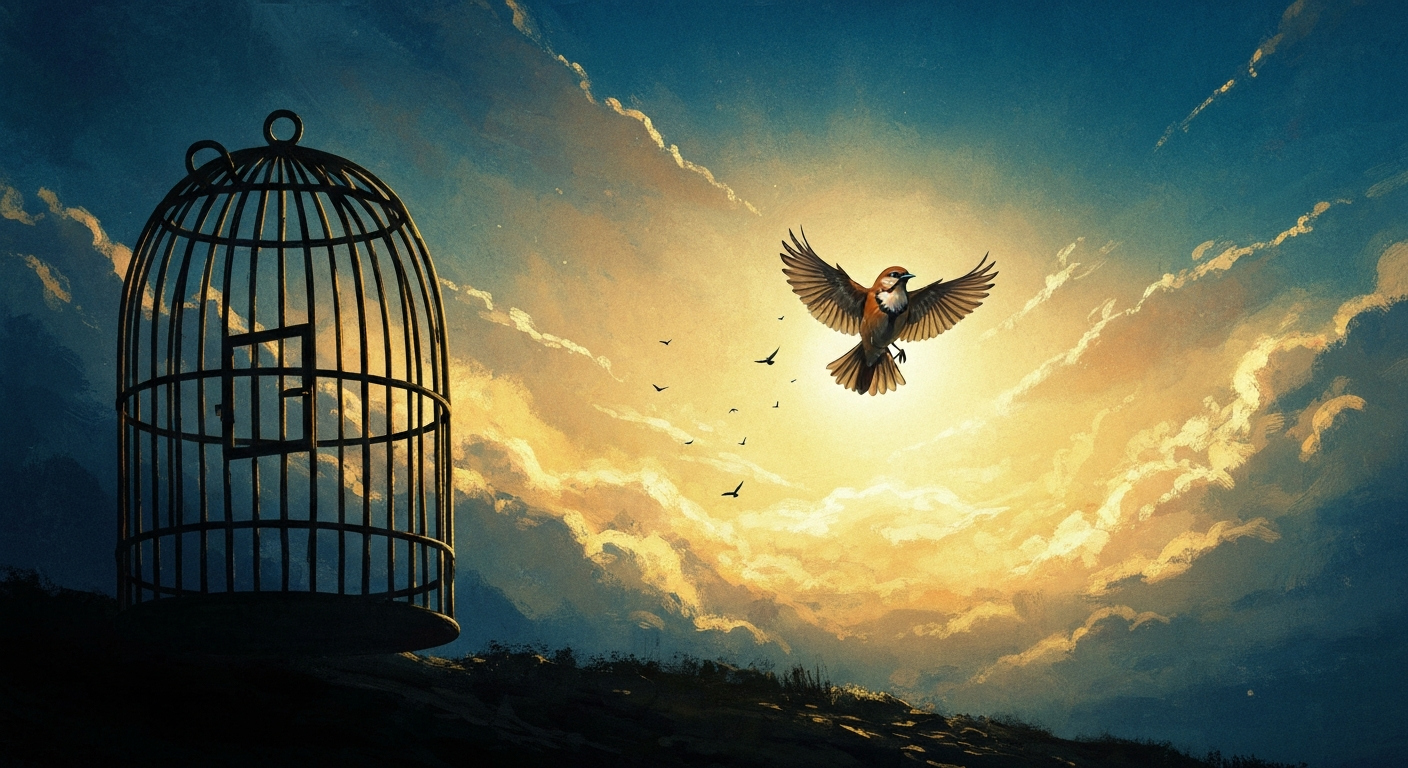
The 'bird or cage' motif in BioShock Infinite is the game's central symbolic question: are you free, or are you contained? BioShock Infinite: Burial at Sea, Wikipedia (DLC summary and development notes) notes that The ‘Bird or the Cage’ motif extends into DLC: Burial at Sea (Episode 2) includes Songbird‑related material and recontextualizes the guardian/construct in relation to Suchong and Rapture; promotional materials and DLC notes tie Songbird’s origin and design back to the main game’s avian/cage imagery. (DLC page / development notes.) BioShock Infinite: Burial at Sea — Wikipedia (DLC summary and development notes). It plays out most literally when Elizabeth stops at a merchant stall and asks Booker which brooch he prefers, bird or cage, but that small moment threads through everything in the game, from Songbird's role as Elizabeth's guardian-captor to the C-A-G-E whistle sequence that lets the player control the creature. The short version: the bird represents freedom and selfhood, the cage represents protection that has curdled into imprisonment, and every major story beat forces you to ask which of those two things Columbia actually offers Elizabeth.
Bird or Cage Bioshock Infinite Meaning: Freedom vs Cage

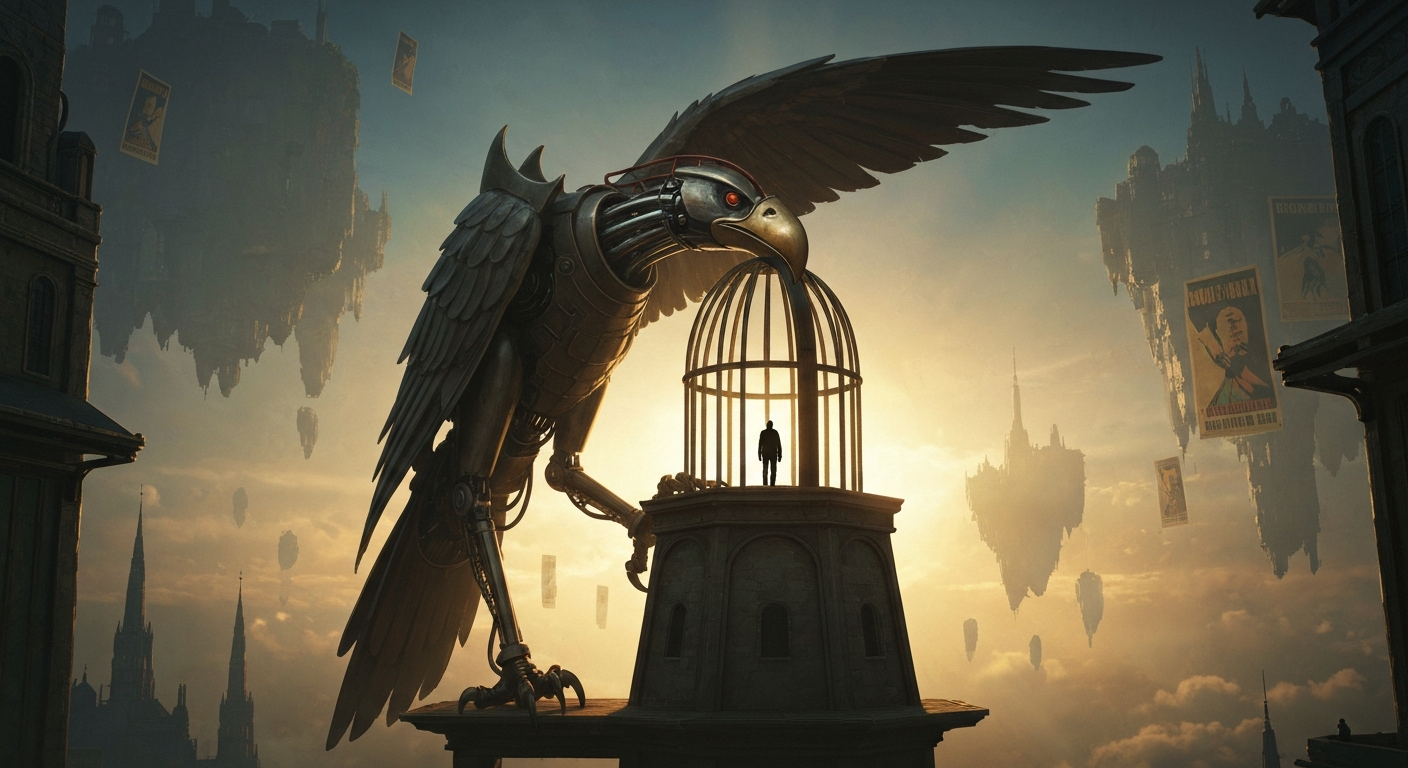
The motif in Columbia's world
Columbia presents itself as a city in the sky, literally lifted above the earth and its constraints. The floating city's whole ideological pitch is liberation: from the ground, from government, from 'lesser' people. But the game spends most of its runtime showing you the mechanisms that keep that story running. Propaganda kinetoscopes advertise a 'Mighty Songbird' patrolling the skies. Statues of the creature loom over public spaces. The city's most visible landmark is a tower where a young woman has been locked away for years. The bird and cage imagery is everywhere precisely because Columbia has built its self-image around the idea of the soaring, free bird while actually operating as an elaborate cage. Ken Levine and the Irrational Games team were deliberate about this doubling: in promotional interviews around the game's 2013 release, Levine described Songbird as Elizabeth's companion and warden in the same breath, a sky-level echo of BioShock's Big Daddies who protect their Little Sisters while also defining and enforcing their captivity.
In-game elements worth checking during a playthrough
If you want to trace the motif carefully, there are specific places and moments to watch for. Some are hard to miss; others are easy to walk past.
The brooch scene (Soldier's Field)
This is where the motif is named out loud. During the Soldier's Field sequence (roughly Chapter 8), Elizabeth and Booker pass a merchant stall. Elizabeth picks up two brooches and turns to Booker: 'Bird? Or the cage?' She also says, in a nearby lockpicking moment, 'If you put a person in a cage, they develop an interest in such things.' The game is not being subtle. Your choice of brooch doesn't change the outcome, but the act of choosing is the point: the game wants the question lodged in your head.
Songbird's repeated appearances
Songbird first appears as a threat during the Monument Tower escape. It pursues Booker and Elizabeth across Battleship Bay, surfaces again at the Hall of Heroes, at Grand Central, and at Comstock House. Each appearance is staged as a pursuit or intervention, and the game's camera work consistently frames Songbird as enormous and Elizabeth as small. The creature is not presented as simply monstrous. Found documents and in-game archival footage establish that a young Elizabeth repaired and fed an injured Songbird, creating an imprinting relationship. Fink and Suchong's R&D notes confirm Songbird was an engineered guardian, built and programmed, but the footage makes it something more uncomfortable: a bond formed between captor and captive that looks, from the inside, like love.
The C-A-G-E whistler sequence
One of the game's most pointed pieces of symbolic design is the whistler, a flute-like instrument whose control sequence Elizabeth decodes as the notes C-A-G-E. Her line is: 'C-A-G-E! It's not a word, Booker... it's a SONG!' The sequence is used in the Hand of the Prophet airship section to direct Songbird as a weapon. Garry Schyman's score and diegetic music, including a whistler tune and a distinct 'Songbird alarm', are employed throughout the game to signal Songbird's presence and to encode the C‑A‑G‑E control sequence blank" rel="noopener noreferrer">Garry Schyman's score and diegetic music, including a whistler tune and a distinct 'Songbird alarm', are employed throughout the game to signal Songbird's presence and to encode the C‑A‑G‑E control sequence.. The game makes you spell out 'cage' to control the creature that was Elizabeth's cage. That is not an accident.
Visual and environmental repetition
Beyond the major set pieces, the imagery saturates the environment. Columbia's propaganda posters, jewelry stalls, kinetoscopes, and architectural statues all repeat the Songbird motif. The Art of BioShock Infinite (published by Dark Horse) documents how extensively the production design team built the bird figure into Columbia's visual fabric, and the official 'Ultimate Songbird Edition' marketing leaned into the creature as the game's central image. It is worth pausing at prop clusters and environmental art to see how normalized the bird-as-guardian image is in Columbia's public iconography.
Elizabeth's spoken lines about captivity
Elizabeth's dialogue is the clearest running commentary on what the motif means to her personally. She tells Booker: 'I won't be locked up again... promise me... you will not let him take me back.' Later she demonstrates direct knowledge of the whistler notes. The arc from prisoner who names her prison, to person who uses the symbol of her prison as a tool, is the emotional spine of the game's final act.
Key scenes to watch carefully
- Monument Tower escape: the first time Songbird is presented as a direct threat, framing the creature as pursuer rather than protector.
- Battleship Bay pursuit: establishes the pattern of Songbird as mobile cage, following Elizabeth across geographic and narrative distance.
- Archival lab footage (Elizabeth's old room): the imprinting backstory that makes Songbird's role ambiguous rather than simply villainous.
- Soldier's Field merchant stall: the 'bird or cage' brooch dialogue and the lockpicking line, the verbal crystallization of the motif.
- Hand of the Prophet airship sequence: the C-A-G-E whistler control, where you use the symbol of captivity as a weapon.
- Final Songbird sequence: Booker and Elizabeth direct Songbird to destroy the siphon and Columbia's infrastructure, and the creature is ultimately crushed by ocean pressure in Rapture. Elizabeth's lines during this sequence address the bond directly and frame the ending as both liberation and loss.
Freedom vs. confinement
The most direct reading of bird vs. cage is the oldest one: the bird is freedom, the cage is its denial. Paul Laurence Dunbar fixed this image in English literary consciousness with his 1899 poem 'Sympathy,' whose most famous line, 'I know why the caged bird sings,' described a bird that beats its wings bloody against the bars not from hope but from a compulsion toward the sky it can see but not reach. Maya Angelou used the same image for her 1969 memoir, 'I Know Why the Caged Bird Sings,' and the phrase entered common cultural shorthand for constrained selfhood. BioShock Infinite inherits this tradition consciously. For background on the captive bird meaning in literature and culture, consult sources discussing the captive bird meaning. Elizabeth is literally imprisoned in a tower above a city that calls itself free. The cruel irony the game foregrounds is that her prison is a floating sky-city, so even the language of freedom (the sky, flight, birds) is co-opted by the structure that confines her. When she picks up the bird brooch and asks Booker which he prefers, she is asking whether he sees her as a free being or as property of Columbia's sky.
Protection vs. imprisonment
The game complicates the freedom-vs-confinement reading by making Songbird genuinely protective as well as genuinely confining, and by suggesting these two things are not separable. Songbird was engineered to keep Elizabeth safe, and the archival footage establishes that Elizabeth and the creature formed a real bond during her years in the tower. The scholarly reading in BioShock and Philosophy (Wiley) treats Songbird as emblematic of captivity-as-care: the creature cannot distinguish between 'keeping Elizabeth from harm' and 'keeping Elizabeth from leaving,' because those two functions are the same instruction from its programming's point of view. This is not unique to science fiction. The concept of the captive bird, whether in fable, folklore, or lived experience, frequently involves a captor who genuinely believes the cage is shelter. For readers interested in names and language around this idea, the 'captive bird' entry on this site explores the symbolism of birds kept against their will across cultural traditions, and names meaning caged bird appear in several cultures as markers of either tragedy or protection depending on context.
Agency vs. objectification
Elizabeth's arc is also a study in what it means to be treated as a thing rather than a person. Comstock built the tower and commissioned Songbird to contain a person he had reduced to a function: 'the Lamb,' a prophetic tool, a weapon. The brooch scene is significant here because Elizabeth is the one asking the question. She is not asking Booker to choose between two decorative objects. She is asking whether he sees her as a subject who can fly or as an object that must be contained. The academic conference paper 'Non-Humans as Meaning-Makers: Elizabeth as Co-Designer of BioShock Infinite' argues that Elizabeth's role in the game's mechanics, her active contributions to puzzle-solving, combat support, and narrative agency, is itself a design-level argument against her objectification. The game gives her voice, skill, and decision-making so that her imprisonment registers as a genuine violation rather than a neutral plot condition. When she eventually turns the C-A-G-E sequence into an instrument of her own liberation, she reclaims the symbol of her objectification and makes it a tool of agency.
Choice vs. determinism and the cage of fate
The fourth and deepest layer of the bird-or-cage motif is the one the game's ending makes unavoidable: the question of whether choice exists at all when fate runs on loops. BioShock Infinite's multiverse structure reveals that Booker and Comstock are the same person across different timelines, that Elizabeth has seen all possible versions of events, and that the 'baptism' scene at the end is not one choice but a recurring constant that plays out the same way across nearly infinite iterations. The game's mechanics embed this. The vigor tears Elizabeth opens, the moments of foreknowledge she displays, the way certain outcomes repeat regardless of what Booker does: these all suggest that the cage is not just a tower or a creature but the structure of fate itself. Elizabeth's line about the whistler, 'It's not a word, Booker... it's a SONG,' is pointed here too. A song, unlike a word, repeats. It has a structure you move through rather than a meaning you can simply choose. The C-A-G-E sequence is not a lock you break; it is a score you perform. The game asks whether freedom is possible inside a deterministic system, and it does not give a comfortable answer. Viktor Frankl's argument in Man's Search for Meaning, that a person can choose their attitude toward suffering even when they cannot choose their circumstances, resonates here: Elizabeth cannot escape the mechanics of Comstock's world, but she can choose what to do inside them, and the game treats that internal agency as meaningful even while the plot closes off most external escapes. For readers exploring that existential angle further, the 'man's search for meaning bird' entry on this site tracks how bird symbolism appears in literature about constraint and interior freedom.
How the four readings sit alongside each other
These interpretations are not competing. The game supports all four at once, which is why the brooch question feels resonant rather than contrived. The bird and the cage are not simple opposites in BioShock Infinite: they are entangled. Songbird is both bird and cage. Columbia is both a soaring city and an enclosed system. Elizabeth is both captive and, eventually, the person who holds the key. The motif's richness comes from the game refusing to resolve the tension cleanly.
| Reading | What the bird represents | What the cage represents | Key in-game evidence |
|---|---|---|---|
| Freedom vs. confinement | Liberty, selfhood, the sky Elizabeth cannot reach | The tower, Songbird, Columbia's ideology | Brooch scene; Elizabeth's 'won't be locked up' dialogue; Dunbar/Angelou literary lineage |
| Protection vs. imprisonment | Genuine safety and companionship | Care that cannot be separated from control | Archival lab footage; Songbird imprinting; Ken Levine's guardian/warden framing |
| Agency vs. objectification | Elizabeth as subject with skills and voice | Elizabeth as 'the Lamb,' a prophetic tool | Elizabeth's active mechanics; C-A-G-E as reclaimed symbol; academic co-designer analysis |
| Choice vs. determinism | Interior freedom, choosing one's response | The loop of fate, repeating timelines, the score of C-A-G-E | Multiverse structure; baptism repetition; 'it's a SONG' whistler line; Frankl parallel |
How the motif extends into the DLC
If you play BioShock Infinite: Burial at Sea, the Songbird material gets a further layer. Episode 2 recontextualizes Songbird's construction through Suchong's involvement in Rapture's Little Sister program, drawing a direct line between Songbird's engineering and the Big Daddy guardian model. The final sequence where Songbird is crushed by Rapture's ocean pressure is given additional weight here: the creature that embodied Elizabeth's sky-cage meets its end in an underwater prison. The bird that patrolled a floating city is destroyed by the deepest possible version of a closed, pressurized container. The imagery is not accidental.
Literary and cultural parallels worth knowing
The caged bird as symbol of constrained freedom is one of the most durable images in English-language poetry and prose. Dunbar's 'Sympathy' (1899) is the formal anchor, but the image runs through African American literary tradition, Romantic poetry, and folk song in ways that predate Dunbar by centuries. Keats's nightingale, Blake's 'Robin Red Breast in a cage,' and dozens of folk traditions treat the caged or captured bird as a figure for any person or group denied movement and voice. BioShock Infinite places Elizabeth in this lineage deliberately: a young woman of specific ancestry and prophetic power, imprisoned in a tower by a theocratic patriarch, in a city built on racial hierarchy and religious nationalism. The literary resonances are earned rather than decorative. For readers who want to trace the bird-and-cage image as a standalone symbol outside the game, the bird and cage meaning entry on this site covers the broader cultural history of the pairing.
Practical notes for players citing this motif
If you are writing about the game or preparing for a discussion, there are a few specific moments and items worth screenshotting or noting by chapter. The Soldier's Field brooch conversation is the verbal anchor and is easy to return to via chapter select. The C-A-G-E whistler section in the Hand of the Prophet sequence is the mechanical demonstration. The archival lab footage provides the biographical context for Songbird's bond with Elizabeth. And the final Songbird cutscene, including Elizabeth's closing lines to the creature, is the emotional resolution. Between those four moments you have a complete arc of the motif: it is named, it is embedded in the game's mechanics, it is given emotional roots, and it is resolved (though not simply).
- Soldier's Field merchant stall: the 'Bird? Or the cage?' brooch dialogue and the lockpicking observation line.
- Elizabeth's lab archival footage: the imprinting backstory that makes Songbird a companion as well as captor.
- Hand of the Prophet whistler sequence: the C-A-G-E note control, where you play the cage to free Elizabeth.
- Final Songbird cutscene (Columbia to Rapture): Elizabeth's farewell lines and the creature's destruction by ocean pressure.
- Propaganda kinetoscopes and environmental statues: repeated visual reinforcement throughout Columbia's public spaces.
- Burial at Sea Episode 2: Suchong's R&D notes and Songbird's origin story as a designed guardian system.
FAQ
Concise answer: What does the “bird or cage” motif in BioShock Infinite mean?
Directly: the motif operates as a deliberately ambiguous symbol that points to both freedom and confinement. In-game evidence (brooch choice dialogue, the repeated presence of Songbird, Elizabeth’s lines about being locked up, the whistler/C‑A‑G‑E tune, and environmental bird/cage imagery) supports multiple, coexisting readings: Songbird is simultaneously guardian and jailer; the bird image evokes longing for flight and enforced enclosure; and the cage image underscores control, possession, and limits on agency. The game and developer commentary present this ambiguity rather than a single fixed meaning.
What explicit in‑game sources and visual examples should I check to document the motif?
Key moments and objects to inspect: the brooch choice conversation where Elizabeth asks “Bird? Or the cage?” (merchant/stall scene); Elizabeth’s line about people developing interests when put in a cage (chapter around Soldier’s Field); Songbird’s scripted attacks and appearances (Monument Tower escape, Battleship Bay, Hall of Heroes, Comstock House, Hand of the Prophet/airship sequences); the whistler/whistle tune that spells C‑A‑G‑E and is used to call/control Songbird; lab footage/archival logs showing Songbird’s creation and Elizabeth caring for it; propaganda posters, statuettes and jewelry repeating bird/cage imagery; and the final sequence where Songbird is destroyed/drowns. Also consult the Art of BioShock Infinite and official developer features on Songbird for concept art linking the avian motif to Elizabeth.
How does the motif support a freedom vs confinement reading?
Freedom reading: the bird evokes flight, escape, and Elizabeth’s desire for the outside world; visuals (open skies, Songbird’s wings) and Elizabeth’s longing reinforce this. Confinement reading: cages, Elizabeth’s repeated claims about not being locked up, the whistler‑coded control (C‑A‑G‑E), and Songbird’s physical restraint of her movements show enforced confinement. Both are supported by direct lines, environmental storytelling, and the game's sound/visual design, making the bird/cage a tension between aspiration and restriction.
How does the motif support protection vs imprisonment and agency vs objectification readings?
Protection vs imprisonment: developer commentary and in‑game logs frame Songbird as Elizabeth’s guardian—protective behavior (attacking intruders) is coded as care. But the same behavior physically bars Elizabeth from leaving, and Songbird was constructed by adults (Fink/Suchong) to keep her contained, so its protection is also imprisonment. Agency vs objectification: Elizabeth’s identity is managed by others (Comstock, Suchong, Fink) who treat her as a project; Songbird’s imprinting and the whistler control reduce her autonomy, while Elizabeth’s own lines and actions (learning the whistler notes, bargaining with Booker) indicate a struggle to reclaim agency. Both interpretations are grounded in dialogue, found documents, and scenes where control is literal (locked rooms, cages, the whistler) or metaphorical (titles, caregiving framed as possession).
How does the motif shape Elizabeth’s arc and Songbird’s role specifically?
Elizabeth’s arc: she moves from childlike dependence and enforced seclusion to increasing knowledge of tools of control (she recognizes the whistler sequence) and to acts that rupture the protective/jailer bond. Songbird’s role: initially a guardian/companion (imprinting/feeding scenes), it enforces isolation, pursues intruders, and ultimately is weaponized and destroyed—its final sequence dramatizes the rupture of bond and the moral ambiguity of killing a creature that once 'protected' Elizabeth. The motif marks Elizabeth’s transition from captive to an actor in her own fate, even as the game complicates whether she attains true freedom.
Where does the whistler/C‑A‑G‑E mechanic fit into the motif?
The whistler is a diegetic control device whose notes spell out C‑A‑G‑E (explicitly called a song by Elizabeth). It functions as a literal key to summon or direct Songbird, making the cage motif musical and programmable: the code that controls the guardian is spelled as the word that names confinement. This ties symbol and mechanic together and is a strong textual anchor for readings about control, determinism, and constructed cages.
Man's Search for Meaning: Bird as Freedom vs Captivity
Explore what "bird" symbolizes in a man's search for meaning, freedom vs captivity, literary & cultural examples.