A captive bird is any bird kept by humans in a controlled environment rather than living freely in the wild. That sounds simple, but the term carries a surprising amount of weight depending on where you encounter it. In a veterinary clinic, it refers to a pet parrot with specific welfare needs. In a legal document, it describes a precisely defined category that determines whether you need a permit to own or trade the animal. In a poem, a novel, or a video game, it becomes one of the most powerful metaphors in the cultural toolbox. This guide untangles all of those layers, whether you are a student trying to decode Maya Angelou's title, a prospective bird owner doing research, a writer looking for the right imagery, or simply someone who wants to understand what a phrase actually means.
Captive Bird Meaning: Definition, Symbolism & Usage Guide

What 'Captive Bird' Actually Means (Literal Definition)
At its most straightforward, a captive bird is a bird whose movements, feeding, and reproduction are controlled by humans. But within that broad category, there are three distinct types that matter enormously for legal, ethical, and welfare purposes, and they are not interchangeable.
Pet Bird
A pet bird is simply a bird kept in a domestic setting for companionship. The term says nothing about how the bird was obtained or bred. Your neighbour's budgerigar is a pet bird. So is an African grey parrot bought from a breeder, or a cockatiel inherited from a family member. 'Pet bird' is an ownership and care context, not an origin classification.
Wild-Caught Bird
A wild-caught bird is exactly what it sounds like: an individual taken from a wild population and brought into captivity. Historically, this was the dominant source for the pet trade in many species. It remains legal for some species under permit, but it is heavily restricted for birds listed under CITES (the Convention on International Trade in Endangered Species). U.S. federal regulations under 50 CFR require that import and export permits explicitly declare a specimen's source using standardised codes, making 'wild' versus 'captive' an official legal field, not just an informal description. Wild-caught birds generally face greater adjustment challenges in captivity than those born in it, and their removal directly reduces wild population numbers.
Captive-Bred Bird
A captive-bred bird is one produced in controlled conditions, meaning its parents mated or their gametes were combined under human management. U.S. federal regulations under 50 CFR § 23.5 define 'captive-bred' for CITES purposes as offspring (first generation, or F1, or later) produced this way, and distinguish it from the stricter term 'bred in captivity,' which carries additional requirements. This distinction matters practically because CITES parties can exempt genuinely captive-bred specimens from the standard import/export permit requirements that apply to wild-sourced animals. CITES, Facts about captive breeding and artificial propagation explains that parties may exempt traded specimens that are ‘bred in captivity’ or ‘artificially propagated’ and stresses the legal and practical importance of distinguishing genuine captive‑bred specimens from wild‑sourced fraud blank" rel="noopener noreferrer">CITES — Facts about captive breeding and artificial propagation explains that parties may exempt traded specimens that are ‘bred in captivity’ or ‘artificially propagated’ and stresses the legal and practical importance of distinguishing genuine captive‑bred specimens from wild‑sourced fraud.. However, authorities in multiple countries, including the UK, EU, Australia, and the United States, have all flagged the persistent problem of laundering: wild-caught birds being fraudulently declared as captive-bred in trade documentation. Australia's biosecurity rules (via BICON) require exporters to declare that birds were captive-bred and continuously held in the source flock for defined pre-export periods, precisely because verification is so difficult.
| Type | Origin | Typical Legal Status | Key Welfare Consideration |
|---|---|---|---|
| Pet bird | Any (pet is a care context, not an origin) | Varies by species and country | Ongoing husbandry, enrichment, veterinary care |
| Wild-caught | Taken from wild population | Restricted or prohibited for many species under CITES | Stress of capture and adjustment; conservation impact |
| Captive-bred | Born from parents managed in captivity | Often exempt from standard CITES permits if verified | Hand-rearing vs. parent-rearing affects adult behaviour |
Legal, Ethical and Welfare Context
The moment you move a bird across a border, the word 'captive' triggers a specific regulatory framework. CITES requires that traded specimens carry documentation showing their source code (captive-bred, wild, pre-Convention, etc.), and the distinction directly affects whether a permit is even required. The EU implemented wildlife trade regulations that treat captive birds as a distinct category for movement and health checks under Commission Delegated Regulation (EU) 2020/692. The UK has been reforming its captive-breeding registration and traceability rules, with government consultation outcomes published in 2026. Under U.S. migratory bird law (50 CFR § 21.48), there are specific permit exceptions for captive-bred migratory waterfowl, illustrating how origin-based distinctions ripple down to possession and movement rules at the species level.
On the conservation side, the stakes are real. Parrots are among the most threatened bird groups on the planet, with roughly 28% of extant parrot species assessed as threatened on the IUCN Red List. Capture for the pet trade is identified as a key driver for many of those species. Analyses of the CITES trade database show millions of legally traded parrots since 1975, with volumes reported as 'captive-bred' rising in some regions even as wild-sourced trade declined in reported figures, though researchers caution that permit data alone cannot confirm actual conservation outcomes given the laundering problem.
Welfare is a separate concern from legal status. Research comparing hand-reared, parent-reared, and wild-caught African grey parrots has found measurable behavioural differences in adults, with hand-reared individuals showing higher rates of problematic behaviours than parent-reared or wild-caught birds. Feather-damaging behaviour (feather-plucking and self-mutilation) is estimated to affect around 10% of captive parrots in some studies and has multifactorial causes spanning medical, husbandry, social, and behavioural factors. A 2024 to 2026 body of expert consensus work identifies behavioural problems, lack of species-appropriate veterinary care, and enrichment deficits as the top priority welfare issues for captive parrots. The Association of Avian Veterinarians has published welfare standards for birds held under the U.S. Animal Welfare Act, and the RSPCA in the UK flags that some parrot species can live more than 50 years, meaning the welfare commitment is genuinely long-term.
- Check legal permit requirements before acquiring any non-domestic bird species.
- Prefer captive-bred birds from reputable, verifiable breeders over unknown sources.
- Research species-specific needs: space, diet, enrichment, and veterinary care vary dramatically.
- Recognise that 'captive-bred' on a document is not automatically a welfare guarantee.
- Be aware of the long lifespan of many species, particularly parrots, before committing to ownership.
What a Captive Bird Symbolises Across Cultures
Birds in flight are one of the oldest human symbols for freedom, transcendence, and the soul's capacity to move beyond earthly limits. A caged or captive bird, then, becomes the natural counter-image: what happens when that freedom is denied. This tension shows up across remarkably diverse cultural traditions, often carrying multiple meanings simultaneously.
Freedom and Its Denial
The most immediate symbolic meaning of a captive bird is constrained freedom. A creature built for flight and song, reduced to a confined space, becomes a visual shorthand for any kind of oppression, imprisonment, or enforced limitation. This reading is cross-cultural: you find it in ancient Chinese poetry where caged birds lament the mountains they can no longer see, in Persian classical verse where the nightingale's longing for the rose represents the soul's yearning for the divine, and in African-American literary tradition where the caged bird's song is both a cry of suffering and an act of defiance.
Voice and Resilience
One of the most powerful wrinkles in the captive bird symbol is the bird that keeps singing. The song does not stop just because the cage is there. This detail matters enormously in how the motif is used in literature and civil rights discourse. The captive bird's voice becomes a symbol of resilience, of inner life that cannot be fully controlled even when the body is constrained. It shifts the symbol from pure victimhood to something more complex: survival, persistence, the refusal to be silenced.
The Soul and Spiritual Longing
In many spiritual and religious traditions, the caged bird represents the human soul trapped in the body or in the material world, yearning for reunion with the divine or for liberation into something greater. This reading appears in Sufi poetry (particularly Rumi's use of the reed flute as a related image of separation and longing), in some Buddhist allegorical frameworks, and in various folk traditions across South Asia and the Middle East. The cage here is not necessarily a villain's tool but a condition of mortal existence.
Protection and Domesticity
Not every culture reads the captive bird negatively. In some traditions, keeping a songbird was a mark of refinement and care, a form of relationship rather than oppression. Victorian parlour culture in Britain and North America placed enormous sentimental value on pet songbirds as symbols of domestic harmony. In parts of East Asia, the tradition of keeping birds for their song was and remains a serious artisanal pursuit, with connoisseurship of bird song treated with the same seriousness as music. The cage in these contexts can represent protection, devotion, and even elevated status for the bird itself. Context, as always, determines meaning.
How the Bird and Cage Motif Works in Language
The bird-plus-cage combination functions in language in a few distinct but overlapping ways. As a metaphor, it maps the relationship between freedom and constraint onto human experiences: a person in an unhappy marriage, a worker trapped in a soul-crushing job, a political prisoner, or a community under systemic oppression can all be described through the lens of the captive bird without anyone being confused about what is meant. The image is doing conceptual work, translating an abstract social or emotional condition into something viscerally understandable.
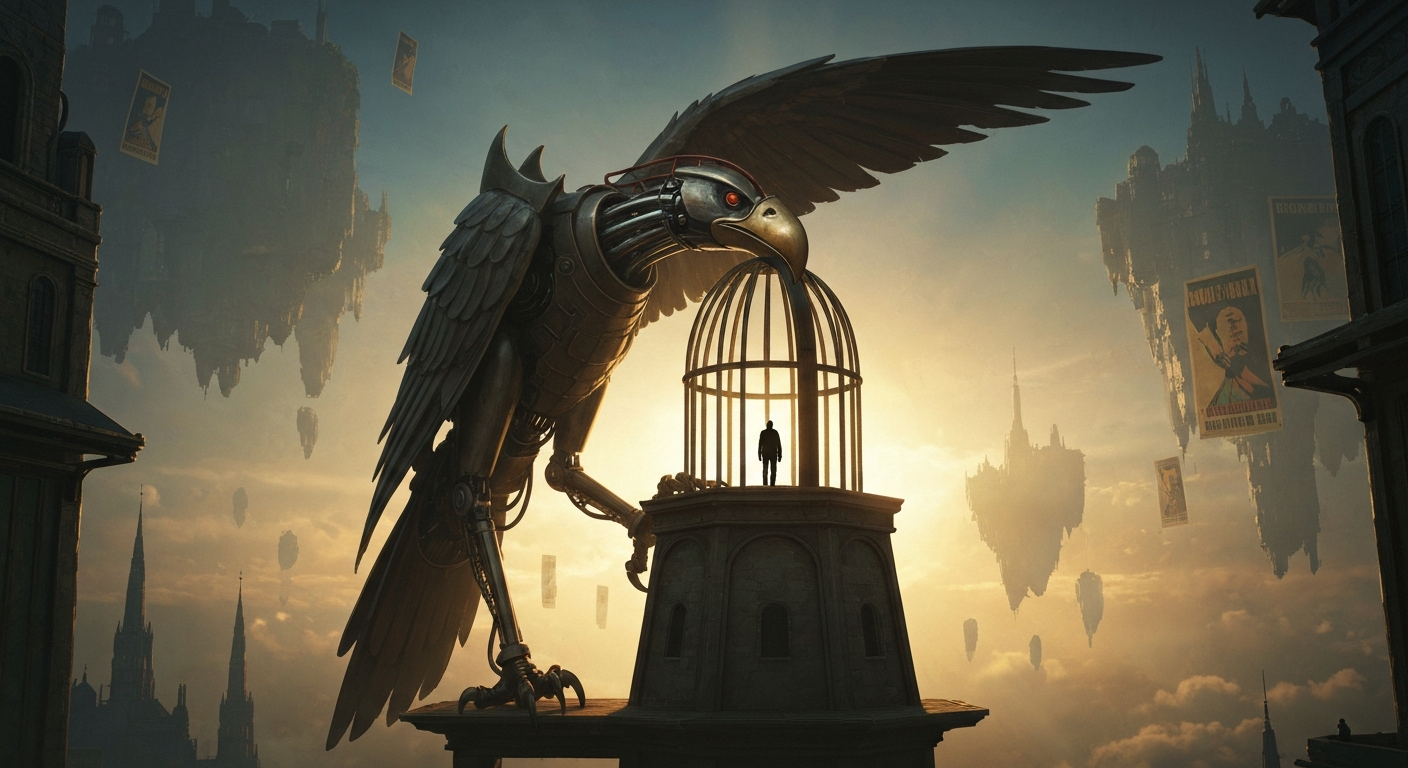
As allegory, the bird and cage become a sustained narrative framework rather than a passing comparison. An entire story, song, or artwork can be built around the captive bird as its central organizing logic, with characters, settings, and plot points mapping onto the elements of captivity and potential release. Maya Angelou's memoir uses it this way. For a prominent example in gaming, see Bioshock Infinite's 'Bird or Cage' symbolism, which uses the option as a thematic choice about freedom, control, and worldview. So does the design philosophy behind certain games, where the 'bird or cage' choice is literally presented to the player as a symbol of contrasting worldviews.
As visual shorthand, the image requires almost no explanation to carry its meaning. A silhouette of a bird behind bars on a poster, a book cover, or a tattoo communicates a whole complex of ideas (restriction, longing, resilience, the desire for liberation) almost instantly. This is why the image appears so reliably across political art, album covers, literary fiction, and pop culture. It has the compression efficiency of a very good symbol: a lot of meaning in a small space.
The bird-and-cage topic connects naturally to broader discussions about how the bird-plus-enclosure image functions across media, including its specific use in interactive storytelling where the cage and the bird become active choices rather than passive observations. For a concise explanation of bird and cage meaning, see the related article titled bird and cage meaning.
Idioms, Names and Nicknames Built Around Captivity
The captive bird has left its mark on everyday language in ways that are easy to overlook. Several common expressions carry its logic without explicitly mentioning cages or captivity.
- 'Free as a bird': used to describe complete freedom, which only makes sense because a caged bird is the implicit contrast.
- 'Sing like a canary': in criminal slang, to inform on others to authorities, drawing on the captive bird's compulsion to produce sound in confinement.
- 'Caged': used informally to mean trapped in a situation (a job, a relationship, a place) with no apparent exit.
- 'Bird in a gilded cage': an idiom for someone who has material comfort but no real freedom, popularised by a 1900 song of the same name and still in active use.
- 'Fly the coop': to escape or leave abruptly, from the image of a chicken or bird escaping its enclosure.
- 'Rare bird' (from the Latin 'rara avis'): used to describe an exceptional or unusual person, drawing on the idea that such individuals are as hard to find as exotic captive specimens.
Names meaning 'caged bird' or carrying captivity imagery appear in personal naming traditions across several cultures, often with the intent of marking a child as precious or protected (in the same way a valued bird is kept close) rather than as a statement of oppression. Place names, too, sometimes carry bird-and-enclosure references, often from historical associations with aviaries, falconry mews, or bird markets. If you are researching specific names that carry this meaning, the naming traditions themselves reveal a great deal about how different cultures have understood the relationship between care and confinement.
How to Tell If a 'Captive Bird' Reference Is Literal or Metaphorical
This is genuinely useful to know, because the same two words can mean completely different things depending on the context. Here is a practical framework for working it out.
- Check the genre and medium. A government document, a veterinary guide, or a wildlife trade report almost certainly means a literal bird in a physical enclosure. A poem, novel title, song lyric, or political speech is likely (but not always) using the image metaphorically.
- Look at who or what is described as captive. If the subject is an actual animal, you are probably in literal territory. If the subject is a person, a community, a soul, or an idea, the usage is metaphorical.
- Notice whether a cage or enclosure is described. Literal uses tend to describe physical spaces: a cage, an aviary, a pen, a quarantine facility. Metaphorical uses often leave the enclosure abstract or use it as a structural image rather than a physical location.
- Consider the emotional register. Literal descriptions of captive birds are usually factual and neutral in tone. Metaphorical uses are almost always emotionally charged, whether in the direction of suffering, resilience, longing, or liberation.
- Ask whether the bird sings. In symbolic uses, a singing captive bird almost always signals resilience, protest, or the persistence of inner life. A silent captive bird (if the silence is noted) often signals complete suppression. This specific detail rarely appears in literal descriptions of animals.
- Look for named species versus unnamed birds. A literal bird is usually identified: African grey parrot, canary, migratory waterfowl. A metaphorical bird is often just 'the bird' or 'a caged bird', unnamed and universal.
When you are writing and deliberately using the captive bird as a metaphor, the same principles help you control how readers interpret your image. If you want the literal and metaphorical to coexist (as Angelou does), name the bird, describe the physical cage, and then let the human resonance emerge from context rather than spelling it out. If you want a purely symbolic reading, keep the bird unnamed and the setting abstract.
This interpretive approach is especially useful when encountering the motif in unexpected places, such as in memoirs that use natural imagery to carry themes of confinement and survival, or in works that position the bird and its cage as a philosophical choice rather than a physical fact.
Case Study: Maya Angelou's I Know Why the Caged Bird Sings
Published in 1969, Maya Angelou's autobiographical memoir is one of the most widely read American books of the 20th century, and its title is essentially a compressed argument about what the captive bird means. The title is a direct allusion to Paul Laurence Dunbar's 1899 poem 'Sympathy,' which includes the line 'I know why the caged bird sings.' By choosing this as her title, Angelou is immediately placing her personal story of growing up Black in the American South within a larger tradition of Black artistic expression about confinement and voice.
The caged bird in Dunbar's poem beats its wings against the bars, bruises itself, and yet still sings. Not from joy, Dunbar insists, but from a deep, almost desperate need to express something that the cage cannot contain. Angelou adopts this image to frame her own memoir: the 'cage' is the intersecting oppressions of racism, poverty, and sexual violence that shaped her childhood, and the 'song' is the act of writing itself. To know why the caged bird sings is to understand both the necessity and the cost of that self-expression.
For readers approaching this title for the first time, a few signals are worth noting. The title does not promise resolution or escape. It promises understanding. The bird is still caged at the end of the question implied by the title. What Angelou offers is not a story of simple liberation but a meditation on why creative and expressive voice persists under conditions designed to silence it. The cage is real. The song is real. Neither cancels the other out.
This makes the work a particularly rich example of the captive bird motif used at full symbolic power. The literal bird Dunbar describes becomes a complete allegory for a specific historical and social experience, and Angelou's title signals to readers that she is working within that tradition deliberately and knowingly. If you encounter references to 'caged bird singing' in other contexts, whether in music, speeches, or other literary titles, the Angelou and Dunbar lineage is almost always part of what is being invoked, consciously or not.
Reading this title alongside other works that use bird-and-cage imagery as a central motif reveals consistent patterns: the cage as a symbol of systemic constraint, the bird's voice as an assertion of humanity, and the act of naming (giving the bird's experience a title, a story, a poem) as itself a form of resistance. These are themes that extend well beyond any single work, appearing across literature, visual art, and even the philosophy embedded in certain games and memoirs that use natural imagery to explore questions of freedom and meaning. See also Man's Search for Meaning, which explores resilience and meaning-making under extreme constraint and complements the bird-and-cage themes discussed here.
FAQ
What is the literal definition of a “captive bird”?
A captive bird is any bird kept and housed by humans rather than living freely in the wild. This includes pet birds, birds held in zoos, farms, research facilities, rescue/rehabilitation centres, and birds temporarily confined for transport or quarantine. Legal and trade frameworks further distinguish origin: “wild‑sourced” (taken from the wild), “captive‑bred” (offspring produced under controlled conditions such as mating or gamete transfer), and other permit codes used in CITES and national regulations (see 50 CFR §23.5 and CITES guidance).
How do legal and trade systems classify captive birds (wild‑caught vs. captive‑bred)?
Regulatory systems require exporters/importers and permitting documents to record the specimen source. CITES and implementing rules use explicit source codes (wild, captive‑bred, pre‑Convention, etc.) and treat “captive‑bred” as offspring produced in controlled conditions (see 50 CFR §23.5 and 50 CFR §23.24). National rules (EU, UK, Australia, US) add further movement, health and traceability conditions for captive birds and often privilege genuinely captive‑bred specimens for import to reduce biosecurity and conservation risks (see APHIS EU guidance, GOV.UK export rules, Australia BICON).
What welfare differences are associated with captive‑bred, hand‑reared and wild‑caught birds?
Welfare and behaviour vary by origin and rearing method. Peer‑reviewed studies report measurable behavioural differences: for example, some hand‑reared parrots show higher rates of problematic adult behaviours than parent‑reared birds (Applied Animal Behaviour Science). Feather‑damaging behaviour (feather‑plucking) is a common welfare disorder in captive parrots linked to multifactorial causes (medical, husbandry, social). Recent expert reviews call for species‑specific welfare tools, better veterinary care and owner education (Scientific Reports 2024–2026).
What are the main legal and biosecurity issues readers should be aware of regarding captive birds?
Key issues: legal permits and accurate source reporting (to prevent laundering of wild birds as captive‑bred), species‑specific import/export health and quarantine requirements, and national rules that may restrict movement of wild‑sourced specimens. Many jurisdictions treat captive‑bred birds differently for permitting and biosecurity (see CITES factsheet, 50 CFR sections, BICON guidance, and GOV.UK export pages). Misreporting origin has conservation and legal consequences.
What symbolic meanings does the captive bird motif commonly carry across cultures?
Common symbolic themes include lost freedom or oppression (the caged bird as constrained autonomy), suppressed voice or silenced expression (bird as song; cage as censorship), resilience or hope (a bird still singing despite confinement), and captivity as a state of exile or protection depending on context. These meanings appear in literature, religion, political imagery and art; the motif’s interpretation often depends on surrounding narrative and cultural history (examples discussed below are cited as context rather than exhaustive scholarship).
How does the bird+ cage motif function in language, idioms and names?
The motif appears in idioms and names as shorthand for constraint or protection: “a bird in a gilded cage” suggests luxury plus loss of freedom; “caged bird” evokes suppression of voice; terms like “free as a bird” contrast the opposite state. Writers and speakers use the motif metaphorically to discuss imprisonment, domestic confinement, emotional constraint or protective custody. Context (literal vs. metaphorical cues) determines meaning.
Bird or Cage Bioshock Infinite Meaning: Freedom vs Cage
Bird or Cage (BioShock Infinite): concise meaning, in-game examples, Elizabeth & Songbird symbolism explained.