If you searched 'loon bird definition,' you might be looking for one of two very different things: a striking aquatic bird known for its haunting calls, or an informal word for someone who's acting completely unhinged. Both meanings are real, both come up in everyday English, and they're easy to confuse in context. This guide covers both, starting with the actual bird and moving into the slang and symbolism, so you can walk away with exactly the meaning you were after.
Loon Bird Definition and Meaning: Species ID and Symbolism

Marcus Whitmore
23 Mar 2026

Loon bird meaning vs. 'loon' as an insult or slang term
The word 'loon' pulls double duty in English. As a bird term, it refers specifically to a group of diving waterbirds in the order Gaviiformes, genus Gavia. As slang, 'loon' means a person who is crazy, silly, or strange, and Merriam-Webster notes this is arguably the word's most common current usage in everyday speech. The slang version also powers idioms like 'crazier than a loon,' which has nothing to do with the bird's behavior and everything to do with the long history of English speakers borrowing bird names to describe human eccentricity.
The overlap between the two meanings isn't accidental. The connection to 'lunatic' (from the Latin 'luna,' meaning moon) is debated, but the eerie, almost unhinged quality of the loon's call likely helped cement the slang meaning over time. So when you see 'loon' in a sentence, context is everything: a 'loon on the lake' is a bird, while calling someone 'a complete loon' is a casual put-down (or affectionate teasing, depending on tone). We'll dig into both, but let's start with the real animal.
What a loon actually is

A loon is a large, aquatic diving bird belonging to the order Gaviiformes and the genus Gavia, which contains five recognized species. These are ancient, highly specialized birds built almost entirely around life on and under water. They are, in the words of ornithologists, 'almost wholly aquatic,' and everything about their anatomy reflects that. Their legs sit far back on their bodies, which makes them powerful underwater swimmers but genuinely awkward walkers on land. They have webbing between their front three toes, small pointed wings, and a strong tapered bill built for catching fish.
The common loon (Gavia immer) is the species most North Americans will encounter and the one that appears most often in cultural references and wildlife photography. It can dive from the water's surface to depths of at least 200 feet and stay submerged for up to roughly a minute. That diving ability is what sets loons apart from ducks or geese at a glance, and it's central to how they hunt.
Where loons live and what they look and sound like
Range and habitat
Common loons breed mainly on lakes in the coniferous forest zone of North America, and also push north into open tundra beyond the treeline. They return to the same ponds and lakes year after year to nest and rear their young. In winter, they move to large bodies of open coastal water. Other North American species, like the Red-throated Loon (Gavia stellata) and Yellow-billed Loon (Gavia adamsii), winter in southern coastal Pacific waters and northern seas respectively. If you're in the interior of the continent on a forested lake in summer, you're almost certainly looking at a Common Loon.
What they look like
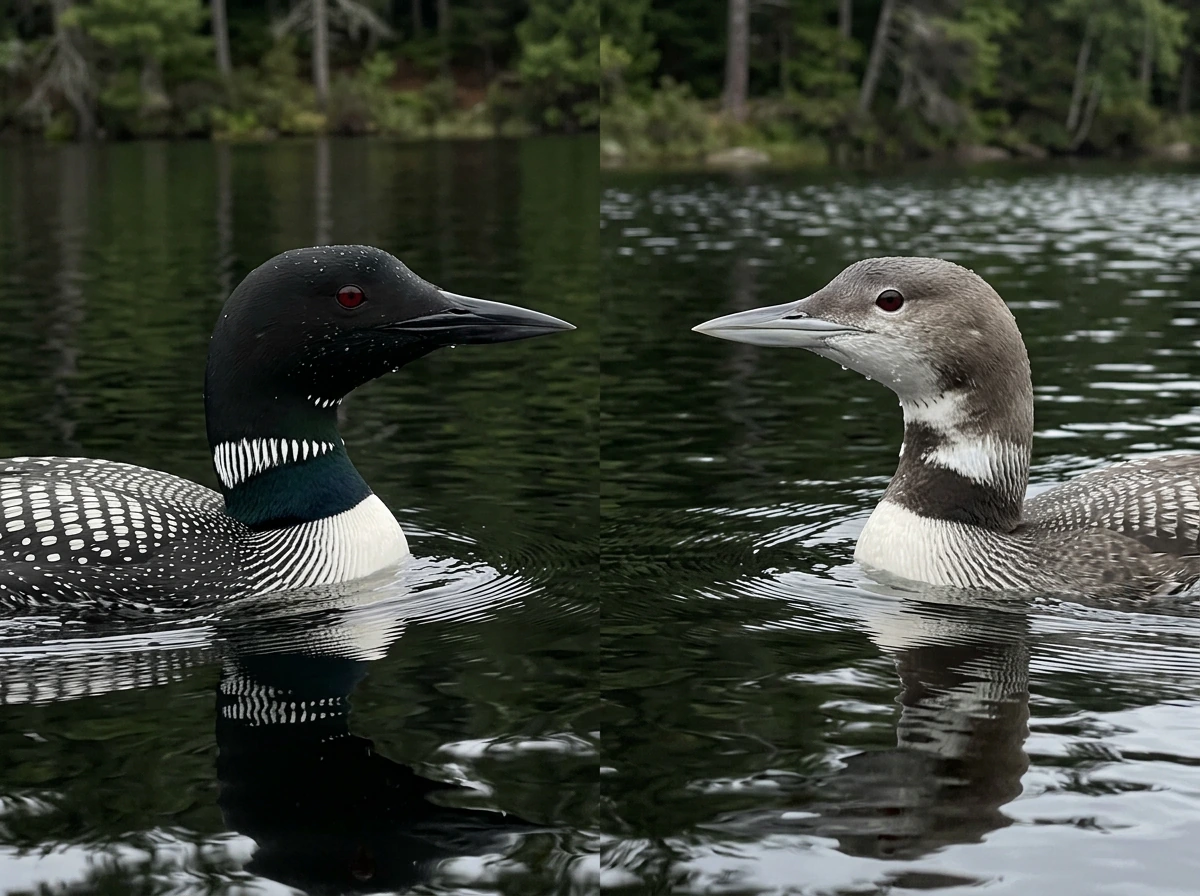
The Common Loon in breeding plumage is one of the more striking birds in North America. Key field marks include a black neck with a distinct white collar pattern, an overall checkered black-and-white back, and a long body that rides very low in the water. That low-riding posture is one of the first things to look for: loons sit deeper in the water than ducks, almost like a submarine at periscope depth.
In winter plumage, loons are much plainer, brownish-gray above and white below, which is when they're most likely to be confused with other diving birds. To separate Common Loons from similar species, watch the bill: the Red-throated Loon carries a thinner, upturned bill tilted slightly above horizontal, and the Yellow-billed Loon has a bill beveled upward at the tip with a blockier head overall. Loons are also frequently confused with grebes, mergansers, and coots on the water, so behavioral cues (deep diving, low posture, size) matter as much as plumage.
What they sound like
The loon's voice is the thing that leaves people a little awestruck, and it's probably what gave rise to every 'crazy as a loon' comment ever made. The Common Loon has four main call types, each with a specific social function.
| Call Type | What It Sounds Like | When/Why Loons Use It |
|---|---|---|
| Wail | Long, mournful cry | Long-distance communication between birds trying to locate each other |
| Yodel | Rising, complex call | Territorial signal used by males only to defend territory |
| Tremolo | Wavering, staccato call | Given when alarmed or announcing presence; the most 'laughing' quality |
| Hoot | Short, soft contact call | Close-range communication between adults, or between adults and chicks |
Hearing a tremolo across a quiet lake at dusk is one of those genuinely eerie wildlife experiences. It's easy to understand why generations of people heard that call and immediately reached for words like 'haunting' or, less charitably, 'crazy.' The wail in particular carries enormous distances and has a quality that sounds almost human, which makes it a recurring fixture in folklore and film soundtracks.
Loon symbolism and cultural meaning
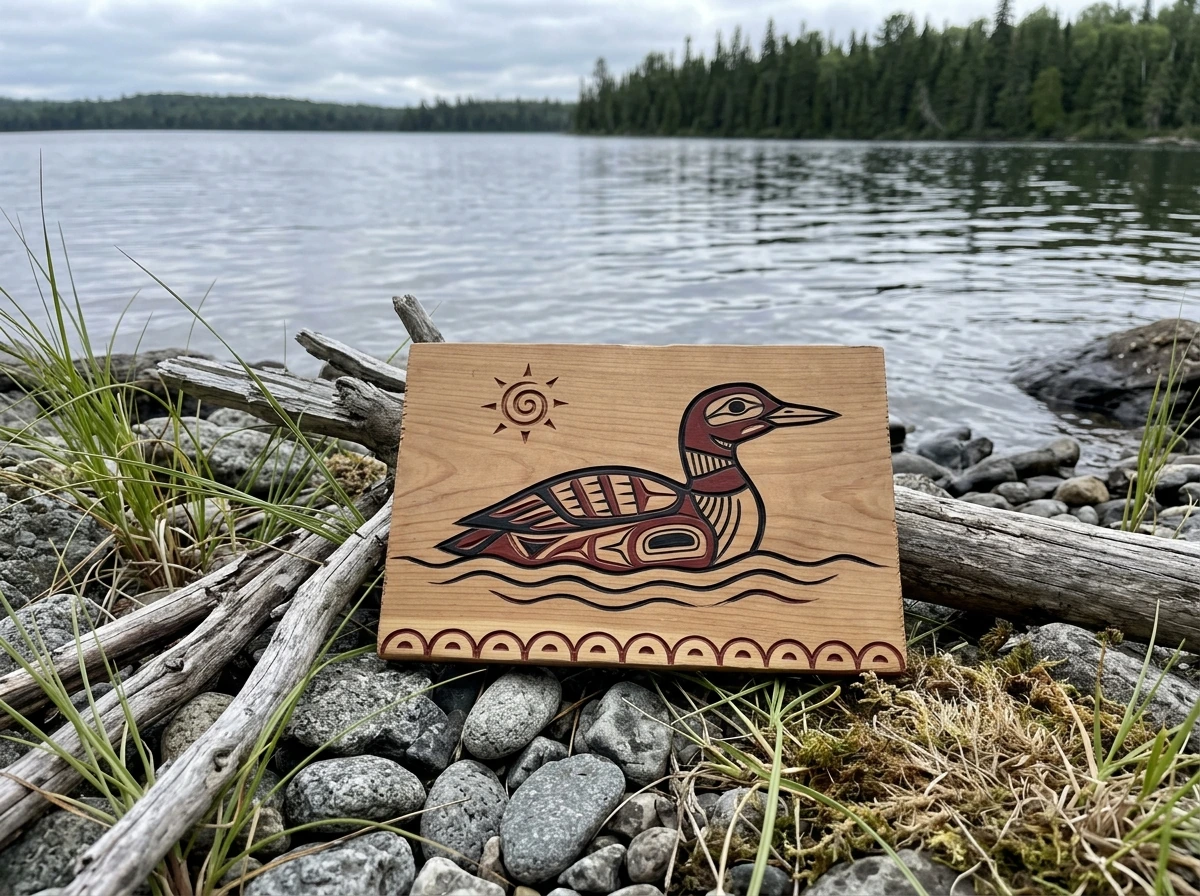
Loons carry serious symbolic weight in North American Indigenous traditions. For the Koyukon people of interior Alaska, the loon's remarkable voice and striking plumage were understood as expressions of spiritual power. Cornell Lab's All About Birds describes the Common Loon as featuring prominently in Native American mythology more broadly, often as a messenger between worlds or a spirit figure rather than simply a bird. The phrase 'Spirit of the North' is used in some teaching and writing contexts to capture this association, tying the loon's presence on remote northern lakes to something older and less easily categorized than 'wildlife.'
In a more general cultural sense, the loon has come to represent wildness, solitude, and the northern wilderness. It appears on the Canadian dollar coin (nicknamed the 'loonie' for this very reason), on provincial symbols, and in conservation imagery across the Great Lakes and boreal regions. Wikipedia notes that the $1 and $2 coins are colloquially known as the “loonie” and “toonie,” and explains that “loonie” comes from the common loon depiction on the reverse nicknamed the 'loonie' for this very reason. The loon's image functions as a shorthand for pristine, undisturbed water: healthy loon populations are considered an indicator of clean lake ecosystems, which adds an environmental symbolism layer on top of the mythological one.
If you're interested in how other birds carry this kind of dual identity as both literal species and symbolic figures, you'll find similar dynamics in how the hawk, the storm bird, and the snowbird each move between literal species definition and figurative cultural meaning. storm bird meaning
How 'loon' shows up in language and idioms
Outside of birdwatching and mythology, 'loon' lives a busy life in everyday English as a casual insult or affectionate label for someone behaving irrationally. The Cambridge English Dictionary defines it plainly as 'a person who is crazy, silly, or strange.
' Merriam-Webster goes a step further, noting that 'loon' in this sense has its own complex history, with theories connecting it to the older English word 'loon' meaning a simple or worthless person (unrelated to the bird), and to the adjective 'loony,' which is itself tangled up with 'lunatic.
Merriam-Webster describes “loon” as a crazy person and notes that this is arguably the word’s most common current meaning Merriam-Webster notes that 'loon' in this sense is arguably the word's most common current meaning. .
'
The idiom 'crazier than a loon' is the clearest example of the slang sense in action. It uses the bird's name and, by extension, its wild, unpredictable-sounding call as a reference point for irrational behavior. It's worth noting that loons aren't actually 'crazy' by any behavioral standard; they're highly adapted, socially sophisticated birds. The idiom is a case of human perception (that tremolo call really does sound unhinged) being baked into language over generations.
This pattern of borrowing bird names to describe human behavior or character is all over English. The same thing happens with 'hawk' (used as a metaphor for aggressive political positions), 'warbird,' and 'snowbird.' Loon just happens to sit at the intersection of the figurative (crazy person) and the literal (a real and genuinely extraordinary bird) more visibly than most.
How to confirm you're actually looking at a loon
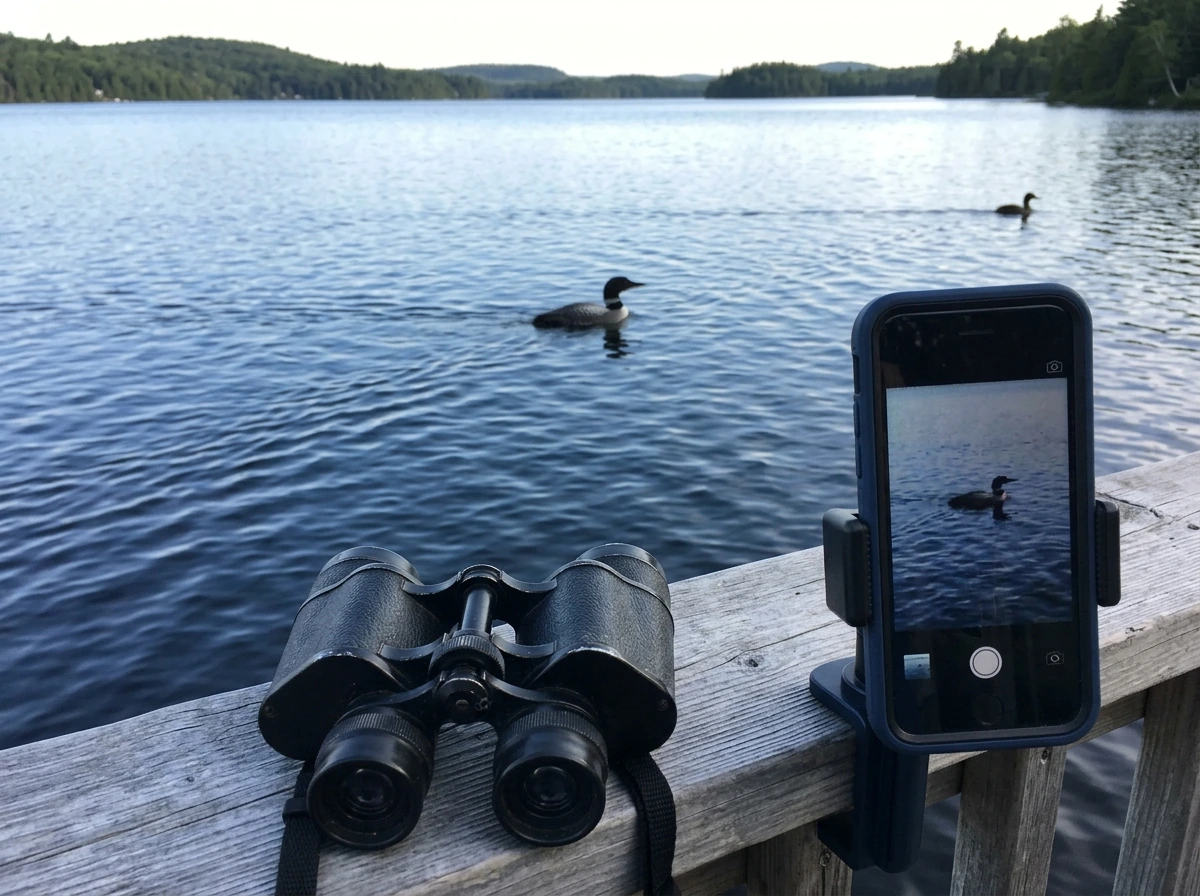
If you've spotted a large diving bird on a lake and want to confirm it's a loon before the moment passes, here's a practical checklist to work through on the spot.
- Check the posture on water: loons ride very low, almost submerged to the body, with just the head and neck clearly above the surface. Ducks and geese sit much higher.
- Look at the bill: it should be long, straight, and tapered (not upturned or hooked). An upturned bill points to a Red-throated Loon; a hooked bill suggests a merganser.
- Look for diving behavior from the surface (not a running takeoff like ducks, and not a plunge-dive like pelicans): loons simply slip underwater.
- In breeding season, look for the black neck with white collar/necklace pattern on a Common Loon.
- Listen: if you hear a wail, tremolo, yodel, or hoot, you almost certainly have a loon. Play back the four call types on Cornell Lab's All About Birds to compare against what you heard.
- Use Merlin Bird ID's Sound ID feature to record and compare calls in real time. It won't replace field marks, but it's a fast first check.
- If you're uncertain, cross-reference with the species comparison tool on All About Birds, which explicitly walks through how to separate Common Loons from Red-throated, Yellow-billed, and similar diving birds like grebes and mergansers.
One last thing worth knowing: if you're on a lake in summer and see what you think is a loon but the bird looks slightly slimmer and more elegant, check for Common Mergansers, which share similar lake habitats and can fool a quick glance. Maine Audubon specifically flags this as one of the most common summer misidentifications. The bill shape is the fastest giveaway: mergansers have a serrated, hooked bill built for gripping slippery fish, while a loon's bill is smooth and tapered.
Whether you came here trying to pin down a species or untangle a confusing use of the word in a sentence, the loon turns out to be one of those subjects where both the literal and figurative versions are worth knowing. If you meant the term used in idioms and slang, the storm bird meaning changes depending on the context and the wording around it. The bird is genuinely remarkable, the symbolism runs deep across cultures, and the slang has a history that's more layered than it first appears. You're now equipped for whichever version you needed.
FAQ
Is the slang “loon” related to “lunatic” (moon)?
Yes, but it is different from “lunatic” even if people connect them. In modern English, “loon” as slang primarily means a crazy or odd person, while “lunatic” comes from Latin roots tied to the moon, so any link between the slang “loon” and “lunatic” is debated rather than settled.
Why does a loon look harder to identify outside breeding season?
A common mistake is assuming all loons are equally vocal and equally distinctive in any season. Many first-time sightings happen in winter when plumage is plainer and identification relies more on behavior (deep diving, low posture) and bill shape than on the high-contrast “collar” look of the breeding season.
What should I check if I can only see a bird for a few seconds?
If you only get a brief glimpse, use “surface habits” as the tie-breaker. Loons tend to ride low, dive steeply from the surface, and reappear after longer submergence than many dabbling ducks, while mergansers and grebes often look different in posture and bill texture.
What birds are most often mixed up with loons, and what behavior usually gives it away?
Potential confusion can happen in groups. Grebes can be similar in size and “waterbird silhouette,” but loons are the ones most strongly associated with sustained deep diving and a smoother, tapered bill for fish capture.
Does “loonie” mean loon bird, or is it just the Canadian coin nickname?
Yes, “loonie” is commonly used as a nickname for the Canadian one-dollar coin, and that nickname is directly tied to the loon symbol on the coin. It is not the plural of “loon bird,” but a separate everyday term people use when talking about the currency.
Are loons actually “crazy,” or is that just an idiom?
Not exactly. The idiom “crazier than a loon” uses the bird as a stereotype of unpredictability, but the bird itself has specialized social and breeding behaviors, so the “crazy” part is human interpretation rather than a description of loon behavior.
How can I avoid confusion between the bird meaning and the insult meaning in a sentence?
If you are writing or speaking and want to avoid confusion, specify the intent in the sentence. For example, say “loon (the bird)” when describing wildlife, and if you mean the insult, add a clear target like “called him a loon” to signal the slang meaning.
What’s a good short “loon bird definition” that also helps with identification?
For a “loon bird definition” used in education or field notes, include both taxonomy and the practical ID traits. A useful short definition is that loons are large aquatic diving birds (order Gaviiformes, genus Gavia) known for low riding on the water and deep, sustained dives.
If I’m worried it might be a merganser, what single feature should I trust most?
Watch the bill and head profile when plumage is unclear. Mergansers often have a serrated, hooked-looking bill, while a loon’s bill is smoother and more tapered, and the overall head shape tends to look less “hooked” than mergansers.
Is the loon symbolism the same everywhere in Indigenous traditions?
If you are trying to interpret symbolism, be careful not to overgeneralize. Indigenous traditions include loons as spiritual messengers or power figures, but specific meanings can vary by community and region, so it is best to treat “spirit/messenger” as a general pattern rather than a one-size-fits-all definition.
Next Article
What Does Snowbird Mean and What It Looks Like
Meaning of snowbird: a seasonal winter traveler who migrates south for warmer weather, plus what they look like.