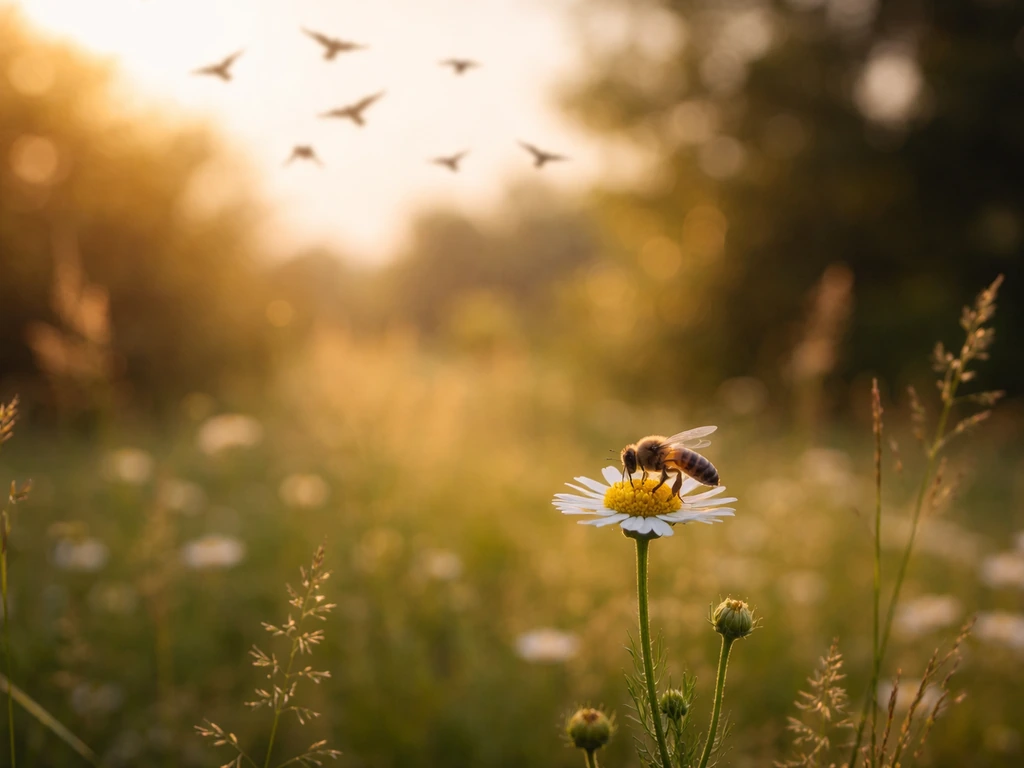
"blank" rel="noopener noreferrer">The birds and the bees" means sex education, plain and simple. It's an idiom, a polite euphemism English speakers use when they want to refer to the talk about sex, reproduction, and human sexuality, especially the conversation parents have with their kids. If someone says "I had to give my daughter the birds and the bees talk last night," they are not discussing ornithology or apiology. They are saying they sat down and explained where babies come from. blank" rel="noopener noreferrer">Some Reddit users describe being confused by the “birds and the bees” metaphor and share first-hand interpretations of it as a euphemism for sex education and reproduction talk.
What Is Bird and Bees Mean and How to Talk About It

Marcus Whitmore
15 Apr 2026

What "the birds and the bees" actually means

The Cambridge Dictionary defines it directly: "the birds and the bees" is a way of talking about sex and reproduction, particularly when parents explain it to children. Dictionary.com frames it the same way, calling it a euphemism and code phrase for sex education. So if you searched "what is bird and bees mean" expecting a literal biology lesson, here is your answer: it has nothing to do with actual birds or bees. It is figurative language, a cultural shorthand for the whole subject of human sexuality and reproduction.
The phrase is also broader than people often assume. A common confusion is that "the birds and the bees" only refers to the sex act itself. But reputable sources frame it more comprehensively, covering sexual intercourse, pregnancy, puberty, and how babies are made. Think of it less as a single awkward sentence and more as the whole territory of sex education that a young person needs to understand as they grow up.
If you want to understand the full landscape of how birds show up in expressions about relationships and intimacy, it helps to know that bird-related language has a surprisingly rich double life in English. For example, what "bird" means sexually in a relationship is its own rabbit hole, with slang meanings that vary quite a bit by region and context. The phrase we're focused on here, though, is specifically about that educational conversation.
How people actually use this phrase
You will hear several wording variations in the wild, and they all mean roughly the same thing. The most common forms are "the birds and the bees," "the birds and the bees talk," "the sex talk," or just "the talk." Collins Dictionary's example sentences include constructions like "It would be many years yet before she could talk about the birds and the bees with Joey," which shows exactly how naturally the phrase slots into everyday conversation.
In real life, people use it in a few distinct ways. They use it as a noun phrase to name the conversation itself ("we need to have the birds and the bees talk"), as a subject of discussion about parenting ("how do you handle the birds and the bees at your house?"), or sometimes humorously to signal that a topic is getting into adult territory. The humor comes from the phrase being a deliberately indirect way of saying something everyone knows you mean.
VOA Learning English characterizes it as an "evasive expression" used to avoid saying the word "sex" directly, which is exactly right. The indirectness is the point. In polite or family contexts, saying "the birds and the bees" signals the subject without the perceived bluntness of stating it outright. It also carries a cultural signal that this is a rite of passage, something every parent eventually navigates with their children.
You may have also seen "the bird and the bees meaning" searched without the plural, or encountered the phrase "the bird and the bee" as a variant. These are all reaching for the same idiom, just with slightly different wording. The plural form "the birds and the bees" is the standard, established version you will find in major dictionaries.
Where the phrase came from, and why those animals

The exact origin is debated, which is true of most idioms that have been floating around for a century or two. One widely cited explanation points to Samuel Taylor Coleridge's 1825 poem "Work without Hope," which contains the evocative line "The bees are stirring, birds are on the wing." The Public Domain Review traces the euphemism's roots to around this period, connecting the imagery to a Victorian-era tendency to speak about human reproduction by analogy with nature. Using animals that were clearly involved in pollination and reproduction, but in a gentle, outdoor kind of way, gave adults a layer of distance from the more explicit subject.
John Evelyn's diary from the 1640s is sometimes cited as containing earlier "birds and bees" language in a nature context, though the direct connection to the sex-education meaning is not a clean line. What is clearer is that by the early 20th century, the phrase had taken hold in English-speaking culture as a recognizable code. Cole Porter's 1928 song "Let's Do It, Let's Fall in Love" included phrasing along the lines of "for each bird and each bee," which helped cement the birds-and-bees romantic and reproductive association in popular culture. The National Archives in the UK also records the phrase appearing in early 20th century sex education materials, showing it was well established in institutional contexts by then.
So why birds and bees specifically? Birds are one of the most universal symbols of life, freedom, and renewal across cultures, and they are visibly active in mating, nest-building, and raising young. Bees are pollinators, creatures whose entire ecological role involves transferring reproductive material from flower to flower. Live Science describes the phrase as parents’ story to help explain reproduction mechanics to children using imagery connected to bees and birds [bees are pollinators](https://www.
livescience. com/39316-birds-and-bees. html). Together, they gave Victorian and Edwardian adults a way to gesture toward reproduction using creatures that were wholesome, natural, and visible to any child who had spent time outdoors.
It was a pedagogical metaphor before anyone called it that. The phrase works because it leans on that long symbolic tradition of birds representing life's cycles, something explored in depth when you look at the bird and the worm meaning and other bird-based idioms where nature becomes a stand-in for human experience.
How to interpret it today
The phrase itself is as current as ever, but what goes into "the talk" has evolved considerably. Modern guidance from organizations like Planned Parenthood and the American Academy of Pediatrics frames sex education as much broader than explaining where babies come from. It now routinely includes healthy relationships, consent, bodily autonomy, puberty, and emotional wellbeing. Planned Parenthood is explicit that "it's never too early and it's never too late to start talking" with children about sex and relationships, as long as conversations are age-appropriate.
Consent has become a central piece of the modern "birds and the bees" conversation in a way that earlier generations did not emphasize. Planned Parenthood defines consent as communication, noting that "consent is how you and your partner both know that sex is OK," and positions it as something that should be introduced and built on across a child's development, not delivered as a single lecture at age 13. This is a significant shift from the old model of one uncomfortable conversation and then hoping for the best.
Age-appropriateness is the other key modern lens. The Mayo Clinic Health System recommends treating puberty and sex discussions as "an ongoing conversation, not a one-time event," and advises starting with correct anatomical terms early rather than waiting for a formal sit-down talk. Nationwide Children's Hospital notes that for most girls, puberty changes begin between ages 8 and 12, which means waiting until the teenage years to start the conversation can mean you're already behind.
The phrase also appears in the context of the bird and the bee meaning in broader cultural and symbolic discourse, where the pairing of birds and bees carries weight beyond any single conversation. But for practical purposes today, "the birds and the bees" talk is best understood as an ongoing, evolving dialogue rather than a one-night event.
What to say, and when to say it
The biggest mistake most people make with the birds and the bees talk is treating it as a single, scheduled event rather than a series of age-appropriate conversations. Here is a practical breakdown of what to cover and roughly when:
| Age Range | What to Cover | Tone and Framing |
|---|---|---|
| Ages 3 to 6 | Correct names for body parts, basic body safety, the concept that bodies are private | Simple, matter-of-fact, use correct anatomical terms |
| Ages 7 to 10 | How babies are made at a basic level, what puberty is and that it is normal, questions about gender and bodies | Calm, curiosity-led, answer what they ask without over-explaining |
| Ages 11 to 13 | Puberty in detail, menstruation, erections, emotional changes, friendships and crushes | More detailed, normalize the awkwardness, invite questions |
| Ages 14 and up | Sexual intercourse, contraception, consent, healthy vs. unhealthy relationships, STIs | Honest, non-judgmental, include your values clearly but without lecturing |
| Ongoing | Consent, relationship health, media literacy about sex, revisiting earlier topics with more depth | Open door policy, check in regularly, respond to what they encounter |
The American Academy of Pediatrics recommends that parents share their values alongside factual information rather than treating the conversation as purely biological. Kids want to know what you think, not just what the textbook says. St. Louis Children's Hospital frames the entire thing as an ongoing conversation rather than a single event, which takes a lot of pressure off. You do not have to cover everything in one go.
The CDC advises that with teenagers especially, privacy matters. Being willing to step away from siblings or other family members to have a one-on-one conversation signals to a teen that you are taking the subject seriously and that they can be honest with you. That shift from a formal family announcement to a private, personal conversation can change the whole dynamic.
Practical tips to make the conversation less awkward
Awkwardness is almost universal here, and acknowledging it out loud actually helps. Saying something like "I know this might feel a little weird to talk about, but I want you to be able to ask me anything" normalizes the discomfort rather than letting it shut the conversation down. WebMD's guidance on this conversation makes the same point: don't let embarrassment stop communication. The goal is not a perfect, smooth performance. It's a real, honest exchange.
Here are the practical moves that actually make these conversations go better:
- Start younger than you think necessary. Accurate, calm, age-appropriate language from an early age builds the foundation and removes the shock factor later.
- Use correct terms for body parts from the beginning. Euphemisms signal that the subject is shameful; anatomical terms signal it is normal and discussable.
- Let their questions lead. You do not have to give a comprehensive lecture every time. Answer what they are actually asking, then check if they want to know more.
- Use external triggers as conversation openers. A TV show, a news story, or something they mention from school can make it feel like a natural conversation rather than a formal talk.
- Be honest about your own uncertainty. If you don't know the answer to a question, say so and offer to find out together. This models good behavior and keeps the door open.
- Keep conversations short and repeat them often. A five-minute conversation every few months beats a single hour-long talk that exhausts everyone.
- Include consent and relationship health, not just biology. How people treat each other, what healthy communication looks like, and what they are allowed to say no to are just as important as the mechanics.
- Make it clear you are always available. End conversations with something like "you can always ask me about this" so they know it is not a one-time offer.
Planned Parenthood's parenting resources also emphasize using conversation prompts and asking open-ended questions rather than delivering monologues. Questions like "what have you heard about this at school?" or "what do you think that means?" invite kids into a dialogue rather than putting them in the position of passively receiving information. That shift from lecture to conversation is what makes these talks stick.
The phrase "the birds and the bees" has been around for nearly two centuries because it captures something real: the need to find a gentle, approachable way into a subject that matters enormously and can feel impossibly awkward. The animals in the idiom are doing exactly what animals in bird-related idioms so often do, carrying meaning that feels too direct to say plainly. But the directness is exactly what the conversation itself needs. Use the phrase to describe the talk, then drop the euphemism once you are in it.
FAQ
Is “the birds and the bees” the best wording to use with children?
Use the phrase if you are naming the topic indirectly, but switch to accurate language once the conversation starts. For younger kids, lead with correct anatomical terms and simple, factual explanations, then build from there as they ask questions. This avoids the common mistake of relying on euphemisms as the only language.
Do I have to avoid saying the word “sex” when I have the talk?
Yes, but the word “sex” itself usually does not need to be avoided. Many families start with “sex and relationships” or “how bodies change,” then explicitly address sexuality, reproduction, and boundaries when the child is ready. If you want to keep it gentle, use a softer intro, then be direct about the facts.
My teen keeps using vague phrases. How do I respond if I do not know what they mean?
If a teen uses a euphemism, it is fine to mirror their language briefly, but do not let it block clarity. Ask what they mean, then correct misconceptions with specifics (for example, what consent means, what pregnancy requires, and how contraception works). “Awkward code” can become “vague misinformation” if you do not translate it.
What should I do if my child asks about sex before I’m ready?
A good rule is to handle questions as they come, even if you have not planned a “talk.” If a question arrives, answer the part they asked about, then ask what they are curious about next. This supports the idea that it is an ongoing conversation rather than one scripted moment.
Is the birds-and-the-bees talk only about pregnancy?
Do not treat it as only an explanation about pregnancy. For most teens, it also needs to include healthy boundaries, consent, pleasure in age-appropriate terms, safer sex basics (especially STI prevention), and how relationships affect decisions. Focusing only on “how babies happen” can leave major gaps.
How can I talk about this if I’m not a parent or I’m worried I’ll be intrusive?
If you are not the parent, guardian, or educator, you should still match the intent but adjust the approach. Use respectful, non-shaming language, check what they already know, and avoid assumptions about their experience. When in doubt, focus on boundaries, safety, and accurate information rather than personal anecdotes.
When should the birds-and-the-bees conversation start, realistically?
Timing is flexible, but being too late is a common problem. If puberty may be starting (sometimes as early as late childhood), begin with body changes and emotions first, then add relationships and consent. Waiting until the teen years can mean missed teachable moments.
What if the questions get uncomfortable or too detailed for their age?
If your child has questions that feel intense, you can set a tone without shutting them down. Try acknowledging the topic, inviting questions, and saying you will answer in an age-appropriate way. For example, you can say you want to talk more but prefer to continue after you both have time and privacy.
How do I handle privacy if siblings or other relatives are around?
Have a private conversation when possible, but do not make privacy so strict that it feels secretive. You can still be open about the fact that you will listen and that they can ask anything. If the family is crowded, suggest a quieter moment rather than turning the topic into a family spectacle.
How do I make the conversation less awkward and more effective?
Aim for dialogue, not performance. Start with a question that gauges their knowledge (for example, “What have you heard about this?”), then correct myths and add your values. Ending with “Is there anything you still want to ask?” helps ensure the conversation is actually understood.
Next Article
The Bird and the Bee Meaning: Romance, Sex, and Context
Meaning of the bird and the bee: a euphemism for sex and romance, with context, tone, variants, and examples.