
"Early bird gets the wood" is a folk variant of the well-known proverb "the early bird gets the worm." The meaning is essentially the same: whoever shows up first, acts earliest, or moves quickest has the best shot at securing the reward on offer. "Wood" here is not about lumber. It functions as a stand-in for the prize, the payoff, or the advantage that goes to the first mover. The phrase is informal, often used playfully or regionally, and in some modern slang circles it carries a cruder double meaning altogether. But at its core, whether someone says "worm" or "wood," the lesson is identical: timing and initiative matter. Wikipedia describes the proverb “the early bird gets the worm” as suggesting that getting up early will lead to success during the day.
Early Bird Gets the Wood Meaning and Real-World Use


The origin of the phrase and where "wood" fits in
The original proverb traces back to at least 1605, when William Camden included a form of it in a collection of English proverbs. By the 17th century it was already considered a well-established saying, not a fresh coinage. The standard versions you will hear today are "the early bird gets the worm" and "the early bird catches the worm" (those two are interchangeable; the swap between "gets" and "catches" is trivial and doesn't change anything). Merriam-Webster and Cambridge Dictionary both anchor their definitions of "early bird" directly to this proverb, and Wiktionary's etymology for the term points squarely back to the worm version.
"Wood" is not part of the historical record. It does not appear in proverb inventories the way "worm" does, and it is not listed as a regional or archaic alternative in mainstream reference sources. What it almost certainly is: a spoken mishearing, a folk substitution, or a deliberate playful rewrite. The kind of thing someone says in conversation and it sticks. English proverbs have always had this quality; the USC Digital Folklore Archives documents multiple variants and rewrites of the early bird proverb, and Wikipedia's article on anti-proverbs shows that reworking the wording of classic sayings is a long tradition in English. "Wood" is part of that ongoing evolution, not a competing original.
What "wood" actually means here

If someone uses the phrase straight, without any winking or comedic intent, "wood" works the same way "worm" does: it is the figurative reward waiting for the person who moves first. Think of the worm as the prize the bird earns by getting up early and searching while others sleep. Swap in "wood" and the underlying image shifts slightly (maybe a bird claiming a good nesting tree, or a woodpecker beating rivals to a promising trunk) but the lesson stays intact. You could also read "wood" in a broader metaphorical sense, the way we talk about "securing the goods" or "getting what you came for." It is not about actual timber any more than "the worm" is about actual invertebrates.
The one context where "wood" takes on a different meaning entirely is modern slang. Urban Dictionary records "early bird gets the wood on" as a phrase with an explicit sexual reading in some communities. That usage is a completely separate thing from the proverb's initiative-and-timing lesson. If you ran into the phrase in a casual or comedic setting and wondered whether something else was being said, the answer is: possibly yes, depending on the audience. But in any workplace, classroom, or general conversation context, the proverb reading is far more likely and appropriate. In that same spirit, some people look up the day bird meaning to understand how the wording connects to early action and the expected prize.
How people actually use this phrase day to day
In practice, you hear the early bird proverb (in all its variants) in a handful of recurring situations. At work, a manager might say it to encourage a team to submit a proposal before competitors do, or to motivate someone to arrive early for a busy event. In school settings, teachers use it constantly to encourage students to start assignments ahead of deadlines; WeAreTeachers includes it as a classroom idiom precisely because it gives children a memorable mental model for why early action pays off. In customer or retail contexts, it shows up as the logic behind "early bird sales" and "early bird pricing," which Merriam-Webster explicitly notes as a modern commercial extension of the proverb. Socially, people invoke it when talking about relationships, networking events, or any situation where arriving or acting first gives you a genuine edge.
The "wood" version tends to appear in more informal, often humorous settings. When someone says she is an early bird figure of speech, they mean she consistently acts first to get the best outcome. Someone might say "early bird gets the wood" as a knowing nod to the original proverb while being a little irreverent about it, or they might use it in a regional or community context where the substitution is common. Either way, anyone who knows the original proverb immediately grasps the intent. The bird imagery carries cultural weight: birds in language have long symbolized readiness, alertness, and the messenger who arrives before others. That association makes the proverb's logic feel instinctively right.
Sorting out the variants and mix-ups
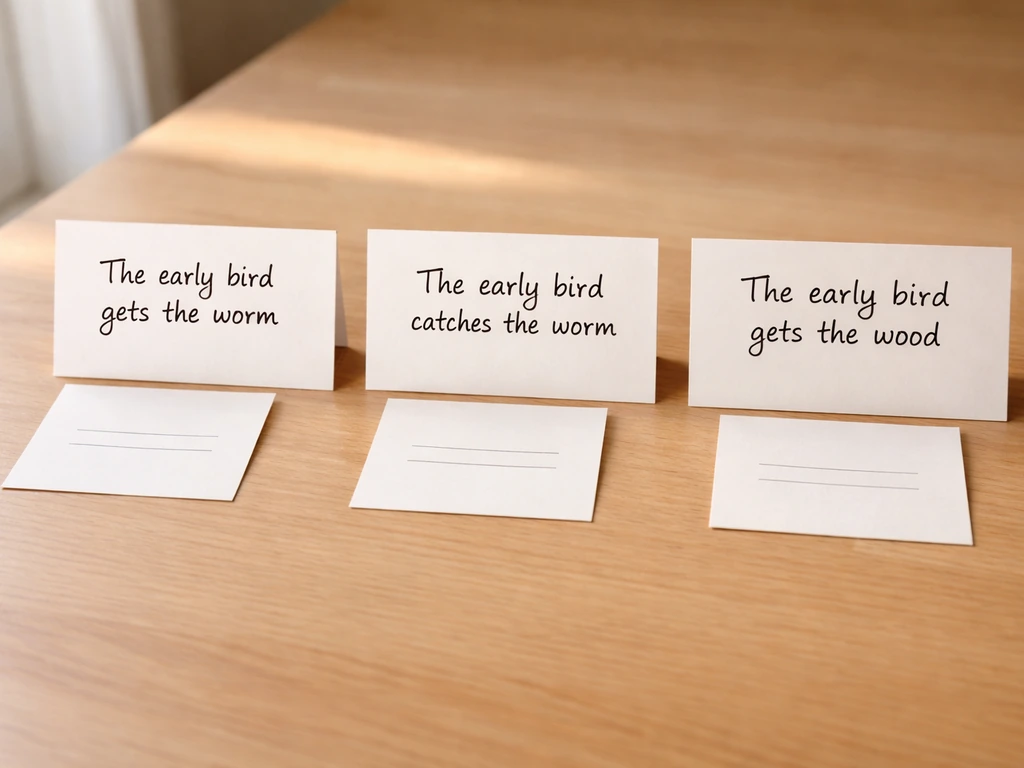
There are a few versions floating around, and it is worth being clear about what each one is.
| Variant | Status | Meaning |
|---|---|---|
| The early bird gets the worm | Standard, historical (1605) | Acting early gives you the best chance at the reward |
| The early bird catches the worm | Standard, equally valid alternative | Same meaning; 'catches' and 'gets' are interchangeable |
| The early bird gets the wood | Folk/informal variant, not historically documented | Same lesson; 'wood' substitutes for the figurative reward |
| Early bird gets the wood on | Modern slang (some communities) | Separate sexual meaning; unrelated to the proverb's lesson |
| The early worm gets picked first | Anti-proverb / ironic inversion | Challenges the proverb; being first can sometimes be a disadvantage |
The most common confusion is simply between "worm" and "wood" as a mishearing. If someone says, “he is an early bird,” that is figurative language for someone who arrives or acts first. English speakers often swap similar-sounding words in familiar phrases, and "wood" and "worm" share enough sonic overlap that the substitution happens naturally in speech. If you heard someone say "early bird gets the wood" and were not sure whether they misspoke or were deliberately using a variant, the safe assumption is that they meant the same thing as the classic proverb. On Reddit, users commonly interpret the early bird proverb as about getting an advantage by arriving early, such as lining up first or being first in a situation blank" rel="noopener noreferrer">interpret the proverb as arriving early to secure an advantage.
What the proverb is actually trying to teach
The core lesson is about three things working together: timing, initiative, and awareness of competition. Wiktionary frames it neatly: whoever arrives first has the best chance for success, and some opportunities are only available to the first competitors. Dictionary.com similarly explains that the proverb refers to someone who arrives first having the best chance for success, including in auction and customer-style contexts whoever arrives first has the best chance for success. That last part is crucial. The proverb is not just saying "be an energetic person." It is saying that certain resources or windows are genuinely limited, and the person who moves first gets access before those options close. Cambridge Dictionary's example illustrates this well: setting up a market stall at 7 a.m. because you know the best spots go early. That is the proverb working exactly as intended.
There is also an ecological truth baked into the imagery. Birds actually do catch more worms in the early morning, when worms are near the surface and conditions are right. Lexistry points out that the proverb works both as a literal observation and as a metaphor, which is part of why it has lasted four centuries. The image is not arbitrary; it reflects something real, which makes the metaphorical lesson feel earned rather than invented.
From a symbolic standpoint, birds in language frequently represent messengers, scouts, and early movers. Across cultures, the bird that appears first at dawn carries significance: it signals readiness, alertness, the start of the day. The morning bird meaning is closely tied to that idea of readiness at dawn and taking advantage of early opportunities. The early bird proverb taps into that symbolism deliberately, which is one reason it feels so immediately intuitive. Other bird-related idioms and sayings in everyday English draw on similar imagery, connecting birds to timing and opportunity in ways that go back much further than any single proverb.
When the proverb doesn't hold up
Being early is genuinely useful in many situations, but the proverb oversimplifies things in ways worth acknowledging. A few real limitations:
- Some opportunities depend on luck, connections, or structural access more than timing. Getting there first means nothing if you do not have the credential, the contact, or the capital required to convert that early arrival into an actual advantage.
- The anti-proverb tradition captures a real counter-truth: "the early worm gets picked first." Acting early can expose you to risk, or make you the test case that a later mover learns from at lower cost.
- Racing to be first can produce sloppy work. Many domains reward quality over speed, and a slightly later but more polished effort routinely beats a rushed early one.
- Not everyone has equal ability to show up early. Caregiving responsibilities, economic constraints, health limitations, and other systemic factors mean that "just get there first" is not equally achievable advice for everyone.
- Dictionary.com's framing is instructive here: the proverb says the early arrival gives you the "best chance" for success, not a guarantee. The probabilistic reading is more honest than the absolute one.
Living on Earth's BirdNote segment makes exactly this point from a nature angle: the ecological logic of feasting very early is not always optimal for birds either, which quietly undercuts the proverb's certainty. Knowing when the lesson applies and when it does not is at least as useful as knowing the lesson itself.
How to actually apply this today

The practical version of this proverb is not "wake up at 5 a.m. forever." It is about identifying which specific opportunities in your life right now are genuinely time-sensitive or first-come-first-served, and moving on those deliberately. Here is a simple way to put the lesson to work:
- Identify one opportunity in the next week that has a clear timing advantage. This could be a job application, a seat in an oversubscribed course, a sale, a networking event, or a proposal deadline. Not everything qualifies; pick something where being first actually matters.
- Act the same day you identify it. Do not wait for a "better moment." Draft the email, submit the form, make the call. The proverb's entire point is that the window exists now.
- Prepare the night before when you can. The Cambridge Dictionary example of setting up at 7 a.m. works because someone planned ahead. Early action is most effective when it is not frantic.
- Check whether "early" is actually the advantage here. Ask yourself: does this opportunity genuinely reward first movers, or does it reward the best-qualified candidate regardless of timing? If it is the latter, invest your energy in quality rather than speed.
- Set one recurring reminder or habit that shifts a regular task earlier by 30 minutes. Small consistent earliness compounds over time in ways that one dramatic early morning does not.
The expression "early bird gets the wood" (or the worm, or however you heard it) is ultimately a prompt to pay attention to timing as a variable you can control. Most people treat timing as fixed and then wonder why someone else got the spot, the deal, or the role. The proverb's real lesson is that timing is often more within your control than it feels, and that small shifts in when you act can change what you are able to access. That is worth taking seriously, even if the word "wood" still makes you raise an eyebrow.
FAQ
Is “early bird gets the wood” grammatically correct, or should I use “worm” instead?
Both work as variants of the same proverb. In formal writing, “worm” is usually safer and more widely recognized. Use “wood” only if the setting is informal, you are quoting someone, or you want a playful regional feel, since some readers may assume you mean the classic version but others may react to the “wood on” slang possibility.
How can I tell whether “early bird gets the wood on” is being used literally or as slang?
Look at the context and the audience first. If it is said as part of casual banter with obvious humor, adult innuendo, or a flirtatious tone, it may be slang. In workplace, school, or general conversation, it is far more likely the speaker means “first mover gets the prize.” When unsure, it is okay to ask a clarifying question like, “Do you mean the early action proverb?”
Does the proverb mean “be early,” or “act first,” even if you are not actually the first to arrive?
The core idea is initiative in the relevant window. You can apply it by being ready to act immediately when the opportunity opens, not just by physically arriving early. For example, if an application portal opens at 9 a.m., having your details prepared at 8:50 a.m. is often what matters, not whether you were online at 8:00 a.m.
When does the proverb not apply, or when can being early backfire?
If the opportunity is not truly first-come-first-served, arriving early can waste time or even harm your position. Examples include bureaucratic processes where “first in line” does not change outcomes, deadlines where submissions are equally accepted until the cutoff, or situations where you need quality checks more than speed. The useful test is whether a time window or limited resource is actually closing.
What is the practical way to decide which opportunities are “time-sensitive”?
Ask two quick questions: “Does the option close or get worse if I wait?” and “Is there a limited quantity, best locations, or limited review capacity?” If the answer is yes, prioritize early action. If not, prioritize preparation, competence, or negotiation instead of rushing.
How should I respond if someone says “early bird gets the wood” but I think the outcome is based on something else?
A tactful approach is to agree with the timing idea, then add a nuance. For instance, you can say, “Timing helps if there is limited space, but in this case quality and requirements matter too.” That keeps the conversation constructive while addressing edge cases where speed alone does not win.
Could “wood” be interpreted as something other than the proverb in a professional setting?
Yes, a fraction of audiences may associate “wood” with the sexual slang variant. In professional settings, that risk is lower than the classic “worm” meaning, but it is still not zero. If you are writing for a mixed audience, prefer “worm” or rephrase the thought as “the early bird gets the advantage” to avoid distraction.
Is “early bird gets the wood” ever used ironically or critically?
It can be. People sometimes use the proverb when they want to imply someone is overly focused on speed, sometimes even when the first mover ends up with a worse deal. If you hear it with a mocking tone, treat it as a comment on judgment, not just timing.
What mistake do people commonly make when applying this proverb to work or school?
They assume being first guarantees the best outcome. A better application is “move first with enough preparation to be credible.” For school, that might mean starting early but still editing and following requirements. For work, it can mean submitting the proposal early but also making sure it meets the brief, so “first” does not become “first and wrong.”
Day Bird Meaning: What It Can Mean and How to Tell
Clarify day bird meaning: literal vs metaphor, daybird vs two words, and how to tell which fits your context.