If you searched for 'what a bird thought meaning,' you're probably trying to figure out one of three things: you encountered a poem or story where a bird seems to narrate its own inner life, you heard someone use the phrase figuratively to suggest a bird-like perspective or instinct, or you're genuinely curious what birds actually perceive. The most likely answer, especially in an English class or literary context, is that 'a bird thought' is a poetic or metaphorical device used to project human emotions like curiosity, growth, or freedom onto a bird. It's not a real idiom with a fixed dictionary definition, but it carries a lot of symbolic weight depending on where you saw it.
What a Bird Thought Meaning: Symbolism, Context, and More

Marcus Whitmore
10 Jun 2026
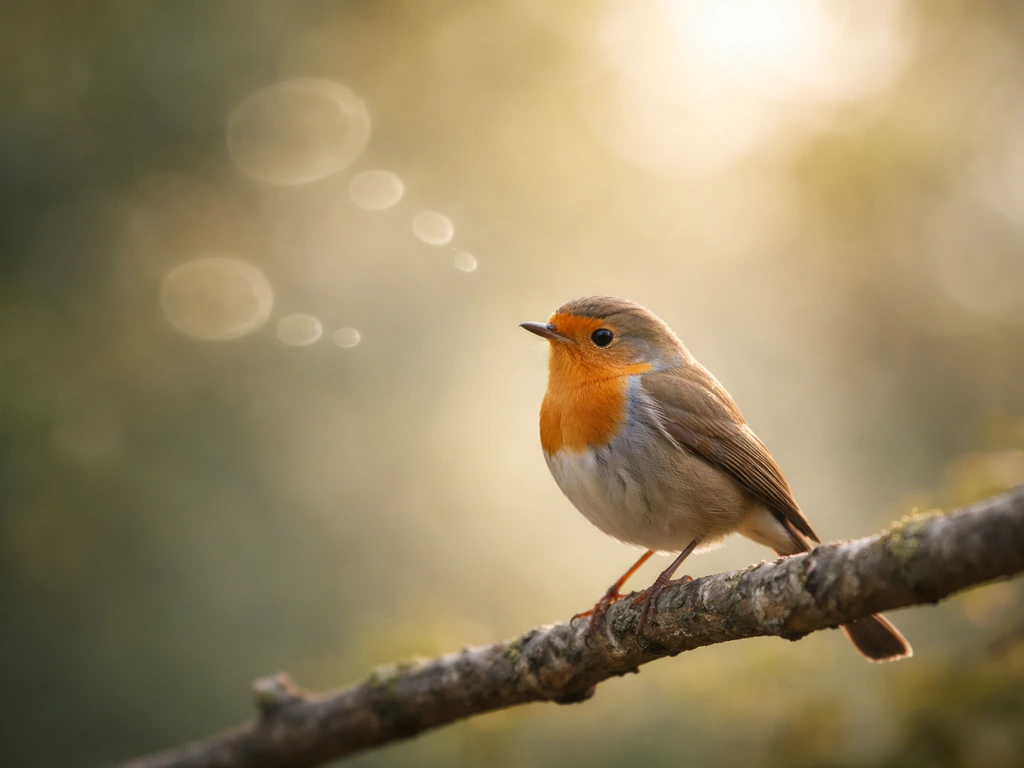
Literal, figurative, or a misread phrase? Let's sort it out

The phrase 'a bird thought' can land in at least three different categories, and knowing which one you're dealing with makes all the difference. First, it might be literal bird cognition, as in 'what does a bird actually think or perceive?' Second, it could be figurative or poetic, where a writer gives a bird an inner voice to explore themes like freedom, curiosity, or transformation. Third, you might have misread or half-remembered a different phrase entirely, such as 'a little bird told me,' 'bird's-eye view,' or even a species-specific idiom like calling something a stormbird (a bird 'thought to presage storms,' in Merriam-Webster's own phrasing).
That Merriam-Webster example is worth pausing on, because it shows how naturally English uses 'thought' around birds without quoting actual bird cognition. When we say a bird is 'thought to' do something, we mean people believe or attribute that quality to it. The bird isn't thinking anything. That same logic applies to most figurative uses of 'a bird thought': the bird is a vessel for human projection, not a subject reporting its own mental state.
If you're unsure which category you're in, the quickest fix is to look at the sentence structure. 'What a bird thought' as a noun phrase (like a chapter title or a poem title) is almost always poetic or reflective. 'What a bird thought' as part of a question ('Do you know what a bird thought when it saw the sky?') is usually figurative or metaphorical. And 'what birds think' in a science or nature context is the literal cognition question.
Where you saw the phrase matters a lot
'What a Bird Thought' is the title of a well-known school poem taught in English curricula, and if you found this phrase in a classroom, a study guide, or a textbook exercise, that's almost certainly what you're dealing with. The poem follows a bird narrating its own journey of perception: it begins inside a shell seeing only darkness, then moves to a nest seeing only the tree, then flies and finally perceives the whole sky. Study guides frame it as a meditation on growth, limited perspective, and the expanding nature of knowledge. Many study guides interpret “What a Bird Thought” as growth and learning through experience, paired with curiosity about the world’s true nature growth, limited perspective, and the expanding nature of knowledge. The bird 'cannot tell' the full picture from its early vantage point, and then the poem turns to the reader: 'can you?'
If you saw it in a social media caption, a quote image, or a dream interpretation post, the context shifts. There, 'a bird thought' usually signals something intuitive, free-spirited, or omen-like, often tied to the idea that birds perceive things humans can't. If it appeared in a poem, short story, or song lyric you were analyzing, the writer is almost certainly using the bird as a symbolic narrator, a classic literary move with a long history.
Emily Dickinson's poem 'A Bird came down the Walk' is a good parallel here. Readers and scholars spend a lot of time interpreting what the bird 'meant' by its behavior, even though the poem never claims the bird has human thoughts. The speaker is projecting and observing, not reporting. That's how most literary uses of 'a bird thought' work: the thought belongs to the human watching the bird, dressed up as the bird's own perspective.
| Where you saw it | Most likely meaning | What to do |
|---|---|---|
| School poem or study guide | The classic 'What a Bird Thought' poem about growth and perception | Look up the poem directly; focus on the shell-nest-sky progression |
| Dream interpretation or spiritual content | Symbolic: the bird represents intuition, freedom, or an omen | Match the bird species to its common symbolic meaning |
| Social media caption or quote | Figurative: someone expressing a free, instinctive, or elevated perspective | Read the surrounding context for the emotional tone |
| Literary analysis or fiction | Poetic projection: the author gives the bird a symbolic inner voice | Ask what theme the bird's 'thought' is serving in the narrative |
| Nature or science article | Literal bird cognition question | Focus on what neuroscience and behavior research says birds actually perceive |
What 'bird thoughts' tend to represent in language and stories
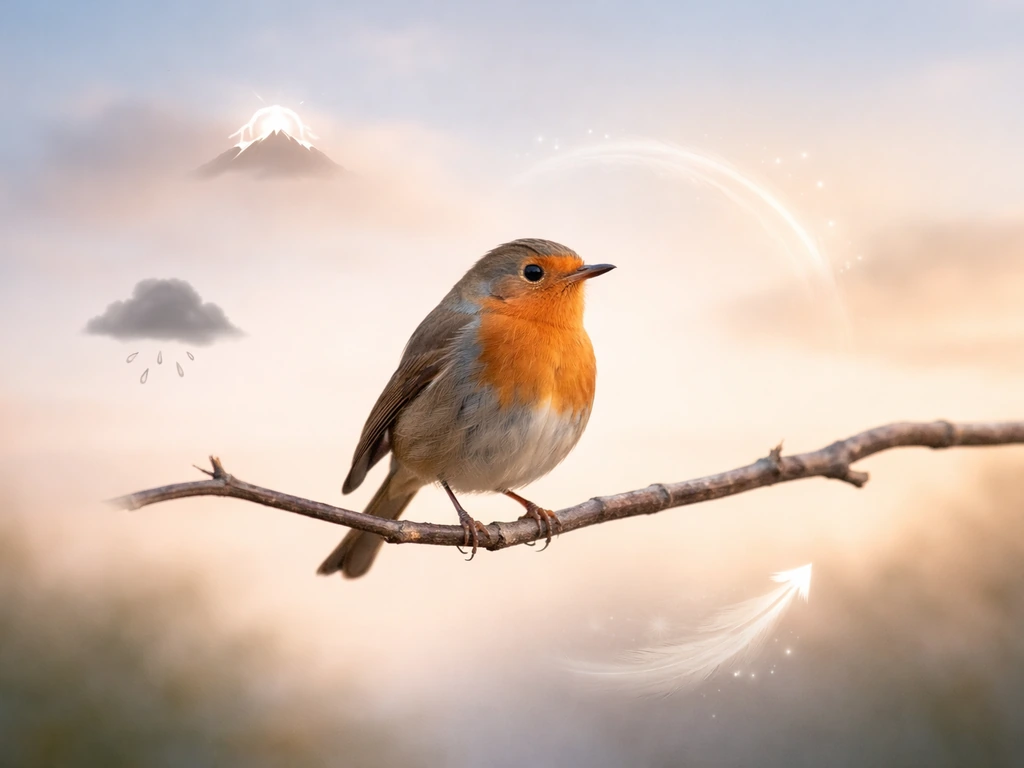
Across poetry, folklore, and everyday speech, attributing a 'thought' to a bird almost always draws on one of a handful of recurring symbolic themes. Birds are positioned as creatures with a perspective humans can't easily access: they see from above, they migrate across vast distances, they exist in a world of air and instinct that feels both free and mysterious. When a writer gives a bird a 'thought,' they're usually reaching for one of these ideas.
- Elevated perspective: the bird 'sees' something the grounded human character can't, often used to represent wisdom, foresight, or objectivity
- Innocent curiosity: the bird doesn't know what it doesn't know, making its 'thoughts' a mirror for human naivety or wonder (the core theme of the school poem)
- Omen or warning: a bird's perceived 'awareness' of something coming, tied to the deep folklore tradition of birds as messengers or signs (stormbirds are a literal example of this)
- Freedom and yearning: the bird's 'thought' is a stand-in for the human desire to be unburdened, unrooted, or unafraid
- Spiritual communication: in many traditions, birds carry messages between the living and the dead, so a bird's 'thought' can imply a message from beyond
- Transformation: like the poem's shell-to-sky arc, a bird's changing perception represents growth, learning, and the expansion of the self
How the bird species changes the meaning
When the species is named, the symbolic meaning gets much more specific. A generic bird can carry any of the themes above, but once you know it's a raven, a dove, or a sparrow, the cultural associations narrow things down quickly. If your question is really about a specific species, you may also want to check flamingo bird meaning as a related way to interpret how that bird symbolism changes the message.
| Bird | What its 'thought' typically symbolizes | Common contexts |
|---|---|---|
| Raven or crow | Cunning, prophecy, death, transformation, trickster intelligence | Gothic literature, Native American mythology, omen-based folklore |
| Dove | Peace, love, spiritual purity, hope | Religious texts, wedding symbolism, poetry about grief or longing |
| Owl | Hidden knowledge, night wisdom, death as transition | Greek and Roman mythology, Halloween imagery, wisdom figures in fables |
| Eagle | National pride, power, spiritual authority, sharp vision | Patriotic symbolism, Indigenous spiritual traditions, leadership metaphors |
| Sparrow | Humility, resilience, the overlooked individual, soul | Christian symbolism, folk songs, working-class narratives |
| Robin | New beginnings, spring, cheerfulness, returning hope | British folklore, spring poetry, children's stories |
| Flamingo | Flamboyance, individuality, tropical vibrancy, social belonging | Pop culture, fashion symbolism, playful or ironic contexts |
| Phoenix (mythic) | Rebirth, endurance, rising from destruction | Fantasy literature, motivational language, fire symbolism |
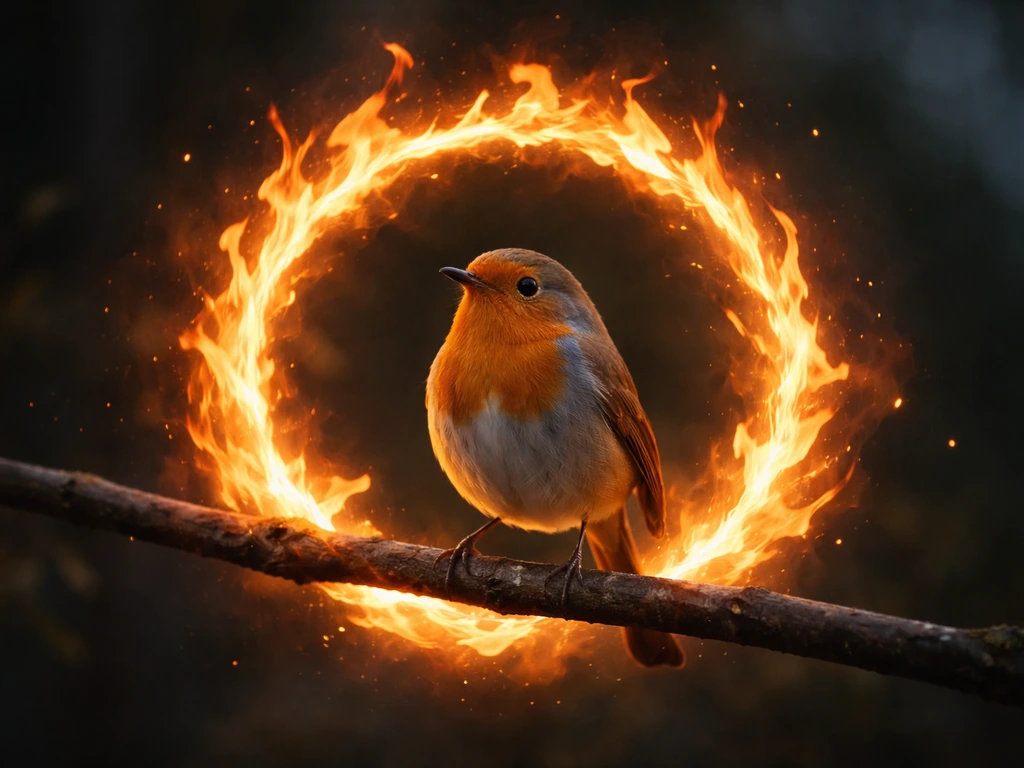
If the context involves fire or burning imagery alongside a bird's 'thought,' that usually points toward phoenix symbolism or ideas related to transformation through destruction, which connects to the broader symbolic territory of birds on fire or fever-dream bird imagery. If you're wondering, what does a bird on fire mean in this kind of imagery, it's usually tied to rebirth, transformation, and dramatic change phoenix symbolism. If your clue involved a fever-dream or birds-on-fire image, the fever bird meaning is usually tied to transformation, renewal, and warning-like omens Phoenix symbolism. Fever-dream bird meaning is often tied to intense emotion, symbolism, and a surreal shift in perception rather than literal avian thoughts fever-dream bird imagery. The emotional register shifts significantly from, say, a dove's peaceful associations to something more intense and dramatic.
What birds can actually perceive (and what they can't)

If your question is genuinely about bird cognition rather than symbolism, here's the honest picture: birds are far more perceptive than people used to assume, but they don't have 'thoughts' in the human sense. Modern research shows that many bird species demonstrate problem-solving, tool use, memory, social learning, and even rudimentary planning. Corvids (ravens and crows especially) can solve multi-step puzzles and recognize individual human faces. Parrots can associate words with objects. Pigeons can navigate using magnetic fields and visual landmarks.
What birds almost certainly don't have is the kind of reflective, narrative thought the school poem imagines: a bird is unlikely to contemplate its own limited perspective or wonder about the nature of its knowledge. The poem's bird asking 'can you?' is a literary device, not a report on avian self-awareness. So if someone says 'I wonder what a bird thinks when it migrates,' the honest answer involves sensory perception and instinct, not conscious reflection.
- Birds can perceive ultraviolet light, magnetic fields, and infrasound that humans can't detect
- Corvids and parrots show the strongest evidence of higher-order cognition among birds
- Birds likely experience basic emotions tied to survival (fear, hunger, territorial aggression, pair bonding) but not abstract self-reflection
- The 'messages' birds seem to carry in folklore are human interpretations of natural behavior, not intentional communication from the bird
- Bird song and behavior absolutely carry information, but it's aimed at other birds, not at human observers
How to pin down exactly what your phrase means
Run through this quick self-check and you'll land on the right interpretation almost every time.
- Note where you saw or heard it: a classroom text, a dream journal, a social media post, or a poem you were analyzing. The source almost always determines the register.
- Check whether a specific bird species is named. If yes, look up that bird's core symbolic associations, because the species will narrow the meaning dramatically.
- Ask whether the phrase frames the bird as a narrator or a symbol. If the bird is 'speaking' or 'wondering,' it's poetic projection. If someone else is observing what the bird 'thought,' it's interpretive.
- Look for emotional tone in the surrounding text. Growth and wonder point toward the school poem tradition. Darkness or warning points toward omen symbolism. Peace or love points toward dove-like associations.
- If you're still stuck, try substituting 'what a bird represents here' for 'what a bird thought.' If that substitution makes the sentence make sense, you're dealing with symbolism, not cognition.
- For literal bird intelligence questions, look toward modern ethology and comparative cognition research rather than poetry or folklore.
Most of the time, 'what a bird thought' is an invitation to think about perspective, not a claim about animal consciousness. Whether it's a classroom poem asking you to examine how your own knowledge grows, a folktale using a crow's cunning as a moral lesson, or a dream interpretation suggesting that a visiting bird carried a message, the bird is doing what birds do best in human storytelling: acting as a mirror for something we want to understand about ourselves.
FAQ
Is “what a bird thought meaning” a real English idiom with a fixed definition?
No. It is usually a search phrasing or a literal fragment pulled from a poetic line or study guide. English often uses bird-adjacent “thought” language figuratively, so the meaning depends on the exact sentence or source you saw it in.
How can I tell if the phrase is describing a poem versus real animal cognition?
Look for cues like a title, school-study framing, or a narrative arc (shell to sky, nest to flight). If it reads like a reflective question aimed at the reader, it is almost certainly literary. If it is in a science context asking about perception, it is about cognition, not “human-style thoughts.”
What’s the difference between “thought to” and “what a bird thinks”?
“Thought to” typically signals human belief or attribution, meaning people are assigning an expectation to the bird’s behavior. “What a bird thinks” treats the bird as having conscious, internal reflection, which most symbolic uses of “bird thought” are not claiming.
If a caption says “a bird thought it saw something,” is that usually an omen or a literal claim?
In social captions, it is usually symbolism, intuition, or an omen-like framing. Unless the post clearly cites evidence about behavior, assume it is metaphorical and interpret it through the bird’s common symbolic associations.
Why do some people connect bird “thought” with messages or omens?
Because birds are commonly used as mirrors for human uncertainty, attention, and timing. When writers treat bird behavior as meaningful, they are translating observable cues (arrival, sudden presence, unusual timing) into a narrative the human reader can interpret.
Can “a bird thought” ever imply real introspection in animals?
Some birds show complex cognition like problem-solving, memory, and learning, but “introspection” in the human reflective sense is a different claim. If the text does not discuss experiments or behavior studies, assume it is symbolic rather than a statement about inner monologue.
What if I saw a specific species, like raven or dove, instead of “a bird”?
Species names usually narrow the symbolic meaning. Ravens often shift toward intelligence, mystery, or moral ambiguity, while doves commonly suggest peace or gentleness. The safest approach is to match the species’ common cultural symbolism to the surrounding imagery.
How should I interpret “a bird on fire” in the same symbolism conversation?
In most literary and dream-style contexts, “birds on fire” points to transformation, rebirth, intense emotion, or a dramatic change in perception, not that the bird is literally experiencing the event. Focus on the emotional tone and what is “changing,” not on literal mechanics.
If the phrase appeared in a dream interpretation post, what should I do first?
Check what other dream elements were present (burning imagery, location, time of day, your feelings during the dream). Dream posts often blend omen and transformation themes, so the emotions and surrounding symbols help you choose the most likely interpretation.
What common mistake should I avoid when interpreting “a bird thought meaning”?
Don’t over-literalize. Many texts use the bird to represent a human perspective process (limited knowledge becoming wider understanding). Treat the bird as a symbolic narrator unless the source clearly discusses verified animal cognition.
When the text asks “can you?” or “what do you think,” how do I answer it?
In classroom and literature contexts, the “can you?” usually invites you to consider your own knowledge limits and growth, not to guess a specific mental state of the bird. Use the bird’s changing viewpoint as a prompt to discuss perspective expansion.
Next Article
What Does a Bird on Fire Mean Literal and Symbolic
Meaning of what does a bird on fire mean, from literal danger to symbolism like urgency, transformation, and omens.