
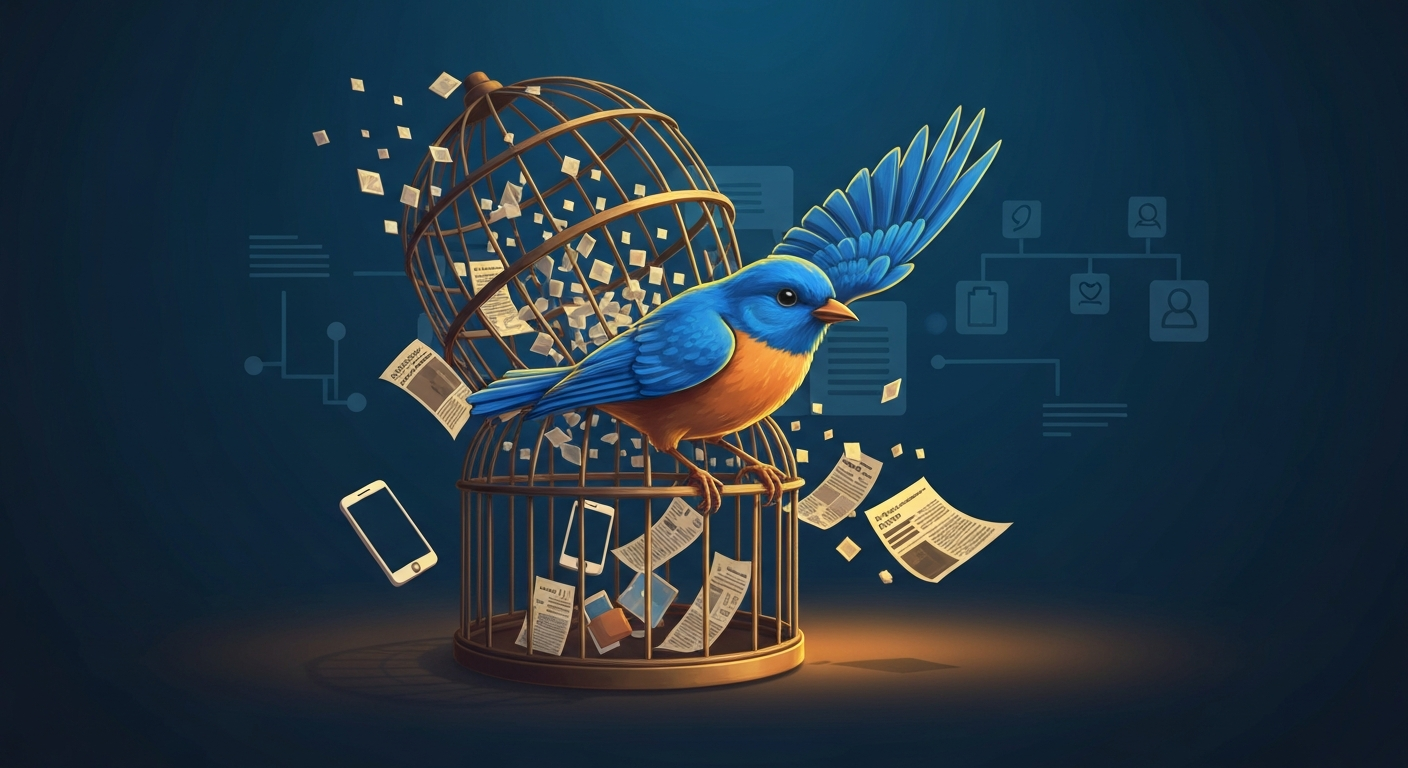
"The bird is freed" means that something or someone previously confined, restricted, or controlled has been released. In its most literal sense, an actual bird has been let out of a cage or trap. In its more common idiomatic sense, it signals liberation, the lifting of a constraint, or the announcement that a situation has changed and something is now free to move as it pleases. The phrase got a massive cultural boost on October 28, 2022, when Elon Musk posted exactly those four words as his first tweet after completing his $44 billion acquisition of Twitter, using Twitter's bird logo as the referent. That single post turned a fairly ordinary passive construction into a shorthand announcement of takeover, transformation, and declared freedom, all at once.
The Bird Is Freed Meaning: Literal, Symbolic & Military

What the phrase actually means, plainly put
"The bird is freed" is a passive-voice construction: something (the bird) has had freedom granted to it by some external agent. That grammatical framing matters. Whoever freed the bird is implied but not stated, which gives the phrase a slightly dramatic, proclamatory feel. It is not an entrenched dictionary idiom the way "free as a bird" is. Merriam-Webster and Cambridge both carry "(as) free as a bird" as an established entry meaning "completely free," but "the bird is freed" does not appear as a headword in any major dictionary. Cambridge Dictionary lists "(as) free as a bird" as an established idiom meaning "completely free." blank" rel="noopener noreferrer">Cambridge Dictionary lists "(as) free as a bird" as an established idiom.. Searches of major dictionaries show entries for 'free as a bird' and 'free bird' but not for the exact string 'the bird is freed', and Merriam‑Webster's entries reflect this absence blank" rel="noopener noreferrer">Merriam‑Webster entries for bird idioms (absence of 'the bird is freed' as a headword). It reads as a natural English sentence that carries idiomatic weight through context, not through centuries of fixed idiomatic use.
That distinction is worth holding onto as you use or interpret the phrase. If someone says it about an actual bird, take it literally. If someone says it after a political event, a corporate deal, a prison release, or the end of a restrictive relationship, the bird almost certainly stands in for a person, an organization, or an idea.
When it means exactly what it says: a real bird, a real release
At face value, the sentence describes the physical act of releasing a bird from captivity. You might hear it from a wildlife rehabilitator sending a recovered raptor back into the sky, from a child opening a cage door, or from a falconer returning a bird to the wild. In ceremonial contexts, the release of doves at weddings, funerals, and peace events is often narrated with variations of this phrasing. The passive construction ("is freed" rather than "flies free") emphasizes the human role in the release, the deliberate act of letting go.
Across many cultures, birds held in captivity symbolize potential, the soul, or constrained spirit, so the literal act of freeing one carries symbolic resonance even when the speaker intends it purely physically. The two layers, literal and symbolic, are almost impossible to fully separate when birds are involved. That is part of what makes bird imagery so durable in language.
The idiomatic meanings: freedom, escape, and big announcements
Idiomatically, "the bird is freed" can carry several distinct flavors depending on the context. Here are the main senses you are likely to encounter:
- Liberation after constraint: A person, organization, or idea has been released from control, censorship, or restriction. This is the sense Musk invoked in 2022 when referring to Twitter.
- The revealing or escape of something kept hidden: A secret, a person, or information has gotten out. "The bird is freed" can work as a metaphor for a leak or an announcement of something previously suppressed.
- Personal freedom: Departing an oppressive situation, job, relationship, or obligation. In casual speech, someone might say this about themselves after quitting a difficult job or leaving a controlling relationship.
- Completion or resolution: The problem, deal, or conflict is done. The phrasing announces a concluded action with a note of triumph or relief.
The phrase leans triumphant. Whether the speaker approves of the release or not, the word "freed" carries positive connotations of liberation rather than loss. That rhetorical tilt is what made it such effective tweet language for Musk: it framed acquiring a social media company as an act of liberation rather than a business transaction.
How it sounds across different registers
Casual speech
In everyday conversation, the phrase is informal and slightly theatrical. People use it when they want to signal a moment of release with a little flair. "The bird is freed" at the end of a workday on a Friday, or after finishing a difficult project, has the playful energy of someone who knows they are leaning into a metaphor. It is not a phrase you would use in a neutral, matter-of-fact way: it signals that the speaker sees the situation through the lens of confinement and liberation.
Literature and poetry
In literary writing, the caged bird and its release is one of the most persistent metaphors in the English language and well beyond it. Maya Angelou's memoir "I Know Why the Caged Bird Sings" (1969) and her poem "Caged Bird" make the confinement and longing for freedom of a caged bird into a direct metaphor for racial oppression and personal resilience. When a literary text declares that the bird is freed, the weight of that tradition follows the phrase into the room. It is the end of a long story about confinement, not just a quick announcement.
Military slang
U.S. military personnel, especially Vietnam veterans, used the phrase "Freedom Bird" to mean the aircraft that carried them home at the end of their tour of duty. That is a distinct expression covered in more detail in its own section below, but it shares the same symbolic root: the bird as a vehicle for freedom and return. In this register, the language of bird-as-freedom takes on enormous emotional weight, because for many veterans that flight represented survival.
Music
Music has done more than almost any other medium to cement bird-freedom imagery in the popular imagination. Lynyrd Skynyrd's "Free Bird" (1973), written by Allen Collins and Ronnie Van Zant, turned the free bird image into an emblem of restless American independence, the desire to keep moving and not be held down. The Beatles' "Free as a Bird" (1995, released on the Anthology project) gave the phrase a more melancholy, reflective tone. These songs have shaped how a general audience reaches for bird-freedom language, often without consciously knowing why the phrase feels so loaded.
Comparing the close variants
"The bird is freed" belongs to a small family of bird-freedom expressions that are related but not interchangeable. Each carries its own tone and cultural baggage. Here is a quick side-by-side comparison:
| Phrase | Core meaning | Typical register | Key cultural association |
|---|---|---|---|
| The bird is freed | A formal/rhetorical announcement that something or someone has been released from constraint | Dramatic or proclamatory; also literal | Elon Musk / Twitter acquisition, Oct 2022; wildlife release |
| Free bird | A person who cannot or will not be tied down; spirit of restless freedom | Casual, musical, emotional | Lynyrd Skynyrd 'Free Bird' (1973); general slang for an unattached person |
| Freedom bird | The aircraft carrying U.S. service members home from a combat zone | Military/veteran; deeply emotional | Vietnam War era slang; later formalized as Patriot Express |
| The bird has landed | Something or someone has arrived safely at a destination | Casual, often humorous or ironic | Riff on Neil Armstrong's 'The Eagle has landed,' Apollo 11, July 20, 1969 |
| Let the bird out of the cage | Allow someone or something to be free; stop controlling or suppressing | Informal, idiomatic, sometimes cautionary | General English idiom; echoes caged-bird symbolism in literature |
The clearest practical distinction is between "the bird is freed" (announcement, completed action) and "free bird" (description of a person or spirit). "Freedom bird" is almost exclusively military in origin, while "the bird has landed" flips the direction entirely: instead of departure and liberation, it signals arrival. "Let the bird out of the cage" is the most cautionary of the group, often implying that the release has consequences. If you are writing and need to choose between these phrases, the register and the direction of movement (release vs. arrival, departure vs. return) are your best guides.
The U.S. military's "Freedom Bird": what it meant and where it came from
During the Vietnam War, U.S. service members called the aircraft taking them home at the end of their tour the "Freedom Bird." The term appears repeatedly in veteran oral histories collected by archives including the Vietnam Archive at Texas Tech University, in base newsletters, and in museum documentation. It was not an official military designation; it was soldier slang, born from the enormous emotional significance of that flight. For many veterans, boarding the Freedom Bird was the moment they allowed themselves to believe they had survived.
The flights themselves were often operated by civilian contract airlines rather than military aircraft, which added to the slightly surreal quality of the experience: stepping from a combat zone onto a commercial plane staffed by flight attendants, as though the war were something you could simply fly away from. The SFO Museum has documented the role of airlines in this airlift, and U.S. Air Mobility Command historical records acknowledge the Freedom Bird legacy explicitly, noting that the later Patriot Express program was "formerly known as the Freedom Bird" in passenger-movement contexts.
The emotional vocabulary of the Freedom Bird is distinct from the celebratory tone of "the bird is freed." Veterans describing the Freedom Bird are often recounting relief, disbelief, grief, or survivor's guilt alongside the joy of going home. The bird metaphor here is about movement and return, not proclamation. It is worth keeping that weight in mind when using bird-freedom language in writing that touches on military experience.
Where does the phrase come from? What we know and what we don't
The broader idiom "free as a bird" has deep roots in English. Phrase-history references citing the Oxford English Dictionary place the bird-as-freedom simile early in English idiomatic usage, with the association between birds and liberty being essentially ancient across many cultures. Birds fly where humans cannot, so the metaphor of a bird for freedom is not culturally specific: it appears in classical literature, in Middle Eastern poetry, in Indigenous oral traditions, and throughout European folklore.
The specific construction "the bird is freed," however, does not have a traceable origin as a fixed phrase. It is a natural English sentence, and versions of it have certainly appeared in literature and speech for centuries whenever someone was actually or metaphorically releasing a bird. What it does not have is a single founding moment, a first famous use that all later uses refer back to. Before October 2022, you would have read it in wildlife rehabilitation reports, nature writing, poetry, and fiction without any particular idiom flag going up.
The 2022 Musk tweet changed that, at least for a generation of internet users. It gave the exact string "the bird is freed" a specific, heavily documented cultural moment that now colors how the phrase reads in news media, tech commentary, and political discussion. Whether that association sticks the way, say, "the eagle has landed" stuck after Apollo 11 is genuinely uncertain. Idioms earn their staying power through repeated use across many contexts, and it is too early to say whether "the bird is freed" will develop that kind of durability or remain primarily a reference to one famous tweet.
The cultural references that shape how we read the phrase
Lynyrd Skynyrd's "Free Bird" (1973)
It is almost impossible to use any bird-freedom phrase in American English without brushing up against Lynyrd Skynyrd's "Free Bird," written by Allen Collins and Ronnie Van Zant and released on the band's 1973 debut album. The song became one of the most recognizable pieces of American rock, famous for its long guitar solo and for the tradition of audience members shouting "Free Bird!" at any concert they attend, regardless of genre. That shouting tradition is its own kind of cultural artifact: "Free Bird" became a symbol of a certain kind of American restlessness, the refusal to be pinned down, the road always calling. When writers or speakers invoke a free bird, that song is in the background whether they know it or not.
The Beatles' "Free as a Bird" (1995)
The Beatles released "Free as a Bird" in 1995 as part of the Anthology project, completing a John Lennon demo using audio restoration technology. The song gave the bird-freedom phrase a more elegiac, bittersweet quality: freedom here is tinged with loss and longing rather than triumphant departure. For listeners who came to bird-freedom language through this song rather than Lynyrd Skynyrd, the emotional register is quieter and more reflective. Both songs sit in the background of the phrase, pulling it in slightly different emotional directions.
Maya Angelou's caged bird
Maya Angelou's poem "Caged Bird" and her 1969 memoir "I Know Why the Caged Bird Sings" are the literary touchstones that give the caged-bird-and-freedom metaphor its most powerful American cultural resonance. In Angelou's work, the caged bird is not simply a metaphor for personal unhappiness: it is a direct representation of systemic racial oppression, and the free bird that "dares to claim the sky" represents a freedom that is desired but structurally denied. When the phrase "the bird is freed" appears in any context that touches on civil rights, social justice, or political liberation, Angelou's framing is almost certainly in play.
Elon Musk's 2022 tweet
On October 28, 2022, after completing his $44 billion acquisition of Twitter, Elon Musk posted "the bird is freed" as his first tweet from the platform. Major news organizations including technology press and general news outlets quoted and analyzed the tweet extensively, reading it as a declaration that Twitter, symbolized by its bird logo, had been liberated from previous constraints (whatever those constraints were depended heavily on the reader's politics). The tweet was four words long and generated an enormous volume of commentary, which is itself a demonstration of how much cultural work bird-freedom language can do when deployed with the right timing. The phrasing also nodded to the "give someone the bird" slang sense of the bird as a middle-finger gesture, a double meaning that some commentators noted, though Musk did not confirm it.
Neil Armstrong and "The Eagle has landed"
While not directly about freedom, Neil Armstrong's transmission "The Eagle has landed" on July 20, 1969, when Apollo 11's lunar module touched down on the Moon, created a template for short, bird-named proclamatory announcements of momentous events. The phrase has been echoed, parodied, and riffed on ever since, including as "the bird has landed" in countless informal uses. That phrasing tradition, a named bird completing a significant act with a short declarative sentence, is part of the cultural grammar that makes "the bird is freed" feel immediately legible as a big announcement rather than just a description of a door being opened.
How to use the phrase in your own writing
Because "the bird is freed" is not an established dictionary idiom, you have more freedom with it than you would with a fixed expression like "free as a bird." But that also means the phrase carries no automatic meaning: the context has to do the work of telling the reader which sense you intend. A few practical notes:
- Be clear about what the bird represents. If you are writing literally about a bird release, the sentence works as-is. If the bird is a metaphor, the surrounding context should make the referent obvious before you drop the phrase.
- Match the tone. The phrase is dramatic and proclamatory. It fits a triumphant announcement, a significant moment, or a piece of writing with some rhetorical flair. It is out of place in a straightforward, neutral report.
- Be aware of the Musk/Twitter association. In technology or business writing since 2022, readers may automatically read the phrase as a reference to that event. If you do not intend that reference, consider rephrasing.
- Avoid the phrase in formal academic or legal writing. As style authorities note, idiomatic or colloquial expressions should be used sparingly in formal contexts. This phrase is casual and rhetorical, not precise.
- Use it when the liberation is genuine in the narrative. The phrase loses force if the reader does not feel that the confinement and the release are both real within the story or argument you are making.
If you are exploring the related family of expressions, the entries on free bird meaning and freedom bird meaning dig into the personal and cultural dimensions of those phrases in more detail. The military sense of freedom bird and the arrival-focused the bird has landed meaning are also worth reading alongside this entry, since they show how the same symbolic bird flies in very different directions depending on who is using it and why. See also the bird has landed meaning for the arrival-focused sense.
FAQ
What does 'the bird is freed' mean literally?
Literally, it describes a bird that was confined (in a cage, hand, or net) and has been released. The phrase is a passive sentence: an agent (person, event) freed the bird, and the focus is on the bird's new state of freedom.
What does 'the bird is freed' mean idiomatically?
As an idiom it is not a well‑established headword in major dictionaries, but readers will typically map it onto familiar bird‑freedom idioms (e.g., 'free as a bird', 'free bird') to mean someone or something has been released, set free, or is now independent. Because it’s a literal passive form rather than an entrenched idiom, its idiomatic sense depends on context and can sound rhetorical or poetic.
What symbolic senses does the phrase evoke?
Symbolically, birds commonly represent freedom, escape, release, and transcendence. 'The bird is freed' can suggest liberation from physical, social, psychological, or legal constraints; a new start; or the end of captivity. In literary and poetic registers it can carry emotional or spiritual connotations (hope, emancipation, release).
How is 'the bird is freed' used in different registers (casual speech, literature, military, music)?
Casual speech: uncommon and might sound dramatic or playful—people more often say 'he/she's free' or 'free as a bird.' Literature/poetry: fits well as a concise, image‑rich line. Military: not a standard military idiom; rather, 'Freedom Bird' (capitalized) is the relevant military slang for the flight taking troops home. Music/pop culture: listeners will map it to songs and idioms about birds and freedom (e.g., 'Free Bird', 'Free as a Bird'). Tone and meaning vary with register and context.
What is 'Freedom Bird' in U.S. military slang and how does it relate?
'Freedom Bird' (often capitalized) is U.S. military slang from the Vietnam era onward for the aircraft that carried service members home at the end of a tour. It denotes the flight or ticket home rather than a literal bird. This is a specialized, historically attested usage distinct from the literal or poetic reading of 'the bird is freed.' Official Air Mobility/Patriot Express materials and veteran oral histories document the term's usage.
How does 'the bird is freed' compare with close variants like 'free bird', 'freedom bird', 'the bird has landed', and 'let the bird out of the cage'?
- 'Free bird' / 'free as a bird': established idioms meaning completely free; widely used in speech, literature, and music. - 'Freedom bird': military slang for the homebound flight. - 'The bird has landed' / 'The eagle has landed': denotes arrival or completion (famously Apollo 11); different focus—arrival, not release. - 'Let the bird out of the cage': literal or idiomatic phrase emphasizing the act of release. 'The bird is freed' emphasizes the resulting state (past participle) and can feel more formal or poetic than 'let the bird out.' Context determines which variant fits best.
What Does Freedom Bird Mean in the Military?
Explains what Freedom Bird means in military slang, named units or callsigns, and how to verify the exact usage.