SEO Title: Bird with Twig in Mouth Meaning: Behavior, Symbolism & What It Tells You Meta Description: A bird with a twig in its mouth is almost always nest-building or courting. Here's what it means literally, symbolically, in dreams, and in language.
Bird with Twig in Mouth Meaning: Symbolism, Behavior and Guidance

Marcus Whitmore
23 Jul 2026
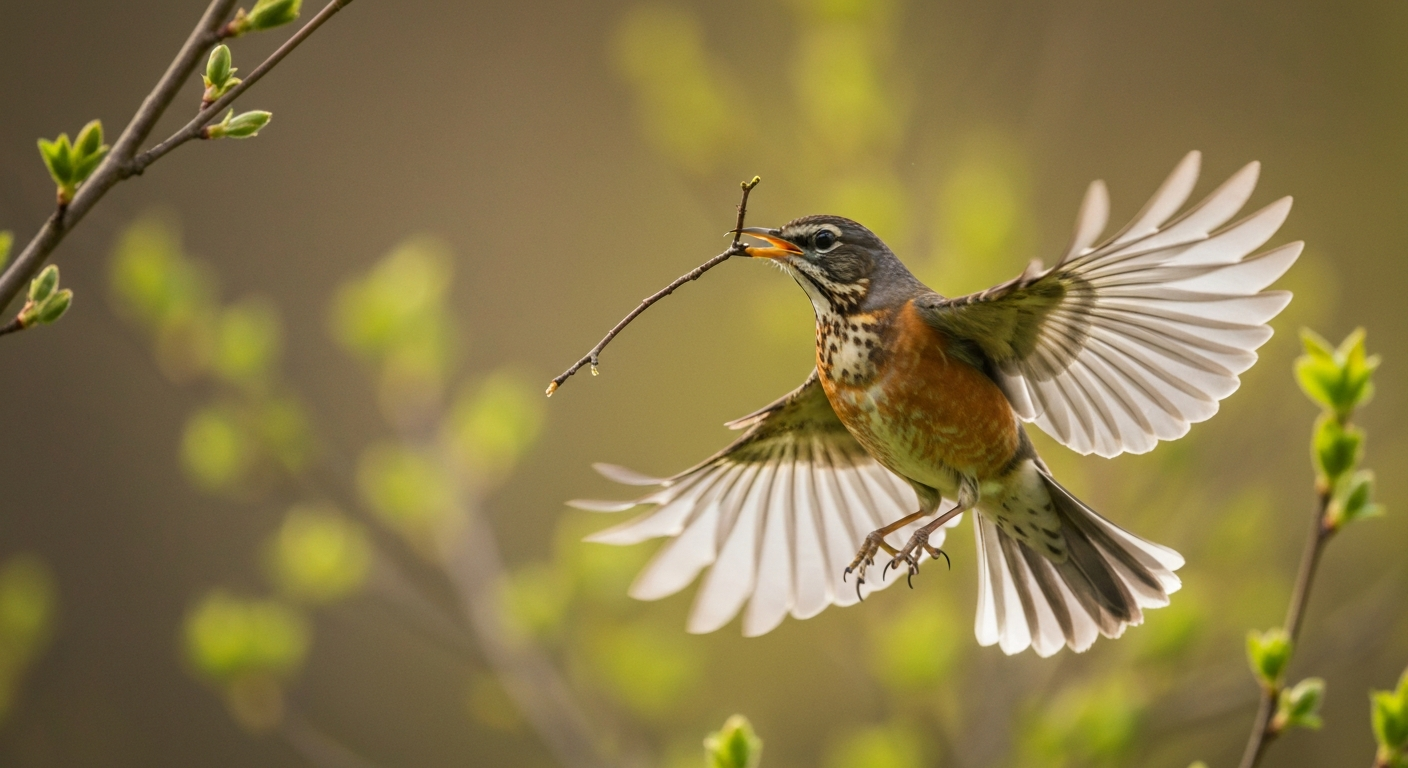
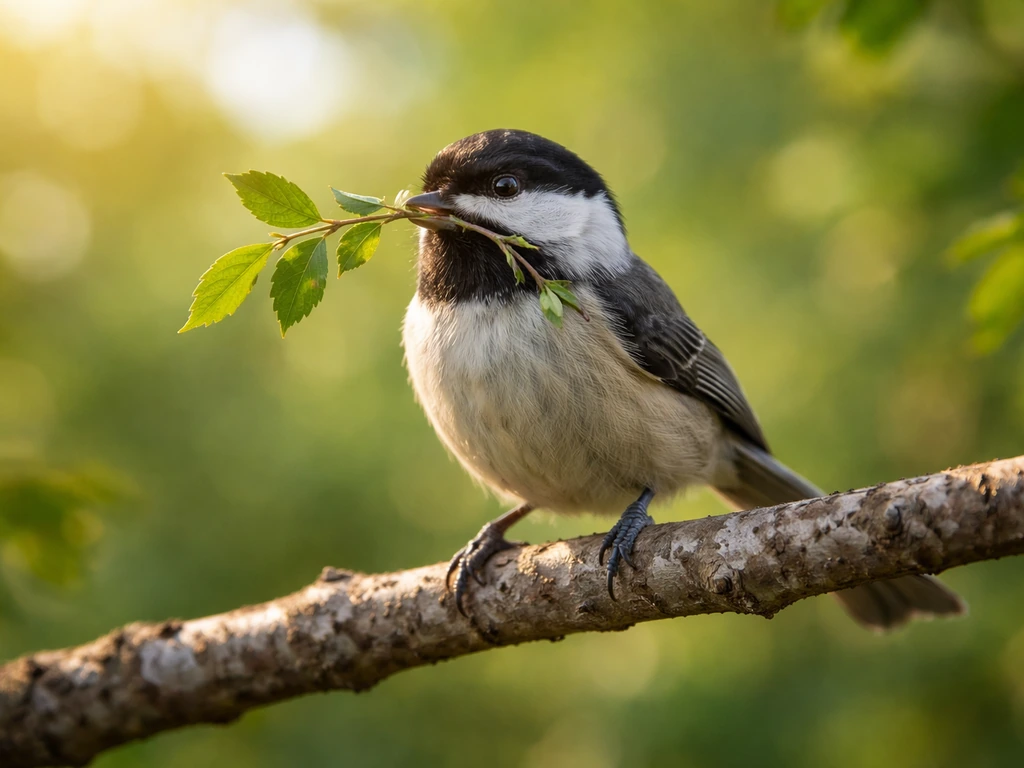
A bird carrying a twig in its mouth is almost always doing one of two things: building a nest or, in a smaller number of species, constructing a courtship display. Either way, it signals something foundational is being created, whether that's a home for eggs or an elaborate performance to attract a mate.
What's actually happening when a bird carries a twig
In the vast majority of cases, a twig in a bird's bill means nest construction is underway. Birds collect sticks, grasses, mud, plant fibers, and other materials and weave them into structures that will shelter their eggs and chicks. This is not a simple reflex. Research from the Cornell Lab of Ornithology and peer-reviewed reviews published in journals like Philosophical Transactions B have shown nest construction to be energetically demanding, plasticity-driven behavior that can even involve learning. Cliff swallows, for instance, have been recorded making roughly 1,400 collection trips to assemble a single nest weighing around 600 grams. That's a serious commitment.
Beyond nest-building for eggs, some species carry twigs as part of courtship. Male bowerbirds (family Ptilonorhynchidae) build elaborate stick structures called bowers at a fixed display court, not to hold eggs, but purely to impress females. Research from Gerald Borgia's lab at the University of Maryland documented how bower construction and decoration function as honest male signals in sexual selection. Cognitively driven co‑option and evolution of complex sexual displays in bowerbirds (Borgia & Keagy, lab publications) documents how bower construction and decoration function as male courtship signals rather than nest-building for eggs. So if you watch a bird deposit a stick and then stand near it displaying rather than sitting on it, you may be watching courtship architecture, not a nursery being built.
Which birds commonly carry twigs, and what materials do they use
Most of the birds you're likely to see carrying twigs belong to a fairly predictable set of families. Corvids such as American Crows build bulky outer baskets of interlaced sticks and twigs, with both sexes contributing. Their nests can take one to two weeks to complete. Many raptors build even larger stick platforms, some of which are added to year after year. Passerines like American Robins construct cup nests combining coarse twigs and grasses on the outside with mud and fine fibers on the inside. NestWatch at Cornell has documented the typical sequence: coarse structure first, then finer lining materials.
At the other end of the size scale, hummingbirds build tiny cup nests using plant down and spider silk rather than stiff twigs. Not All Sweetness and Light: The Real Diet of Hummingbirds (All About Birds, Cornell Lab) documents that hummingbirds build tiny cup nests using plant down and spider silk. If you see a hummingbird carrying a wispy strand rather than a proper twig, it's lining its nest rather than framing it. Orioles weave intricate hanging pouches from long plant fibers. The material a bird carries, not just the behavior, tells you a lot about the species and the construction stage.
| Bird | Typical twig/material type | Who builds | Purpose |
|---|---|---|---|
| American Crow | Sticks and twigs (outer basket), softer lining | Both sexes (and sometimes helpers) | Nest for eggs |
| American Robin | Coarse twigs, grasses, mud, fine lining | Primarily female | Cup nest for eggs |
| Bald Eagle | Large branches and sticks (added annually) | Both sexes | Nest platform for eggs |
| Satin Bowerbird | Sticks and decorations at a display court | Male only | Courtship bower, not egg nest |
| Hummingbird | Plant down, spider silk (rarely stiff twigs) | Female | Tiny cup nest for eggs |
| Baltimore Oriole | Long plant fibers, grasses | Primarily female | Hanging pouch nest for eggs |
How to tell what's going on: season, sex, and the twig itself
Context gives you most of what you need. Spring is overwhelmingly the dominant nesting season in the northern hemisphere, so a bird carrying a twig in March, April, or May is almost certainly nest-building. If you're watching in late summer and you see the same behavior, it may be a second brood, a replacement clutch after nest failure, or in a small number of species, genuine late-season nesting. Some tropical and southern hemisphere species nest outside what we'd call the typical window, so local field guides matter.
Sex is trickier than most people assume. A 2023 peer-reviewed multi-species study confirmed significant variation in who does the building across species: sometimes it's the female alone, sometimes the male alone, sometimes both. You cannot reliably guess the sex of a twig-carrying bird from the behavior itself without knowing the species. In American Robins, the female does most of the construction; in crows, both sexes pitch in; in some wrens, the male builds several incomplete starter nests and lets the female choose and finish one.
The twig type is a useful clue. A stiff, woody stick points to outer structural work (early nest phase or a large raptor platform). Soft plant fibers, moss, or spider silk suggest lining work (late nest phase). A stick being arranged at a horizontal display perch rather than woven into a cup or basket may indicate courtship behavior, especially if the bird shows off near it rather than leaving immediately to fetch another.
What the image has meant across cultures
The symbolic weight of a bird carrying a twig or branch is surprisingly consistent across different cultural traditions, even when those traditions developed independently. The most famous example in Western culture is the dove with an olive branch from the Book of Genesis, in which Noah's dove returns with a freshly plucked olive sprig, signaling to those aboard the ark that dry land has appeared and the flood is receding. That single image has anchored the dove-and-branch as a near-universal shorthand for peace, hope, and new beginnings across centuries of art, diplomacy, and everyday speech. The olive branch specifically carries the meaning of a peace offering in idioms that survive to this day.
Beyond the Judeo-Christian tradition, birds carrying materials to build shelters appear in folklore across Asia, Africa, and the Americas as emblems of industry, homemaking, and prosperity. In many East Asian traditions, a bird arriving at or near a home with nesting materials is read as an auspicious sign, a prediction that the household will soon be blessed with new family members, financial improvement, or stability. In Native American traditions, the specific meanings vary considerably by tribe and by the bird species involved, but the act of nest-building is frequently associated with the creation of sacred space and the protection of life. The common thread running through most of these traditions is the same one the behavior actually represents: a creature preparing a home.
Gift-giving birds appear in folklore too. In various European folk tales, a helpful bird delivers a special twig, branch, or flower to a human protagonist, marking the beginning of a transformative journey or offering protection. The twig in these stories often functions as a token of blessing, a physical object that carries the goodwill of the natural world into human hands. This intersects with real bird behavior in interesting ways: some corvids do leave objects near humans they've formed associations with, though the intent behind that behavior remains a subject of ongoing behavioral research.
How the 'bird with a twig' image works in language and literature
The bird-and-twig image does a lot of heavy lifting in English and in many other languages. 'Extending an olive branch' is probably the most embedded of all the related idioms, meaning to make a peace offering or to signal willingness to reconcile after a conflict. You'll hear it in political reporting, in business negotiations, and in everyday conversations about patching up relationships. The phrase works because the dove-and-branch image is so deeply embedded in the cultural memory that you don't even need to mention the bird anymore.
In poetry and literary fiction, a bird carrying a twig or branch is almost always used to signal one of a small cluster of meanings: the arrival of spring or renewal, the creation of home and safety, or the beginning of something new. Think of Keats's 'season of mists and mellow fruitfulness' and the birds preparing for winter, or the countless passages in Romantic and Victorian nature writing where nest-building becomes a metaphor for domestic virtue and the foundation of family life. Contemporary writers still reach for the same image when they want to suggest hope being actively constructed rather than passively received.
In visual symbolism, heraldry, and iconography, birds carrying objects in their bills (called 'in the beak' in heraldic terminology) are common. The object carried changes the meaning: a twig or branch signals peace, renewal, or fertility; a fish or worm signals provision and industry; a ring signals betrothal or a message. The specific combination of bird species and carried object creates a readable visual shorthand that heraldic artists and logo designers still use. You'll see twig-carrying birds on everything from bank logos to national emblems.
Dream and spiritual meanings people commonly attach to this image
Dreams about birds carrying twigs or branches tend to cluster around a few consistent interpretations in popular dream dictionaries, spiritual traditions, and folklore-based readings. These are cultural and symbolic readings, not psychological diagnoses, but they're worth knowing if you've had this dream and you're trying to make sense of it.
- Home and security: Seeing a bird build or carry materials for a nest is widely read as a sign that you are (or soon will be) creating stability in your life, whether that's a new home, a new relationship foundation, or a period of emotional security after upheaval.
- New beginnings: Because nest-building precedes new life, the image is commonly interpreted as a herald of something starting fresh, a project, a relationship, a family addition, or a creative endeavor.
- Peace arriving: Drawing on the dove-and-branch tradition, a bird carrying a twig in a dream is sometimes read as a signal that conflict in your waking life is about to resolve or that reconciliation is possible.
- Industriousness and reward: The sheer effort involved in nest-building (those cliff swallow trips add up) makes the image a symbol of diligent work paying off. Dreaming of a bird carrying twigs can be interpreted as encouragement to keep working toward a goal.
- A message being delivered: In some spiritual traditions, particularly those that treat birds as messengers between the living and the dead or between the human and divine, a bird bringing something in its bill represents a communication arriving from a source beyond ordinary experience.
- Fertility and family: Because nests hold eggs and young, the image in dreams is frequently connected to pregnancy, new family members, or a desire for family and belonging.
The species of bird in a dream is often considered relevant to the interpretation. A white bird (dove or egret) carrying a twig amplifies the peace and purity readings. A crow or raven carrying one can be read as a more complex message, perhaps about intelligence being applied to building something lasting. A small, bright songbird tends to carry cheerful connotations of joy and spring energy. As with most dream symbolism, the emotional tone of the dream matters as much as the visual content itself.
How to watch, photograph, and not disturb nesting birds
Watching a bird carry nesting materials is one of the most rewarding things you can observe in a backyard or on a walk, and it's worth doing it in a way that doesn't cost the birds anything. The core principle is distance. Use binoculars or a telephoto lens rather than creeping close. Audubon's ethical bird photography guidelines recommend keeping enough distance that the bird does not change its behavior because of your presence. If the bird stops what it's doing and watches you, you're too close. Move back until it resumes normal activity.
Drones are worth calling out specifically. U.S. Fish and Wildlife Service guidance explicitly discourages drone use near raptor nests, and the same logic applies to any active nesting site. The noise and visual disturbance of a drone can cause adults to abandon a nest entirely. Keep drones away from any area where you've observed nesting activity.
On the legal side, protections vary by country but are worth knowing about. In the United States, the Migratory Bird Treaty Act prohibits taking, possessing, or disturbing migratory birds or their active nests without a permit. In the UK, the Wildlife and Countryside Act 1981 makes it an offence to intentionally damage or destroy the nest of any wild bird while it is in use or being built. In Canada, the Migratory Birds Regulations 2022 prohibit damaging or removing nests containing live birds or viable eggs. The practical upshot: once you've spotted a bird carrying twigs and traced it back to a nest site, observe from a distance, photograph with long lenses, and don't go poking around the nest itself.
How this sighting compares to similar bird encounters
The bird-with-twig image sits within a broader family of bird-with-object sightings and symbolism. Knowing how they differ helps you interpret what you're seeing (or dreaming) more precisely.
| Sighting or image | Most likely literal meaning | Core symbolic meaning | Key distinction |
|---|---|---|---|
| Bird with twig in mouth | Nest-building or courtship structure construction | Home-making, new beginnings, peace (dove/olive branch) | Active creation; effort invested in building something |
| Bird with branch in mouth | Nest-building (larger structural material) or the olive-branch symbol | Peace offering, reconciliation, hope after hardship | Branch is larger than a twig; the olive-branch archetype is the dominant symbolic reference |
| Bird with flower in mouth | Rare in literal behavior; primarily symbolic or artistic image | Beauty, love, offering, courtship gift | Flowers are not typical nest materials; the image is more often symbolic than literal |
| Bird on a branch | Resting, surveying territory, singing, or waiting | Pause, perspective, watchfulness, readiness | The bird holds nothing; stillness is the key quality, not construction or carrying |
| Bird on the glass | Territorial behavior (fighting reflection) or accidental collision | Message, transition, a spiritual signal in many folk traditions | Bird is not carrying anything; the encounter is often abrupt and unexpected |
| Bird in the sky | Normal flight, migration, foraging flight | Freedom, perspective, transcendence, aspiration | The bird is in motion through open space rather than grounded and building |
A bird with a branch in mouth sits very close to the twig meaning, but the branch carries more explicit weight as a peace symbol because of the olive-branch tradition. For a focused explanation of the bird with branch in mouth meaning, see the dedicated section on that image and its interpretations. A bird with a flower in mouth is almost never a literal nesting behavior (flowers aren't structural nest materials), so when you encounter it in art, dreams, or folklore, it skews strongly toward symbolic readings around love and offering rather than home-building. If you're curious about any of these neighboring topics, each one has its own symbolic landscape worth exploring.
Putting it all together
A bird with a twig in its mouth is, at its most fundamental level, a creature in the act of making something. For a related discussion of symbolism, see bird on a branch meaning. That literal truth, a nest being assembled one trip at a time, feeds directly into every symbolic layer the image has accumulated across human cultures: home, effort, peace, new life, hope constructed rather than wished for. For a related interpretation, see bird on the glass meaning. Whether you've spotted a crow ferrying sticks to a Norway spruce, dreamed of a dove arriving with a small branch, or come across the image in a poem or a piece of heraldry, the core meaning is consistent. Something is being built. That's almost always a hopeful thing to witness. For related symbolic interpretations, see bird in the sky meaning.
FAQ
Title and meta description
Title: "Bird with a Twig in Its Mouth: Meaning, Behavior, Symbolism & What to Do". Meta description: "What a bird carrying a twig usually means—nesting, courtship, symbolism, and ethical observation tips."
Quick answer
Literally, a bird with a twig most often is collecting nest material or building a courtship structure; symbolically it commonly suggests home, peace, or new beginnings. Context (species, location, repeated trips) clarifies whether it’s nest building, courtship, or practice.
Literal bird behaviour: nest‑building and how to recognise it
Many birds carry twigs, grass, mud, spider silk and other materials in the bill to build nests. Nest building is widespread, energetically costly, and varies by species and sex: some species show female‑only, male‑only or biparental construction. Repeated trips to a fixed site (e.g., sheltered fork, nest box) during breeding season strongly indicate nest building. Field guides and nest‑monitoring projects (e.g., NestWatch, Cornell All About Birds) document species‑typical materials and timing.
Species examples and special cases
Common twig‑carriers include corvids (crows, jays) that build bulky stick nests; many passerines (some blackbirds, orioles) that weave cups or bulky nests; raptors and larger birds that fetch sturdy sticks; hummingbirds that carry soft lining materials like plant down and spider silk. Exceptions: male bowerbirds carry sticks and decorations to build a bower for courtship (not for eggs). Species accounts (All About Birds, Sibley-style guides) are the best source to identify local behaviour.
Cultural and symbolic meanings
Across cultures the image of a bird carrying a twig commonly signifies home, nest‑making, family, peace, new beginnings, provision, or a gift. Religious and folkloric uses vary—doves with olive branches are peace symbols in Judeo‑Christian art; nesting birds can symbolize domestic stability in other traditions. These interpretations are cultural/common meanings rather than scientific claims and should be presented as such with cultural citations where used.
Language, idioms and literary uses
Birds with twigs appear in speech and literature as metaphors for building, planning, caring, or courtship. Writers use the image to suggest domesticity or industriousness (e.g., "busy as a bird with twigs"), or to signal preparation and future‑oriented activity. Check literary sources and proverb collections for region‑specific idioms.
Next Article
Bird With Branch in Mouth Meaning: Nature and Symbolism
Learn why a bird carries a branch in its mouth, plus the home and devotion symbolism in art and nature.