"Third bird" doesn't point to one universal symbol. It almost always means "the third item in a specific ordered list of birds" within whatever system the speaker is using, whether that's a piece of art criticism lore, a spiritual practice, a video game puzzle, a crossword clue, or a lyric. The symbolism of that "third" position only makes sense once you know which system or story you're inside. This guide walks you through identifying your context first, then decoding what the third bird actually means there.
Third Bird Meaning: How to Identify the Right Context Fast

Marcus Whitmore
11 Jul 2026
What "third bird" usually refers to
The phrase "third bird" shows up in a surprisingly wide range of places, and most of the time it's doing one of two things: marking a position in an ordered sequence, or referencing the specific symbolism of that position in a culturally loaded story. In everyday slang and casual speech, saying "that's the third bird today" most often just means you've seen or heard the word "bird" come up for a third time in some list or encounter. It's positional, not symbolic. But in certain well-defined systems, being the "third bird" carries real weight because the third position is the one that's loaded with meaning in that tradition.
The most concentrated version of this in contemporary usage comes from an art-world story about the painter Zeuxis, where three birds encounter a painting and each reacts differently. The first bird pecks at it (mistaking it for something real), the second bird is frightened away, and the third bird stops and contemplates it. That third bird is the one doing something intentional and reflective, and it's become a touchstone reference in aesthetic theory, museum culture, and the practice-based arts community under the name "The Order of the Third Bird." If you're seeing "third bird" in the context of art, exhibitions, or performance, this is almost certainly the reference.
Outside of that, "third bird" turns up in spiritual and occult communities (especially around bird omens and ancestor messages), in games and puzzles as a literal positional marker, in crossword and wordplay contexts where it names the third item in a trio clue, and occasionally in phonics and educational materials as a simple rhyme pair ("third" and "bird" rhyme). None of these uses the same underlying meaning.
Identify where you saw it first
Before you do anything else, ask yourself: where exactly did I encounter "third bird"? The context almost always narrows it down to one of these categories.
- Art, museums, or aesthetic theory: You're almost certainly looking at a reference to the Zeuxis story and The Order of the Third Bird, a practice group focused on direct, contemplative attention to artwork.
- Spiritual, witchcraft, or ancestor-communication contexts: You're probably dealing with someone tracking multiple bird sightings (first, second, third bird appearing in the house or around them) and trying to interpret what the third visitation means.
- A game, puzzle, or quest: The phrase is positional. "Third bird" means the third object, tile, statue, or answer in a sequence. There's no universal symbolism; the game's own system defines the meaning.
- A crossword clue or wordplay article: The author has a specific trio of bird-related answers or references, and "third bird" just means the third one in that particular list.
- A lyric, poem, or story: The writer has set up their own bird triad. You need to know what the first two birds are to understand what the third one is supposed to represent.
- A falcon or bird-of-prey discussion: You may actually be looking at "tercel" or "tiercel" territory, where "third" refers to the male falcon being roughly a third smaller than the female, not a position in a sequence at all.
What the "third" position actually symbolizes
Once you know the system, the symbolism of the third position becomes much clearer. Across the contexts above, "third" carries different but related energies.
In the Zeuxis / Order of the Third Bird story
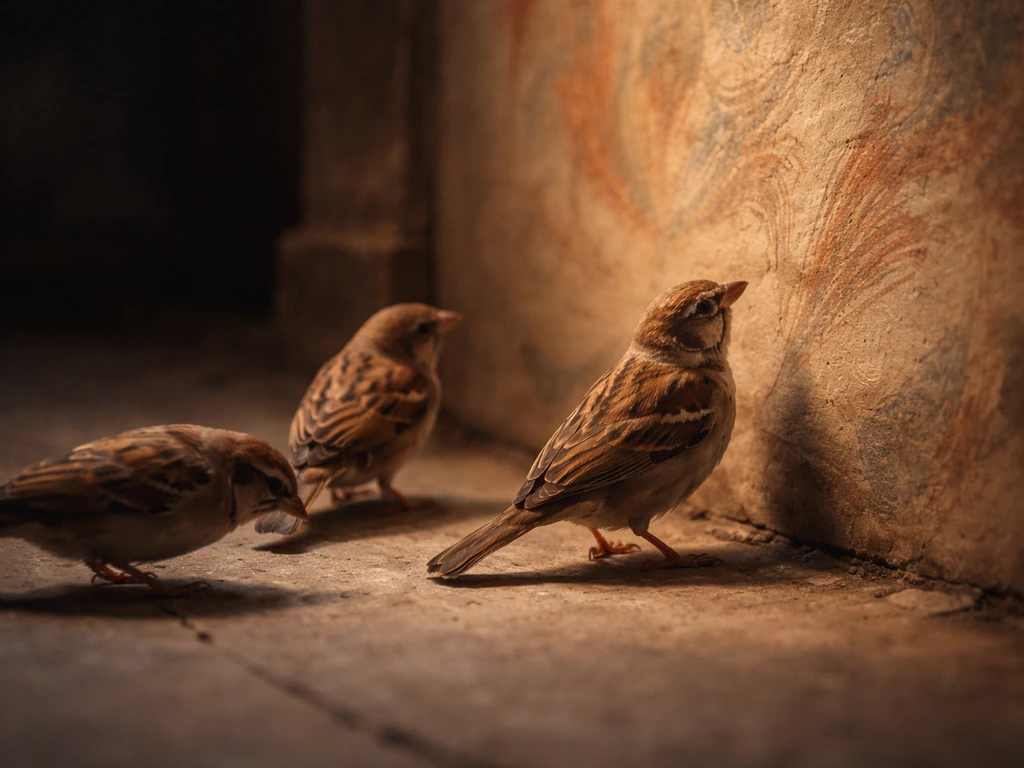
The third bird is the one that neither acts impulsively (like the first bird, who pecks) nor retreats out of fear (like the second). It pauses. It looks. It engages with the painting as a painting, not as a threat or a food source. In aesthetic terms, this bird represents the ideal viewer: someone who stops, attends directly to the object, and stays with it long enough to let understanding arrive. In that museum write-up, the Zeuxis tale is tied to a viewer practice with stages framed as “Encounter, Attend to, Negate, and finally Realize,” focused on attending to the object itself blank" rel="noopener noreferrer">“Encounter, Attend to, Negate, and finally Realize”. The blank" rel="noopener noreferrer">Order of the Third Bird formalizes this into a practice with stages described as Encounter, Attend to, Negate, and Realize. If someone uses "third bird" as a positive label for a viewer or thinker, this is the lineage they're drawing from.
In spiritual and omen-reading contexts
In spiritual traditions that track bird appearances as messages (especially practices rooted in ancestor communication, folk omens, or witchcraft communities), the significance of "three" birds appearing is the important thing, not the third bird as a distinct category. The number three is treated as a completion or confirmation: one sighting could be coincidence, two is a pattern, and three is a message that's insisting on being heard. What the message means depends almost entirely on the species of bird involved, not purely on the count. A third crow carries different weight than a third robin. The "third" here is a threshold, not a separate symbol.
In games, puzzles, and quests

Here, "third bird" is completely literal. It's the third collectible, the third statue on a map, the third answer in a sequence. In a Nancy Drew game context, "third bird tile" is a navigation marker. In Genshin Impact puzzle discussions, "the third bird is on Mt Aozang" tells you a physical in-game location. No symbolic overlay is intended. The meaning is whatever the game designers put there.
In crossword and wordplay
When a crossword blogger refers to "the third bird" in a clue breakdown, they mean the third entry in a themed set. In one well-documented example, the third bird in a three-bird crossword set is "BEE-EATER," described by the puzzle setter as "the most colourful of the three." The point is that the third bird is simply whichever bird the setter put last in the sequence. It's positional within that puzzle's own logic.
How different cultures and language versions handle this
The concept of a significant "third" bird in storytelling and symbolism is not unique to Western contexts, but the specific phrase "third bird" as a formal term or system is largely an English-language phenomenon. In many folk traditions, the symbolism lives in the number three itself rather than in a named "third bird" category. Three crows calling from the left is a bad omen in Irish tradition, but you'd call that "three crows," not "the third bird." The phrase "third bird" as a deliberate label is more characteristic of contemporary English-language art, puzzle, and online spiritual communities.
In Spanish, French, and German bird-omen and folklore traditions, triads of birds appear frequently in proverbs and stories, but they're typically named by species or grouped by number, not by ordinal rank. The closest parallel to the Zeuxis third-bird concept in visual culture shows up in classical Chinese painting criticism, where the ideal observer is also characterized by stillness and contemplative attention, but it's not framed through a bird metaphor specifically.
One important language note: if you're coming across "third" in a falcon or hawk context, you may be dealing with "tiercel" or "tercel" (the male peregrine falcon), a word that comes from the Latin tertius, meaning "third." The folk etymology ties this to the belief that the third egg in a clutch produced the male, or that the male is about a third smaller than the female. This is a completely separate "bird plus third" concept from any of the above, but it gets mixed up with "third bird" searches fairly often.
How to figure it out fast
If you need the answer right now, here's a quick process to follow.
- Find the list or sequence. Ask: what are the first and second birds in this system? If there's no first and second bird mentioned, the phrase is probably being used loosely, not as part of a formal system.
- Identify the domain. Is this art/aesthetics? Spiritual practice? A game? A puzzle? A piece of writing? Each domain has its own rules, and the meaning won't transfer cleanly between them.
- Check whether the species matters. In omen-reading contexts, the species of the third bird is often more important than its ordinal position. In the Zeuxis story, the species is irrelevant; the behavior is what counts. In games, both are irrelevant; position is everything.
- Look for a triad structure. The "third" only carries symbolic weight if there's a deliberate three-part structure (first bird does X, second bird does Y, third bird does Z). If you can find what the first and second birds represent, the third almost always completes the pattern by opposition or escalation.
- Confirm with the source. If it's from a specific song, game, exhibition, or story, go back to that source and check whether the creator has explained the sequence. Many puzzle designers, game developers, and artists publish walkthroughs or artist statements that name the bird explicitly.
Common misconceptions and close matches to watch for
The biggest confusion people run into is assuming "third bird" is a single fixed system with one universal meaning. It isn't. Here are the most common mistaken assumptions.
- "Third bird" as a universal omen: There's no pan-cultural tradition where the third bird always means the same thing. Anyone claiming that is either oversimplifying a specific cultural tradition or making it up.
- Confusing it with "bird number three" in Chinese zodiac or similar animal-based systems: Birds don't typically occupy numbered slots in the Chinese zodiac. If someone frames it that way, double-check which system they're actually referencing.
- Mixing up "third bird" with "tiercel/tercel": The male falcon's association with "third" is etymological and biological, not about position in a bird sequence. These are genuinely different concepts that share a word root.
- Treating the Order of the Third Bird as an ancient or mystical tradition: It's a contemporary art practice group. It has a documented, traceable modern origin, not an ancient esoteric lineage.
- Assuming any three-bird sighting is a complete "third bird" system: In spiritual contexts, someone saying "this is the third bird" often means they've counted three separate sightings of the same or similar bird, not that they're working within a named three-bird symbolic framework.
- Mixing up "two birds, one stone" sibling idioms: Phrases like "two bird" or "double bird" (which relate to rude gestures or the classic efficiency idiom) are structurally similar but completely unrelated in meaning to "third bird" in any of its uses.
What to actually do with the meaning
Once you've identified which "third bird" you're dealing with, here's how to use that meaning productively, depending on why you were looking it up. If you're looking for half bird meaning, you’ll want to treat it as a specific symbol or character device and define which system it comes from.
If you're reflecting or journaling
The Zeuxis third-bird idea is genuinely useful as a reflective prompt regardless of whether you're interested in art theory. Ask yourself: in whatever situation prompted you to search this, are you the first bird (reacting impulsively), the second bird (retreating), or the third bird (pausing to really see what's there)? To better understand the double bird meaning, focus on how the count and context change the message you are interpreting. That's a surprisingly sharp lens for examining how you engage with difficult or unfamiliar things. If you're in the spiritual-sightings camp, journal what species you saw, how many times, and what was happening in your life at each sighting. The pattern across all three often reveals more than any single "third bird" interpretation would.
If you're writing a story or building a world
The three-bird triad is a structurally satisfying narrative device because it follows a classic rule-of-three logic: the first bird establishes a pattern, the second bird confirms it, and the third bird breaks or completes it. That third bird is where your story's turn happens. If you're assigning symbolic birds to characters or events, consider giving your first bird a reactive quality (crows, magpies, starlings work well for impulsive or observant characters), your second bird a fearful or fleeing quality (doves, sparrows), and your third bird the quality of deliberate attention or wisdom (owls, herons, and in some traditions, the crane). The third bird in your sequence should feel inevitable in hindsight.
If you're solving a puzzle or game
Stop overthinking the symbolism. Find the in-game or in-puzzle list that names or shows the birds in order, count to the third one, and use whatever information (location, letter, number, color) that bird is associated with in the game's own logic. Most puzzle designers who use "third bird" as a clue are testing whether you can follow a sequence, not whether you know bird symbolism. When in doubt, look for a community walkthrough specific to your game or puzzle, since the answer is almost always documented.
If you're trying to use the phrase in conversation or writing
Be explicit about which system you mean. "Third bird" without context will confuse most readers. If you're invoking the Zeuxis/Order of the Third Bird meaning, a brief gloss ("the one that pauses to look rather than react") makes your meaning land clearly. If you're using it in a spiritual or omen context, name the species and the tradition you're drawing from. Precision here is more interesting than vagueness, and it respects the real depth behind each of these very different uses of the same phrase.
| Context | What "third bird" means | Does species matter? | Is position symbolic? |
|---|---|---|---|
| Art / Zeuxis story | The contemplative, attentive observer | No | Yes: third = deliberate pause |
| Spiritual / omen-reading | Third sighting = confirmed message | Yes, strongly | Yes: three = threshold/completion |
| Game / puzzle | Third item in the designer's sequence | Depends on the game | Yes, but purely mechanical |
| Crossword / wordplay | Third bird entry in the setter's trio | Yes (it's a specific answer) | No deeper symbolism |
| Falcon / falconry etymology | Tiercel/tercel: the male falcon | Yes (specifically falcons) | No: "third" is etymological, not positional |
| Story / narrative device | The bird that breaks or completes the pattern | Depends on the author's intent | Yes: third = the turn or revelation |
FAQ
How can I tell if “third bird” is positional (a sequence) or symbolic (loaded meaning) in the same text?
Look for cues like “first, second, third” actions, letters, locations, or counting instructions (positional). If the wording emphasizes a viewer type, aesthetic judgment, or a spiritual threshold and mentions the Zeuxis-style practice or a tradition’s teaching (symbolic). When it only says the third item in a list, treat it as positional.
What if the article or post shows multiple bird lists, and I’m not sure which one the writer meant?
Check whether the author names an ordering rule, such as “in order of appearance,” “in the grid left to right,” or “stages of a practice.” If no ordering system is stated, assume it could be more than one list, then identify the nearest explicit sequence marker and use that for the “third.”
In spiritual or omen contexts, does “third bird” mean the third bird species, or three separate sightings?
Most commonly it means three sightings or a count of appearances, with the species determining the message weight. If the source instead uses phrasing like “third species” or lists species in order, then it is about rank within that list. When unclear, prioritize “three sightings” and confirm whether the author tracks species per sighting.
Do bird omens interpret the same way if the count is three but the birds are different species?
Usually the tradition assigns the “message” by species, not only by the number. A third crow and a third robin are typically treated as different communications. Practical approach: separate the sightings by species and note what each sighting coincided with, rather than forcing one generic “third bird” meaning.
What’s the most common mistake people make when searching “third bird meaning”?
Assuming one fixed universal meaning exists. A safer method is to identify the exact category first (art-theory reference, spiritual omen practice, game puzzle tile, crossword entry, or education rhyme) and then apply only the meaning attached to that category.
If I find “third bird” in a game walkthrough, how do I avoid getting the wrong clue answer?
Use the walkthrough’s ordering logic, not your own counting. Many puzzles label birds implicitly (for example, by map location, diagram order, or UI panels), so “third” can change depending on whether you count rows, columns, or steps. Confirm by counting all items the way the puzzle screen arranges them.
Can “third bird” be confused with “tiercel/tercel” in searches, and how do I filter that out?
Yes, search results can mix them because “tercel” comes from a Latin word tied to “third.” If the context is falcons or breeding, treat it as the male peregrine falcon term, not an ordinal “third bird” symbol. If it mentions eggs or male falcons, it’s tiercel related rather than Zeuxis or sequence counting.
How should I apply the “Order of the Third Bird” idea if I’m not sure the writer means Zeuxis specifically?
Ask whether the author discusses the “third” as a contemplative viewer and uses a staged practice concept. If they do not mention that lineage but still say “third bird as pause to see,” you can still use the reflective prompt, but label it generically as “third position as attention,” not as a formal Zeuxis practice.
What practical note should I keep if I’m journaling bird sightings for “third bird” interpretations?
Write down date, time, species, exact number of sightings, and what was happening in your life at each time point. That lets you distinguish “a threshold of three appearances” from simple coincidence, especially when different species appear across the three entries.
Next Article
One Bird Meaning: How to Interpret Solo Bird Messages
Interpret one bird or solo bird messages using context, symbolism, and clue checks for confident meaning today.