
There is no widely recognized, dictionary-verified sexual definition of 'bird in hand' as a fixed phrase. What you are almost certainly encountering is the old proverb 'a bird in the hand is worth two in the bush' being repurposed as a sexual joke, usually built around the slang sense of 'bird' (British/Australian English for a young woman or girlfriend) or the physical imagery of hands and bushes. The punchline writes itself, and plenty of people online have written it. But that is comedy and innuendo, not a lexicalized second meaning you will find in a reputable dictionary.
What Does Bird in Hand Mean Sexually? Meaning & Usage

Marcus Whitmore
12 Jul 2026
Why people search for a sexual meaning here
If you heard someone use 'bird in hand' and raised an eyebrow, you are not imagining things. The phrase is genuinely easy to read as a double entendre, especially in British social contexts where 'bird' already means a woman or girlfriend. Someone saying 'I'd rather have the bird in hand' with a smirk is almost certainly making the joke deliberately. Online, Reddit threads and Urban Dictionary entries amplify this by proposing masturbation-versus-intercourse reinterpretations of the proverb, and the phrase shows up in song lyrics from the 1960s onward with an obvious romantic or sexual subtext. The confusion is understandable, which is exactly why it is worth untangling the actual layers of meaning.
The sexual and slang sense, clearly defined
When 'bird in hand' is used sexually, it almost always works as a pun or innuendo rather than a stand-alone slang term. The most common versions treat the full proverb ('a bird in the hand is worth two in the bush') as a dirty joke, playing on 'bird' as a woman, 'hand' as masturbation, or 'bush' as female pubic hair. Urban Dictionary has catalogued several of these, including reversals like 'a dick in the bush is worth two in the hand.' These are crowd-sourced jokes, not dictionary entries, and specialist slang lexicographers such as those behind Green's Dictionary of Slang and the New Partridge Dictionary do not record a conventionalized sexual meaning for the fixed phrase itself.
Register and offensiveness: in context, this kind of wordplay lands somewhere between mildly cheeky and genuinely crude depending on how explicitly someone spells it out. The word 'bird' on its own (as slang for a woman) is considered informal and slightly dated in the UK; many women find it reductive. When the whole proverb is deployed as sexual innuendo, the offensiveness depends almost entirely on delivery, audience, and how graphic the speaker is willing to get. In a stand-up set, it might be funny. In a workplace, it is the kind of thing HR departments exist to discourage.
The real proverb: what it literally means and where it came from
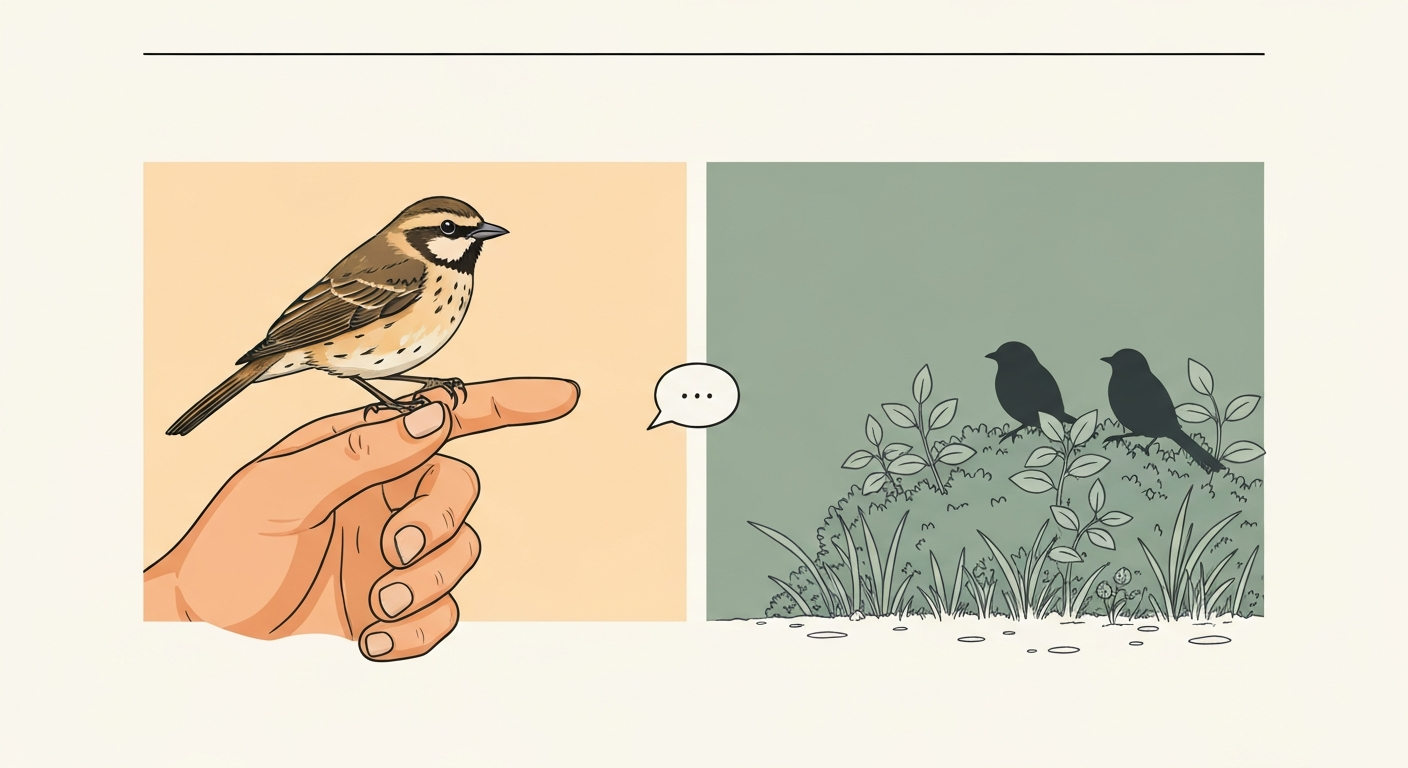
The actual proverb, 'a bird in the hand is worth two in the bush,' means it is better to hold onto something you already have than to risk it chasing something bigger or better that you may not get. The message is about practical caution over speculative ambition. If you have caught one bird, letting it go to chase two others is a gamble: you might end up with three birds, or you might end up with nothing. For a concise explanation of the proverb’s literal sense and usage, see what does a bird in the hand mean.
The origins sit firmly in falconry and medieval proverbial tradition. An early English form appears in The Boke of Nurture in the 15th and 16th centuries, and the version closest to the modern phrasing was collected by John Ray in his A Compleat Collection of English Proverbs in 1670. A Bird in the Hand, British Ornithologists' Union (history and John Ray citation) documents the proverb's history and cites John Ray's A Compleat Collection of English Proverbs (1670), noting earlier variants in 16th-century sources such as The Boke of Nurture A Bird in the Hand — British Ornithologists' Union (history and John Ray citation). The core idea, that a certain possession outweighs an uncertain prospect, is even older: Latin and Greek traditions share structurally identical proverbs. The imagery is not sexual in origin at all. It is about a falconer literally holding a trained hawk while watching prey in a thicket. 'In the bush' simply meant 'out there in the undergrowth,' not yet captured.
'Bird' as slang and why that opens the door to innuendo
The British and Australian slang sense of 'bird' meaning a young woman or girlfriend is what gives the proverb its comedic sexual potential. Cambridge and Collins both record this sense with a UK regional label. It is roughly equivalent to 'chick' in American English, though 'bird' carries more of a working-class British flavor and feels more dated today than it would have in the 1960s and 1970s, when it was widespread. The Online Etymology Dictionary traces the slang use to around 1915, evolving from the Middle English word 'burd' or 'burde,' which referred to a young woman.
Once you know that 'bird' can mean a woman, the proverb becomes ambiguous in a way the original falconry metaphor never was. 'A bird in the hand' suddenly sounds like a comment about a woman you are already with, versus two you are not. That reading is funny in some contexts and can shade into something more explicitly sexual depending on what the speaker does with the 'hand' and 'bush' imagery. blank" rel="noopener noreferrer">Proverb researchers and folklorists have documented this kind of deliberate sexual reuse across many proverbs: a well-known saying gets twisted by swapping or emphasizing body-part double meanings, and the result is a joke that travels partly because the original phrasing is already so familiar.
UK and Australia vs. the US: does the sexual reading land the same way?
The short answer is no, not quite. In the UK and Australia, where 'bird' as a slang word for a woman is a living part of the vernacular (even if somewhat dated), the double entendre lands more immediately and naturally. A British or Australian speaker hears 'bird in hand' and can access the slang meaning almost automatically, which makes the innuendo feel like a real pun. In American English, 'bird' as a slang term for a woman is far less common. Americans are more likely to know 'bird' as general slang for a person ('what a weird bird') or as a euphemism for the middle-finger gesture. The sexual reinterpretation of the proverb still circulates in American online spaces, but it tends to lean more heavily on the 'hand' and 'bush' imagery than on 'bird' as a woman.
Corpus studies of large English-language databases (the British National Corpus, COCA, and GloWbE) show the proverb appearing frequently with humorous or altered variants, but no stable, conventionalized sexual meaning has been identified across any national variety of English. The sexual use is real but it is better described as recurring ad hoc innuendo than as a fixed second sense of the phrase.
| Dimension | UK / Australia | United States |
|---|---|---|
| 'Bird' as slang for a woman | Common, well-documented, still recognized | Rare; not a standard slang term |
| Sexual reading of the proverb | More immediate; pun works on 'bird' alone | Relies more on 'hand'/'bush' imagery |
| Register of 'bird' (woman) | Informal, somewhat dated | Largely unfamiliar in this sense |
| Where sexual version circulates | Pubs, comedy, casual conversation, online | Primarily online (Reddit, Urban Dictionary) |
| Standard idiom meaning | Universally understood | Universally understood |
How to tell which meaning is intended
Context does almost all the work here. If someone says 'a bird in the hand is worth two in the bush' in a conversation about whether to take a job offer or hold out for a better one, they mean the proverb. For a concise explanation of what is bird in hand, see the overview. If someone drops 'you know what they say about the bird in hand' while leaning toward a date with a grin, they are making the joke. A few reliable signals:
- Tone and delivery: innuendo is usually performed with a pause, a smirk, or a deliberate emphasis on 'hand' or 'bush'
- Who is speaking: British or Australian speakers using 'bird' elsewhere in conversation are more likely to be leaning into the slang layer
- Context of the conversation: relationship talk, flirtatious exchanges, or stand-up comedy all raise the probability of sexual intent
- Whether the full proverb is quoted or just the fragment: 'bird in hand' as a fragment is more likely to be playful; the full proverb in a serious discussion almost always means the idiom
- Online context: if you saw it on a meme, an Urban Dictionary thread, or a comedy account, it is almost certainly the joke version
When in doubt, the safe interpretation is the proverb. It is the only meaning backed by centuries of documented use, and defaulting to it in any professional or ambiguous context is simply the better call. If someone really did mean it sexually, they will make that clear soon enough.
Example sentences: the proverb in use and the innuendo in action
Seeing both uses side by side makes the contrast obvious. The following examples show the phrase in context, with a note on what each one is actually doing.
- "She offered me the contract at 80% of what I wanted, and I took it. A bird in the hand, you know." (Standard idiom: accept what is certain rather than negotiate and risk losing the offer entirely.)
- "Don't turn down the internship while you wait to hear back from your dream company. A bird in the hand is worth two in the bush." (Standard idiom: practical advice about not gambling a solid opportunity on an uncertain one.)
- "He winked and said, 'Well, you know what they say about the bird in hand,' and everyone at the table groaned." (Sexual innuendo: the speaker is deliberately invoking the pun, relying on the audience knowing both the proverb and the slang.)
- "The 1966 song plays the whole 'bird in the hand' line as a romantic come-on, and it works because the listener fills in the gap." (Popular culture double entendre: the lyric is not explicit but banks on the audience making the connection.)
- "She told him to stop being so greedy and remember that a bird in the hand is worth two in the bush." (Standard idiom, used to caution against overreach.)
Related meanings worth knowing
The entrepreneurship principle
In business literature, 'bird in hand' has taken on a very specific technical meaning that has nothing to do with the proverb's advice or any sexual reading. Researcher Saras Sarasvathy identified a 'bird-in-hand principle' as the first principle of effectuation, a theory of expert entrepreneurial thinking. The idea is that effective entrepreneurs start with what they already have: their identity, knowledge, skills, and network. Rather than beginning with a fixed goal and working backward to find resources, they look at the resources in hand and ask what they could do with them. It is a formal framework published in management and small business economics literature, and it is entirely unrelated to the joke or even to the cautionary tone of the original proverb.
The 'bird-in-hand ice cube' and novelty references
If you have come across a 'bird-in-hand ice cube,' you have landed in the world of novelty products and cocktail accessories, not linguistic theory. These are ice cube molds or trays shaped to produce a bird-in-hand image, often sold as conversation-starter gifts. They lean into the phrase's mix of familiarity and mild double-entendre potential to market themselves. Fun party item, no deeper meaning required.
The place name
Bird-in-Hand is a real community in Lancaster County, Pennsylvania, well known as part of the Pennsylvania Dutch Country tourist area. The place name predates most modern playful reinterpretations of the phrase and is almost certainly derived from an old inn or tavern of the same name, following the very common English tradition of naming pubs after proverbs. (There are multiple historic 'Bird in Hand' pubs recorded across Gloucestershire and other English counties.) Visitors to Lancaster County will find the name on signs, businesses, and local maps with no irony intended.
Other 'bird' slang entries worth exploring
The slang life of 'bird' extends well beyond this one phrase. As a standalone British/Australian term for a young woman, it carries its own history and cultural baggage. As American slang, 'bird' can describe an eccentric person or function as a mild expletive stand-in. In rhyming slang traditions, 'bird' (from 'birdlime') means prison time. Each of these senses has its own register and regional fingerprint, and understanding them helps decode not just this phrase but a whole constellation of bird-related expressions that pop up in British television, music, and literature. The broader meanings of 'bird in hand' as a proverb, the full etymology of the saying, and the way sayings like this one are formally categorized as proverbs or idioms are all worth following up if this entry has left you curious.
FAQ
What does 'bird in hand' mean sexually?
As a sexual slang or innuendo, 'bird in hand' is usually a jocular, context‑dependent reinterpretation of the proverb. It can imply sexual access to a person ('having the bird' as British slang for a woman) or be used as a bawdy joke about masturbation/sex. This is not a stable, dictionary‑listed lexical sense of the fixed phrase; it appears mainly in jokes, memes, and user‑generated slang sites.
How offensive or informal is the sexual use?
The sexual/innuendo use is informal and potentially disrespectful. Calling a woman a 'bird' is regional slang (chiefly UK/Ireland/Australia) and can be seen as objectifying; explicit sexual reinterpretations or jokes can be crude. Use only in private, among consenting adults who accept that register; avoid in professional, formal, or mixed‑company situations.
What is the standard idiom 'a bird in the hand is worth two in the bush'?
The proverb means it's better to hold onto a sure thing than risk it for something uncertain that might be better. It’s recorded in major dictionaries and has a long history in English proverb collections going back to the 16th–17th centuries, originally linked to falconry and general proverbial tradition.
Where did the idiom come from (etymology)?
The phrase evolved from older proverbial material and was fixed in the modern bird form by the 17th century (notably John Ray, 1670). Its imagery—valuing a captured bird over two that might be unattainable—comes from falconry and everyday practical wisdom, predating modern sexual slang.
Does 'bird' mean 'woman' everywhere in English?
'Bird' as slang for a young woman or girlfriend is primarily British, Irish and Australian; US English more often uses 'chick'. That slang sense is attested in dictionaries, but regional labels matter: in the UK the word is common colloquially; in other varieties it may be unfamiliar or sound dated/offensive.
How common is the sexual reinterpretation of this phrase?
The sexual reinterpretation is common as a joke or meme online (forums, social media, Urban Dictionary entries) but not common as a formal dictionary sense. Corpus and proverb studies show many humorous variants, but no widely accepted, conventionalized sexual meaning for the fixed proverb.
Next Article
Bird-in-Hand Meaning in Entrepreneurship: Examples and Guide
Entrepreneurship guide to bird-in-hand principle with examples, decision checklists, and common mistakes for founders.