"And this bird you cannot change" is a lyric from Lynyrd Skynyrd's 1973 classic "Free Bird," written by Allen Collins and Ronnie Van Zant. In context, it means: I am who I am, and nothing you do will alter that. The "bird" is the speaker himself, cast as a free-flying creature whose nature is fixed and inviolable. Beyond the song, the phrase has taken on a broader life as a shorthand for permanent personal identity, the idea that some things, some people, some situations, simply resist transformation no matter how hard you push.
And This Bird You Cannot Change: Meaning and Uses

Marcus Whitmore
28 Jul 2026
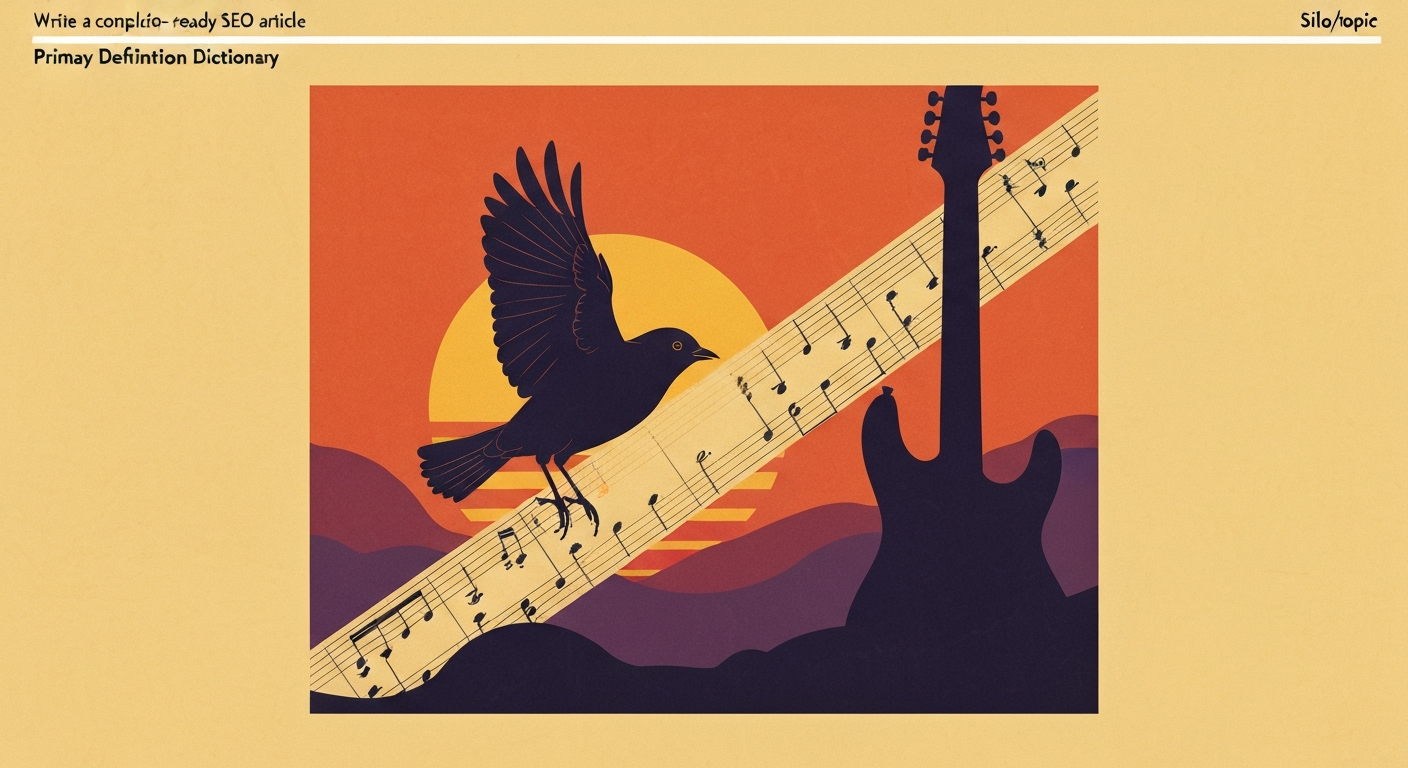
Three ways to read this phrase
Like most resonant bird expressions, this one works on several levels at once, and which reading lands hardest depends on context. At its most basic, it's a literal statement about an actual bird: birds can't be reshaped by human will. Lift it one level and it becomes a metaphor for a person whose character is irreducible. Go further and it touches something symbolic: birds across many cultures stand for fate, the soul, or freedom itself, things that exist outside human control. All three readings live comfortably in the Lynyrd Skynyrd lyric, and all three are worth unpacking.
The literal meaning: an actual bird you cannot change
Taken at face value, the line is simply true. A wild bird is what it is. You can train a parrot to mimic speech or a falcon to return to a glove, but you cannot change the underlying species, instinct, or biological nature of the creature. Birds migrate when their biology tells them to, sing the songs encoded in their DNA, and flee or fight according to instincts that predate human civilization by millions of years. In that literal sense, "this bird you cannot change" is almost a biological statement.
There is also a legal dimension to literal bird untouchability worth knowing if you are a writer or translator reaching for this phrase. In the United States, the Migratory Bird Treaty Act makes it unlawful to take, possess, transport, or sell most migratory birds or their parts without a federal permit. Eagles carry an additional layer of protection: bald and golden eagles are governed by separate rules, and even feathers used in Indigenous ceremonial practice require specific U.S. Fish and Wildlife Service authorization. So "a bird you cannot change" or touch is not just poetic in American legal terms, it is codified in statute. That background quietly reinforces the phrase's power for anyone who knows it.
A quick practical note for writers: if you are writing nonfiction or educational content that references touching, catching, or possessing wild birds, flag those legal realities. Phrases like "catch a bird" or "catching a bird with bare hands" carry real-world consequences that metaphorical readings gloss over.
The metaphorical meaning: permanence, character, and unchangeable situations
This is where most people live with the phrase. In "Free Bird," the speaker is telling someone, a lover, a family member, anyone trying to hold him in place, that his character and his need for freedom are non-negotiable. He is not asking permission to be this way. He is stating a fact. Popular lyric commentary consistently reads "and this bird you cannot change" as a declaration of irreducible selfhood: you can't fix what isn't broken, and you can't reshape a person whose identity is as natural and fixed as a bird's instinct to fly. Sonichits' Free Bird, lyrical interpretation and meaning (Sonichits) page interprets "And this bird you cannot change" as a metaphor for personal freedom Free Bird — lyrical interpretation and meaning (Sonichits).
As a metaphorical tool for writers, the phrase signals finality without hostility. It doesn't say "I won't change" (which sounds defiant) or "I can't change" (which sounds helpless). It says you cannot change me, placing the impossibility outside anyone's agency. That is a subtler and more interesting rhetorical move, and it's one reason the line has stuck in the cultural memory for over fifty years.
Translators should note: the metaphor depends on the English idiom "free as a bird," which both Merriam-Webster and Cambridge Dictionary record as meaning completely free or carefree. That idiomatic frame is what gives the word "bird" its specific gravity in the line. Languages that don't share that idiom may need a localized equivalent rather than a direct translation, otherwise the metaphorical weight evaporates.
Symbolic readings: destiny, conscience, freedom, and the untouchable
Birds carry enormous symbolic freight across cultures, and the phrase sits at the intersection of several long traditions. In ancient Egypt, the ibis was sacred to the god Thoth and the falcon was associated with Horus, birds so embedded in divine identity that harming them was a religious transgression, not merely a practical one. The Metropolitan Museum holds votive ibis figures from the Late Period and Ptolemaic Period that show just how seriously that sacred status was taken. In that frame, an untouchable bird is not just free: it belongs to a realm beyond human authority entirely.
South Asian religious tradition offers the Garuda, the eagle-like mount of Vishnu, as another example of a bird so symbolically elevated that the concept of changing or controlling it would be almost absurd. Encyclopaedias of Hinduism document Garuda's long mythic role as a sacred figure, underscoring a cross-cultural pattern: the bird that cannot be changed is often a bird that represents divine will or cosmic order.
In Indigenous North American traditions, eagle feathers carry ceremonial significance that sits at the intersection of the sacred and the legally protected, as noted above. The bird in those contexts functions simultaneously as a spiritual messenger, a mark of honor, and a creature whose very feathers demand careful, respectful handling. The symbolic untouchability and the literal legal untouchability reinforce each other in a way that's genuinely unusual in English-language bird lore.
Etymologically, the word "bird" in English (from Old English "bridd," originally meaning a young bird or chick) took centuries to displace "fowl" as the general term. The shift matters because "bird" carried associations of youth, lightness, and impermanence even as it evolved, making it an unusually rich vehicle for ideas about freedom and transience. Calling yourself a bird, as the Lynyrd Skynyrd lyric does, taps all of that.
How the phrase shows up in literature
The motif of an unchangeable bird, a creature or person whose fundamental nature resists transformation, appears in literature long before Lynyrd Skynyrd made it famous. Maya Angelou's title "I Know Why the Caged Bird Sings" (1969) treats the bird's song as an inalienable act of selfhood even under captivity: the bird cannot be silenced at its core even when it is confined. That's a close cousin to the Skynyrd formulation. Oscar Wilde's fairy tale "The Happy Prince" uses a swallow whose migratory instinct (and then its loyalty) define it as a creature shaped by forces larger than circumstance. Neither of these is the exact phrase, but both deploy the same underlying logic: the bird's nature holds.
More broadly in Romantic and post-Romantic literature, birds function as the go-to symbol for the untameable interior life. Keats's nightingale, Shelley's skylark, and Whitman's mockingbird all operate as creatures whose song (read: authentic self) cannot be commanded or redirected by human will. Writers working in this tradition would find "and this bird you cannot change" a natural, resonant echo of that lineage, even if they didn't consciously trace the connection back to 1973.
Note on citations: the literary examples above are drawn from well-documented primary texts. Attribution of specific quoted passages to lesser-known works or oral traditions should always be verified independently before publication.
The phrase in song: "Free Bird" and the lyrical tradition
The most direct and documented source for "and this bird you cannot change" is, of course, "Free Bird" by Lynyrd Skynyrd. The song appeared on their 1973 debut album "(Pronounced 'Lĕh-'nérd 'Skin-'nérd)," and the lyric is verified across commercially published songsheets, chord transcriptions, and lyrics databases including Shazam. In context, the relevant chorus lines run approximately: "I'm as free as a bird now / And this bird you cannot change." The phrase is the logical conclusion of the song's central argument: the speaker has established that he is leaving, that he cannot stay, and then seals it with a statement about his irreducible nature.
Lyrically, the line functions as what songwriters call a button, a closing declaration that lands with finality and is deliberately not softened or qualified. It shifts register from emotional pleading to almost philosophical statement in the space of a single line. That shift is a big part of why the song became an anthem rather than just a breakup song.
Beyond "Free Bird," the broader idiomatic family, freedom, birds, the impossibility of control, runs through American roots music, blues, and country in ways that are worth noting if you are tracing the phrase's ancestry. The image of a bird as a free or uncontrollable soul appears in traditional blues (where birds often signify travel, escape, or the afterlife) and in gospel (where the soul ascending like a bird is a standard metaphor). The Skynyrd lyric drew consciously or unconsciously from a very deep well. Specific line-level citations from other songs should be verified before reproduction.
Proverbs, folk sayings, and cross-cultural parallels
English proverb tradition has long used bird-catching as a metaphor for attempting the difficult or the impossible. The saying "you can catch a bird by putting salt on its tail" appears in 19th-century proverb collections, including material recorded in blank" rel="noopener noreferrer">Farmer's "Slang and Its Analogues" and discussed in folklore texts like "The Magic of the Horseshoe." Folklorists treat it as a children's superstition that doubles as gentle irony: if you could actually do the first impossible thing (sneak up close enough to salt a bird's tail), you could do anything. The folk logic is that the catching is the hard part, not the salt.
That proverb tradition connects directly to the broader theme of bird-resistance: birds in folk sayings are perpetually elusive, free, and resistant to human effort. "A bird in the hand is worth two in the bush" (recorded in English as early as the 15th century) turns on the same assumption, birds in the bush are not caught, and probably won't be. The cultural intuition that birds escape human control is ancient and cross-cultural.
In Chinese proverbial tradition, the image of a bird that cannot be caged (or that breaks free of the cage) is a recurring metaphor for the human spirit or for talent that cannot be suppressed. In Persian classical poetry, most famously in Rumi's work, the bird is frequently the soul longing to return to its origin, a creature whose essential nature (the return, the flight) cannot be redirected by earthly circumstance. These aren't translations of the Lynyrd Skynyrd lyric; they're evidence that the underlying idea is genuinely cross-cultural and ancient. The specific English phrase "you cannot change" carries American vernacular energy, but the concept it expresses has global parallels.
Note: specific proverb attributions to oral traditions or regional folk collections should be treated as approximate unless you can trace them to a documented collector and date. The examples above draw on commonly cited sources, but variant wordings exist and geographic origins are often disputed.
Related bird phrases worth knowing
"And this bird you cannot change" doesn't exist in isolation. It belongs to a family of bird-based expressions that each handle the relationship between birds, humans, and control differently. Understanding the differences makes you a sharper reader and a better writer.
| Phrase | Core meaning | Register | Cultural origin |
|---|---|---|---|
| And this bird you cannot change | My nature is fixed and irreducible; you have no power to alter who I am | Lyrical, American rock idiom | Lynyrd Skynyrd, 1973 (Collins / Van Zant) |
| Catch a bird | Literal: to capture a wild bird. Metaphorical: to attempt something difficult or elusive | Literal and proverbial | English proverb tradition, folk sayings |
| Catching a bird with bare hands | Literal act emphasizing difficulty; metaphor for attempting the near-impossible without tools or help | Literal and metaphorical | English folk and proverbial usage |
| Ignore the bird, follow the river | Follow practical guidance over instinct or distraction; a directional instruction | Cinematic / narrative | Willow (film, 1988, Lucasfilm dialogue) |
| Pull a bird (UK slang) | To attract or seduce a romantic partner; 'bird' = person (usually a woman) | British informal slang | British English vernacular |
| Throw / flip a bird | To make an obscene gesture (middle finger) | American / British slang | English slang, documented in modern dictionaries |
| Untouchable bird | A bird (or person) that is sacred, legally protected, or symbolically beyond reach | Symbolic, legal, mythological | Cross-cultural: Egyptian, South Asian, Indigenous North American traditions |
Several of these deserve a closer look because they illuminate what "and this bird you cannot change" is doing by contrast. "Catch a bird" and "catching a bird with bare hands" are about human effort and its limits: they cast the bird as the elusive prize, not the speaker's identity. For a brief explainer of the idiom and its uses, see catch a bird meaning. "Throw a bird" and "pull a bird" shift entirely into human social territory, where the bird is a stand-in for a gesture or a person rather than a symbol of freedom. "Ignore the bird, follow the river" from the film Willow uses a bird as a distraction or a false signal, which is almost the inverse of the Skynyrd framing where the bird is the truth. And "untouchable bird" overlaps most directly with the core phrase: in both cases, the bird sits outside the range of human agency, whether for sacred, legal, or deeply personal reasons. For a concise explanation of the term, see untouchable bird meaning.
When "bird" means person: pull a bird and throw a bird
British slang has used "bird" to mean a young woman informally for decades, and "pull a bird" (to successfully attract or pick up someone) sits in that tradition. For more on the British slang sense, see pull a bird meaning for a concise explanation of how "bird" can mean a person and how "pull" means to attract someone. It's worth flagging for translators and international readers because it is a distinctly regional usage: American English speakers generally don't use "bird" this way, which means a British speaker and an American speaker can hear very different things in the same sentence. Meanwhile, "throw a bird" or "flip the bird" is a cross-Atlantic expression documented in Dictionary.com and other reference sources, meaning to make the middle-finger gesture. Here the word "bird" functions as slang for the gesture itself, not the animal or the person. Writers working in international or mixed-audience contexts should be explicit about which sense they mean.
Practical guidance for writers and translators
If you are quoting or paraphrasing "and this bird you cannot change" in your own writing, a few things are worth keeping in mind. First, the phrase is strongly associated with Lynyrd Skynyrd and will carry that cultural baggage in most English-language contexts, especially for readers over thirty-five. Using it approvingly invokes Southern rock, American individualism, and a specific era of rock music. Using it critically or ironically plays against that association, which can be effective if intentional. Second, the phrase works best when the "bird" metaphor has already been established. Out of context, it can read as obscure. In context, it lands with the finality the original songwriters intended.
For translators, the challenge is that the phrase relies on two things that don't travel automatically: the English idiom "free as a bird" (which gives "bird" its metaphorical meaning) and the grammar of "you cannot change," which places the impossibility outside the speaker's control rather than inside it. A good translation needs to preserve both the freedom-bird link and the passive-resignation of the modal. Languages with strong bird-freedom idioms of their own (French "libre comme l'air," for example, though that's air rather than bird) may need creative adaptation rather than literal rendering.
- Establish the bird-as-self metaphor before using the phrase, or lean on shared cultural knowledge of the Lynyrd Skynyrd source.
- In translation, find a local equivalent for 'free as a bird' rather than translating word-for-word.
- Be explicit about register: this is American vernacular, not formal idiom. It suits personal essays, song lyrics, fiction dialogue, and cultural commentary, less so academic or legal writing.
- If quoting the lyric directly, attribute it to Lynyrd Skynyrd (Collins / Van Zant, 1973) to avoid ambiguity.
- When using the phrase metaphorically for a person or situation, make sure the irreducibility is clear: you are saying change is impossible, not just difficult.
- Avoid conflating this phrase with 'flip the bird' or 'pull a bird,' which are entirely separate idioms that happen to share the word.
Why this phrase has lasted
Fifty-plus years after its first recording, "and this bird you cannot change" still circulates in cultural conversation for a reason that goes beyond nostalgia for a classic rock song. It captures something true and hard to say more efficiently: that some identities, some freedoms, and some natures are genuinely outside the reach of other people's will. The bird image does a lot of heavy lifting there. It is natural, it is ancient, it is cross-cultural, and it flies. Humans have been projecting their deepest ideas about freedom, fate, and the soul onto birds for as long as we have been telling stories, from the Egyptian falcon cult to the Garuda to the nightingale in Keats. The Skynyrd lyric plugged into that current in 1973 and the current was already ancient. That's the real reason the phrase still resonates: it feels bigger than the song it came from, because in a meaningful way, it is.
FAQ
What does the phrase “and this bird you cannot change” mean in plain terms?
Literally it states that a particular bird cannot be changed. Idiomatically (the most common reading) it means a person or situation is fixed or resistant to change — often used to claim personal freedom or an immutable nature: “you won’t be able to change who I am.”
Where does the exact wording “And this bird you cannot change” come from?
The exact line appears in the chorus of Lynyrd Skynyrd’s song “Free Bird” (written by Allen Collins and Ronnie Van Zant, first released 1973). Printed chord/lyric sheets and many lyric sites reproduce the line. Claims that it predates the song are unsupported here.
What are the plausible literal readings of the phrase and its variants (e.g., “untouchable bird”)?
Literal readings treat it as about an actual bird: an untamable species, a protected/sacred animal, or a bird physically impossible or illegal to catch. Variants like “untouchable bird” can denote legal protection (e.g., Migratory Bird Treaty Act) or ritual taboo (sacred birds in some religions).
What are the common metaphorical and symbolic readings?
Metaphorical readings include: personal autonomy (‘I can’t be changed’), resistance to control, irreversibility (something set in nature), and freedom (linked to ‘free as a bird’). Symbolically, birds often stand for the soul, freedom, messages, or social status; the line can emphasize an essential, untamable identity.
How does this line relate to similar bird expressions (sibling keywords)?
Relations: “free as a bird” shares the freedom/escape frame; “catch a bird” and proverbial ‘salt on the tail’ express attempting the difficult or impossible; British “pull a bird” treats ‘bird’ as a person (seduce); “throw/flip the bird” is obscene gesture slang. “Ignore the bird — follow the river” is a directive in film context (Willow) and not a general idiom. Each sibling varies by literal vs. social-personal sense.
How should writers use or adapt the phrase to avoid ambiguity?
If you mean personal autonomy, pair the line with clarifying context (speaker, emotion, or consequence). Avoid using ‘bird’ where a modern audience may read British slang (person) or think of an obscene gesture. For literary effect, lean on surrounding imagery (wings, sky, absence of cage). For idiomatic clarity, consider established paraphrases: ‘you can’t change me’ or ‘this is who I am’.
Next Article
Pull a Bird Meaning: Slang, Literal Sense & Safety Guide
'Pull a bird', literal vs slang meanings, regional use, examples, safety notes, and polite alternatives.