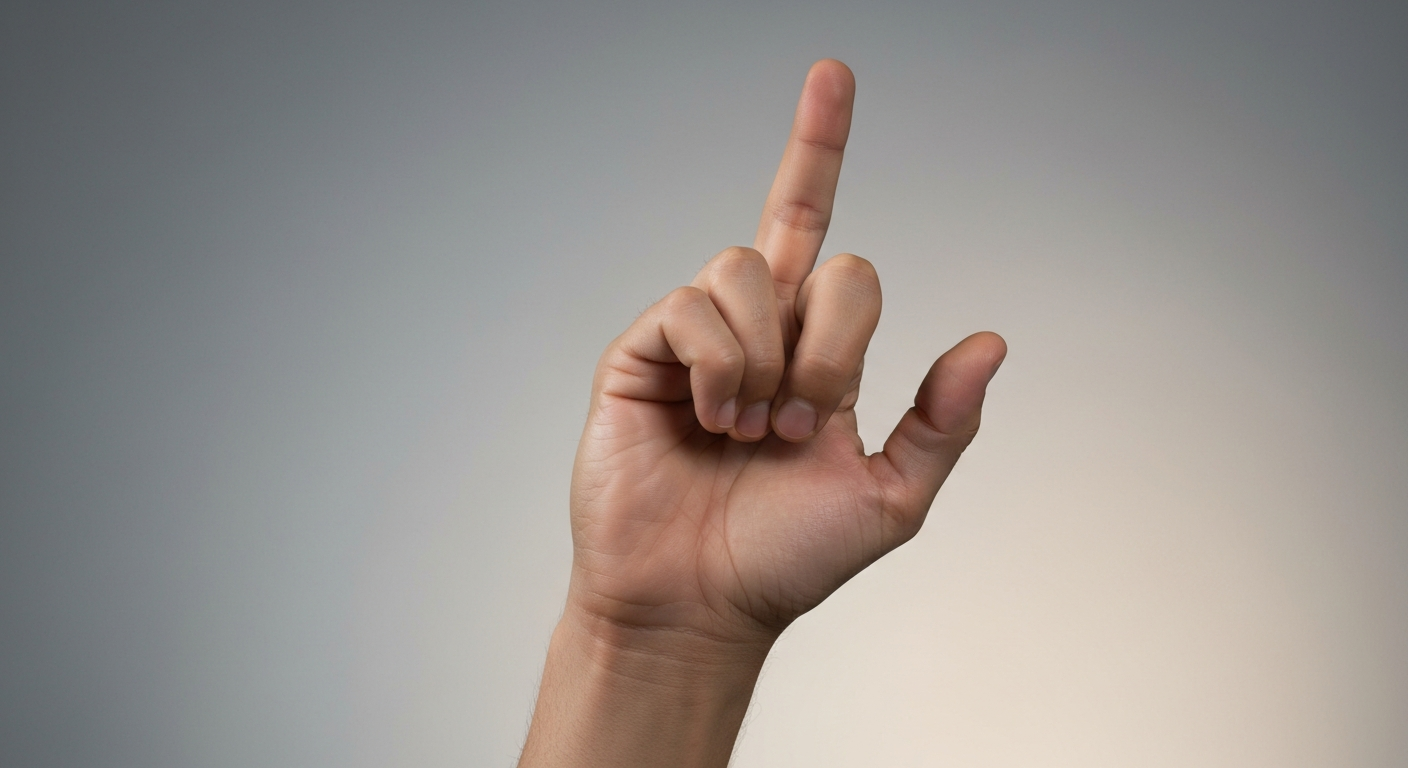
To flick the bird at someone means to extend your middle finger toward them as an obscene, dismissive, or insulting gesture. It is the same act most people know as flipping the bird, giving someone the finger, or flipping someone off. In idiomatic use, the phrase describes that single loaded gesture: one raised middle finger, directed at a person, vehicle, or situation to express contempt, anger, or defiance. You will see it written as flick the bird, flip the bird, flipping the bird, and several other close variants, all pointing to exactly the same thing.
Flick the Bird Meaning: Origin, Usage & Etiquette

Marcus Whitmore
11 Aug 2026
What the phrase actually means
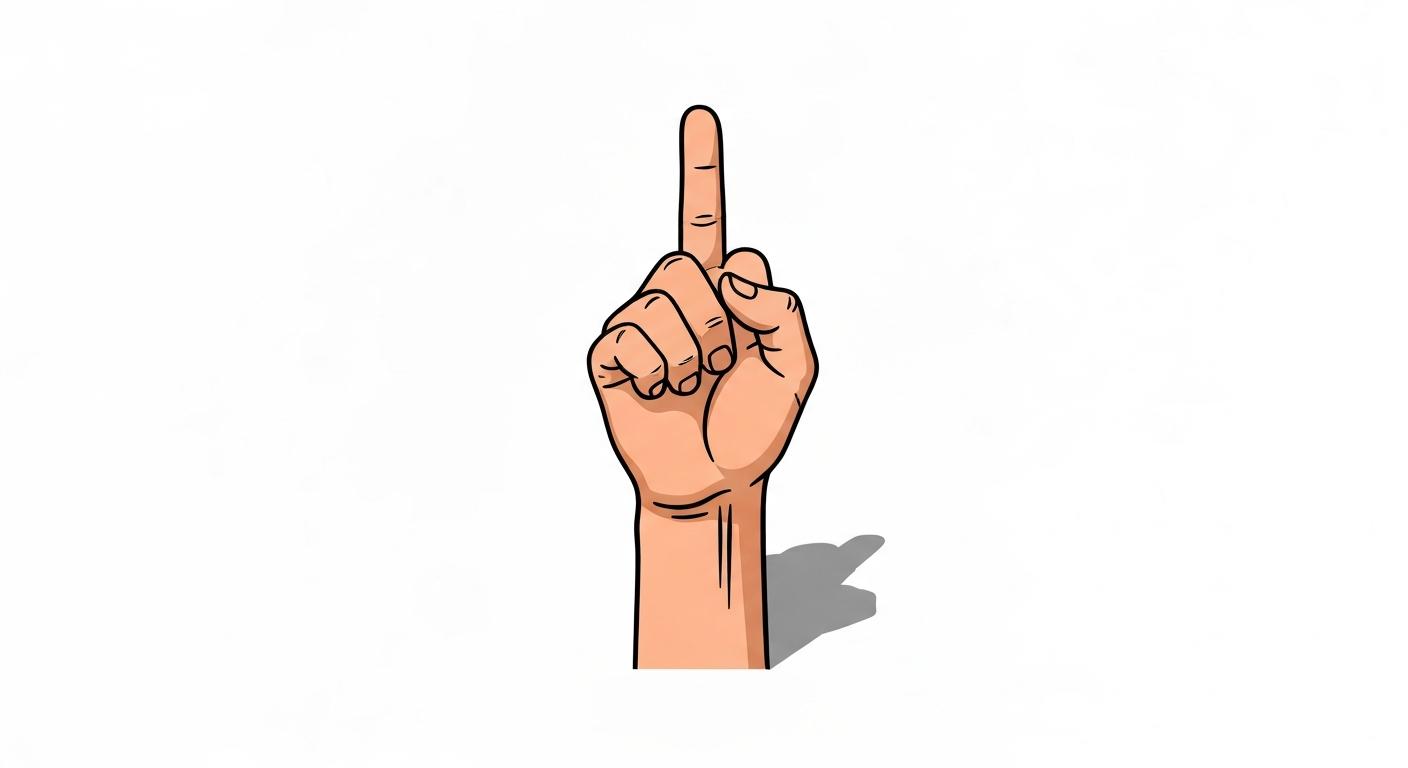
At its most literal, flicking or flipping the bird is a physical action: the hand is formed into a loose fist, the middle finger is extended upward, and the gesture is directed at someone. The meaning is unmistakably hostile or contemptuous. As an idiom, the phrase is used both to describe the act in the past tense ("she flicked the bird at the referee") and to instruct or encourage it ("just flip him the bird and drive away"). Merriam-Webster lists "flip the bird" as US informal for making this gesture, and Collins English Dictionary defines "flip someone the bird" as equivalent to giving someone the finger. For a concise definition and usage notes, see flip someone the bird meaning. Cambridge's entry for "flip someone off" covers the same gesture and confirms US usage as the core context.
Variants, spellings, and common typos
The phrase shows up in a surprising number of forms, and it helps to know they all mean the same thing. The verb slot is the most variable part: people say flip, flick, give, or shoot, and the meaning does not change. Spoken contractions produce forms like "flippin' the bird" (common in casual speech and song lyrics) and "flickin' the bird." You will also find common misspellings in search queries, including "flick the berd," "flip tha bird," and the curious phrase "flip the bull the bird," which actually has its own meaning rooted in a specific story or expression of defiance toward authority (think of a cowboy refusing to be intimidated). Wiktionary and slang dictionaries catalogue most of these variants, and a quick corpus search confirms that "flip the bird" is the dominant American written form, with "flick the bird" appearing as a close, fully accepted alternative.
- flip the bird (most common American written form)
- flick the bird (accepted variant, same meaning)
- flip someone the bird / flip him the bird / flip her the bird
- flippin' the bird (spoken/casual contraction)
- give someone the bird (has a distinct older meaning — see below)
- flip someone off / flipped off
- give the finger / give someone the finger
- the finger (shortened noun form)
- flip the bull the bird (specific idiomatic use involving defiance toward a powerful figure)
Two very different birds: flipping vs. giving
This is worth pausing on, because "flip/flick the bird" and "give someone the bird" are related phrases that do not mean the same thing, and conflating them leads to genuine confusion. "Flip the bird" or "flick the bird" always refers to the middle-finger gesture, full stop. "Give someone the bird," however, has a separate and older history rooted in theatrical slang. In 19th-century British theater, a performer who bombed onstage was said to "get the bird," meaning the audience hissed at them like a goose. The "big bird" was the collective hiss of a hostile crowd. That sense survives today in expressions like "the audience gave him the bird," meaning they booed and jeered. The two phrases overlap in connotation (both are hostile) but differ in meaning: one is a specific obscene hand gesture, the other is a vocal act of heckling or rejection.
Where the phrase comes from
The history here splits into two threads: the gesture itself, and the phrase used to describe it. The middle-finger gesture is genuinely ancient. Classical scholars and legal historians, including Ira P. Robbins in his law review article "Digitus Impudicus: The Middle Finger and the Law," document the gesture in ancient Greek and Roman sources under the Latin term digitus impudicus, meaning the unchaste or shameless finger. So the physical act predates English by roughly two millennia. What is more recent is the specific verbal idiom "flip the bird" or "flick the bird" attached to it.
The theatrical "give someone the bird" (hissing) is traceable to early 19th-century British stage culture. Victorian theatrical lexica and the reference work "Passing English of the Victorian Era" record "big bird" as theatrical slang for an audience hissing a bad performer. Oxford reference works confirm this etymology for the vocal sense. The slang authority Eric Partridge and later compilers in the Concise New Partridge Dictionary of Slang document how the phrase shifted over the 20th century from the vocal/theatrical sense toward the finger-gesture sense in American slang.
For the specific phrasing "flip the bird," early printed attestations in American English appear in the 1960s, with Atlas Obscura's historical summary pointing to counterculture press and publications like Broadside as early documented sources. This timing fits the broader pattern of mid-20th-century American slang codifying a gesture that had existed informally for far longer. It is worth being appropriately cautious here: many online sources cite dramatic or entertaining origin myths for the middle-finger gesture (including a popular but poorly documented claim about medieval archers). Historians and gesture scholars generally treat those stories skeptically in the absence of verified primary evidence.
How people use it today
In contemporary American English, "flip the bird" and "flick the bird" are used freely in casual conversation, comedy, news reporting, and social media. The Corpus of Contemporary American English (COCA) shows the phrase appearing across spoken, fiction, and magazine registers, confirming it is not confined to any single context. Corpus of Contemporary American English (COCA) is a large, balanced corpus recommended for contemporary American usage and frequency research. The tone is almost always one of irritation, defiance, or humor, and the phrase is common enough that most major newsrooms paraphrase it when reporting incidents rather than printing the gesture description directly.
Sample sentences showing natural use:
- "He cut her off in traffic, and she flicked the bird at his rear window without hesitation."
- "The crowd erupted when the player flipped the bird at the opposing team's bench."
- "She was caught on camera flippin' the bird at the press, which made the front page the next morning."
- "In the film, the kid flicks the bird at the principal and sprints for the exit — it gets a huge laugh."
- "If someone tailgates you, flipping the bird might feel satisfying, but it can also escalate things quickly."
Variant forms side by side
| Phrase | Meaning | Register | Notes |
|---|---|---|---|
| flick the bird | Make the middle-finger gesture | Informal/slang | Fully accepted variant of 'flip the bird' |
| flip the bird | Make the middle-finger gesture | Informal/slang | Most common American written form |
| flip someone the bird | Direct the gesture at a specific person | Informal/slang | Adds explicit target; same gesture |
| flip him/her the bird | Direct the gesture at a specific person | Informal/slang | Pronoun substitutes the target |
| flippin' the bird | Making the middle-finger gesture (ongoing) | Casual/spoken | Contracted progressive form |
| give the finger / give someone the finger | Same middle-finger gesture | Informal/slang | Synonym; widely understood |
| flip someone off | Same middle-finger gesture | Informal/slang | Phrasal verb form; common in US English |
| give someone the bird | Boo, hiss, or heckle someone | Informal (older sense) | Distinct theatrical origin; not the finger gesture |
| flip the bull the bird | Defy a powerful or intimidating figure | Idiomatic/figurative | Metaphorical use; can imply literal or figurative defiance |
When it's offensive, and what can actually happen
Flicking or flipping the bird is an obscene gesture, and context determines just how much trouble it can cause. In casual settings between friends, it is often used playfully with zero real hostility. Among strangers or in professional environments, it reads as a direct insult and can escalate a tense situation significantly. Road rage incidents involving the gesture have resulted in confrontations, and in some jurisdictions the gesture in certain contexts has led to disorderly conduct or disturbing the peace charges, though in the United States courts have repeatedly found the gesture to be protected expression under the First Amendment.
Robbins' law review article on the digitus impudicus surveys American case law extensively and finds that courts generally treat the middle-finger gesture as constitutionally protected speech, but that protection does not insulate someone from social or professional consequences. The 2012 Super Bowl halftime show, in which performer M.I.A. directed the gesture at the broadcast camera, triggered FCC complaint proceedings and a significant legal and financial dispute with the NFL, illustrating how even a brief gesture can generate regulatory, contractual, and public-relations fallout. Workplaces, schools, and broadcasters operate under their own codes of conduct that can result in discipline regardless of First Amendment protections.
- In casual or close-friendship contexts, the gesture is often playful and carries little real offense
- Directed at strangers, especially in traffic or public confrontations, it can escalate to physical conflict
- In professional, educational, or broadcast settings it can result in termination, suspension, or regulatory action
- US courts generally protect it as free speech, but workplace and school policies are separate from constitutional law
- In other countries the legal and social tolerance for the gesture varies considerably
The same idea, different gestures around the world
Gesture scholars classify the raised middle finger as an emblem, meaning a gesture with a culturally agreed-upon meaning that can stand in for a spoken word or phrase. Kendon, Efron, and Ekman and Friesen, whose foundational work on gesture typology underpins most modern gesture research, distinguish emblems from spontaneous gestures precisely because emblems are culturally learned and therefore vary across cultures. The raised middle finger is widely understood in North America, Western Europe, and Australia, but it is not universal.
Equivalent insult gestures in other cultural traditions include the V-sign with palm facing inward (common in the UK, Ireland, Australia, and New Zealand as an obscene insult, distinct from the palm-outward peace sign), the arm-and-fist gesture known in several European countries as the bras d'honneur, and the thumbs-up in some parts of the Middle East and West Africa, where it carries an obscene connotation rather than a positive one. It is genuinely worth knowing these distinctions if you travel, since a gesture that reads as playful irritation in one context can read as a serious insult or an entirely innocent greeting in another.
Politer ways to say it
If you are writing for a general audience, reporting on an incident, or simply want to avoid printing an obscenity, English has a well-stocked supply of euphemisms and paraphrases for both the gesture and the phrase. Major newsrooms and style guides routinely use these in formal copy.
- made an obscene gesture
- extended her middle finger
- gave the one-finger salute
- made a rude hand gesture
- responded with an obscene hand sign
- made a gesture that cameras caught and audiences understood immediately
- gave a gesture that requires no translation (used wryly in feature writing)
In speech, people who want to convey the idea without performing the gesture will often say things like "I was this close to flipping him off," "I basically gave her the finger in my head," or "let's just say my hand had a strong opinion." These softer forms appear constantly in conversation and entertainment writing, and they illustrate how culturally embedded the gesture and its language have become.
Suggested images and layout notes
For editors and designers working with this article, a few image ideas work particularly well without reproducing the gesture itself. An illustrated hand with the middle finger extended (rendered as a clean line drawing rather than a photograph) keeps the entry informative without being gratuitously provocative. A timeline graphic showing the documented history from ancient Roman digitus impudicus references through 19th-century theatrical slang to the 1960s American idiom would give readers a clear visual of how the phrase evolved. A simple comparison infographic mapping the gesture equivalents across cultures (middle finger in the US, V-sign in the UK, bras d'honneur in parts of Europe) would support the cross-cultural section. Captions should be matter-of-fact and descriptive: "The raised middle finger, or digitus impudicus, has been documented as an obscene gesture since classical antiquity."
Related entries worth exploring
This entry sits alongside several closely related idiom entries on this site. If you arrived here looking for a specific phrasing, the entries on flip him the bird meaning, flippin the bird meaning, flip someone the bird meaning, and flip the bird idiom meaning each cover the same core gesture but with slightly different grammatical framing and usage contexts. The entry on flip the bull the bird meaning is worth a separate read if you are interested in the figurative, defiance-toward-authority use of the expression. All of these entries build on the same linguistic foundation explained here.
The short version, if you need it fast
Flick the bird means to make the middle-finger gesture at someone as an expression of contempt, anger, or dismissal. It is identical in meaning to flip the bird, flip someone the bird, flippin' the bird, and giving someone the finger. The phrase is American English slang documented in print from the 1960s, though the gesture itself is ancient. It is distinct from "give someone the bird," which historically meant to boo or hiss a performer. The gesture is legally protected speech in most US contexts but can still get you fired, suspended, or into a physical confrontation depending on when and where you use it. When in doubt, one of the polite paraphrases above does the job without the risk.
FAQ
What are the core research questions to answer when writing a Bird Definition Dictionary entry for “flick/flip the bird”?
1) What is the plain‑language definition of the phrase as both a physical gesture and an idiom? 2) What are the variant spellings, phonetic forms, colloquialisms and common typos? 3) How does “flip/flick the bird” (middle‑finger gesture) differ historically and meaningfully from “give someone the bird” (booing/heckling)? 4) What is the documented origin and etymology of each sense, with dated attestations? 5) How has usage changed over time and across regions (US vs UK vs others)? 6) What are clear contemporary usage examples and sample sentences? 7) What is the register and etiquette guidance (offensiveness, contexts to avoid, legal/disciplinary risks)? 8) What are cross‑cultural equivalents and gesture variations to note? 9) What practical euphemisms and polite alternatives should writers use? 10) Which images, tables and internal links will best aid comprehension?
Which authoritative dictionary and lexical sources are required?
Consult major desk and learner dictionaries: Oxford (OED/Oxford reference), Merriam‑Webster, Collins, Cambridge, and reputable learner dictionaries. Include specialized slang/reference works (Partridge, Green’s), and verified online dictionary entries to document definitions, example sentences, variant forms, and dating where provided.
What historical and etymological sources are needed to trace both senses of ‘the bird’?
1) Historical dictionaries and word‑origin references (Oxford Dictionary of Word Origins). 2) 19th‑century theatrical lexica and period writing for the ‘give the bird’ = booing sense. 3) 20th‑century print and periodical archives to date the ‘flip the bird’ phrasing. 4) Primary evidence from digitized newspapers, Google Books, HathiTrust, and Library of Congress collections for dated citations.
Which corpora and quantitative resources are essential for regional and temporal usage analysis?
Use large corpora such as COCA (Corpus of Contemporary American English) for US usage, BNC (British National Corpus) for UK usage, Google Books/Google Ngrams for diachronic frequency, and newspaper/book archives for fine‑grained dated attestations. These let you measure rise/fall, regional prevalence, and variant frequency.
What classical and scholarly sources should document the gesture’s deeper history?
Consult classical studies and scholarly reviews that reference ancient attestations (Greek/Roman sources calling the middle finger digitus impudicus), and gesture scholarship that contextualizes continuity or discontinuity (law reviews summarizing classical evidence, plus academic articles on gesture history).
Which gesture scholarship and typologies are required for an accurate physical description?
Rely on core gesture literature and typologies (works by Kendon, Efron, Ekman & Friesen) and recent cognitive‑linguistic reviews to (a) classify the raised middle finger as an emblem, (b) describe handshape and variants, and (c) explain pragmatic functions across contexts.
Next Article
Flippin the Bird Meaning: Definition, Origins, Usage
What 'flippin the bird' means: definition, gesture, variants, history, usage, etiquette, alternatives.