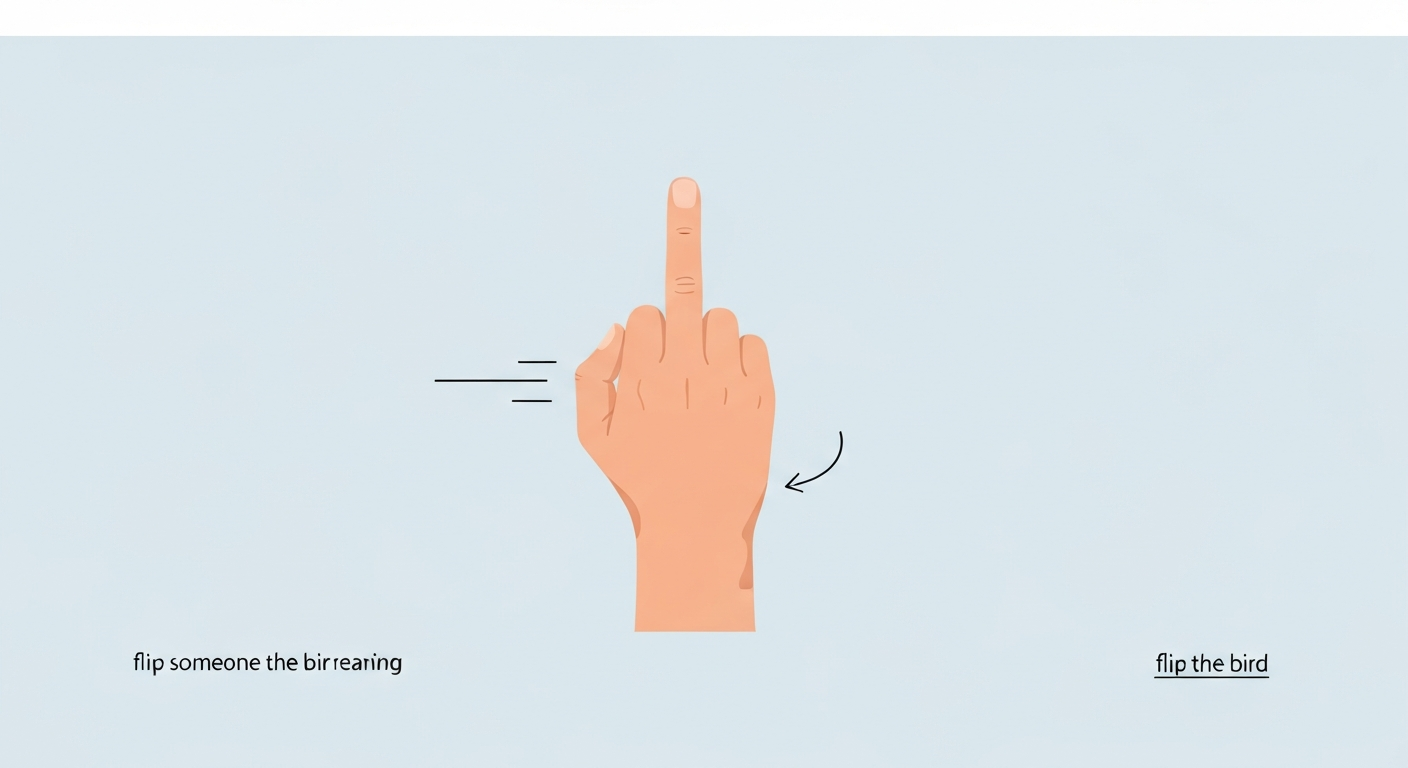
"Flippin' the bird" means extending the middle finger toward someone as a deliberate insult or act of defiance. The gesture itself is what matters here, not any actual bird. Merriam-Webster defines the related phrase "flip (someone) the bird" as US slang for making an offensive gesture by pointing the middle finger upward while keeping the other fingers folded down. The word "bird" in this expression is slang for the gesture, and "flippin'" is simply an informal, present-participle spelling of "flipping" that you'll see constantly in casual writing and speech.
Flippin the Bird Meaning: Definition, Origins, Usage

Marcus Whitmore
7 Aug 2026
What exactly does "flippin' the bird" mean?
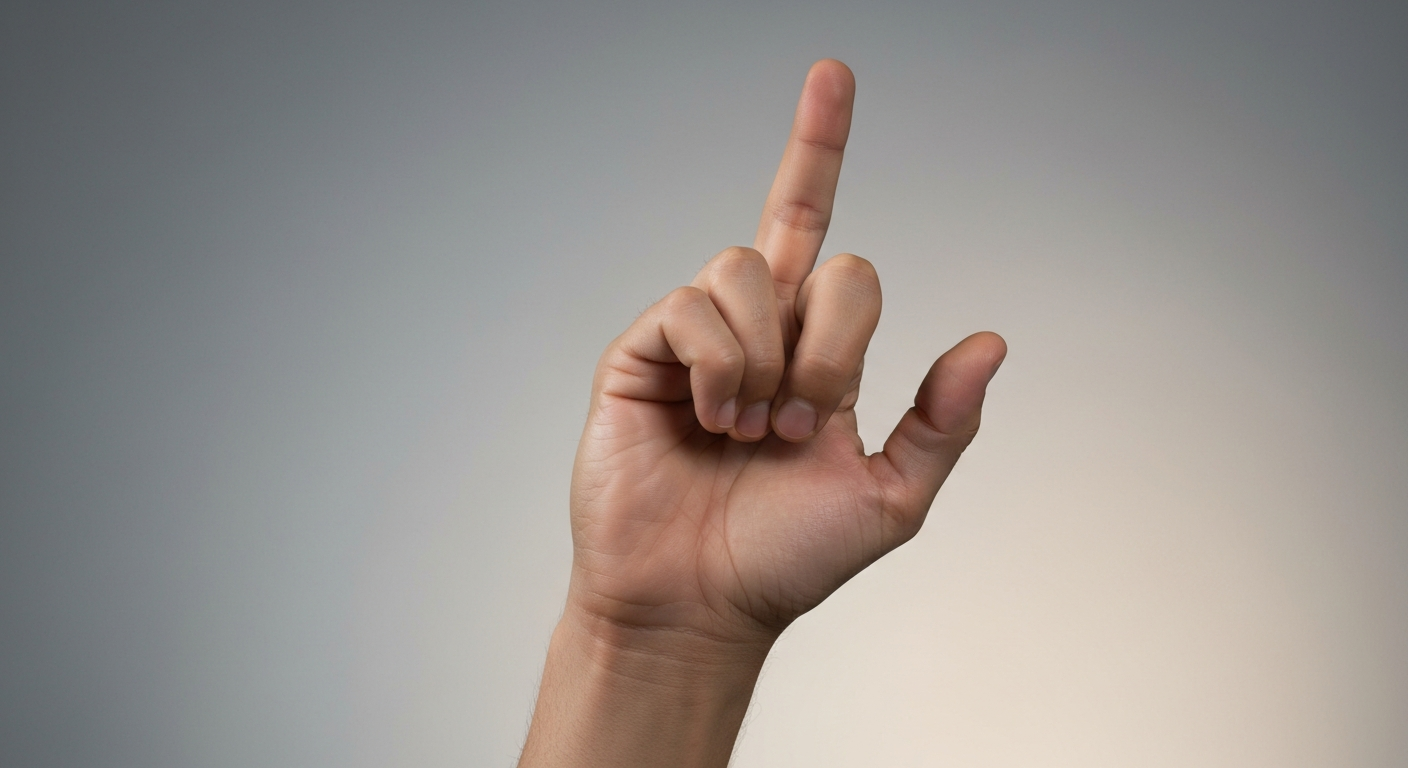
At its core, "flippin' the bird" describes the act of raising your middle finger at someone, usually with the back of the hand facing you and the remaining fingers curled down. It is one of the most widely recognized obscene gestures in the English-speaking world, functioning as a nonverbal way to express contempt, anger, or defiance. Collins English Dictionary records "flip the bird" as informal US and Australian usage, synonymous with "give the finger" or "give the bird," meaning a sign of contempt. The phrase has nothing to do with literal birds; the word "bird" here is slang for the gesture itself, almost certainly pulling from theatrical and popular English slang where "the bird" has long meant a dismissive, contemptuous signal.
It is worth being direct: this is an entry about a piece of idiomatic language. If you arrived here looking for a bird species, you are in the wrong place. But if you are curious about why English speakers call a middle-finger gesture "the bird," read on, because the answer turns out to be surprisingly interesting.
All the variants you'll encounter
The phrase appears in a handful of slightly different forms, and it helps to know they all mean essentially the same thing. The core expression is "flip the bird," which is the standard dictionary form. From there, speakers and writers adapt it in predictable ways depending on context.
| Variant | Form | Notes |
|---|---|---|
| flip the bird | Infinitive / base form | Standard dictionary entry; most common written form |
| flippin' the bird | Present participle (informal spelling) | Casual writing; the apostrophe replaces the final 'g' |
| flipping the bird | Present participle (standard spelling) | More formal written version of the same action |
| flip someone the bird | Infinitive with indirect object | Specifies a target; e.g., "she flipped him the bird" |
| flip him the bird | Infinitive with specific pronoun | Common spoken and written form with a named recipient |
| flick the bird | Variant verb | Used in some regions and contexts; 'flick' suggests a quicker motion |
| give the bird | Alternative verb phrase | Older form; also used in the theatrical 'booing' sense |
| give the finger | Alternative noun phrase | Direct reference to the finger rather than the gesture's slang name |
| flip (someone) off | Phrasal verb | Common American alternative; same gesture, different label |
Corpus data from tools like the Corpus of Contemporary American English (COCA) and the Corpus of Historical American English (COHA) show that "flip the bird" and "give the finger" are the dominant printed forms in American English, while "give the bird" appears with some frequency in older material and British sources. "Flick the bird" is less common but appears in Australian and some British usage, which aligns with Collins flagging the broader phrase as Australian informal as well. All these variants share the same core meaning and gesture.
The gesture itself: what it looks like and what it signals
The physical gesture is straightforward. You raise one hand, extend the middle finger fully upward, and keep the thumb and remaining three fingers curled into the palm. The wrist can be still or involve a short upward or forward motion, the "flip" referenced in the phrase. The gesture is directed at a specific person or group and is understood almost universally in Western culture as expressing hostility, contempt, or defiant dismissal.
Gesture researchers and classical scholars have long linked the extended middle finger to a phallic symbol, a reading that connects directly to the ancient Roman term for it: digitus impudicus, meaning roughly "the shameless finger" or "the indecent finger." The gesture's power comes partly from that implied sexual insult, partly from the deliberate, directed nature of the act. You are not just expressing frustration into the air; you are pointing it at someone.
When people use it: tone and typical contexts
"Flippin' the bird" covers a surprisingly wide emotional range depending on who is involved and what the relationship is between them.
- Genuine insult: directed at a stranger in traffic, during an argument, or following a perceived slight — this is the core hostile use
- Defiance: aimed at an authority figure, a camera, or an institution to signal non-compliance or contempt for rules
- Joking between friends: performed with a grin or laugh to signal playful mockery rather than real anger — context and tone make this read as affectionate ribbing
- Performance and self-expression: musicians, athletes, and celebrities sometimes use it on stage or in photographs as a gesture of rebellious attitude rather than a targeted insult
- Reaction to frustration: a private or semi-private gesture made after a bad experience, not necessarily directed at a specific person
The same gesture can be an act of aggression or a moment of humor depending entirely on relationship, facial expression, and delivery. That range is worth keeping in mind when assessing whether a given use of "flippin' the bird" was intended as a genuine insult or something more casual.
A brief, carefully-phrased history
The middle-finger gesture is old, though the exact chain of transmission from ancient to modern use is not fully established, so this history is presented with appropriate caution rather than a clean unbroken line.
The earliest documented attestations come from ancient Greece and Rome. Aristophanes appears to reference the gesture in his comedy Clouds (5th century BCE), and the philosopher Diogenes is reported in Diogenes Laërtius' Lives of the Eminent Philosophers (compiled 3rd century CE, recording earlier events) to have extended the middle finger toward Demosthenes in a pointed insult. Roman sources used the term digitus impudicus, the shameless or impudent finger, as a recognized obscene gesture. These citations are collected and surveyed in Ira Robbins' "Digitus Impudicus: The Middle Finger and the Law" (UC-Davis Law Review, 2008), which is the most thorough legal-historical treatment of the gesture in U.S. scholarship.
The pathway from classical antiquity into modern English slang is not fully documented, and historians are cautious about claiming a direct, unbroken line. What we do know is that by the 19th century, English theatrical slang had a distinct phrase, "the big bird" or "give the bird," meaning the hissing and booing noise an audience made to dismiss a bad performer. Victorian slang dictionaries such as John Camden Hotten's Slang Dictionary document this theatrical usage. Whether this theatrical "bird" directly shaped the modern American middle-finger expression is debated. Some etymologists suggest the modern phrase developed independently in American English, building on the gesture's long-standing vulgarity rather than the theatrical tradition.
The earliest widely cited photographic evidence of the gesture in the United States is a detail from an 1886 Boston Beaneaters baseball team photograph in which pitcher Charles "Old Hoss" Radbourn can be seen extending his middle finger toward the camera. The earliest widely‑cited photographic evidence of the middle‑finger gesture in the United States appears in an 1886 baseball team photograph (Charles “Old Hoss” Radbourn, Boston Beaneaters), held in public collections and reproduced via the Library of Congress / Wikimedia Commons, a recommended image to illustrate late‑19th‑century U.S. attestation 1886 Boston Beaneaters team photo (detail showing Charles “Old Hoss” Radbourn) — Library of Congress / Wikimedia Commons. The image is held in public collections and reproduced via the Library of Congress and Wikimedia Commons. Baseball historian and photo-history outlets including PetaPixel have identified it as the earliest known photograph capturing the gesture in the U.S. This does not mean the gesture began in 1886, only that this is the earliest photographic evidence we currently have.
Google Books Ngram data and corpus searches in COHA suggest that the specific phrase "flip the bird" in print became more common in the mid-to-late 20th century in American English, though the gesture itself is obviously older. As with most slang, written documentation lags behind spoken use.
Regional differences and usage notes
"Flippin' the bird" and "flip the bird" are primarily American English expressions. British English speakers are more likely to use "give the V-sign" or simply "give the finger," and the V-sign (palm facing inward, index and middle finger raised) is a distinct but similarly obscene gesture with its own British history. In Australia, "flip the bird" appears in informal use, which is why Collins flags it as US and Australian. In other English-speaking contexts, the gesture is understood, but the specific phrase "flip the bird" may sound distinctly American.
Within American English, the phrase itself does not carry strong regional variation, though corpus comparisons in COCA and the British National Corpus (BNC) confirm that "give the finger" and "flip the bird" both appear in American sources while British material more commonly uses "give the finger" or describes the gesture more neutrally. "Flick the bird" is worth noting as a variant that appears in some Australian and British usage, suggesting the verb choice shifts slightly by region even when the meaning stays the same.
How it shows up in text, emoji, and online slang
In digital communication, the gesture has direct equivalents that people use in texts, posts, and comment sections.
| Digital form | How it's used | Register |
|---|---|---|
| 🖕 | Middle finger emoji; most direct digital equivalent | Casual to hostile depending on context |
| "flip the bird" | Typed out in full; clear and unambiguous | Informal written description |
| "the finger" | Abbreviated reference; widely understood | Informal |
| "FTB" | Rare abbreviation; not widely standardized | Very informal / niche |
| "flipping you off" | Typed description of the action | Informal |
| ASCII art (╖ or similar) | Rough ASCII representations; vary in clarity | Very informal / internet humor |
| "\m/" or similar | Sometimes used loosely for rebellion gestures, though originally a metal horns sign | Informal / ambiguous |
The 🖕 emoji (officially called "reversed hand with middle finger extended" in Unicode) was added to Unicode 7.0 in 2014 and quickly became the most straightforward digital stand-in for the gesture. Like the physical gesture, its meaning shifts with context: between close friends it can read as playful; directed at a stranger or public figure it carries the full weight of the insult. Platform content policies vary on whether the emoji can be reported or removed, so its online use is not without risk in moderated communities.
Legal, workplace, and social consequences
This section is not legal advice. It is an overview of what the law and documented case history suggest. If you need guidance on a specific legal situation, consult a qualified attorney.
In the United States, the middle-finger gesture has generated a meaningful body of case law. Many U.S. courts have treated the gesture as constitutionally protected expressive conduct under the First Amendment, particularly when directed at police officers or public officials. A useful reference case is Coggin v. State, 123 S.W.3d 82 (Tex. Ct. App. 2003), in which a Texas appellate court reversed a disorderly-conduct conviction that had been based solely on a middle-finger gesture, finding that the gesture alone did not rise to the level of "fighting words" required to remove First Amendment protection. blank" rel="noopener noreferrer">Ira Robbins' law review survey collects numerous similar decisions and shows that criminal convictions based purely on the gesture have often been overturned on appeal in the U.S.
That said, legal protection is not the same as consequence-free. Consider the following real risk areas:
- Workplace: most employers prohibit conduct that creates a hostile environment; directing the gesture at a colleague or supervisor can lead to disciplinary action, suspension, or termination regardless of what the law allows
- Schools: students have been disciplined and suspended for the gesture; school contexts often operate under different standards than public streets
- Driving: gesturing at other drivers while in traffic has, in some documented cases, escalated confrontations dangerously; some jurisdictions have attempted to prosecute it under traffic or road-rage laws with mixed results
- Social media: posting content showing the gesture can violate platform community guidelines and result in content removal or account suspension
- International contexts: in countries outside the U.S., the gesture may carry different legal weight and should be used with extreme caution; what has First Amendment protection in the U.S. has no equivalent protection elsewhere
The social consequences can be just as significant as the legal ones. Even in contexts where no law is broken, the gesture is widely recognized as one of the most aggressive nonverbal insults in English-speaking culture. It tends to escalate rather than resolve conflict, and using it in professional, family, or public settings will almost always be read negatively by witnesses regardless of intent.
If you want to express the same feeling without the gesture
If the underlying goal is to express contempt, frustration, or defiant dismissal, plenty of verbal options carry the same weight without the physical and legal risks.
- "Take a hike" or "get lost" (dismissive, lower risk)
- "I couldn't care less" (expresses contempt verbally)
- "With all due respect..." followed by a pointed criticism (professional-register dismissal)
- "Go pound sand" (informal American; dismissive without being obscene)
- "I have nothing but contempt for that" (direct verbal statement)
- In writing, simply stating clearly that someone's behavior was unacceptable is almost always more effective than gesture-based insults
Sample sentences showing it in context
Seeing a phrase in actual sentences helps clarify how it functions in real language. Here are examples across different tones:
- "She looked in the rearview mirror and, without hesitation, started flippin' the bird at the driver who had cut her off." (hostile, traffic context)
- "The punk band finished their set by flippin' the bird at the cameras — classic move." (performative, rebellious tone)
- "He thought he was being funny when he flipped the bird at his best friend across the restaurant, but the family at the next table did not appreciate it." (joking intent, social consequence)
- "The photograph shows the player flippin' the bird at opposing fans, which led to a fine from the league." (documentary description, consequence noted)
- "I asked her how the meeting with her boss went, and she just mimed flippin' the bird — said it all really." (gestural shorthand, humorous retelling)
How this connects to other bird idioms and phrases
"Flippin' the bird" sits in a cluster of closely related phrases that all describe the same core gesture from slightly different grammatical angles. See the concise entry on the flip the bird idiom meaning (internal reference 1be773df-94a0-48b0-8124-1aa3de50f9f2) for a dictionary-style definition and usage notes. Phrases like flip someone the bird and flip him the bird are simply the same expression with different objects. The variant flick the bird uses a different verb but points to the same action. And the broader idiom flip the bird is the canonical dictionary form that anchors all of them. For a focused explanation, see our article on flip the bull the bird meaning.
What is interesting from a language perspective is how a single physical gesture has generated this whole family of variant phrases, each capturing a slightly different framing of the action. The verb choice matters: "flip" suggests a quick, decisive motion; "flick" implies something even faster and more casual. These are subtle distinctions, but they reveal how much work the gesture does in English-language expression that it has earned its own rich slang vocabulary.
It is also worth noting what this phrase is not. It has nothing to do with the early-bird idiom, bird symbolism in different cultures, or birds as animal species. The word "bird" here is pure slang, entirely detached from any feathered creature. That is exactly the kind of linguistic curiosity this site exists to untangle.
FAQ
What authoritative dictionaries should I cite for a crisp definition and variant mapping of “flippin the bird”?
Cite major current lexicographic authorities for definition and variants: Merriam‑Webster (entry for “flip (someone) the bird”), Collins English Dictionary (entry for “flip the bird”), and consult the Oxford English Dictionary (OED) for dated citations, variant spellings and earliest attested forms (search for “give the bird”, “flip the bird”, “flip off”, “give the finger”).
Which primary historical sources document the obscene middle‑finger gesture in antiquity and early modern reception?
Use classical primary texts cited in scholarship: Aristophanes’ Clouds (5th c. BCE) and Diogenes/Diogenes Laërtius passages that record insulting finger gestures. For early modern reception, cite John Bulwer’s Chirologia/Chirographia (17th century). Always reference the specific edition/translation (Loeb, authoritative critical editions or public‑domain translations) and include line/page citations.
What secondary scholarly works explain continuity and meaning of the gesture and provide scholarly context?
Include peer‑reviewed gesture and classical studies: the UC‑Davis Law Review survey article “Digitus Impudicus: The Middle Finger and the Law” (Robbins, 2008) for classical attestations and legal overview, and peer‑reviewed gesture research (e.g., the open PMC survey article on gestures/memory/associations). For broader history/interpretation, cite books such as Tracing Gestures: The Art and Archaeology of Bodily Communication and chapters treating the digitus impudicus and Bulwer.
Which empirical language‑data tools should I use to document diachronic and regional variant frequencies?
Use structured corpora for quantitative evidence: COHA (Corpus of Historical American English) for 19th–20th century U.S. trends, COCA (Corpus of Contemporary American English) for recent U.S. usage, and the British National Corpus (BNC) for U.K. frequency. Complement with Google Books Ngram Viewer for long‑term printed‑book trajectories, but interpret Ngram with caution and corroborate with COHA/COCA concordances.
What 19th‑century theatrical sources are needed to separate the theatrical ‘give the bird’ sense from the middle‑finger sense?
Cite Victorian/19th‑century slang and theatrical dictionaries (e.g., Hotten’s Slang Dictionary and other contemporary theatrical compendia) that document “the big bird”/“give the bird” as booing/hissing a performer. Provide edition details and example quotations to show the distinct theatrical sense.
Which visual/photographic evidence is recommended to illustrate historical attestations of the gesture?
Recommend public‑domain or clearly licensed images with provenance: the 1886 Boston Beaneaters team photograph (detail showing Charles “Old Hoss” Radbourn) from Library of Congress / Wikimedia Commons as an early photographed U.S. attestation. Also use public‑domain scans of Bulwer and classical editions/Loeb translations for antiquity. For each image include collection metadata and licensing/copyright checks and a fair‑use justification if needed.
Next Article
Flip Someone the Bird Meaning: Gesture, Origin & Usage Tips.
'Flip someone the bird' explained: gesture vs idiom, origins, variants, examples, and usage advice.