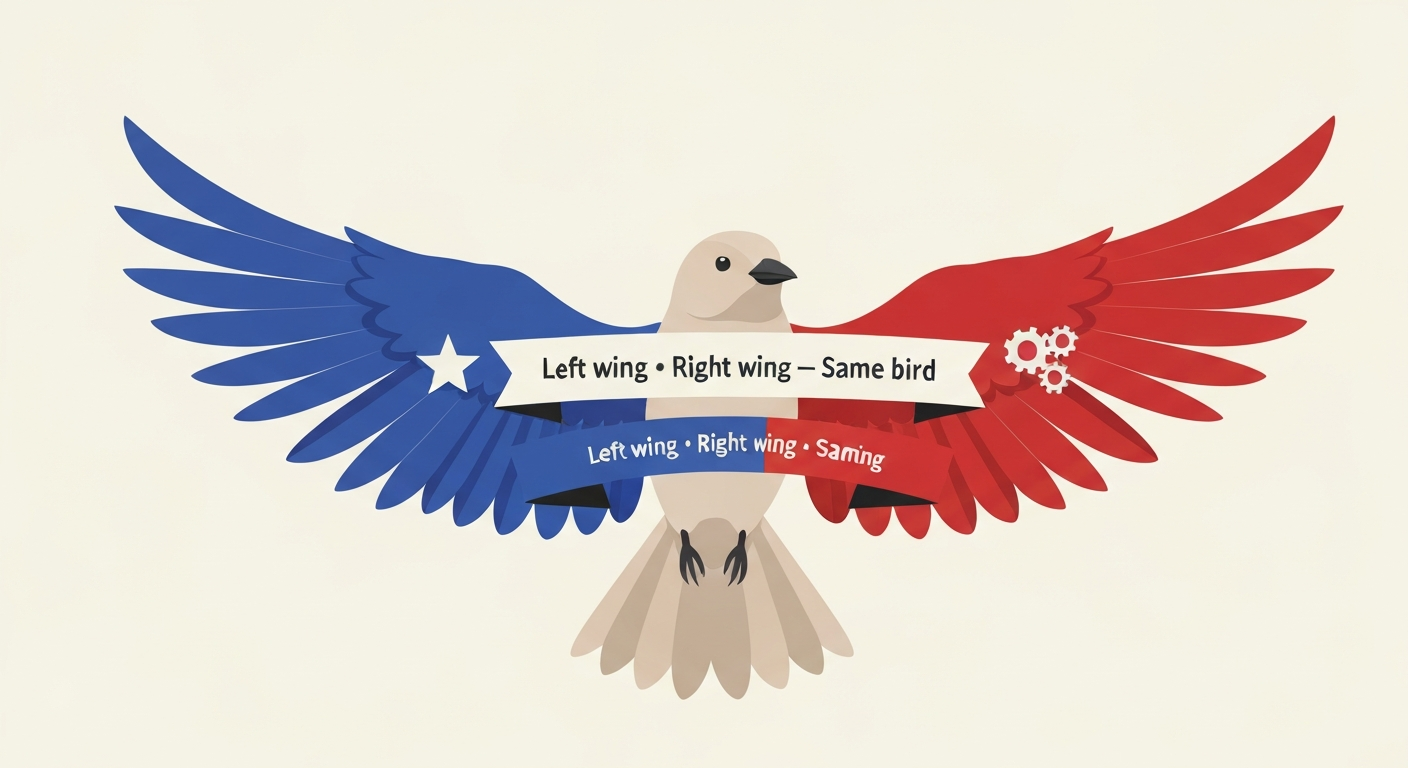
When someone says 'left wing and right wing, same bird,' they mean that two things which appear to be opposites actually belong to the same whole and cannot function without each other. Most often you'll hear it as a political jab: the idea that the left and right of a political system are not real opposites but two parts of the same machine, serving the same interests. The phrase works because it borrows a literal biological truth, a bird really does have two wings, and both belong to the same creature, and turns that anatomy into a pointed argument about unity, control, or false choice.
Left Wing and Right Wing Same Bird: Meaning & Uses

Marcus Whitmore
24 Jul 2026
The plain definition
At its most basic, 'left wing and right wing, same bird' means: two things that look separate or opposed are actually parts of a single entity. The phrase is used to argue that surface-level differences are less important than the shared origin or shared purpose of the two sides. You'll encounter it most often in political commentary, where the speaker is suggesting that opposing parties or factions ultimately serve the same system, owners, or agenda. The tone is usually skeptical or critical, implying that the apparent opposition is illusory.
The literal picture: avian anatomy
The metaphor draws its force from a simple biological fact. A bird's wings are paired forelimbs, one on each side of the body, and both are essential to the same animal. Avian anatomy references, including the standard international nomenclature laid out in the Handbook of Avian Anatomy (Nomina Anatomica Avium), describe the wing as a modified forelimb built on a shared skeletal plan: humerus, radius, ulna, and a series of specialized hand bones. Each wing carries primary and secondary flight feathers (called remiges), coverts, and the small alula at the leading edge. There is no anatomical difference in kind between the left and right wing, they are mirror-image structures serving the same bird.
Frank B. Gill's widely used university textbook Ornithology describes both wings as paired structures that operate together during every phase of flight. Neither wing is dominant in a way that makes it 'more bird' than the other. They are symmetrical, functionally equivalent, and inseparable from the animal that grows them. That symmetry is exactly what makes the image so rhetorically useful when people want to argue that two seemingly opposing sides are, in reality, the same thing.
How a bird actually flies: why both wings have to work together
Bird flight is not just a matter of flapping two limbs up and down independently. Biomechanics research published in journals like the Journal of Experimental Biology, including work by Bret Tobalske and colleagues, shows that the two wings operate as kinematically coupled control surfaces. For experimental evidence on musculoskeletal coordination in wing mechanics, see the PMC pigeon study. They must produce matched lift and thrust on both sides of the body simultaneously, or the bird loses control. A bird with one wing simply cannot fly; the asymmetry of force and drag would send it spinning. Studies on rock pigeons have also documented how the musculoskeletal system and feather attachments within each wing are themselves precisely coordinated, so the whole flight apparatus is a tightly integrated system, not two independent units that happen to be attached to the same body.
This is what gives the metaphor its rhetorical sting. It is not just that the two wings belong to the same bird, they depend on each other to produce any result at all. That mutual dependence is the implicit message when someone uses the phrase figuratively: the two sides need each other, or at least serve the same flight path, even if they appear to be moving in opposite directions up close.
The figurative meaning: politics, organizations, and rhetoric
The figurative use of this phrase is where most readers will actually encounter it. In political commentary, 'left wing and right wing, same bird' is a way of saying that both major parties, both sides of a political debate, or both ends of a spectrum ultimately serve the same interests or answer to the same power. The phrase carries a strong skeptical or populist flavor, it implies that the choice between left and right is a false choice, that the real power lies in the bird itself (typically glossed as the state, a ruling class, corporations, or the political establishment).
Phrase historian Barry Popik has traced a closely related version back to 1928, when Socialist Party figures including Norman Thomas and Morris Hillquit used the formulation 'the Democratic and Republican parties are two wings of the same bird of prey.' A 1928 campaign handbook cited in Popik's research uses the image explicitly, and he found it appearing in the New York Times and in sources like the American Mercury as early as 1932. So this is not a new social-media meme, it has over a century of documented use as political rhetoric, particularly from third-party and socialist movements arguing that the two dominant parties were interchangeable tools of capital.
Beyond politics, the phrase can be applied to any organization or system where two apparently opposing parts serve the same whole: two departments in a company that seem to fight each other but report to the same leadership, or two schools of thought in an academic field that share the same foundational assumptions. The political use is by far the most common, but the underlying logic, complementary parts of a single entity, can travel into many other contexts.
Conceptual metaphor theory, as laid out by George Lakoff and Mark Johnson in Metaphors We Live By, explains why this kind of body-based image works so well. Humans naturally map physical, part-of-a-whole structures onto abstract social and political ones. A bird's two wings form a concrete, visually intuitive image of duality within unity, which is exactly why the metaphor lands even for listeners who have never thought carefully about avian anatomy.
Literal versus figurative: how to tell which is which
Context does almost all the work here. If the phrase appears in a biology textbook, a wildlife guide, or a veterinary discussion, it is almost certainly literal, describing the anatomical fact that a bird possesses two wings as part of its body plan. If it appears in a political opinion piece, a speech, a social-media post, or a protest T-shirt, it is almost certainly figurative, making a claim about the relationship between political or social factions.
The figurative version is typically signaled by its rhetorical structure. It is usually framed as a punchline or a revelation: 'You think there's a difference between left and right? Left wing, right wing, same bird.' The literal version, by contrast, would just appear as a descriptive statement in a technical or educational context. Style guides like the AP Stylebook recommend that writers signal figurative use clearly, especially with politically charged terms like 'left-wing' and 'right-wing,' which they treat as hyphenated compounds with specific political meaning. For a concise history showing that the political labels left and right (and the compound forms left‑wing/right‑wing) derive from French Revolutionary seating and became common political labels in the 19th–20th centuries, see "Where Did the Terms 'Left Wing' and 'Right Wing' Come From?", HISTORY "Where Did the Terms 'Left Wing' and 'Right Wing' Come From?" — HISTORY. When you combine those terms into a bird metaphor, the figurative intent should be made explicit to avoid confusion.
Real-world examples and sample sentences
Here are concise examples showing both literal and figurative uses of the phrase in natural context.
| Use | Example sentence | What it means |
|---|---|---|
| Literal (anatomy) | The left wing and right wing of a pigeon are the same bird's paired forelimbs, each carrying a matching set of primary feathers. | A factual anatomical description. |
| Literal (biology education) | When studying avian flight, students examine how the left wing and right wing — same bird, same musculature — must coordinate to produce lift. | Describing coordinated bilateral function. |
| Figurative (political critique) | Left wing, right wing — same bird. Both parties are funded by the same donors and pass the same trade deals. | Arguing that political opposition is illusory. |
| Figurative (1928 attested use) | The Democratic and Republican parties are two wings of the same bird of prey. | Classic Socialist Party rhetorical formulation. |
| Figurative (organizational) | The marketing and sales departments act like rivals, but left wing, right wing — same bird. They answer to the same VP and share the same quarterly targets. | Pointing out that apparent internal opposition serves one unified interest. |
Closely related phrases, variants, and common mishearings
This phrase belongs to a cluster of bird-wing idioms that are easy to mix up. Here is how each one works and how it differs from 'left wing and right wing, same bird.'
Two wings of the same bird / 2 wings of the same bird
These are the most direct variants, meaning exactly the same thing: two things that appear separate are parts of one whole. The phrasing 'two wings of the same bird' is slightly more formal and has the longest documented history, appearing in print at least as far back as the 1928 Socialist Party campaign material. '2 wings of the same bird' is the same phrase with a numeric shorthand, common in social media and meme culture. Neither variant changes the core meaning, though the '2' form reads as more casual and is less appropriate in formal writing.
Bird of a feather
This is a different idiom entirely, drawn from the proverb 'birds of a feather flock together,' meaning people with similar characteristics or interests tend to associate with each other. Where 'left wing and right wing, same bird' is about two things that look different but belong to the same whole, 'bird of a feather' is about two things that look similar and therefore belong together. The direction of the argument is reversed.
Bird of a different feather
This phrase means someone or something that stands apart from a group due to notable differences, essentially the opposite of 'bird of a feather. For the contrasting idea that someone stands apart from a group, see the entry on bird of a different feather meaning. ' It has no direct connection to the wing metaphor, though both draw on bird imagery to make claims about similarity and difference.
Two-headed bird
A two-headed bird (most famously the double-headed eagle in heraldry) symbolizes dual power, authority, or dominion, often used to represent empires that span two realms or directions. Unlike the same-bird wing metaphor, which implies hidden unity between apparent opposites, the two-headed bird emphasizes visible dual authority. The two images are occasionally confused, but the symbolic logic is quite different: one is about secret sameness, the other is about proclaimed duality.
Two birds with one stone / killing one bird with two stones
'Two birds with one stone' means accomplishing two goals with a single action, an efficiency idiom with no political implication at all. It is about economy of effort, not about the relationship between two factions or parts of a whole. 'Killing one bird with two stones' is an inversion or parody of that phrase, sometimes used humorously to describe an inefficient or redundant approach. Neither phrase is related in meaning to the wing metaphor, though you will occasionally see them mixed up in casual writing.
Two birds on a wire
'Two birds on a wire' describes two entities coexisting in proximity, often with a sense of fragile balance or quiet companionship. It does not carry the same-whole implication of the wing metaphor. The image is more contemplative than polemical, and it appears in poetry, song, and visual art as a way of describing a pair that may or may not stay together.
Mistakes, mixed metaphors, and variants to watch out for
The biggest practical error is conflating 'left wing and right wing, same bird' with 'two sides of the same coin.' Both phrases make a similar argument, but they come from different image domains, avian anatomy versus currency, and mixing them ('it's like two wings of the same coin') produces a mixed metaphor that undercuts the clarity of either image. Stick to one.
A second common mistake is using the phrase to mean simple similarity ('they're basically the same, like left wing right wing same bird') when what you actually mean is 'bird of a feather.' The wing metaphor is specifically about two things that are parts of one whole and serve one purpose. It is not a general way of saying two things are alike.
- Avoid the numeric shorthand '2 wings same bird' in formal writing — it reads as a meme caption, not an argument.
- Do not hyphenate 'same bird' (it is not a compound modifier here); do hyphenate 'left-wing' and 'right-wing' when they appear as adjectives before a noun, as per standard style guidance.
- Do not use the phrase to describe genuine, structurally independent parties or institutions — it only works rhetorically when you are arguing that independence is an illusion.
- Avoid extending the metaphor too far: adding 'and the beak is the media' or similar elaborations quickly becomes strained and dilutes the original punch.
- Do not confuse the political critique version with a neutral description — the phrase almost always implies skepticism or criticism of the two sides it describes.
Cultural and symbolic notes: who reads this metaphor and how
The phrase lands differently depending on who is using it and who is hearing it. In left-leaning or socialist political traditions, it has historically been a critique directed at liberal and conservative mainstream parties from a third-party or radical perspective, the argument being that neither party challenges the underlying economic system. In libertarian and anti-establishment contexts (across both left and right), it is used to argue that the deep state, globalist institutions, or entrenched elites make both parties interchangeable tools of the same power.
In popular and meme culture, the phrase has shed most of its specific ideological origin and become a general expression of political cynicism or disillusionment. On merchandise sites like Zazzle and Redbubble, it appears on T-shirts and mugs as a kind of bumper-sticker skepticism, divorced from the specific 1928 Socialist Party framing. Reddit threads use it to express a broad distrust of partisan politics without necessarily endorsing any particular alternative.
Symbolically, the bird as a whole, the body that unites the two wings, tends to stand in for whatever the speaker considers the real power: the state, the ruling class, capital, corporations, or the political establishment. The wings are just the visible, publicly contested parts. This is a genuinely interesting structural metaphor because it implies not just duality but a hidden third element: the bird's body, which is doing the actual flying while the wings argue about direction.
It is worth noting that the phrase is almost never used approvingly. Someone who believes genuine, substantive differences exist between political parties would not reach for this metaphor. The image is inherently a challenge to the framework of left-versus-right, not an endorsement of it.
Usage guidance: how to use or quote this phrase clearly
If you are a writer or speaker reaching for this phrase, a few practical notes will help you land it cleanly. First, make the figurative intent explicit on first use, especially in formal writing. Readers encountering the phrase in a political essay will understand it, but readers in a more general context may need a brief gloss. Something like 'as the old political saying goes' or 'to borrow a familiar metaphor' signals that you are using the image deliberately and figuratively.
Second, consider whether the phrase actually fits your argument. It is a strong, cynical claim: that two sides are not genuinely different. If you mean something weaker, that two parties have more in common than they admit, or that they occasionally cooperate, a softer phrase like 'two sides of the same coin' or 'more alike than they appear' is more accurate and less likely to overstate your case.
Third, if you are quoting or paraphrasing the 1928 historical formulation, it helps to note the source, both for accuracy and to show that the phrase has a specific political tradition behind it rather than being a random social-media invention. The full historical form, 'two wings of the same bird of prey', is more rhetorically complete than the shortened modern version.
| Situation | Recommended phrasing | Why |
|---|---|---|
| Formal political essay | 'Left-wing and right-wing, as the saying goes, are two wings of the same bird.' | Signals figurative use; maintains appropriate register. |
| Casual commentary or opinion | 'Left wing, right wing — same bird. Both parties answer to the same donors.' | Conversational, punchy, widely understood. |
| Historical or academic reference | 'The Socialist Party's 1928 campaign used the formulation that the two parties are two wings of the same bird of prey.' | Provides historical grounding and attribution. |
| When you mean similarity, not unity | Use 'birds of a feather' instead. | More accurate for describing resemblance rather than shared identity. |
| When you mean dual authority | Use 'two-headed eagle' or 'two-headed bird' imagery instead. | Better captures official dual power rather than hidden unity. |
Related entries worth reading
If this phrase caught your attention, several related entries in Bird Definition Dictionary will take you deeper into the connected ideas. The entry on 'two wings of the same bird meaning' covers the longer historical phrasing and its specific political tradition in more detail. '2 wings of the same bird meaning' addresses the informal numeric variant and where it shows up today. See the related entry '2 wings of the same bird meaning' for more on the informal numeric variant and its contemporary usage. If you are curious about the similarity-based counterpart, 'bird of a feather meaning' explains the proverb and its many uses, while 'bird of a different feather meaning' handles the flip side. For the dual-authority symbolism that sometimes gets confused with the wing metaphor, the entry on '2 headed bird meaning' covers the heraldic and cultural tradition of the double-headed eagle. And if you are untangling the efficiency idioms that get mixed up with wing imagery, 'two bird with one stone meaning' and 'killing one bird with two stones meaning' are the right places to go. The entry on 'two bird on a wire meaning' rounds out the cluster with the companionship and coexistence reading of bird pairs. See the entry 'two bird on a wire meaning' for the companionship and coexistence reading of paired birds. See the entry 'two bird with one stone meaning' for the unrelated idiom about accomplishing two goals with a single action.
FAQ
What core types of evidence are required to explain the phrase “left wing and right wing same bird” accurately for a dictionary entry?
Three mutually supporting evidence strands are required: (1) literal/biological sources showing that a bird has paired wings and how they work (avian anatomy textbooks and peer‑reviewed biomechanics/experimental studies); (2) figurative/metaphor theory and documented historical/modern attestations showing how and why the wing‑of‑a‑bird image maps onto politics or organizations (conceptual‑metaphor scholarship plus dated primary quotations); and (3) usage and style guidance to indicate register, hyphenation, and cautions for journalistic or academic contexts (major dictionaries and style manuals).
Which specific anatomical and biomechanics sources should be cited for the literal (avian) portion?
Cite an authoritative anatomical nomenclature and at least one standard ornithology textbook plus peer‑reviewed flight biomechanics/experimental papers. Recommended picks from the research list: (a) Handbook of Avian Anatomy: Nomina Anatomica Avium (Baumel et al., 2nd ed.) for formal names/paired‑structure claim; (b) Frank B. Gill, Ornithology (3rd ed.) for wing structure and feather tracts; and (c) a Journal of Experimental Biology review (e.g., Tobalske et al. reviews) and the PMC pigeon flight‑feather/attachment study for empirical evidence of coordinated paired‑wing function. Cite specifics for any factual claims about bones, muscles, primaries/secondaries, and coordinated kinematics.
What evidence is required to support the figurative (idiomatic/political) explanation?
Provide (a) theoretical explanation for why speakers use bodily/part‑of‑a‑whole metaphors (cite Lakoff & Johnson, Metaphors We Live By); (b) dated primary attestations that show historical use (e.g., 1928 New York Times and 1928 Socialist campaign citations compiled by Barry Popik and Google Books examples); and (c) contemporary quotable instances (mainstream opinion pieces, news articles, and notable public usages) to document ongoing currency and typical phrasing. Together these show motivation, earliest attestations, and modern usage.
How many and what kinds of primary attestations should be included to document the idiom’s history and variants?
Include at least two dated primary attestations from the historical record (e.g., 1928 newspaper/campaign citations referenced via Barry Popik/Google Books) plus two to three contemporary quotations from reputable outlets (newspapers, magazines, or widely cited opinion pieces). Also list common colloquial variants found in corpora/social media (e.g., 'left wing, right wing — same bird', 'two wings of the same bird') and indicate register for each variant (formal/humorous/meme).
Which corpora or archival resources are recommended to verify frequency, earliest attestations, and variant forms?
Use Google Books and Google News/News Archive for digitized books and historical newspapers, the New York Times archive for specific 1928 citations, and corpora/social platforms (e.g., Reddit threads, merchandise listings) to document informal and meme variants. For scholarly attestations rely on phrase historians (Barry Popik) who link to primary scans. Record dates, sources, and exact phrasing for each attestation used in the entry.
What style and usage authorities should be cited for guidance on hyphenation, register, and editorial cautions?
Cite major style/usage references such as the AP Stylebook (for hyphenation of left‑wing/right‑wing in journalism), Chicago Manual of Style or Garner’s Modern English Usage (for guidance on signaling figurative language), and major dictionaries (Merriam‑Webster, OED, Collins) for headword treatment and common definitions. Use these to advise readers how to present the phrase in news copy and academic prose (e.g., hyphenate as left‑wing/right‑wing when used adjectivally; mark figurative use on first occurrence).
Next Article
Killing One Bird with Two Stones Meaning and Examples
Meaning of killing one bird with two stones plus examples, misunderstandings, and similar idioms for using it correctly